





Benefits of Laser Periodontics Certification for Dentists
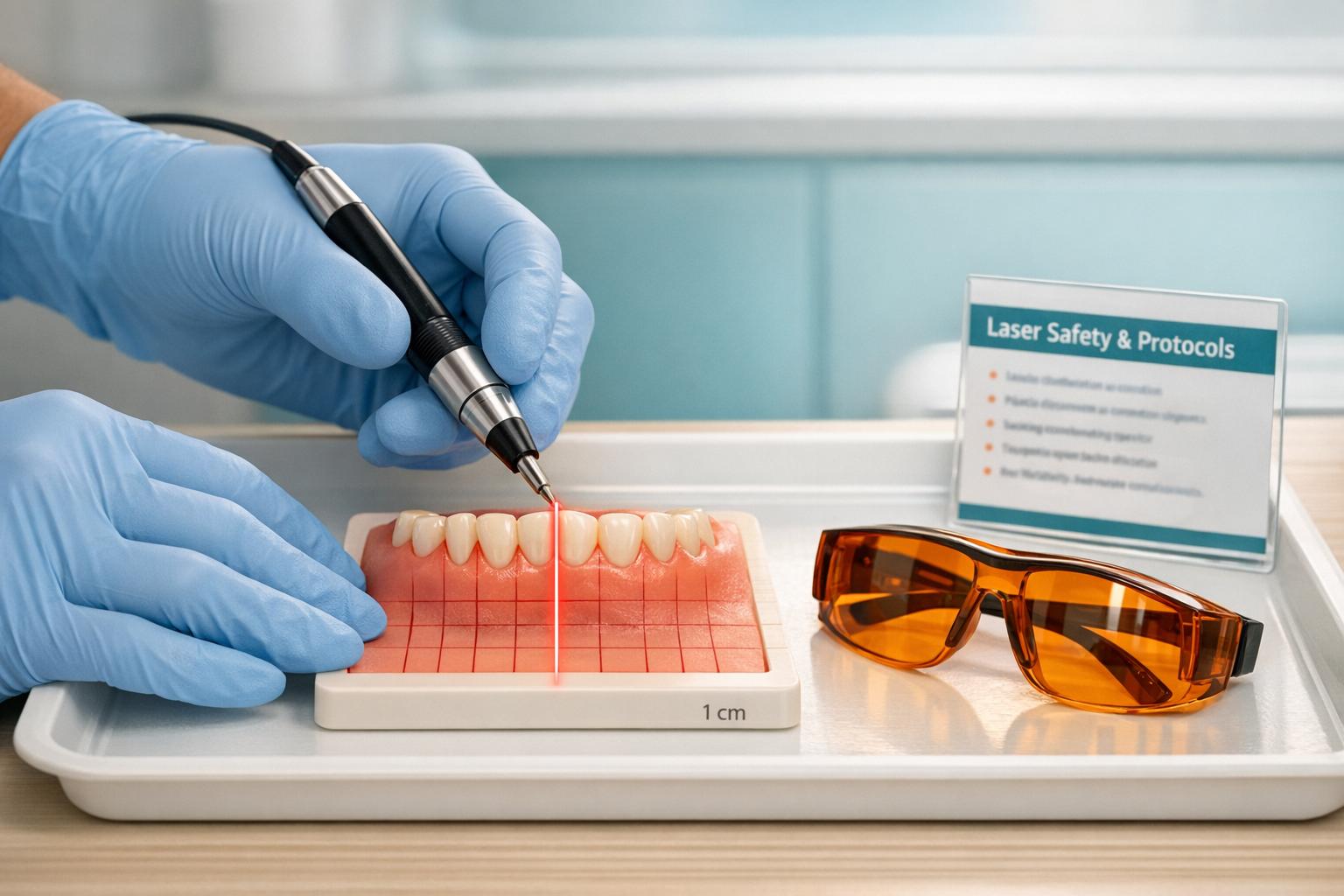
Laser periodontics certification equips dentists with the skills to use advanced laser technology for gum disease and soft tissue treatments. This training focuses on laser–tissue interactions, clinical protocols, and safety standards, aligning with Australian regulations like the ADA Policy Statement 6.29 and AS/NZS 4173. Certified dentists can offer less painful, more precise treatments with faster recovery times, improving patient care and practice efficiency.
Key Takeaways:
- Why it matters: Gum disease affects 47% of adults over 30, and lasers provide better access to deep pockets and bactericidal effects compared to conventional methods.
- Patient benefits: Reduced pain, minimal bleeding, quicker recovery, and less anxiety due to the quieter, needle-free approach.
- Dentist benefits: Expanded skills, compliance with Australian standards, and the ability to perform advanced procedures without referrals.
- Training focus: Laser physics, safety protocols, and hands-on clinical practice with systems like Diode, Nd:YAG, Er:YAG, and CO₂ lasers.
- Certification cost: Basic programs start at $425 AUD, while advanced courses can cost up to $12,400 AUD.
Laser certification is a practical step for dentists aiming to improve periodontal care, meet regulatory standards, and modernise their practice.
Problems with Conventional Periodontal Treatments
Patient Pain and Fear
Traditional periodontal treatments often involve tools like scalpels, curettes, ultrasonic scalers, and drills. These tools not only create noise and vibrations but also cause mechanical trauma, leading to heightened anxiety for many patients [6][12]. The frequent need for local anaesthetic injections and invasive "cut-and-sew" surgeries adds to the discomfort and can delay patients from seeking timely treatment [6][10]. These surgeries are known to cause considerable pain and inflammation [7][10]. For individuals with blood disorders or those on anticoagulant medications, the risk of uncontrolled bleeding during such procedures further complicates the situation [11].
"The invasive nature of some conventional treatments can lead to patient discomfort and prolonged recovery times" – Dr Dhafer Al Asmari, Department of Periodontology and Implant Dentistry, Qassim University [6]
In addition to discomfort, these methods often fail to deliver effective bacterial decontamination.
Treatment Inefficiencies
Conventional mechanical debridement techniques struggle to thoroughly clean deep periodontal pockets and furcation areas, leaving harmful bacteria like Porphyromonas gingivalis behind [8][9][14]. These methods depend entirely on the physical removal of biofilm and lack any bactericidal properties [13]. Furthermore, excessive bleeding during surgery can obscure the dentist’s view, making the procedure less efficient [6][12].
These shortcomings often necessitate the use of systemic antibiotics, highlighting the need for treatment approaches that are both more effective and less invasive [6][12]. These challenges have paved the way for advanced laser techniques to provide better outcomes in periodontal care.
sbb-itb-2be92ed
Online Laser Dentistry Training Program | Gemini diode lasers
What Laser Periodontics Certification Covers
Laser periodontics certification equips dentists with the specialised knowledge and practical skills required to safely and effectively use laser technology for periodontal treatments. This training includes a mix of theoretical understanding and hands-on clinical experience [4].
Core Training Topics
The certification begins with an in-depth study of laser physics, focusing on concepts like wavelengths, pulse modes, and how lasers interact with tissues. Dentists learn how LASER (Light Amplification by Stimulated Emission of Radiation) technology works, including the measurement of wavelengths in nanometres or microns, and the distinction between continuous and pulsed modes. A critical part of the training is understanding how laser energy interacts with tissues – whether it’s absorbed, transmitted, reflected, or scattered – and how to target specific chromophores such as water, haemoglobin, melanin, and hydroxyapatite [16][17].
Safety is another major focus. Dentists are trained in using wavelength-specific eye protection, managing surgical plumes with high-volume evacuation, and ensuring proper room signage [1][16]. Different lasers come with unique risks – for instance, diode and Nd:YAG lasers can damage the retina, while erbium and CO₂ lasers pose risks to the cornea [16].
The Academy of Laser Dentistry mandates at least 12 hours of instruction for standard-level certification. Clinical training covers a range of soft tissue procedures like gingivectomy, frenectomy, sulcular debridement, and troughing for impressions. Dentists also learn hard tissue applications, including calculus removal, bone reshaping, and root surface decontamination [6][1][16]. To develop proficiency, participants typically perform between 4 and 10 clinical procedures, though some certification paths require up to 15 cases [18].
"Laser dentistry certification programs offer didactic and hands-on learning to help develop dentists’ knowledge and competency." – Ryder Waldron, DDS [4]
This combination of theoretical and practical knowledge helps dentists choose the right laser type for specific periodontal treatments.
Laser Types for Periodontal Treatment
Certification programmes also delve into the clinical applications of various laser systems, focusing on four main types – each with unique wavelengths and uses.
- Diode lasers operate at 810–1064 nm, targeting melanin and haemoglobin. They’re ideal for gingival contouring, reducing bacteria, and achieving haemostasis. These lasers are widely used, with 89.5% of North American graduate periodontics programmes incorporating them [18].
- Erbium lasers (Er:YAG and Er,Cr:YSGG) function at 2780–2940 nm, targeting water and hydroxyapatite. Their versatility in treating both soft and hard tissues makes them effective for calculus removal, root debridement, and bone surgeries [16][14][17].
- Nd:YAG lasers work at 1064 nm and penetrate tissues to a depth of 2–3 mm. They are primarily used for the Laser-Assisted New Attachment Procedure (LANAP), which gained FDA approval in 2004 for periodontitis treatment [16][17].
- CO₂ lasers operate at 9300–10,600 nm and are excellent for precise soft tissue excision and detoxifying titanium implant surfaces [16][17].
Understanding how each laser interacts with tissues is critical. For instance, diode lasers are about 1,000 times less effective at soft tissue absorption compared to CO₂ lasers, and 5,000 to 15,000 times less effective than erbium lasers [16]. This knowledge helps dentists select the most suitable laser wavelength for targeting specific chromophores in different procedures [16][17].
How Patients Benefit from Laser Periodontal Treatment
When dentists complete laser periodontics certification, their patients gain access to treatments that significantly reduce the discomforts associated with traditional gum surgery. These advanced techniques not only make procedures more comfortable but also offer long-term health benefits.
Less Invasive Procedures
Laser periodontal therapy replaces the scalpels, incisions, and sutures of conventional gum surgery with a much gentler approach. Tools like the Nd:YAG laser target and vaporise diseased tissue and bacteria while sparing healthy gum and bone, reducing overall trauma to the mouth [10][19]. Additionally, the laser seals blood vessels and nerves during treatment, which helps minimise bleeding and post-operative pain. By sealing capillaries and lymphatics, it also prevents bacteria from entering the bloodstream, lowering the risk of infection [6][15][19].
Another plus? The quieter, vibration-free nature of laser tools helps reduce patient anxiety [6]. Many laser procedures only require local anaesthesia, and some minor treatments may not need any at all – great news for patients who are uneasy about needles [1][6].
A 2024 study highlights the comfort of laser treatments: patients undergoing Oxygen High-Level Laser Therapy reported a median pain score of 3.5 out of 10 immediately after surgery. This dropped to 1.6 within six hours and was nearly gone after 24 hours [8]. Such immediate relief also sets the stage for faster recovery.
Quicker Healing and Fewer Complications
Laser therapy doesn’t just make treatments more comfortable – it also speeds up recovery. Most patients return to their regular activities within 24 to 48 hours, compared to the days or even weeks needed after traditional surgery [19]. Low-level laser energy promotes rapid connective tissue repair by stimulating fibroblasts, often within just 24 hours [10].
Another major advantage is the laser’s ability to deeply disinfect. Studies show an 80.3% to 81.4% reduction in bacterial count within a week of treatment [8]. This level of decontamination reaches areas that mechanical tools can’t, reducing the risk of secondary infections. Plus, the laser’s sealing effect on wound sites creates a protective barrier during the critical early healing phase, further preventing complications [15].
Patients also benefit from the long-term stability of laser treatments. Research shows that about 98% of patients treated with the LANAP protocol maintain stable gum health even five years post-procedure [19]. This durability underscores the effectiveness of laser-assisted care when performed by certified dentists.
How Certification Benefits Dentists
Certification in laser periodontics doesn’t just enhance patient care – it also provides a range of advantages for dental practices, making it a worthwhile investment for dentists.
Expanded Skills and Treatment Options
Certification equips general dentists with the skills to perform procedures that might otherwise require specialist referrals. Dr Ryder Waldron highlights this benefit, stating, "A dental laser may allow a general dentist to offer some treatments that might otherwise require a specialist referral" [4]. Treatments like frenectomies, fibroma removals, and advanced gingival contouring can now stay in-house, offering greater convenience for both patients and practices.
Dentists also learn how to choose the best laser type – whether Diode, Nd:YAG, or Er:YAG – for specific tasks like bacterial reduction, deep pocket cleaning, or reshaping bone contours [6][4]. With certification, practitioners can adopt advanced protocols, broadening their clinical capabilities. These expanded skills not only improve patient care but also streamline practice operations.
Better Patient Outcomes and Practice Development
Laser technology offers significant efficiency gains, which can transform a practice’s productivity. By reducing the need for local anaesthesia, lasers allow dentists to tackle multiple quadrants in a single appointment. Scott D. Benjamin, President of the Academy of Laser Dentistry, explains:
"The ability of quality lasers to control and titrate the amount of energy and its delivery… enables tooth preparations and various other procedures in multiple quadrants to be performed during the same visit, significantly enhancing efficiency and productivity" [20].
Beyond operational efficiency, lasers address common patient fears, such as needles and high-speed drills, improving treatment acceptance rates. Jamie Collins, a registered dental hygienist, observed:
"Patients who were reluctant to accept traditional cut-and-sew periodontal surgery were more willing to undergo [laser protocols]. The laser leaves the noninfected tissue intact, as it only reacts to diseased tissue" [10].
This targeted approach not only reduces patient anxiety but also leads to better outcomes. Patients who might have avoided invasive procedures are more likely to proceed with laser treatments, ensuring they receive the care they need.
Standing Out in the Australian Dental Market
In a competitive market like Australia, certification gives dentists a clear edge. With nearly 47% of adults over 30 experiencing chronic periodontitis [10], offering advanced, minimally invasive treatments meets a critical demand.
Certification also demonstrates adherence to Australian standards, as required by the Australian Dental Association [5]. Meeting the AS/NZS 4173 standard and complying with state-specific regulations in Queensland, Tasmania, and Western Australia highlights a commitment to safety and quality. This not only reassures patients but also sets certified dentists apart by combining comfort-focused care with rigorous professional standards.
Laser vs Conventional Periodontal Methods
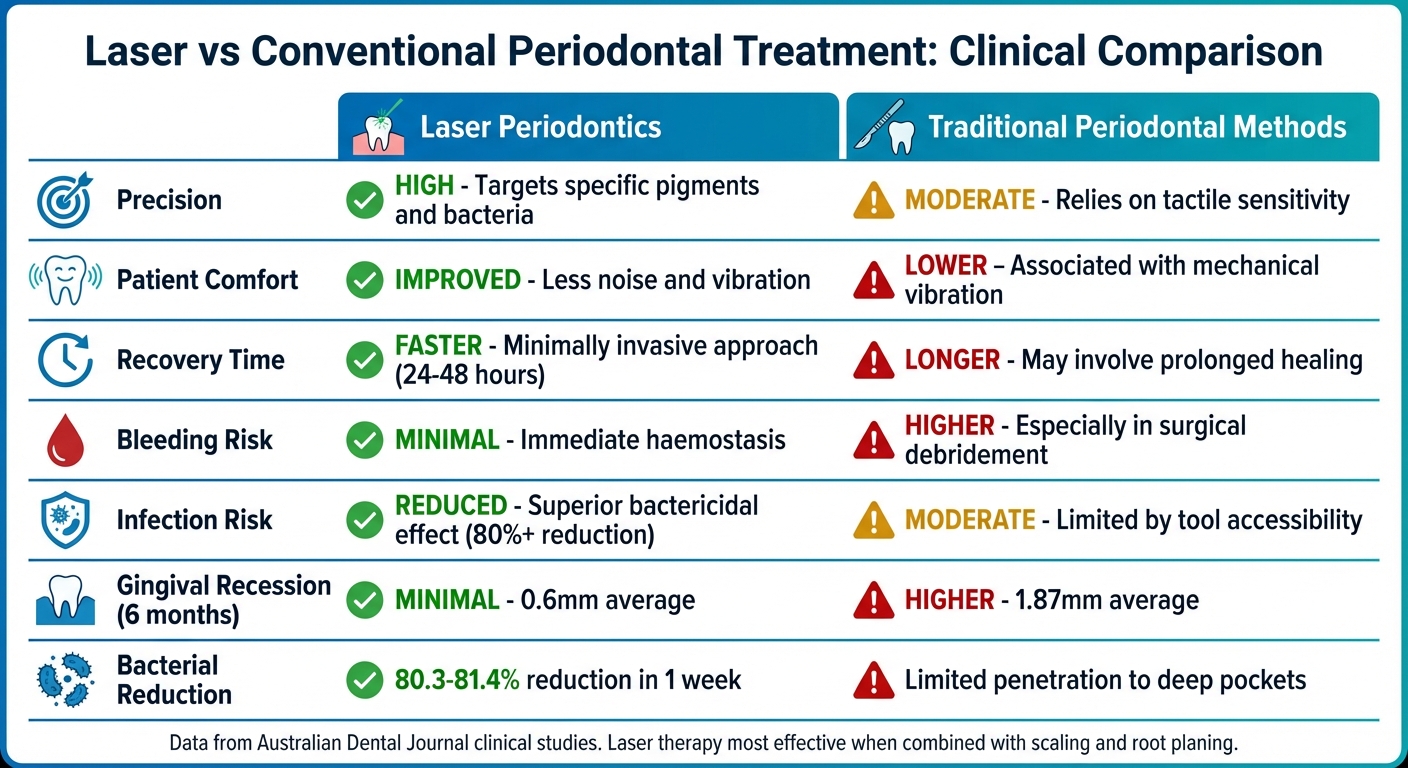
Laser vs Conventional Periodontal Treatment Comparison
This section dives into the differences between laser techniques and conventional periodontal methods, focusing on how each approach affects patient outcomes and practice efficiency.
Research highlights some key contrasts. For instance, one study found that conventional open flap debridement (OFD) led to an average gingival recession of 1.87 ± 0.64 mm after six months. In comparison, laser-assisted pocket therapy (ELAPT) resulted in just 0.60 ± 0.74 mm of gingival recession. This difference is particularly important in areas where aesthetics matter, as patients often worry about exposed roots or the "long teeth" appearance [21]. The Australian Dental Journal summarised the findings:
"ELAPT compared with OFD results in similar CAL gains with less GR and significant reductions in PD, GI and mSBI, and may be considered as an alternative to surgical therapy" [21].
Lasers also outperform traditional methods in reducing bacteria. Protocols like LANAP and OHLLT have shown over 80% reductions in bacterial counts just one week after treatment (80.3% and 81.4%, respectively) [8]. This is because lasers can penetrate dentinal tubules and deep periodontal pockets, targeting bacteria with their bactericidal properties [13].
Treatment Comparison Table
| Factor | Laser Periodontics | Traditional Methods |
|---|---|---|
| Precision | High; targets specific pigments and bacteria [6] | Moderate; relies on tactile sensitivity [7] |
| Patient Comfort | Improved; less noise and vibration [6] | Lower; associated with mechanical vibration [6] |
| Recovery Time | Faster; minimally invasive approach [6] | Longer; may involve prolonged healing [6] |
| Bleeding Risk | Minimal; lasers provide immediate haemostasis [6][7] | Higher; especially in surgical debridement [21] |
| Infection Risk | Reduced; superior bactericidal effect [6] | Moderate; limited by tool accessibility [6] |
| Gingival Recession | Minimal (approximately 0.6 mm) [21] | Higher (approximately 1.87 mm) [21] |
Lasers offer distinct advantages, especially for deep periodontal pockets where traditional tools struggle to reach complex root anatomies [6][13]. They are also a great option for patients who experience high anxiety or have a low tolerance for pain, as laser treatments often result in reduced postoperative discomfort. However, lasers are most effective when combined with scaling and root planing rather than used as standalone treatments. This combination is particularly beneficial for managing advanced periodontitis (Stage 3/4) [6][13]. These findings underscore the value of advanced laser training in achieving better clinical results and improving practice efficiency.
How to Get Certified in Laser Periodontics
Available Training Programs
If you’re looking to offer laser periodontics as part of your dental services, certification is a must. These programs not only provide the technical know-how but also help dentists tackle traditional treatment limitations while improving patient outcomes.
The Academy of Laser Dentistry (ALD) offers a structured Standard Level Course with three parts. You can start with the "Foundations in Laser Dentistry" module, a 6-hour self-paced online course. The cost ranges from $195 (members) to $245 (non-members). Alternatively, the complete certification package costs $275 USD (approximately $425 AUD) and includes the online module, a 75-question exam (1-hour duration), and a 1-year ALD membership[22]. To complete the certification, you’ll need to fulfil a practical requirement: at least 6 hours of didactic training and 3 hours of supervised, hands-on clinical simulation. If you need to retake the exam, there’s a $95 USD fee[22].
For a more advanced option, the Institute for Advanced Laser Dentistry (IALD) offers a "Laser Periodontics" course. This one-day program focuses on Nd:YAG Pulsed Laser techniques and includes live patient training. It provides 8 continuing education hours and costs $8,000 USD (around $12,400 AUD)[25]. In Australia, organisations like the Australian Dental Association Queensland (ADAQ) also run hands-on laser dentistry workshops to help dentists align with local standards[24][26].
"A dentist must voluntarily embark upon a substantial level of education, not only to become proficient using the laser, but to make an informed decision about the best type of laser for the practice." – Dr David Cox, Founding President of the Australian Association of Laser Dentistry[23]
These certifications not only refine your clinical expertise but also help you seamlessly integrate laser treatments into your practice.
Adding Laser Treatment to Your Practice
After certification, incorporating laser treatments into your practice comes with additional responsibilities. First and foremost, ensure compliance with local regulations and safety protocols. For example, specific licensing requirements apply in Queensland, Western Australia, and Tasmania, so check your state’s radiation licensing guidelines before purchasing laser equipment[5][4].
All laser devices must be registered with the Australian Register of Therapeutic Goods (TGA) and meet the AS/NZS 4173 standard for safe laser use in healthcare[5]. Additionally, appointing a Laser Safety Officer (LSO) is critical. The LSO oversees safety measures, staff training, and ensures the proper use of protective equipment[27]. Your treatment area should be designated as a "nominal hazard zone", complete with warning signs, restricted access, and wavelength-specific protective eyewear for everyone present[27].
Since laser equipment prices can vary widely, it’s essential to conduct a thorough needs assessment. Consider your patient demographics and consult with dentists who have already adopted laser treatments to make an informed decision about the right equipment for your practice[4].
Conclusion
Laser periodontics certification is transforming dental practice by providing practitioners with the skills to deliver precise, patient-focused care. Through specialised training, dentists learn to safely manage laser parameters – like wavelength, power, and pulse duration – minimising the risk of thermal damage to teeth, implants, and surrounding tissues. This precision is vital when treating the 10–15% of Australians living with severe periodontal disease, many of whom also contend with conditions like diabetes and cardiovascular disease[2][6].
Certified dentists can also offer less invasive treatment options, avoiding the need for scalpels, bone grafts, or stitches. These methods are particularly beneficial for patients who are elderly, medically compromised, or on anticoagulation therapy, where traditional surgeries might pose higher risks[2][3][10]. For the one-third of dental implant patients dealing with peri-implantitis, evidence-based protocols like LAPIP provide effective solutions to regenerate bone and connective tissue around both natural teeth and implants[2][3].
The clinical benefits of laser-assisted therapy are echoed by leading professional organisations:
"Laser-assisted therapy may offer case management advantages for certain patients insofar as it could provide less patient bleeding, assist in disease site disinfection, [and] be used as an alternative non-surgical or palliative therapeutic approach." – American Academy of Periodontology (AAP)[2]
Beyond improving clinical outcomes, certification also supports practice growth. It enables general dentists to perform advanced procedures while meeting jurisdictional requirements in Queensland, Tasmania, and Western Australia[5]. Additionally, formal training enhances patient satisfaction, broadens treatment capabilities, and ensures compliance with the AS/NZS 4173 standard for safe laser use in healthcare[5].
For dentists aiming to provide top-tier, evidence-based care, laser periodontics certification offers a valuable pathway. By adopting laser-assisted techniques, practitioners can improve patient comfort, enhance clinical outcomes, and streamline operations – raising the bar for periodontal treatment.
FAQs
Do I need state licensing to use dental lasers in Australia?
In Australia, operating Class 4 dental lasers mandates a Radiation Use Licence under the Radiation Safety Act 1999. Licensing rules for other laser classes can differ depending on the specific state or territory. Dentists are required to adhere to strict safety standards, undergo appropriate training, and maintain compliance with ongoing safety protocols to meet regulatory requirements.
Which laser type suits periodontal work in my practice?
Diode lasers have become a popular tool in periodontal treatments due to their ability to target biofilm, remove calculus, and minimise bacterial presence. When used alongside conventional therapies, they can improve both the effectiveness and speed of treatment.
Will laser periodontics reduce my need to refer patients?
Laser periodontics offers a way to address periodontal conditions with less reliance on invasive procedures. By improving treatment precision, it can potentially lower the need for surgical referrals. This allows practices to handle a broader range of periodontal care in-house, providing patients with a streamlined and effective treatment experience.
Related Blog Posts
- Laser Dentistry for Pain Relief
- 5 Benefits of AI in Laser Dental Treatments
- Guide to Laser Safety in Periodontal Care
- 7 Pros And Cons Of Laser Dentistry
Important Notice: Any surgical or invasive procedure carries risks. Before proceeding, you should seek a second opinion from an appropriately qualified health practitioner.
Individual results may vary. The information provided in this article is for educational purposes only and does not constitute medical advice.
Checkout Related Blogs




Get in touch with us
For more information, call us now to start feeling better. Or fill the form below to make appointment
The Latest News from Complete Smiles
How to Clean Clear Plastic Retainers
Checklist for Choosing Wearable Dental Devices
Checklist for Choosing Cloud AI Platforms in Dentistry

Complete Smiles Bella VistaAccepts All Major Health Funds, Including





