





In-Clinic vs. Digital Tools for Patient Outcomes
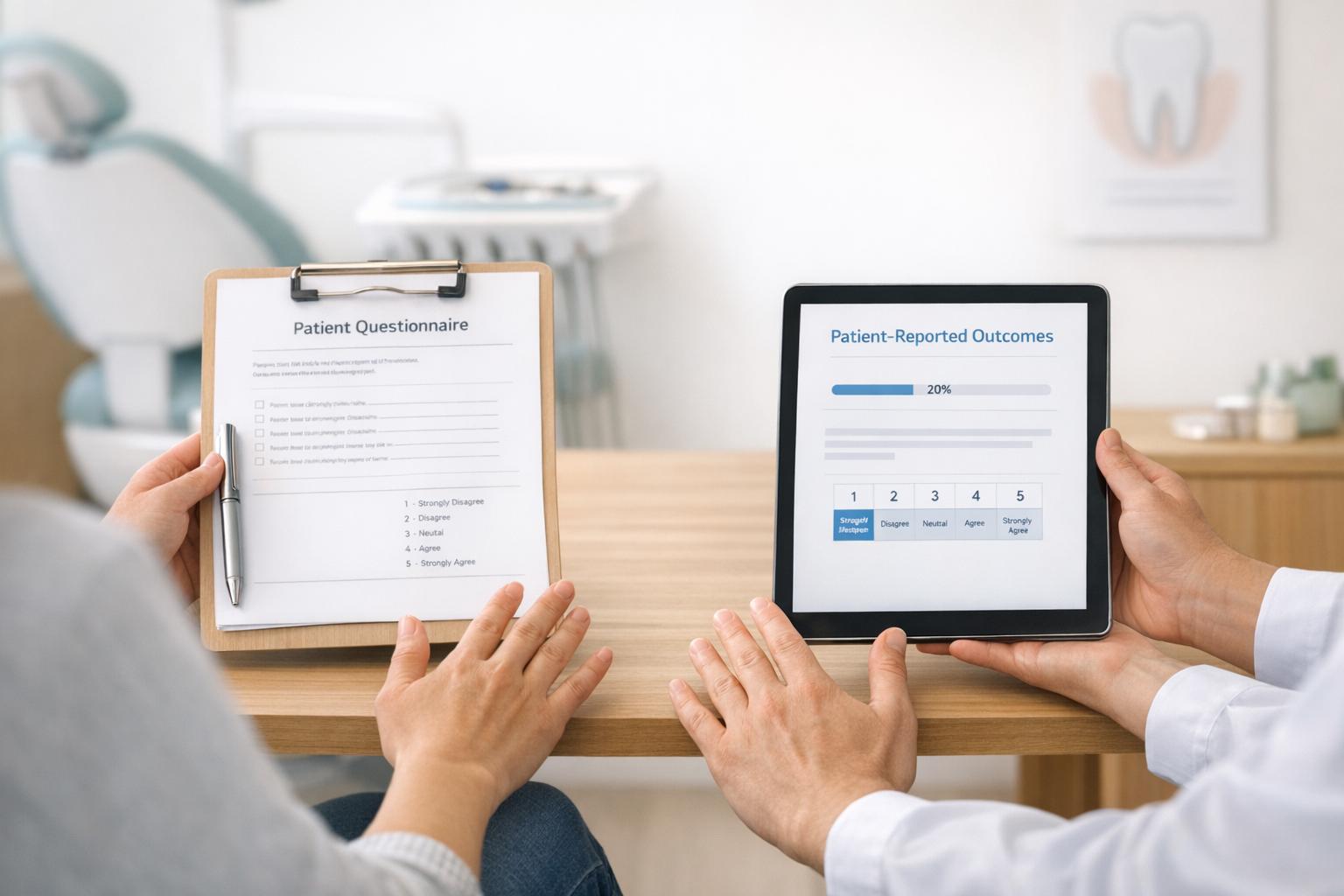
Which is better for dental care: in-clinic methods or digital tools?
Digital tools like apps and online surveys are transforming how dentists collect patient feedback, offering faster, more accurate data with fewer errors. Meanwhile, in-clinic methods, such as paper forms or interviews, provide personal interaction and are better for patients who struggle with technology.
Key points:
- Digital tools save time, reduce errors, and are preferred by 85% of patients.
- In-clinic methods work well for older patients or those with low digital literacy.
- Both approaches can be combined to meet diverse patient needs.
Quick Comparison
| Feature | In-Clinic Methods | Digital Tools |
|---|---|---|
| Accuracy | Prone to manual errors | Automated, fewer errors |
| Time Efficiency | Slower due to manual entry | Faster with automation |
| Patient Preference | 15% prefer paper forms | 85% prefer digital surveys |
| Accessibility | Better for older patients | Requires digital literacy |
Dentists can choose the best approach – or a mix of both – based on their patient demographics and operational needs.
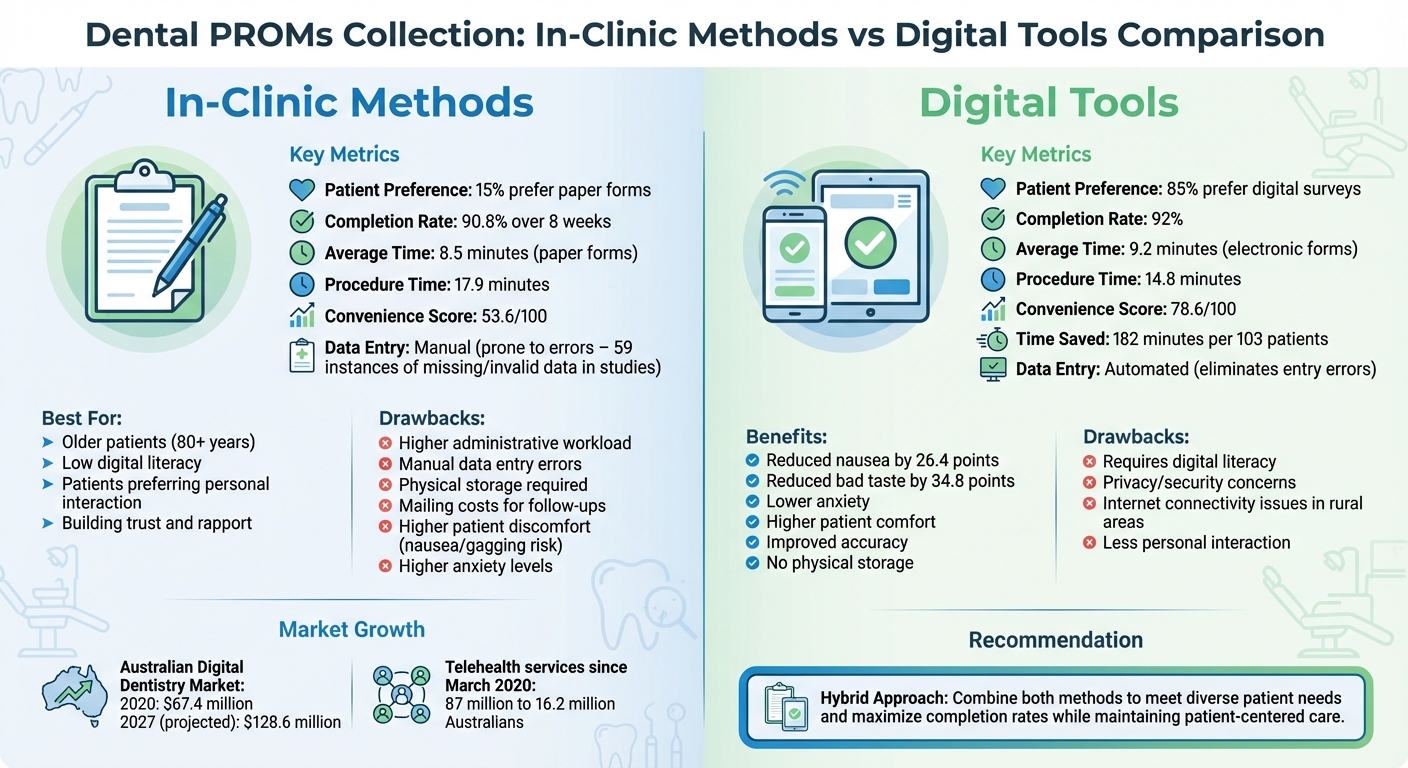
In-Clinic vs Digital Tools for Dental Patient Outcomes: Complete Comparison
Patient Reported Outcome Measures (PROMS) – Dr Shalika Hegde
sbb-itb-2be92ed
In-Clinic Methods for Collecting PROMs
Collecting Patient-Reported Outcome Measures (PROMs) in a clinic often involves paper questionnaires or clinician-led interviews during appointments. Patients typically fill out standardised surveys while waiting, using tools like Visual Analogue Scales (VAS) or Labelled Magnitude scales to assess pain intensity, duration, and tolerability. Alternatively, clinicians or research coordinators may conduct interviews to gather insights into patients’ subjective health states and oral health-related quality of life.
For paper-based surveys, patients mark their responses on a physical scale, which staff then measure using a 10 mm ruler before manually entering the data. Between September 2012 and March 2013, the University of São Paulo’s School of Dentistry studied the efficiency of paper forms versus tablet computers with 30 edentulous participants. Led by Raphael Freitas de Souza, the research showed that completing paper forms took an average of 8.5 minutes, slightly faster than the 9.2 minutes required for electronic forms. Interestingly, both methods produced comparable results for denture satisfaction [7]. This traditional approach contrasts with the digital tools discussed in later sections.
Benefits of In-Clinic Methods
One of the key advantages of in-clinic methods is the opportunity for personal interaction. Clinician-led interviews not only provide immediate clarification but also help build trust and rapport. For example, during semi-structured interviews conducted by the National Dental PBRN between 2021 and 2022, a 41-year-old female dentist shared her perspective:
"I think it’s like relationship building, practice building because they realise we care. We want to make sure that they’re healing well and that they’re comfortable" [4].
Additionally, these methods ensure accessibility for patients who may struggle with digital tools. This includes individuals with low health literacy, language barriers, or limited digital skills. A National Dental PBRN study involving 1,862 patients found that 15% preferred paper-based follow-ups over electronic options. These patients were generally older and had lower levels of education [3][1]. Notably, the retention rate for paper-based follow-ups was 90.8% over eight weeks, highlighting strong engagement despite the manual nature of the process [3][1].
Drawbacks of In-Clinic Methods
While in-clinic methods have clear benefits, they also come with significant challenges. The most prominent issue is the administrative workload. Paper-based collection requires time for distributing forms, measuring responses, and manually entering data. In the National Dental PBRN study, researchers encountered 59 instances of missing or invalid data that required manual corrections by research coordinators [1]. Dorota T. Kopycka-Kedzierawski, DDS, MPH from the University of Rochester, commented:
"The electronic mode of data capture was as operational as the traditional paper mode, while also providing the advantage of eliminating data entry errors" [3].
Time constraints are another concern. Many clinicians find it difficult to balance the demands of personal interaction with the need for efficient data collection. A 44-year-old male dentist from the same study noted:
"It certainly doesn’t replace that personal interaction that one would get if I called them by phone. But oftentimes you just don’t have that kind of time to devote for those follow up calls" [4].
Additionally, paper-based methods require physical storage space and can incur extra costs and delays if forms need to be mailed for follow-up assessments [3][7]. These limitations highlight the need to explore alternative digital tools for PROM collection, which will be discussed next. Understanding patient-reported outcomes in digital dentistry is essential for modernising these workflows.
Digital Tools for Collecting PROMs
Modern technology has introduced mobile apps, intraoral scanners, and cloud-based systems to streamline the collection of patient-reported outcome measures (PROMs). These tools automate processes like response analysis and data storage, eliminating the need for physical records.
How Digital Tools Work
Digital platforms for PROM collection typically operate through smartphone apps, web portals, or practice management software. Patients can easily complete surveys from the comfort of their homes, which is especially beneficial for those in remote areas or with mobility challenges. These systems automatically calculate scores, flag incomplete responses, and sync data with practice records, reducing manual tasks.
For example, in April 2024, the Tooth Memo app was tested in Thailand with dental students and laypeople. It saved 182 minutes of administrative work for every 103 patients and ensured complete data capture, outperforming manual methods [8].
Another study involving 1,862 patients with dentin hypersensitivity revealed that 85% preferred electronic follow-up assessments over paper. Dorota T. Kopycka-Kedzierawski from the University of Rochester highlighted how electronic tools eliminated the need for research coordinators to measure Visual Analogue Scales manually and cut costs associated with mailing forms. Completion rates were slightly higher with electronic methods (92%) compared to paper (90.8%) [3].
With these clear operational benefits, digital tools continue to evolve to meet the specific needs of dental practices.
Types of Digital Tools in Dentistry
Australian dental practices are adopting various digital tools to collect PROMs efficiently.
- Intraoral scanners like the iTero Element 5D create 3D images, replacing traditional impressions and enabling real-time treatment simulations [10][11].
- Mobile health platforms such as FollowApp.Care send automated SMS reminders to patients. A study conducted between February 2020 and January 2022, involving 42 providers and 1,525 patients, showed that 98.3% of patients received notifications on days 1, 3, 5, and 7 after procedures. While these notifications didn’t significantly affect pain scores, they improved communication between patients and providers [6].
- Integrated systems in public services are also gaining traction. For instance, New South Wales public dental services have incorporated PROMs into their electronic oral health records using Titanium®. In August 2024, NSW Health introduced a standardised OH-PROM tool with seven questions covering Oral Function, Orofacial Pain, Orofacial Appearance, and Psychosocial Impact. This integration allows seamless data collection within clinical workflows [2].
The digital dentistry market in Australia reflects this growth, valued at around A$67.4 million in 2020 and projected to reach A$128.6 million by 2027. Since March 2020, 87 million telehealth services have been provided to 16.2 million Australians [11].
Drawbacks of Digital Tools
While digital tools offer many benefits, they also come with challenges. Some patients, particularly those with lower digital literacy, still prefer paper-based options [3]. To address this, practices often maintain both digital and traditional methods to ensure inclusivity.
Data privacy and security remain ongoing concerns with certain dental apps [6]. Additionally, unstable internet connectivity in rural areas can interrupt digital data collection, though some apps mitigate this with offline storage capabilities [8].
Another drawback is the potential reduction in personal interaction between clinicians and patients. Automated SMS surveys, while efficient, lack the warmth and reassurance of direct communication. Similarly, although digital impressions reduce discomfort compared to traditional methods [5], some patients still value the presence and guidance of a clinician. For this reason, many practices adopt a hybrid approach, blending digital efficiency with traditional patient engagement [6].
In-Clinic vs. Digital: A Direct Comparison
PROM Domains Comparison Table
When comparing PROM (Patient-Reported Outcome Measures) domains, digital tools clearly outperform traditional methods in several key areas. Here’s a breakdown of how they fare across essential patient experience metrics:
| Domain | In-Clinic (Conventional/Paper) | Digital Tools (IOS/Electronic) |
|---|---|---|
| Patient Comfort | Lower – bulky trays and viscous materials can be uncomfortable [9] | Higher – digital scanning is more comfortable [9] due to advances in intraoral scanning |
| Nausea/Gagging | Higher risk – physical impressions may trigger a gag reflex [5] | Lower risk – digital scanning avoids contact and reduces nausea by 26.4 points [5] |
| Anxiety | Higher – associated with repeated impressions and discomfort [5] | Lower – perceived as less distressing [5] |
| Perceived Time | Slower – procedures average 17.9 minutes [9] | Faster – procedures average 14.8 minutes [9] |
| Convenience | Lower – score of 53.6/100 [9] | Higher – score of 78.6/100 [9] |
| Data Accuracy | More prone to manual entry errors and delays [3] | Improved accuracy with real-time feedback [3] |
| Overall Satisfaction | Moderate for procedural experience [5] | Higher for procedural experience [5] |
Digital scanning offers additional benefits, such as eliminating the unpleasant taste often associated with conventional impression materials, cutting this complaint by an impressive 34.8 points [5]. While pain levels and final aesthetic results are comparable between the two methods, the convenience and comfort of digital tools stand out. These measurable advantages are reflected in higher patient satisfaction ratings, as evidenced by various studies.
What Patients Prefer: Study Findings
Patient feedback strongly supports the shift to digital methods. A 2015 randomised crossover trial conducted by the University of Bern highlighted this preference. In the study led by Dr Tim Joda, 20 patients experienced both intraoral scanning and polyether impressions. Every participant indicated a preference for digital workflows vs conventional techniques in future treatments due to the increased convenience [9].
"The digital technique emerges as the most preferred one according to patient-centred outcomes and was more time-effective compared to conventional impressions."
– Tim Joda, Division of Fixed Prosthodontics, University of Bern [9]
This study is just one example of a growing body of evidence. Across multiple trials, up to 85% of patients report favouring digital methods for their comfort, efficiency, and reduced anxiety. Meta-analyses further back these findings, showing that digital impressions consistently minimise nausea, bad taste, and discomfort while improving perceived procedure time and overall satisfaction [5].
The data makes it clear: digital tools are not just a technological upgrade – they’re a patient-preferred alternative that enhances the overall treatment experience.
What This Means for Australian Dental Practices
Tailoring PROM Methods to Patients
Australian dental practices have the opportunity to customise Patient-Reported Outcome Measure (PROM) tools to better suit individual patient needs. Research from the Australian private specialist sector shows that 85% of patients prefer email for completing questionnaires, while 15% opt to complete them in-practice using tablets or smartphones. Interestingly, patients over 80 years old are more likely to complete these forms in the clinic rather than online [13].
For patients who experience anxiety or have a strong gag reflex, digital intraoral scanners can make procedures more comfortable compared to traditional impressions [11]. Tele-dentistry offers additional support for patients with mobility challenges or those who prefer remote consultations.
When designing PROM tools, health literacy plays a critical role. For example, NSW public dental services created tools with a grade 6 reading level, simplifying terms like "usual activities" to "daily activities" based on consumer input. During testing, 86–96% of consumers found the questions easy to understand, and 88–98% felt at ease answering them [2]. To ensure accessibility, digital forms should use plain language, and interpreter services should be available for non-English-speaking patients [2].
These patient-specific strategies must also comply with Australia’s rigorous regulatory framework.
Adhering to Australian Standards
To implement these patient-centred innovations, compliance with professional standards is non-negotiable. Using PROMs aligns with the Australian Commission on Safety and Quality in Health Care (ACSQHC) guidelines, which define them as "reports of the status of a patient’s health condition that come directly from the patient, without interpretation by a clinician" [12]. This approach supports person-centred care and shared decision-making, both of which are key to the National Health Reform Agreement 2020–2025 [2].
Dentists must also maintain detailed and accurate records in accordance with the Dental Board of Australia‘s Dental Records Guidelines and privacy laws [14]. Digital systems used for PROM collection must protect patient privacy and ensure data integrity. Additionally, practices should document whether patients completed PROMs independently or with assistance, as this detail can influence data analysis [2].
The Therapeutic Goods Administration (TGA) has shown growing interest in PROM data, particularly for assessing the real-world performance of medical devices like dental implants. As one PROMs expert from the ACSQHC noted:
"The Therapeutic Goods Administration (TGA) are very interested in this type of data… as PROMs come on board that will form part of the assessment for the TGA" [12].
The Future of PROM Collection in Dentistry
With patients showing a strong preference for digital solutions, the future of PROM collection in Australian dentistry is set to evolve rapidly. The local digital dentistry market, valued at $67.4 million in 2020, is projected to grow to $128.6 million by 2027 [11]. This growth reflects a shift towards advanced PROM tools, including AI-driven systems that will streamline patient outcome tracking and expand the use of digital tools for broader population health monitoring [12].
NSW Health is already spearheading a shift toward value-based healthcare, using PROMs to focus on "what matters to people" rather than just "what is the matter with people" [2]. This approach helps uncover hidden concerns, such as psychological distress or embarrassment related to orofacial appearance, which might not surface during routine consultations [12][15]. Integrating PROMs into Electronic Oral Health Records (eOHR) systems like Titanium® or Audit4 can further reduce administrative tasks and enable real-time clinical decisions [13][2].
Looking ahead, advancements in PROM technology are expected to enable "tuned" treatment plans, where care is adjusted to match each patient’s recovery pace [12][2]. While tools like tele-dentistry and e-prescriptions are still in their early stages of adoption, practices that embrace these technologies now stand to gain a competitive edge [11]. With 60% of surveyed patients expressing a desire to continue using healthcare technology introduced during the pandemic [11], investing in digital PROM collection today positions practices for long-term success.
Conclusion
Both in-clinic and digital PROM collection methods offer distinct advantages for dental practices in Australia. In-clinic collection – via paper forms or tablets – tends to achieve strong completion rates [13], making it a reliable option for patients who value face-to-face interactions. On the other hand, digital tools help eliminate errors from manual data entry, save over 200 minutes per case [16], and can ease patient anxiety during procedures like impressions [5].
Hybrid approaches, as supported by recent research [13], provide a flexible solution by accommodating a wide range of patient preferences. This combination ensures high participation rates while addressing varying levels of comfort with technology.
Key Points for Australian Practices
The findings emphasise the importance of tailoring PROM collection strategies to match patient needs and practice workflows. Both methods, along with hybrid models, contribute to improving patient-centred care in dentistry.
Dental practices should evaluate which PROM method aligns best with their patient demographics and operational requirements. For example, practices serving older patients may benefit from in-clinic digital tools, while those with tech-savvy patients could lean towards email-based options. Integrating these methods with Electronic Oral Health Records – such as Titanium® or Audit4 – can simplify data management and support compliance with the Australian Commission on Safety and Quality in Health Care guidelines [2][13].
As value-based healthcare becomes a focus, PROMs play a crucial role in assessing key aspects of oral health quality of life, including Oral Function, Orofacial Pain, Orofacial Appearance, and Psychosocial Impact [2]. Whether collected digitally or in-clinic, PROMs empower patients to share their experiences directly, fostering shared decision-making and enhancing patient-centred care. Choosing the right PROM method strengthens these outcomes and supports the broader shift toward value-based care in Australian dentistry.
FAQs
What should dental practices consider when choosing between in-clinic and digital tools for patient-reported outcomes?
Dental practices face a choice between in-clinic and digital methods for collecting patient-reported outcome measures (PROMs). Each option comes with its own set of advantages and challenges.
In-clinic methods, such as paper-based questionnaires, are often familiar and easy to use. However, they can be time-consuming and require additional resources for management and storage. On the flip side, digital tools offer greater efficiency, streamlined data storage, and the added benefit of reaching patients remotely.
When deciding which method to use, practices should think about:
- Patient preferences: Consider factors like age, comfort with using technology, and accessibility needs.
- Practice infrastructure: Evaluate whether secure digital systems are available and how well they integrate with current workflows.
- Data collection goals: Determine if remote or in-person assessments are better suited to the outcomes being measured.
The right choice will depend on finding the balance between what patients need and what the practice can support, ensuring both effective care and operational efficiency.
What challenges come with using digital tools to collect patient-reported outcomes?
Digital tools designed for collecting patient-reported outcomes (PROMs) come with their own set of challenges. One major hurdle is integrating these tools seamlessly into existing healthcare systems. On top of that, ensuring robust data security is critical to protect sensitive patient information. Another issue is the varying levels of technical literacy among patients – some may find digital platforms intimidating or difficult to use. For these individuals, traditional methods might feel more familiar and comfortable.
In dental practices, the shift from paper-based systems to electronic data collection introduces additional complexities. Technical glitches can arise, and staff often need training to adapt to the new systems effectively. Addressing these challenges is crucial to fully harness the potential of digital tools in enhancing patient care and improving outcomes.
How do digital tools make dental visits more comfortable for patients?
Digital tools are transforming the dental experience by prioritising patient comfort and reducing the need for uncomfortable, traditional methods. Take intraoral scanners, for example. These devices eliminate the need for messy impression materials, offering a cleaner, faster, and more comfortable alternative for patients.
Another game-changer is 3D cone-beam computed tomography (CBCT). This advanced technology provides highly accurate diagnostic images with minimal discomfort. The precision of these images allows for more focused and less invasive treatments, easing both physical discomfort and anxiety during procedures. By simplifying processes and focusing on patient well-being, digital tools are making dental visits a far more relaxed and positive experience.
Related Blog Posts
- Digital Workflow vs Conventional Techniques in Prosthodontics
- Patient-Reported Outcomes in Digital Dentistry
- How Dental Apps Improve Patient Communication
- Why Patients Prefer Digital Scans Over Moulds
Important Notice: Any surgical or invasive procedure carries risks. Before proceeding, you should seek a second opinion from an appropriately qualified health practitioner.
Individual results may vary. The information provided in this article is for educational purposes only and does not constitute medical advice.
Checkout Related Blogs




Get in touch with us
For more information, call us now to start feeling better. Or fill the form below to make appointment
The Latest News from Complete Smiles
How to Clean Clear Plastic Retainers
Checklist for Choosing Wearable Dental Devices
Checklist for Choosing Cloud AI Platforms in Dentistry

Complete Smiles Bella VistaAccepts All Major Health Funds, Including





