





Why Patients Prefer Digital Scans Over Moulds
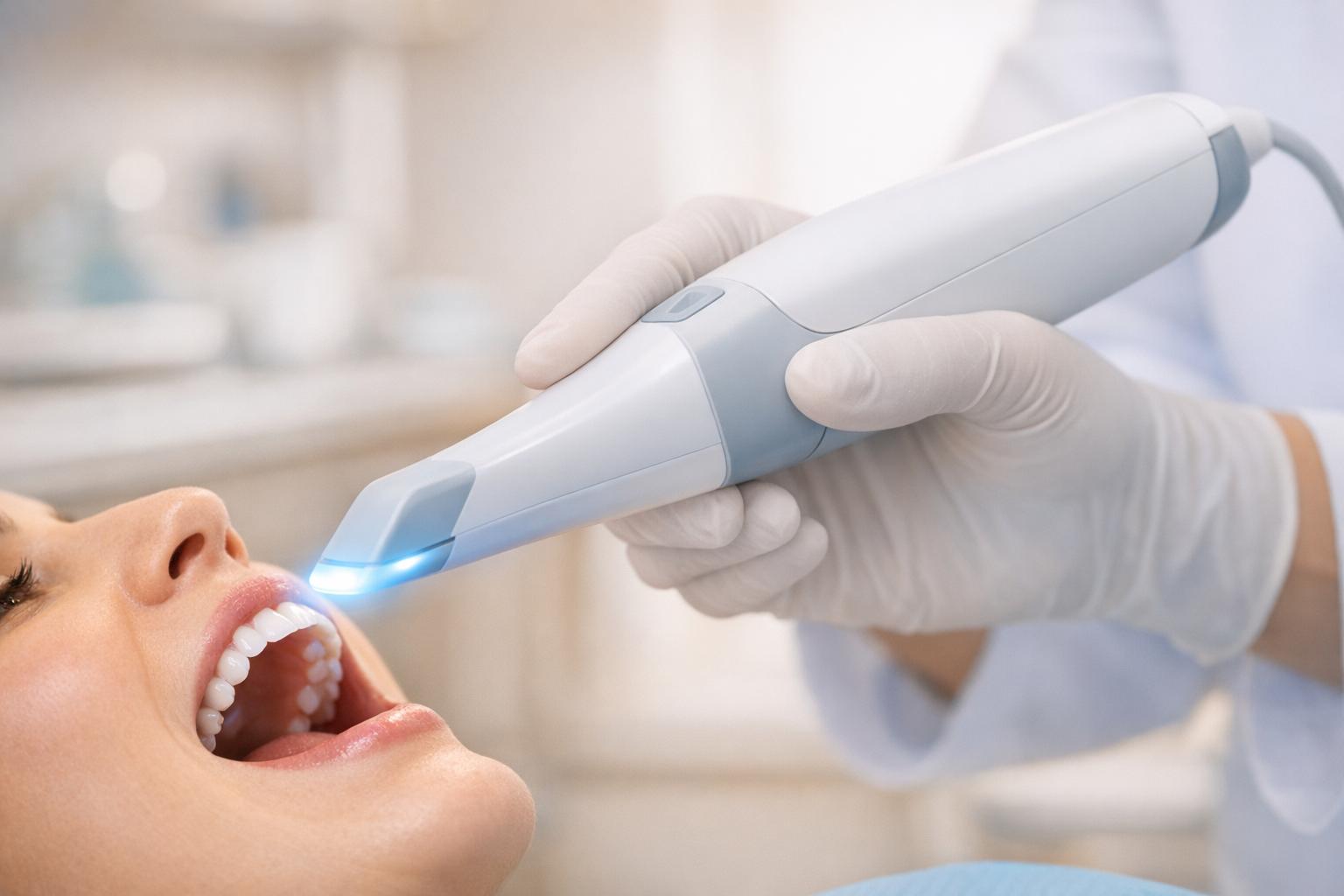
In dentistry, digital scans are replacing messy, uncomfortable moulds – and patients are loving it. Here’s why:
- Comfort: Digital scans skip the bulky trays and unpleasant materials that often trigger gag reflexes. A handheld wand takes precise 3D images without causing discomfort.
- Speed: Scans take seconds, saving time compared to the lengthy process of setting and removing moulds.
- Accuracy: Digital scans avoid the distortions common with mould materials, ensuring better-fitting dental appliances.
- Patient Involvement: Real-time 3D visuals let you see and understand your oral health, making treatment decisions easier.
- Eco-Friendly: Digital files eliminate waste from disposable trays and reduce transport emissions.
Switching to digital scanning transforms the dental experience, making it faster, more precise, and far more comfortable for patients.
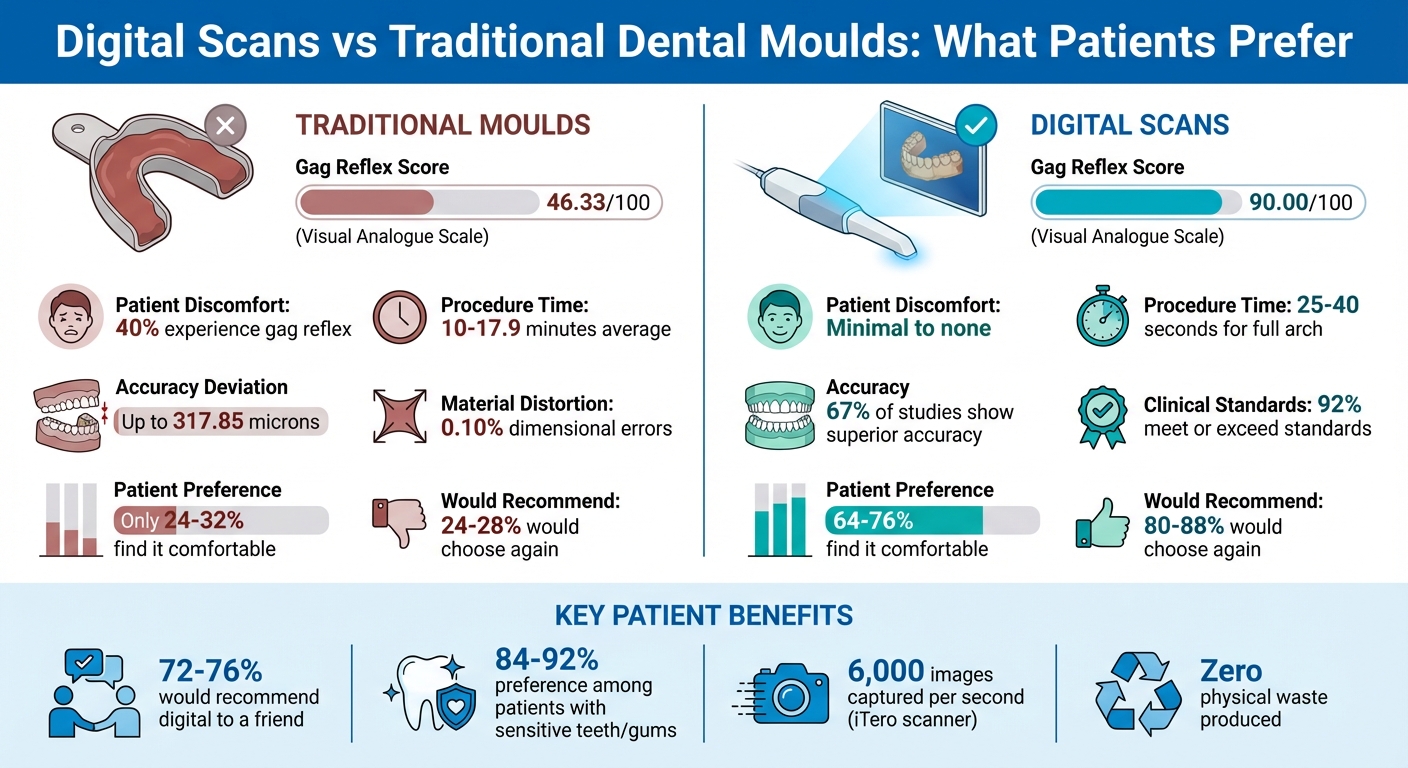
Digital Scans vs Traditional Dental Moulds: Patient Preference Statistics
Why Is 3D Dental Scanning Better Than Old Impressions? – The Pro Dentist
Problems with Traditional Dental Moulds
Traditional dental impressions rely on bulky trays and sticky materials, which often lead to discomfort and heightened anxiety for patients. Commonly used materials like alginate, polyether, or polyvinyl siloxane take several minutes to set, adding to the unease. Beyond the general discomfort, these methods face challenges such as material limitations and structural inaccuracies, which can lead to severe gag reflexes and even breathing difficulties.
Discomfort and Gag Reflex Triggers
A frequent issue with traditional moulds is their tendency to trigger the gag reflex. The large trays, filled with impression material, often press against the soft palate at the back of the throat, causing an involuntary gagging response. Studies show that 40% of patients undergoing these impressions experience this reflex [7]. On a Visual Analogue Scale, conventional impressions scored just 46.33 for gag reflex avoidance, compared to 90.00 for digital scans [2]. Patients also report additional discomforts, such as breathlessness, temporomandibular joint (TMJ) strain from keeping their mouths open for extended periods, and unpleasant tastes or odours, all of which contribute to increased anxiety.
"Gagging problems are not uncommon in daily dental practice… This can have an important impact on treatment plan and dental treatment outcome."
– Alessandro Mangano et al., The Open Dentistry Journal [2]
For some, the gag reflex is so severe that dentists may need to use invasive methods like local anaesthesia or conscious sedation just to complete the procedure [2]. What should be a simple appointment can quickly escalate into a more complex and stressful experience.
Lengthy Appointment Times
Traditional impressions also require significant chair time, averaging about 10 minutes per procedure, with some studies reporting clinical times as long as 17.9 minutes [3]. This includes preparation, mixing materials, waiting for them to set, and carefully removing the moulds. Errors in these impressions often go unnoticed until the casting stage, which means patients may need to return for repeat appointments. This not only prolongs treatment but also increases frustration for both patients and practitioners.
Material Distortions and Inaccuracies
The materials used in traditional impressions are inherently unstable. Alginate, one of the most popular choices, is particularly prone to shrinkage and dimensional changes over time, resulting in reduced accuracy [8]. When dental stone is poured into these impressions, additional dimensional errors – averaging around 0.10% – can occur. Studies have found that conventional models can deviate by as much as 317.85 microns compared to digital alternatives [8], a discrepancy that can lead to poorly fitting orthodontic appliances.
"In the case of conventional impressions, mistakes during the recording can sometimes be detected only after pouring the casts; however, corrections must be made by repeating the impression procedure, otherwise the casts will not be accurate."
– Kinga Mária Jánosi et al., Faculty of Dental Medicine [8]
Moreover, traditional moulds are susceptible to damage or distortion during transport to laboratories. They also require bulky storage solutions, and even routine disinfection can alter their surface or dimensions, further compromising their reliability [8].
How Digital Scans Improve Patient Experience
Digital scans are changing the game in dentistry by addressing the common issues of discomfort, inefficiency, and inaccuracies tied to traditional moulds. Instead of using those bulky trays filled with putty, dentists now rely on a handheld wand to capture detailed 3D images of your teeth. Between 64% and 76% of orthodontic patients report feeling more comfortable with digital scanning, compared to just 24% to 32% with conventional methods [7]. Even more telling, 80% to 88% of patients say they’d prefer digital scanning if they ever needed the procedure again [7]. These numbers make it clear: digital scanning is a win for patient comfort, speed, and precision.
Better Comfort and Non-Invasive Scanning
One of the standout benefits of digital scanning is how much more comfortable it is. Gone are the days of dealing with messy, unpleasant impression materials. Instead, a small wand glides over your teeth without touching the soft palate, significantly reducing the chance of triggering a gag reflex [1][9]. There’s no unpleasant taste or smell either, making the whole experience far more pleasant.
Quicker Appointments and Efficient Workflow
Digital scans also save a lot of time. A full-arch digital scan can take as little as 25 to 40 seconds [6], compared to the minutes it takes for traditional impression materials to set. Plus, the scan data is available instantly, letting dentists review the 3D model on a screen and rescan any missed spots right away.
"Digital is much more accurate, everything fits the first time… Most dental labs we work with have a slightly faster turn-around for digital because they are not waiting half a day for impressions to arrive."
– Dr. Lawrence Neville, Spa Dental, Sydney [4]
This combination of speed and accuracy not only shortens appointments but also ensures better outcomes for treatments.
Greater Accuracy and Treatment Precision
Digital scans bring a level of precision that traditional moulds just can’t match. They avoid common issues like air bubbles, tearing, or material shrinkage, which often compromise traditional impressions. In fact, systematic reviews show that 67% of studies find digital impressions to be more accurate, and 92% confirm that they meet clinical standards just as well – or better – than conventional methods [9].
This precision translates to better-fitting restorations, orthodontic appliances, and prosthetics. Since the digital model is verified during the appointment, the need for remakes due to errors is dramatically reduced. Additionally, the software can overlay scans taken months or even years apart, allowing dentists to monitor changes like tooth wear, gum recession, or orthodontic progress with pinpoint accuracy [1][4].
sbb-itb-2be92ed
Patient Involvement Through Real-Time Visualisation
Getting patients involved is a game-changer when it comes to digital dental scans – it transforms a routine visit into an interactive and informative experience.
Viewing 3D Models During Scans
A standout feature of digital scanning is the ability for patients to see high-definition 3D models of their teeth and gums in real-time on a chairside monitor. Scanners like the iTero, which capture an impressive 6,000 images per second, create these detailed models as the scan happens [10]. Essentially, you can watch your dental anatomy being digitised right before your eyes.
This real-time visualisation adds an educational layer to your appointment. Dentists can zoom in on specific areas to highlight issues like early-stage cavities, plaque buildup, or gum recession. For more involved treatments – think veneers or orthodontics – software like Digital Smile Design can even simulate the final outcome, giving you a sneak peek of your future smile [1][10]. This interactive feedback not only makes the process clearer but also opens the door for better conversations between you and your dentist.
Clear Communication for Better Treatment Acceptance
Real-time imaging also takes communication to the next level. Dr. Lawrence Neville from Spa Dental in Sydney sums it up perfectly:
"Describing a problem to the patient can be quite difficult. But with a scanner it’s much easier because a picture speaks a thousand words. You can show the patient what’s going on and they become more engaged, and are much more likely to go ahead with treatment." [4]
Seeing the problem on screen makes it easier to understand and more likely that you’ll feel confident about moving forward with treatment. Digital scans can even be compared with past records to show changes over time, like tooth movement or wear from grinding, giving you a clearer understanding of your dental health journey [1][4].
"One of the greatest benefits is patient engagement. Being able to visually see your teeth and discuss options has never been easier" [10].
This collaborative approach not only builds trust but also helps reduce anxiety, making you feel like an active participant in your care rather than just a bystander.
Environmental and Practical Benefits of Digital Scans
Digital scanning technology brings a host of environmental and practical perks compared to traditional moulding methods.
Reducing Waste and Supporting Eco-Friendly Practices
One of the standout advantages of digital scans is the elimination of single-use plastics and chemical-based materials. Traditional moulds rely on disposable plastic trays, alginate or silicone putty, and bulky plaster models for storage – all of which contribute to significant waste [6]. Digital scanners, on the other hand, capture all the required data without producing any physical waste.
Another eco-friendly aspect is the reduction of carbon emissions. Traditional impressions often require courier services to transport physical moulds to dental labs, adding to the environmental impact. Digital files, however, are sent electronically in seconds, completely bypassing the need for shipping [6]. Cyberdent highlights this benefit:
"Better for the environment – eliminating the use of plastic impression trays and reducing the use of couriers" [6].
Digital scans also minimise errors that can occur with traditional impressions. When a traditional mould is distorted or incomplete, the process must be repeated, wasting additional materials and energy. Digital technology’s precision reduces the likelihood of remakes, saving resources and cutting down on the need for extra appointments [11].
These eco-conscious practices go hand in hand with improved efficiency in professional workflows.
Streamlined Data Sharing and Collaboration
Beyond their environmental benefits, digital scans make professional collaboration seamless. Files can be securely shared with laboratories and specialists instantly, enabling simultaneous workflows. Labs can start fabricating restorations while dentists finalise treatment plans, eliminating delays caused by shipping physical impressions [5][6].
Cloud-based platforms, like iTero, take this a step further by allowing practitioners to access scans from virtually anywhere. As Adam Hughes from iTero explains:
"If you’re scanning in Tamworth, your Port Macquarie practice can log in and see it. Or a dental assistant can scan a patient, and a dentist can review the scan from their smartphone or tablet from anywhere with an internet connection" [4].
Some systems even offer virtual labs where dentists and technicians can collaborate in real time, reviewing and adjusting 3D models together to ensure both aesthetic and functional accuracy [4][5].
Digital storage is another game-changer. Unlike bulky stone models that take up physical space, digital impressions are stored securely and can be backed up offsite. Avant Dental notes:
"digital impressions eliminate the need to physically store bulky stone models, and can be safely backed up and digitally stored offsite" [5].
This convenience also makes it easier to retrieve records for future use, such as ordering a replacement aligner or mouthguard, without the need for a new impression.
Conclusion
The shift to digital scanning is proving to be a game-changer, tackling many of the challenges associated with traditional moulds. Patients overwhelmingly find it more comfortable, with studies showing that 72% to 76% would recommend digital scanning over conventional methods to a friend [7]. For individuals with sensitive teeth or gums, this preference climbs even higher, with 84% to 92% favouring digital scans [7].
Beyond comfort, digital technology stands out for its precision and efficiency. It reduces the likelihood of remakes, shortens turnaround times, and delivers restorations with a better fit. Impressively, a full-arch scan can be completed in just 40 seconds [12], and the files can be sent to labs instantly, streamlining the entire treatment process.
There’s also a clear environmental advantage. By doing away with disposable plastic trays, impression materials, and courier transport, digital scanning significantly cuts down on waste. As Health Centre explains, digital technology is more eco-friendly since "the images are stored and shared electronically; this eliminates the need for disposing of waste materials" [13].
Additionally, real-time 3D visualisation helps patients better understand their treatment, fostering trust and enabling more informed decisions.
As modern practices increasingly focus on comfort, accuracy, and sustainability, digital scanning is quickly becoming the preferred choice – and patients are noticing the difference.
FAQs
Why are digital scans better than traditional moulds for dental appliances?
Digital scans utilise cutting-edge technology to produce detailed 3D models of your teeth and mouth. Unlike traditional moulds that can sometimes lack precision or lose detail, these scans offer exact measurements, ensuring that dental appliances – like crowns, bridges, and dentures – are crafted to fit seamlessly.
This approach is also quicker and more patient-friendly, removing the need for messy impression materials. By using digital scans, your dentist can provide a more streamlined and comfortable process while delivering results tailored precisely to your dental needs.
Why are digital scans considered more environmentally friendly than traditional moulds?
Digital scans are seen as a greener alternative since they do away with disposable materials like plastic trays, alginate, and plaster that are typically used in traditional mould-making. This shift helps cut down on the waste produced during dental procedures.
On top of that, digital scans eliminate the need to ship physical moulds to laboratories, reducing the carbon emissions tied to transportation. By embracing digital methods, dental practices can play a role in promoting more sustainable and environmentally aware healthcare practices.
How do digital scans make dental visits more comfortable?
Digital intra-oral scanners provide a far more comfortable option compared to the old-school putty impressions, which can be messy and sometimes trigger a gag reflex. For many patients, this shift to a cleaner and simpler method can make dental visits feel less daunting.
Interestingly, while studies suggest that anxiety levels between digital and traditional methods are generally comparable, patients often say they prefer digital scans. The reason? They’re quicker, easier, and more convenient. By simplifying the process, digital scans not only save time but also help create a more relaxed and efficient experience at the dentist.
Related Blog Posts
- Intraoral Scanners vs. Impressions: Accuracy Compared
- How Intraoral Scanners Improve Orthodontic Workflows
- Carbon Footprint of Traditional vs. Digital Dentistry
- Recent Advances in Intraoral Scanning Technology
Important Notice: Any surgical or invasive procedure carries risks. Before proceeding, you should seek a second opinion from an appropriately qualified health practitioner.
Individual results may vary. The information provided in this article is for educational purposes only and does not constitute medical advice.
Checkout Related Blogs




Get in touch with us
For more information, call us now to start feeling better. Or fill the form below to make appointment
The Latest News from Complete Smiles
How to Clean Clear Plastic Retainers
Checklist for Choosing Wearable Dental Devices
Checklist for Choosing Cloud AI Platforms in Dentistry

Complete Smiles Bella VistaAccepts All Major Health Funds, Including





