





Digital Dentistry: Tools That Simplify Patient Education

Digital dentistry is changing how patients understand their oral health. Tools like intraoral scanners, 3D imaging, and Digital Smile Design (DSD) make dental information easier to grasp through visuals and interactive features. This shift helps patients make informed decisions, reduces confusion, and improves communication between dentists and patients.
Key takeaways:
- Visual tools: Intraoral cameras and AI and 3D imaging help patients see their dental conditions and treatment plans.
- Interactive engagement: Apps and simulations involve patients in their care, boosting confidence and understanding.
- Improved access: Teledentistry and AI chatbots extend care to remote areas and make information available 24/7.
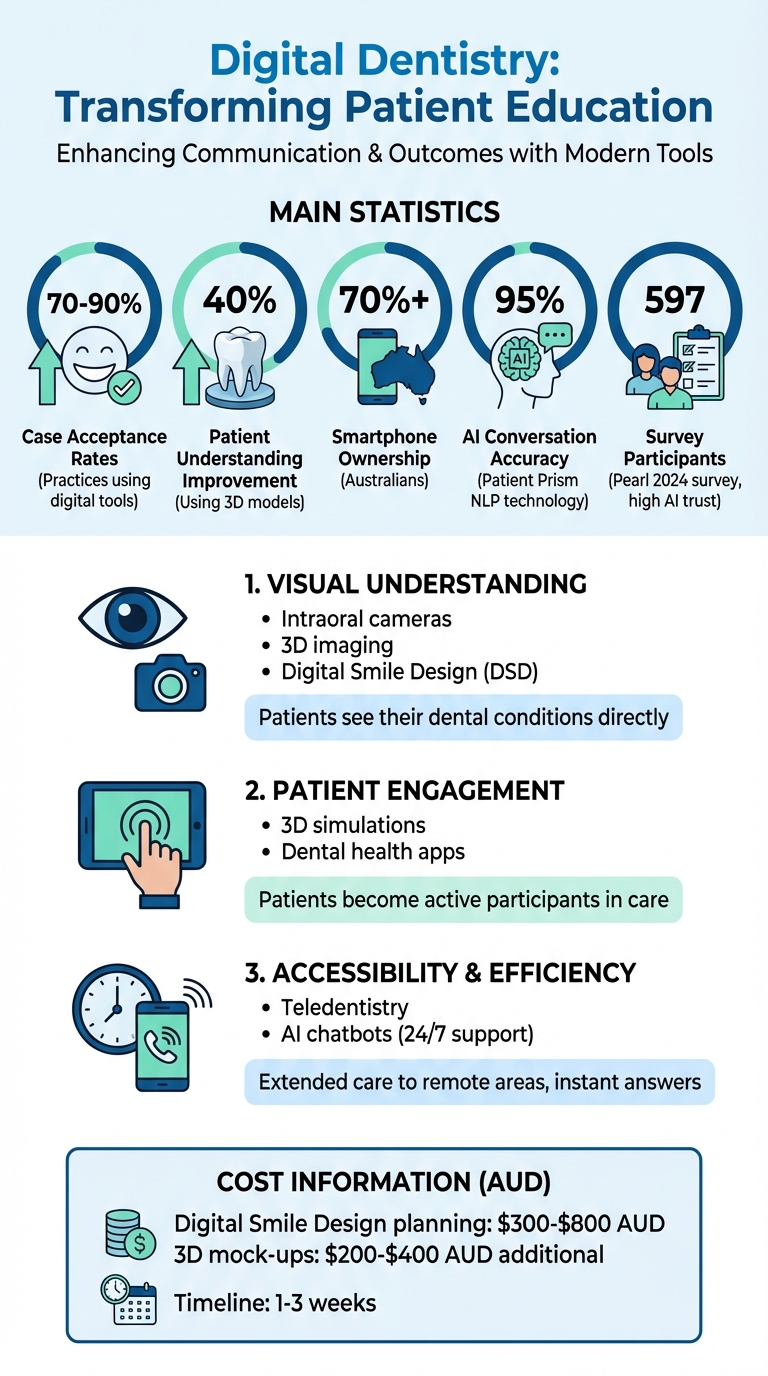
- Higher acceptance rates: Practices using digital tools report case acceptance rates between 70% and 90%.
Digital tools not only simplify patient education but also enhance the overall dental experience, making treatments clearer, faster, and more accessible.
Digital Dentistry Tools Benefits and Statistics
How digital dentistry improves patient communication and restorative workflows: Dr.White & Dr.Halley
sbb-itb-2be92ed
Benefits of Digital Tools in Patient Education
Digital tools have reshaped how patient education is delivered, offering tangible improvements in understanding, involvement, and accessibility. By moving beyond verbal explanations, these tools enhance the overall patient experience and make complex information easier to grasp.
Better Visual Understanding
When patients can see their dental condition, it eliminates much of the confusion that comes with verbal descriptions. Tools like intraoral cameras and 3D imaging let patients view issues such as cavities, gum recession, or misaligned teeth directly on a screen. This approach is far more compelling than simply listening to an explanation.
Take Digital Smile Design (DSD), for example – it allows patients to visualise their potential post-treatment smile. This removes uncertainty about results and fosters trust in the process. By showing the detailed anatomy of a tooth or the need for a procedure like a root canal, these visuals make the reasoning behind treatments far more relatable and concrete.
Increased Patient Engagement
Interactive digital tools shift patients from passive observers to active participants. Dr. Evan Stacey, Lead Dental Surgeon at Profilo Dental Care, highlights this shift:
"The more involved they are, the more they own the result" [2].
With 3D simulations, patients can explore treatment options, ask questions, and even tweak designs. Beyond the clinic, dental health apps help users monitor their brushing and flossing habits, creating a daily connection to their oral health. Given that over 70% of Australians own a smartphone [3], these apps offer a convenient way to encourage preventive care and foster long-term engagement. This active participation helps move the focus from reactive treatments to proactive health management, making patients feel more invested in their outcomes.
Better Efficiency and Accessibility
Digital platforms also improve communication and make dental education more accessible. For instance, intraoral scanners replace traditional, uncomfortable moulds with fast and precise digital impressions, saving time and improving the overall experience. Teledentistry extends care to patients in remote areas, while AI-powered chatbots on practice websites handle common questions, reducing the workload for staff and keeping patients informed.
Practices that integrate these digital tools often see higher case acceptance rates, ranging between 70% and 90% [4]. This is a notable improvement compared to traditional methods. As GoDigital Dental explains:
"Improved case acceptance not only ensures patients receive necessary dental care, but it also strengthens the overall health of the patient and the profitability of the dental practice" [4].
These advancements demonstrate how digital tools are not just improving patient education but also transforming the overall dental care experience.
Digital Tools for Patient Education
Intraoral scanners, patient education software, and teledentistry platforms are changing the way dental practices explain treatment options and engage with patients. These tools make it easier for patients to understand their oral health and actively participate in treatment planning.
Intraoral Scanners
Intraoral scanners use light and sensors to create detailed 3D images of the mouth in real time, offering a quick, non-invasive alternative to traditional moulds. During appointments, patients can watch as high-resolution images of their teeth and gums appear on the screen. This shared viewing experience helps dentists explain conditions and treatments more clearly, giving patients a better understanding of their oral health.
Dr. Rajan, a general practitioner, explains:
"Intraoral scans are becoming a vital component in patient education protocols, diagnosis and treatment planning, and long-term management." [5]
These scanners also allow dentists to compare scans over time, tracking changes like tooth wear or gum recession during routine check-ups. Combined with digital education tools, they help simplify complex treatment details for patients.
Patient Education Software
Interactive 3D tooth models take patient education to the next level. They allow patients to explore their own dental anatomy, see plaque build-up, understand decay progression, and visualise the results of treatments like implants or orthodontics. Studies show that using 3D models can improve patient understanding of treatment plans by 40% [3].
These platforms organise information into bite-sized sections, making it easier for patients to absorb. Digital smile design software is another standout feature, letting patients preview how their teeth could look after treatment. This visualisation helps patients feel more confident and involved in their care decisions. And with remote consultation tools, this support extends beyond the clinic.
Teledentistry Platforms
Teledentistry platforms are bridging the gap for patients in regional or remote areas, offering access to dental education and care without the need for frequent in-person visits. Through video calls or secure messaging, dentists can provide advice, monitor treatment progress, and address questions – all from a distance. This approach aligns with the growing emphasis on proactive, patient-focused care.
Many practices also use AI-powered chatbots on their websites to answer common questions instantly. With over 70% of Australians owning a smartphone [3], these tools make it easier to stay connected and reinforce oral health education outside of the clinic.
Comparing Popular Digital Tools
Building on the advantages of individual digital tools, let’s take a closer look at how key options stack up in terms of their features and challenges.
Features and Capabilities
When it comes to evaluating tools, dental practices need to focus on what each one brings to the table. Take Digital Smile Design (DSD), for instance. This tool excels in facial analysis and offers a collaborative approach, allowing patients to actively participate in designing their treatment. Patients can provide feedback on digital simulations before any work begins – a game-changer in patient engagement [6].
The process for DSD typically takes between 1 to 3 weeks, with planning and simulation services costing anywhere from $300 to $800 in Australia. If patients opt for temporary 3D mock-ups, they can expect an additional cost of $200 to $400 [6].
Traditional methods, on the other hand, don’t offer any visual previews, relying entirely on the dentist’s clinical judgement. DSD changes the game by providing highly personalised 2D and 3D simulations, tailored to each patient’s facial structure. This data-driven approach not only enhances personalisation but also makes outcomes much more predictable. Patients even have the option to trial temporary 3D previews before committing to more permanent treatments [6].
Now, let’s weigh these features against the challenges they present.
Strengths and Limitations
One of the standout benefits of tools like DSD is how they improve communication between dentists, lab technicians, and patients. This enhanced collaboration can lower the chances of patients being dissatisfied with their final results [6]. As Angus Pryor from Mepros points out:
"DSD brings the planning phase into the digital era, improving communication, outcomes, and patient confidence" [6].
However, these advanced tools come with their own challenges. For starters, they require specialised equipment such as intraoral scanners and 3D modelling software. There’s also the matter of upfront costs associated with the planning phase [6]. To avoid confusion, practices should provide itemised quotes that clearly separate planning fees from the overall treatment costs, as DSD-related charges are often bundled into the final price [6].
While the simulation process itself is non-invasive, the significant investment in technology can be a hurdle for smaller practices. This highlights the need for a balanced approach – embracing innovation while ensuring practical and transparent implementation, especially when educating patients about these tools.
Future of Digital Dentistry in Patient Education
The next phase of digital technology is set to revolutionise how dental practices engage with patients. Tools like artificial intelligence (AI) and virtual reality (VR) are already showing promise in transforming patient education.
AI in Patient Education
AI is stepping up to personalise and deepen communication between dental professionals and their patients. AI-powered platforms can now analyse a patient’s medical history, demographic data, and learning preferences to deliver customised educational content. For instance, visual learners might receive video-based materials, while others might benefit from detailed written guides [7].
Take Patient Prism LLC as an example. Their management software, driven by Natural Language Processing (NLP), can interpret dental-related phone conversations with an impressive 95% accuracy. This helps identify patient concerns and provides real-time insights to improve the experience [7]. Similarly, Awrel has developed a HIPAA-compliant virtual assistant that integrates with dental websites. It allows patients to describe symptoms via text or voice, offering self-care recommendations before their appointment [7].
In a 2024 survey conducted by Pearl, an AI dental platform, 597 U.S. dental patients expressed strong support for AI in dental diagnosis. Patients also showed high levels of trust in providers adopting these technologies [7]. Vinayak Thorat from Bharati Vidyapeeth Dental College highlights the benefits:
"Through these AI-driven solutions, dental professionals can enhance communication, education, and patient satisfaction in treatment explanations" [7].
AI chatbots add another layer of convenience, offering 24/7 virtual support. They can handle post-operative queries, send reminders for oral hygiene routines, and provide immediate answers outside regular office hours. This round-the-clock availability helps reduce patient anxiety and boosts adherence to treatment plans [7].
Virtual Reality for Patient Understanding
While AI focuses on tailoring content, virtual and augmented reality take patient education to the next level by creating immersive experiences. VR enables patients to "walk through" a procedure virtually, giving them a clear view of the equipment and steps involved. This approach helps demystify treatments, addressing one of the biggest causes of dental anxiety – the fear of the unknown [8].
Augmented reality (AR) offers a slightly different experience by overlaying digital content onto the real world. As The Dental Market explains:
"Augmented reality bridges this gap by allowing dentists to create 3D models of a patient’s oral cavity. By overlaying virtual models onto the real teeth, patients can visualise the proposed treatment plan in real-time" [8].
These immersive tools significantly enhance patient understanding and engagement. For example, AR-based education apps can teach proper brushing techniques, illustrate the effects of poor oral hygiene, or simulate how decay progresses. These visual demonstrations are far more impactful than verbal explanations alone, making preventive care messages clearer and more memorable.
Conclusion
Digital dentistry tools are reshaping how patients understand and engage with their oral health. Features like interactive guides and 3D visualisations remove much of the guesswork, helping patients feel more confident about their treatment choices. Tools such as Digital Smile Design even let patients preview potential results before committing to a procedure.
These innovations don’t just benefit patients – they also make dental practices more efficient. Digital impressions eliminate the discomfort of traditional moulds, while CAD/CAM technology allows for same-day restorations that previously required multiple visits [9]. This streamlining means fewer delays, less confusion, and fewer follow-up questions, all of which enhance the overall patient experience.
With over 70% of Australians owning a smartphone [3], digital tools are perfectly positioned to meet the demand for accessible and engaging oral health education. Apps and teledentistry platforms make it easier than ever to connect with patients. As Caroline Bishop, Co-founder of Dental News Australia, puts it:
"Digital dentistry and the innovations in dental technology are redefining the dental experience for both patients and professionals" [1].
When patients can see their treatment plans or monitor their oral health on a screen, they become more involved in their care. This level of transparency fosters trust and encourages proactive health management, which can lead to better long-term outcomes and more informed decisions about their dental health.
FAQs
Are digital scans more accurate than traditional moulds?
Digital scans tend to work well for single-tooth restorations and routine dental procedures. They provide real-time error correction and are usually more comfortable for patients. That said, traditional impressions might still be the go-to choice for more intricate cases, like full-arch restorations, where capturing the finest details is absolutely critical.
Is Digital Smile Design (DSD) guaranteed to match the final result?
Digital Smile Design (DSD) serves as a valuable tool for visualising potential outcomes, but it’s important to understand that it doesn’t promise an exact match to the final result. Factors such as individual anatomy, clinical conditions, and the expertise of the practitioner play a crucial role in determining the outcome. Additionally, differences in proportions or arch representation may arise, which is why the skill and experience of the dental professional are key to achieving the best results possible.
How is my privacy protected with teledentistry and AI chatbots?
Protecting patient privacy in teledentistry and AI chatbots relies on adhering to stringent data security protocols and complying with Australian privacy laws, such as the Privacy Act. These regulations mandate the secure storage of health data, limit access to authorised personnel, and ensure proper data handling practices are followed.
Transparency is a key component – patients must be informed about how their data will be used, and their consent must be obtained before any information is collected or processed. Additionally, technologies like encryption and secure data management systems play a crucial role in preventing breaches, safeguarding confidential patient information throughout their use of these digital tools.
Related Blog Posts
- AR in Dental Care: Patient Education Tools
- Digital Smile Design for Patient Communication
- Patient-Reported Outcomes in Digital Dentistry
- Interactive Tools for Dental Patient Education
Important Notice: Any surgical or invasive procedure carries risks. Before proceeding, you should seek a second opinion from an appropriately qualified health practitioner.
Individual results may vary. The information provided in this article is for educational purposes only and does not constitute medical advice.
Checkout Related Blogs




Get in touch with us
For more information, call us now to start feeling better. Or fill the form below to make appointment
The Latest News from Complete Smiles
How to Clean Clear Plastic Retainers
Checklist for Choosing Wearable Dental Devices
Checklist for Choosing Cloud AI Platforms in Dentistry
Complete Smiles Bella VistaAccepts All Major Health Funds, Including





