





How to Choose Between Ceramic and Composite Restorations
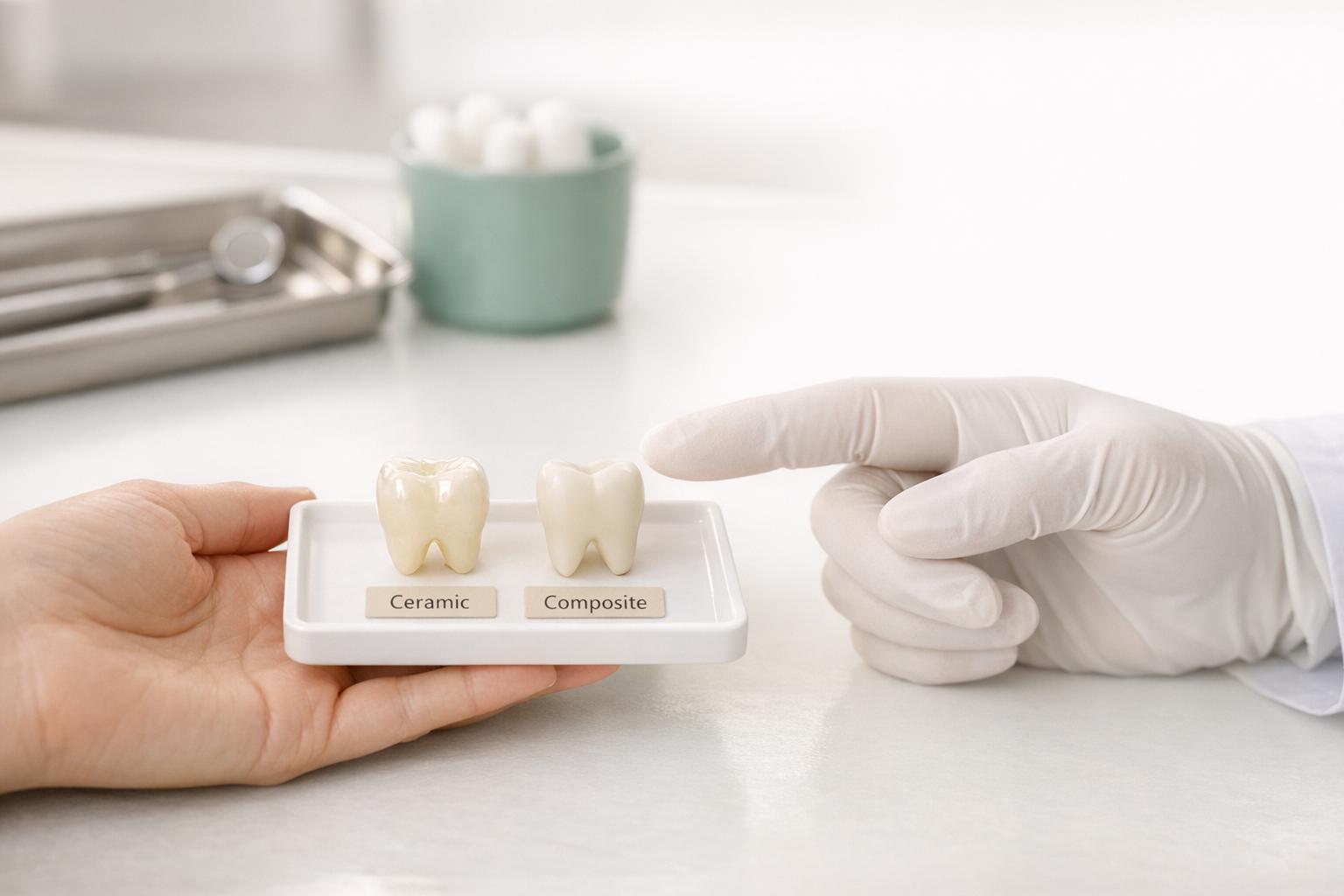
When deciding between ceramic and composite restorations, your choice impacts durability, cost, appearance, and tooth preservation. Here’s what you need to know:
- Ceramic restorations (e.g., porcelain): Strong, long-lasting (10–15+ years), stain-resistant, and ideal for areas under heavy chewing pressure. However, they cost more (AUD$1,100–$3,000 per tooth) and often require multiple visits unless same-day CAD/CAM technology is used.
- Composite restorations: Affordable (AUD$250–$650 per tooth), completed in one visit, and preserve more natural tooth structure. They’re less durable (4–7 years lifespan), prone to staining, and better suited for minor or front-tooth repairs.
Quick Comparison
| Factor | Composite Restorations | Ceramic Restorations |
|---|---|---|
| Durability | 4–7 years (up to 10 in low-stress areas) | 10–15+ years |
| Cost | AUD$250–$650 per tooth | AUD$1,100–$3,000 per tooth |
| Appearance | Matches tooth colour but may stain | Closely mimics natural enamel |
| Stain Resistance | Prone to staining | Resists stains |
| Procedure | Single visit | Multiple visits (or same-day CAD/CAM) |
| Tooth Preservation | Requires minimal enamel removal | Requires 0.3–0.5 mm enamel removal |
Ceramic is best for durability and aesthetics, especially for molars or visible teeth. Composite works well for minor fixes or budget-conscious cases. Consult your dentist to determine the right option based on your needs, tooth location, and lifestyle.
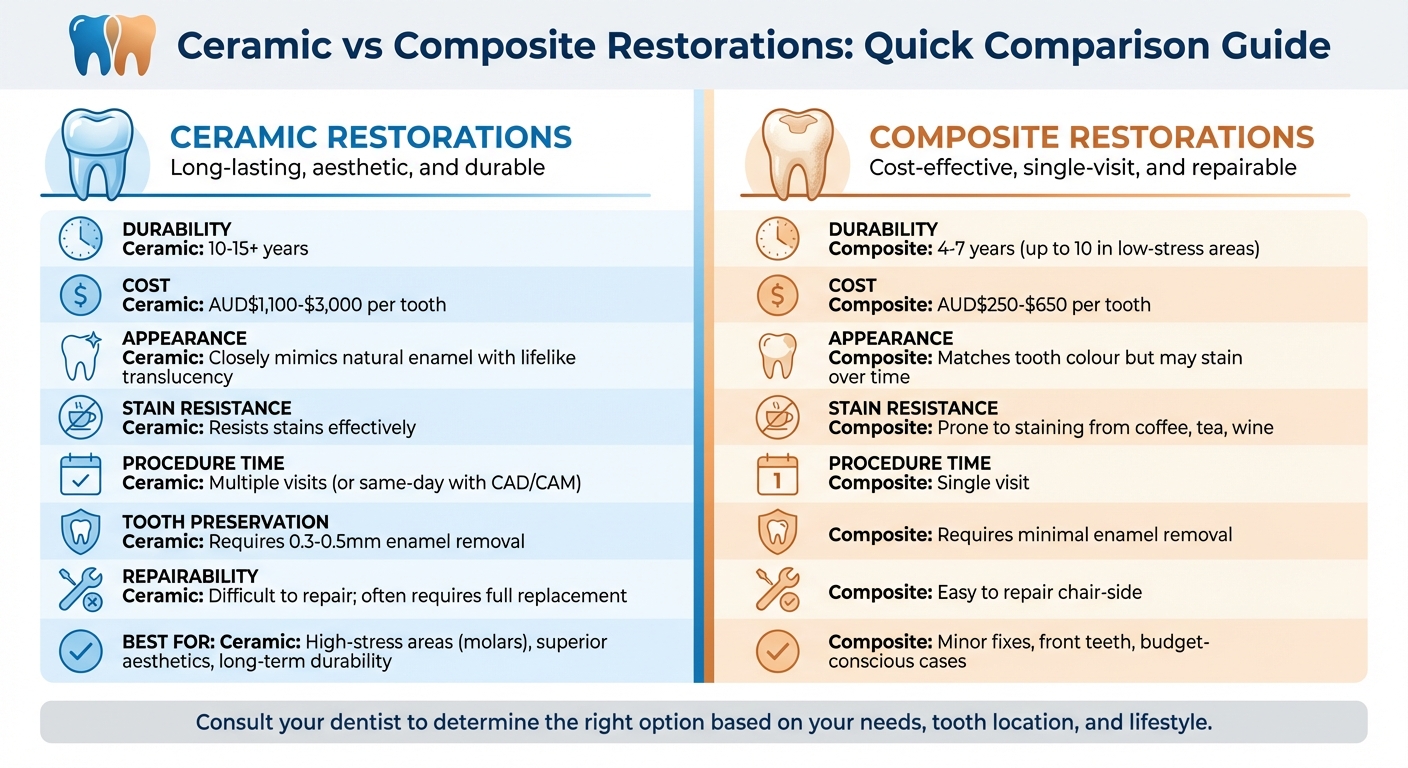
Ceramic vs Composite Dental Restorations Comparison Chart
Ceramic and Composite guide 2023 | Get Excellent long term Aesthetics
sbb-itb-2be92ed
What Are Composite Restorations?
Composite restorations are tooth-coloured fillings made from a mix of plastic resin (like BisGMA or UDMA) and inorganic filler particles, such as silica or glass [6]. Unlike ceramic restorations, which are crafted in a lab, composites are applied directly to the tooth and shaped to match its natural look. To bond the composite material to your tooth, your dentist uses a special adhesive, followed by curing each layer with a specialised light.
Materials and Application Process
The process begins with isolating the tooth to keep it dry. Your dentist then applies an etching solution and a bonding agent to ensure the composite adheres securely. The composite resin is applied in layers, with each layer carefully shaped to replicate the tooth’s natural appearance. After curing each layer with light, the restoration is polished to give it the same shine as natural enamel. This efficient method is one of the reasons composite restorations are widely used.
Benefits of Composite Restorations
Composite restorations come with several advantages that make them a popular choice. For starters, most procedures can be completed in just one visit, saving you time. They’re also more budget-friendly, typically costing between $400 and $600, compared to the $1,500 to $2,500 price range for ceramic restorations [8]. Another key benefit is that they require less removal of healthy tooth structure. If a composite restoration gets damaged, your dentist can often repair it by adding material to the existing restoration rather than replacing it entirely [7][2]. Research shows that composite restorations have a success rate of about 90% after 10 years [6].
Drawbacks of Composite Restorations
Despite their benefits, composite restorations have some downsides. Since the material is softer, it’s more prone to chipping and wearing down under heavy pressure, particularly in back teeth. They can also stain over time from drinks like coffee, tea, or red wine, meaning you might need more frequent cleanings to keep them looking their best. While ceramic restorations can last 10–15 years or more, composites usually need replacement or refreshing every 4 to 7 years. Additionally, larger composite fillings in back teeth have an annual failure rate of around 2.19%, making them less suitable for areas under constant stress [6].
What Are Ceramic Restorations?
Ceramic restorations are a step up from direct composite applications, offering a pre-fabricated solution that closely resembles natural enamel. These tooth-coloured treatments, such as crowns, veneers, inlays, or onlays, are crafted in a lab or milled using CAD/CAM technology. Unlike composites, which are applied directly to the tooth, ceramics are created as solid pieces and then bonded to the prepared tooth. Their ability to replicate the translucency and appearance of natural enamel makes them a popular choice, especially for front teeth.
Materials and How They’re Made
Ceramic materials are generally categorised into three types:
- Glass-based ceramics (feldspathic porcelain): These are highly translucent, making them ideal for veneers and other front-tooth restorations where appearance matters most.
- Lithium disilicate: This material strikes a balance between strength and aesthetics. Its unique crystal structure helps deflect cracks, enhancing durability [9].
- Zirconia: Known for its exceptional strength, zirconia vs. ceramic restorations, zirconia is perfect for areas subjected to heavy chewing forces. Its flexural strength ranges from 900 MPa to 1,400 MPa [10].
The process of creating ceramic restorations is meticulous. Unlike composites, ceramics are fabricated in a lab or milled using advanced CAD/CAM systems like CEREC. These systems digitally scan the tooth and mill the restoration from a solid ceramic block, sometimes enabling same-day placement [11][8]. After milling, the restoration is stained to match the natural tooth colour and glazed to seal its surface [11]. This detailed process ensures both durability and an attractive finish.
Benefits of Ceramic Restorations
Ceramic restorations are well-regarded for their durability and aesthetic qualities. With proper care, they can last 10–15 years or more [1][3]. Zirconia crowns, for instance, boast a low 5-year fracture rate of just 0.71% to 0.97% [10], while lithium disilicate crowns have a survival rate of about 97.4% after 5 years [10]. Ceramics also resist staining from substances like coffee, tea, and red wine, maintaining their appearance over time [1]. Additionally, they are biocompatible, resist bacterial adhesion [10], and can withstand the pressures of chewing, particularly in back teeth where forces are strongest.
Drawbacks of Ceramic Restorations
Despite their many advantages, ceramic restorations come with some downsides. They are expensive, ranging between $1,500 and $2,500 per tooth, and often require multiple visits to complete [8]. Traditional lab-fabricated ceramics typically involve two appointments, with a temporary restoration needed in the interim [11][8]. While strong, ceramics are more brittle than composites, meaning chips or cracks often require full replacement rather than simple repairs [3]. Additionally, if not polished correctly, some ceramic materials can be abrasive to opposing teeth [9][10].
Ceramic vs Composite: Side-by-Side Comparison
When deciding between ceramic and composite restorations, it helps to weigh factors like appearance, durability, procedure time, and cost. Here’s a quick-reference guide that breaks down these key differences.
Comparison Table
| Factor | Composite Restorations | Ceramic Restorations |
|---|---|---|
| Appearance | Matches tooth colour well initially but may become less natural-looking over time [1][2] | Offers a lifelike translucency that closely mimics natural enamel and light reflection [1][12] |
| Stain Resistance | Porous surface is prone to staining from coffee, tea, or wine [1][4] | Non-porous, glass-like surface resists stains effectively [1][12] |
| Durability | Moderate lifespan of 4–7 years, sometimes up to 10–15 years in low-stress areas [1][3] | Long-lasting, typically 10–15+ years with proper maintenance [1][3] |
| Procedure Duration | Completed in a single visit with direct application [1] | Usually requires multiple visits unless using CAD/CAM technology [1] |
| Cost | AUD$200–AUD$800 per tooth; a more affordable option upfront [4][13] | AUD$1,100–AUD$3,000 per tooth; higher initial expense [4] |
| Repairability | Easy to repair or adjust chair-side [4] | Repairs are difficult; chips or cracks often require full replacement [4] |
| Tooth Preparation | Requires little to no enamel removal [4] | Involves removing 0.3–0.5 mm of enamel [4] |
| Best Applications | Great for small chips, minor gaps, and front teeth – ideal for budget-conscious patients [1][12] | Best for high-stress areas like molars or cases needing superior aesthetics [1][3] |
This table highlights the practical considerations for each option, helping you align your choice with your dental needs, lifestyle, and budget. Whether prioritising cost, longevity, or appearance, these factors can guide your decision.
What to Consider When Choosing a Restoration
When deciding on the best restoration material, it’s important to think beyond the basics. Factors like tooth location, durability needs, budget, and personal habits all play a role in making the right choice.
Tooth Location and Chewing Pressure
Where the tooth is located significantly impacts the choice of material. Back teeth, like molars and premolars, handle intense chewing forces, so ceramic is often the go-to option for its strength and durability [1][14]. For restorations involving a tooth cusp, ceramic stands out because it resists chipping and wear under heavy pressure [5][3]. For example, lithium disilicate ceramics offer flexural strength between 360 MPa and 400 MPa, while zirconia-based ceramics are even tougher, ranging from 900 MPa to 1200 MPa [14]. If you grind or clench your teeth, high-strength ceramics combined with a night guard can provide added protection [14][4]. Of course, material choice also depends on your budget and payment options.
Cost and Payment Options
Budget is another key factor when choosing a restoration. While ceramic tends to have a higher upfront cost, it often lasts 10–15 years or more, compared to composite, which typically needs replacing every 4–7 years [8]. Over time, ceramic may actually save you money because of its longevity. Many dental clinics in Australia offer financing or instalment plans, so it’s worth checking with your provider. Additionally, private health insurance may cover part of the cost, depending on your extras cover and waiting periods [16]. If you’re looking into dental care for children, the Child Dental Benefits Schedule (CDBS) provides up to AUD$1,052 over two calendar years for eligible families [15].
Appearance and Lifestyle Factors
Once you’ve considered functionality and cost, personal habits and aesthetic preferences can guide your final decision. Ceramic restorations are highly resistant to stains caused by coffee, tea, wine, or smoking [1][4]. On the other hand, composite resin may discolour or lose its shine over time with frequent exposure to staining agents [4]. Another advantage of ceramic is its ability to mimic the natural translucency of enamel.
"Ceramic restorations are known for their lifelike translucency and polish. They reflect light similarly to natural enamel, making them nearly indistinguishable from real teeth."
– Aesthetik Dental [1]
If you prioritise long-lasting aesthetics and minimal upkeep, ceramic is an excellent choice. However, composite can be a practical alternative if you’re on a tighter budget, need a quicker solution, or want to preserve more of your natural tooth structure [4][5]. For a more personalised approach, consider asking your dentist for a digital mock-up or "wax-up" to see how the restoration will look alongside your natural teeth [1][4].
When to Choose Each Type of Restoration
When Composite Restorations Work Best
Composite restorations are a great choice when you’re looking for a quick fix while keeping as much of your natural tooth as possible. They’re particularly effective for minor front-tooth repairs – like fixing small chips, closing tiny gaps, or reshaping edges – all of which can usually be done in just one visit. If you’re watching your budget, composites are often the more affordable option upfront. Plus, they’re a conservative and reversible treatment, making them ideal if you want to preserve your tooth structure or keep your options open for future dental work.
That said, while composites work well for less-stressed areas and cost-conscious cases, ceramics often take the lead when durability and aesthetics are the main priorities.
When Ceramic Restorations Work Best
Ceramic restorations shine when long-term durability and top-notch aesthetics are non-negotiable. They’re especially suited for larger restorations or cases where a tooth cusp needs replacing, offering the structural strength required for such repairs. In fact, chair-side porcelain restorations boast an impressive 93% success rate over 15 years [8].
"On molar teeth, which sometimes require a larger filling, they [porcelain] are the material of choice."
– Dr. Peter Henderson, Dentist, Smile Solutions [8]
Ceramic is often the go-to for visible teeth, as it closely mimics the natural translucency of enamel and resists staining from coffee, tea, and wine. For those who value longevity and aesthetics, ceramic provides a dependable "set and forget" solution, with a lifespan of 10–15 years or more, which often justifies its higher initial cost.
Making the Right Choice for Your Dental Health
Deciding between ceramic and composite restorations involves weighing factors like durability, appearance, cost, and your daily habits. Ceramic restorations are known for their longevity, often lasting 10–15 years or more, and their resistance to staining makes them a great choice for teeth under heavy pressure or those highly visible, like front teeth. They’re a solid pick if you’re after a long-term, low-maintenance option[1]. On the other hand, composite restorations are more budget-friendly upfront, require less removal of your natural tooth structure, and can often be completed in just one visit. This makes them ideal for minor repairs or when working within a tighter budget[1].
Another key point is how these materials handle wear and tear. Composite restorations are easier to repair if damaged, while ceramic restorations usually need to be fully replaced in such cases[4]. Your lifestyle also plays a big role in determining which option suits you best.
"The choice between ceramic and composite is never just about material – it’s about outcomes. It’s about choosing a solution that respects your time, suits your lifestyle, and supports your vision for your smile." – Aesthetik Dental[1]
As mentioned earlier, the best option depends on your unique dental needs. Factors such as the tooth’s location, the forces it endures while chewing, and your desired aesthetic results all come into play. That’s why it’s essential to consult your dentist, who can guide you based on these considerations. Many dental practices now offer digital smile design mock-ups to help you visualise the results or payment plans to make the cost more manageable[4].
Both materials have a strong track record when properly placed and maintained. Whether you go with ceramic or composite, the key to a long-lasting restoration is maintaining excellent oral hygiene and keeping up with regular dental checkups[3].
FAQs
Which option is better for molars or heavy chewing?
Ceramic restorations are often the go-to option for molars or areas subjected to heavy chewing because of their strength and durability. Materials such as porcelain and zirconia are highly resistant to fractures and can endure significant force, typically lasting 10–15 years when bonded correctly. While composite restorations may offer better aesthetics and require less invasive preparation, they tend to wear down faster and are less robust under heavy pressure. This makes ceramics a better choice for high-stress zones like molars.
How do I choose if I grind or clench my teeth?
To figure out if you grind or clench your teeth, watch for signs like flattened or broken teeth, tenderness in your jaw muscles, or pain around the jaw joint. Dentists can spot these clues during an examination and look for physical evidence of bruxism. If any of these symptoms sound familiar, it’s a good idea to visit your dentist for an evaluation and guidance on how to manage the problem.
Will my private health cover ceramic or composite?
When it comes to private health insurance, whether ceramic or composite restorations are covered depends entirely on your policy and the level of extras or major dental cover you have. Typically, both types of restorations might be included, but the amount covered and eligibility criteria can differ significantly between insurance providers. It’s always best to review the details of your specific policy to understand what’s covered and how much you can claim.
Related Blog Posts
- Durability of Metal-Ceramic Restorations
- How Ceramic Restorations Compare to Amalgam
- Zirconia vs. Ceramic: Biocompatible Dental Materials
- Stress Distribution: Ceramic vs Composite
Important Notice: Any surgical or invasive procedure carries risks. Before proceeding, you should seek a second opinion from an appropriately qualified health practitioner.
Individual results may vary. The information provided in this article is for educational purposes only and does not constitute medical advice.
Checkout Related Blogs




Get in touch with us
For more information, call us now to start feeling better. Or fill the form below to make appointment
The Latest News from Complete Smiles
How to Clean Clear Plastic Retainers
Checklist for Choosing Wearable Dental Devices
Checklist for Choosing Cloud AI Platforms in Dentistry

Complete Smiles Bella VistaAccepts All Major Health Funds, Including





