





Study: Causes of Autoclave Failures in Dental Clinics

Autoclave failures in dental clinics are mostly caused by human error (91.8%), with equipment issues contributing to only 8.2%. These failures disrupt operations, compromise compliance, and pose health risks. Proper training, maintenance, and monitoring can prevent most issues. Here’s what you need to know:
- Common Mistakes: Overloading chambers, wrong cycle selection, poor instrument placement, and skipping pre-cleaning.
- Key Maintenance Tasks: Daily gasket cleaning, weekly water reservoir refills, and annual servicing.
- Monitoring Tools: Use chemical and biological indicators, along with temperature and pressure logs, to catch failures early.
- Water Quality Matters: Always use distilled water to avoid mineral deposits that damage components.
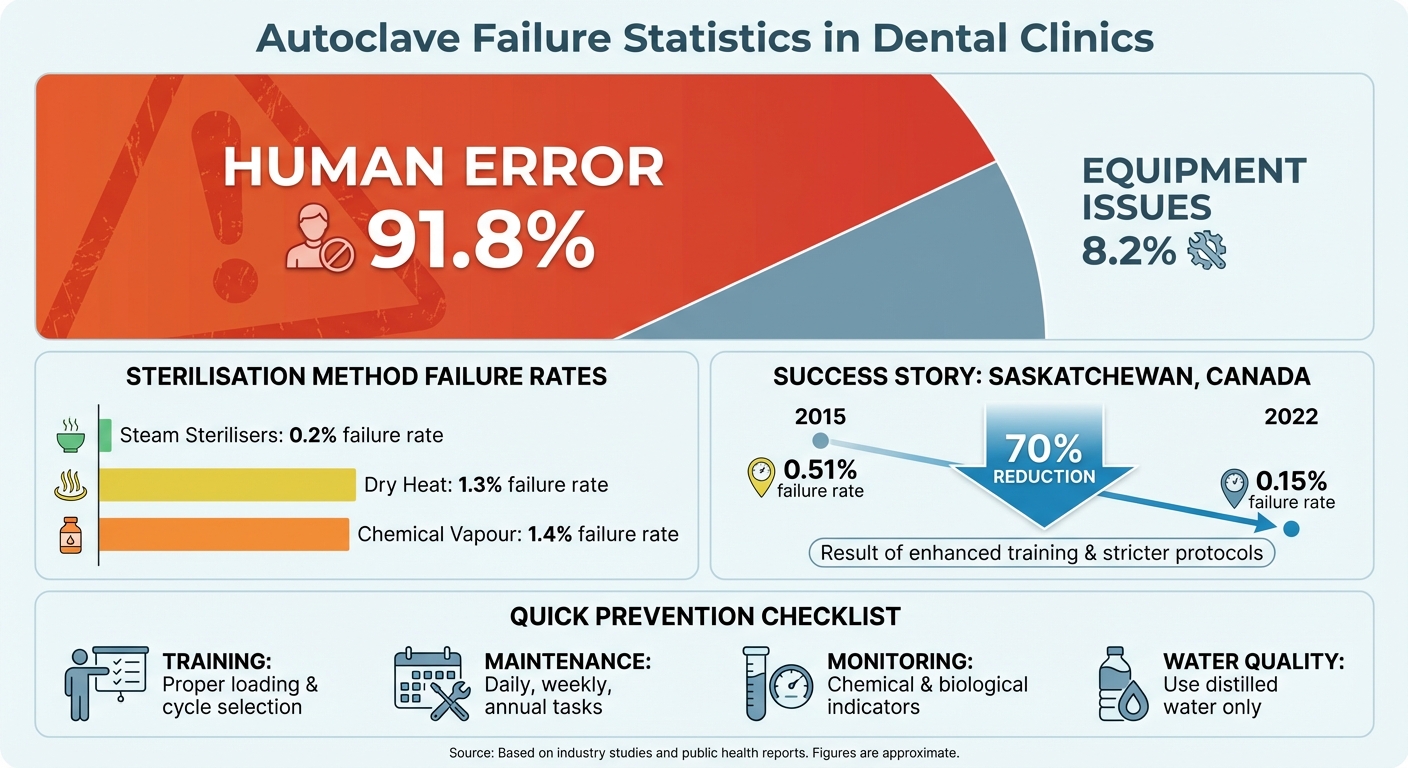
Autoclave Failure Causes in Dental Clinics: Human Error vs Equipment Issues
Failed Spore Test – What do you do?
sbb-itb-2be92ed
Operator Errors That Cause Autoclave Failures
Human error is responsible for a staggering 91.8% of autoclave failures in dental clinics [7]. These mishaps often occur during routine operations when staff rush through procedures or skip crucial steps. The consequences go beyond simple instrument load issues, affecting cycle selection, packaging, and pre-cleaning processes. Such mistakes can disrupt efficiency and compromise compliance, underscoring the need for strict attention to operational protocols.
Overloading and Poor Instrument Placement
One of the most common mistakes is overloading the autoclave chamber. Packing in too many instruments restricts steam circulation, leading to cold spots where harmful microbes can survive. Roson, a dental equipment expert, highlights this issue:
"The single most frequent operator error is overloading the sterilisation chamber. Steam must circulate freely to penetrate every surface of the instruments." [1]
To prevent this, aim to fill the chamber to only 75–80% of its capacity, leaving 10–20% of space between packs. This ensures that steam can circulate freely without obstruction. Additionally, pouches should be placed on their edges in racks, with the plastic side of one facing the paper side of the next. This arrangement allows steam to penetrate effectively and facilitates moisture escape during the drying phase [1][3].
Wrong Cycle Selection and Packaging Mistakes
Using the wrong sterilisation cycle is another frequent error that can undermine the entire process. For example, Class N (gravity displacement) cycles are suitable for solid, unwrapped instruments, but hollow instruments like dental handpieces require Class B (pre-vacuum) cycles to ensure air is removed from internal lumens [8]. Without the correct cycle, air pockets can form, preventing steam from reaching all surfaces.
Packaging mistakes can also contribute to failures. Laying pouches flat traps air and moisture, while removing instruments before the drying phase results in ‘wet packs’ that are prone to bacterial recontamination [3][7]. To avoid these issues, always position pouches on their edges in racks and allow the full sterilisation and drying cycle to complete before handling the instruments.
Inadequate Pre-Cleaning of Instruments
Autoclaves are designed to decontaminate, not clean. Any residual blood, tissue, or debris left on instruments can shield microbes, rendering the sterilisation process ineffective [3]. Tom Toi from MES Australia emphasises this point:
"Sterilisation doesn’t clean, it decontaminates. If instruments are still covered in organic material (blood, tissue, debris), that residue can shield microorganisms from the sterilising steam." [3]
To address this, thorough manual or ultrasonic cleaning before sterilisation is essential. This step removes physical debris, ensuring that the sterilising steam can reach all surfaces and effectively eliminate microorganisms.
Equipment Problems and Maintenance Failures
Equipment problems and maintenance failures account for 8.20% of autoclave sterilisation issues [7]. These mechanical problems often develop gradually, making them tricky to spot until a complete cycle failure occurs. However, regular maintenance and early detection can significantly reduce these risks. Addressing these issues is a key part of ensuring proper sterilisation alongside operator competency.
Steam Quality and Water Supply Issues
Water quality plays a huge role in an autoclave’s long-term performance. Using tap or filtered water instead of distilled water can lead to calcium and magnesium deposits on critical components like heating elements, sensors, and valves [1][2]. These deposits reduce efficiency and slow down cycle times. For instance, if the temperature ramp is more than 20% slower than its baseline, it could point to scale buildup or a degrading heater [1]. Similarly, a cycle time increase of over 10% from the baseline often signals excessive scaling [2].
Water reservoirs can also become a source of contamination. Studies of benchtop autoclaves have found that uncleaned reservoirs can house bacterial counts ranging from 2,300 to 80,000 cfu/ml and endotoxin levels between 360 and 2,200 EU/ml [10]. Professor Jeremy Bagg from the University of Glasgow Dental School highlights the risks:
"The reservoirs of non-vacuum benchtop autoclaves can become severely contaminated with micro-organisms, particularly Gram-negative bacteria. The endotoxin content of the reservoirs can get to high and unacceptable concentrations." [10]
To combat these issues, it’s essential to drain and refill the reservoir daily with fresh distilled or deionised water. This simple step can reduce bacterial counts to 0–40 cfu/ml and endotoxin levels to 0–80 EU/ml [10]. Regular weekly inspections for mineral deposits and annual water quality analyses can also help catch problems before they affect sterilisation.
Damaged Door Gaskets
Door gaskets are responsible for creating the airtight seal that autoclaves need to maintain sterilisation parameters. Over time, these rubber seals can wear out, warp, or collect debris [1][2]. When gaskets fail, the autoclave can’t hold the necessary pressure or vacuum for effective sterilisation.
Signs of gasket problems include hissing sounds, water residue around the door, and a faint steam odour [1][2]. Error messages like "low pressure" or "vacuum failure" can also point to gasket issues. Since gaskets deteriorate with use, they should be replaced every 12 to 24 months, depending on how frequently the autoclave is used [1][2]. Cleaning the gasket and the mating chamber surface regularly with a soft, lint-free cloth can help prevent debris buildup and extend the gasket’s lifespan [1][2].
Blocked Vacuum Systems and Drain Lines
Keeping steam and waste pathways clear is just as important for maintaining autoclave performance. Debris from instrument pouches, tape, or biological matter can clog chamber filters, drain strainers, and vacuum traps [2][9]. These blockages can disrupt steam penetration in Class B autoclaves and prevent proper drainage of condensation. Signs like water pooling in the chamber or "wet packs" are clear indicators that sterilisation may be compromised [1][2].
| Component | Maintenance Task | Frequency | Purpose |
|---|---|---|---|
| Door Gasket | Wipe with a soft, damp cloth | Daily | Prevents debris buildup and ensures a proper pressure seal [2] |
| Drain/Filters | Remove and clean strainer/traps | Weekly | Prevents water pooling and "wet pack" failures [2] |
| Tubing/Lines | Inspect for kinks or wear | Monthly | Ensures unobstructed flow of steam and waste [1] |
| Full System | Professional service/calibration | Annually | Replaces wearable parts and ensures safety compliance [2][9] |
Routine checks are essential to keep the autoclave running smoothly. For Class B autoclaves, performing a daily Bowie-Dick test can help detect vacuum leaks or air removal problems early [1][2]. Keeping spare gaskets and filters on hand can also minimise downtime when replacements are needed. These maintenance practices play an important role in supporting the broader sterilisation protocols discussed later.
How to Monitor and Detect Sterilisation Failures
Once prevention and maintenance measures are in place, the next step is consistent monitoring to catch sterilisation failures as early as possible. This involves three key methods: mechanical monitoring of gauges and displays, chemical monitoring (using indicators within packs), and biological monitoring (spore tests) [4][5]. According to the CDC, mechanical monitoring should be performed for every steriliser load [6]. This method serves as the first and fastest way to spot potential issues by tracking critical parameters like time, temperature, and pressure, which are essential for confirming a successful sterilisation cycle.
Chemical and Biological Indicators
Chemical indicators (CIs) rely on heat-sensitive chemicals that change colour when exposed to the right conditions. These must be placed inside every package to confirm that steam has penetrated the packaging and reached the orthodontic instruments [4]. However, while CIs confirm that physical conditions were met, they don’t guarantee that microorganisms have been eliminated. As Dr. Staat from the University of Louisville puts it:
"verify exposure to elevated temperatures and provide a clear visual indication of processed items" [11].
Biological indicators (BIs), often referred to as spore tests, are considered the most reliable method for confirming sterilisation. These tests use resistant bacterial spores, such as Geobacillus stearothermophilus, to directly challenge the sterilisation process. Spore tests should be performed at least weekly [5][6][12]. A positive result means the steriliser must be taken out of service immediately, and all items processed since the last successful test must be recalled and reprocessed [4][6].
Beyond these checks, electronic monitoring of temperature and pressure adds another layer of assurance.
Temperature and Pressure Monitoring
Electronic systems like data loggers and printers provide detailed records to confirm that the steriliser reached the necessary conditions [4][12]. These tools are invaluable for identifying the exact moment of a failure and determining which loads were affected [12]. However, sensors can drift over time, so annual calibration by a qualified technician is required. Under AS 5369:2023, annual validation now involves three full cycles using three biological indicators per cycle, paired with NATA-certified calibrated data loggers [4][13].
For pre-vacuum (Class B) autoclaves, a Bowie-Dick test should be performed daily in an empty, pre-warmed chamber. This test checks for air leaks or issues with the vacuum pump [4][5]. Keeping sterilisation logs – whether digital or paper – for at least one year is mandatory for compliance and helps streamline recalls if a failure occurs [4].
Prevention and Maintenance Strategies
Keeping autoclaves running smoothly requires a proactive approach to maintenance, rather than waiting for problems to arise. Combining daily care with scheduled professional servicing is the best way to minimise failures. Since 91.8% of sterilisation failures are due to human error [7], consistent routines can help prevent most issues before they even begin.
Regular Maintenance and Inspections
Maintenance tasks can be broken down into daily, weekly, and monthly routines:
- Daily tasks: Wipe the door gasket and chamber surface with a soft, lint-free cloth, check water reservoir levels, and perform a Bowie-Dick test for Class B units.
- Weekly tasks: Drain and refill the water reservoir with fresh distilled or demineralised water, clean chamber racks and drain strainers, and conduct a biological indicator spore test.
- Monthly tasks: Deep clean the chamber, inspect power cords and tubing for wear, and run a cleaning cycle using the manufacturer’s recommended solutions.
Using distilled or demineralised water is crucial to prevent mineral deposits that can damage the system. Door gaskets should be replaced according to the manufacturer’s guidelines. Additionally, an annual professional service by a qualified technician is essential. This includes calibration, validation (IQ/OQ/PQ), electrical safety checks, and replacing parts like gaskets, seals, and filters. In Australia, dental practices are required to validate autoclaves annually to meet AS/NZS 4815:2006 standards.
Regular troubleshooting also plays an important role in addressing minor issues before they escalate into major problems.
Troubleshooting Common Problems
Some common autoclave issues, such as wet packs or low temperature errors, can often be resolved with simple adjustments:
- Wet packs: These are usually caused by overloading the chamber. Review and follow proper loading procedures to ensure adequate air circulation.
- Extended cycle times: If cycle times increase by more than 10% of the baseline, it may indicate mineral buildup. Running a descaling cycle with a manufacturer-approved cleaning agent can resolve this.
- Pressure or vacuum errors: These often result from a worn or dirty door gasket. Listen for hissing sounds or check for moisture around the door during a cycle to identify the issue.
- Low temperature errors: Running a descaling cycle with the recommended cleaning solution can often fix this problem.
As Roson points out:
"A ‘cycle complete’ message only indicates that the machine ran for the programmed time; it does not guarantee that sterilising conditions were met inside each package" [2].
Maintaining a detailed logbook is another critical step. Use it to record every sterilisation cycle, maintenance activity, and calibration result. This not only ensures regulatory compliance but also simplifies the process of addressing recalls and demonstrates accountability during inspections.
Conclusion
Autoclave failures in dental clinics are overwhelmingly linked to operator errors (91.8%), with equipment issues accounting for just 8.2% [7]. Among sterilisation methods, steam sterilisers show the lowest failure rate at 0.2%, compared to 1.3% for dry heat and 1.4% for chemical vapour systems [7].
To address these challenges, clinics must prioritise both staff training and equipment maintenance. Proper loading techniques, accurate cycle selection, and correct interpretation of indicators are key skills every operator should master. Regular training sessions and strict compliance with manufacturer guidelines are essential to minimise human errors. As MES Australia points out, even the best autoclave cannot perform effectively without knowledgeable operators [3].
In addition to training, robust monitoring protocols are critical. Using physical, chemical, and biological indicators ensures that potential issues are identified early. Daily maintenance, weekly spore testing, and annual professional servicing create a comprehensive safety framework. For instance, Saskatchewan, Canada, saw autoclave failure rates drop from 0.51% in 2015 to 0.15% in 2022 after implementing enhanced training and stricter protocols [7].
Effective sterilisation safeguards patients and reinforces a clinic’s reputation. When staff view sterilisation as integral to patient care, a culture of safety becomes ingrained in daily operations, ensuring both trust and high standards are maintained.
FAQs
What should be done immediately after a failed spore test?
If a spore test fails, it’s essential to act promptly by following the correct protocol for handling a positive biological indicator. This typically includes reprocessing the instruments to ensure they are safe for use, verifying the autoclave’s performance to identify any issues, and conducting further tests to confirm effective sterilisation. Make sure every step aligns with infection control standards to prioritise patient safety and maintain compliance with regulations.
How can we tell if our autoclave is overloaded before running a cycle?
To determine if your autoclave is overloaded, make sure there’s sufficient space between items to allow steam to circulate effectively. Many modern autoclaves come with racks specifically designed to help prevent overloading, as overcrowding can obstruct steam flow and impact sterilisation. Correct loading is crucial for ensuring proper sterilisation and avoiding potential equipment problems.
How often should autoclaves be validated and calibrated in Australia?
In Australia, autoclaves need to be validated at least once a year. This process includes performing full cycle tests using biological indicators and calibrating data loggers. Importantly, these tasks must be carried out by a technician certified by NATA (National Association of Testing Authorities). Compliance with standards like AS 5369:2023 is crucial, as regular validation not only ensures adherence to regulations but also guarantees effective sterilisation – an essential requirement for dental clinics.
Related Blog Posts
- Orthodontic Sterilization Tools: Guide
- Common Causes of Sterilization Failures
- Checklist for Sterilisation Competency in Dental Clinics
- Cycle Failures in Autoclaves: Problems and Fixes
Important Notice: Any surgical or invasive procedure carries risks. Before proceeding, you should seek a second opinion from an appropriately qualified health practitioner.
Individual results may vary. The information provided in this article is for educational purposes only and does not constitute medical advice.
Checkout Related Blogs




Get in touch with us
For more information, call us now to start feeling better. Or fill the form below to make appointment
The Latest News from Complete Smiles
How to Clean Clear Plastic Retainers
Checklist for Choosing Wearable Dental Devices
Checklist for Choosing Cloud AI Platforms in Dentistry

Complete Smiles Bella VistaAccepts All Major Health Funds, Including





