





AR vs. Traditional Dental Training
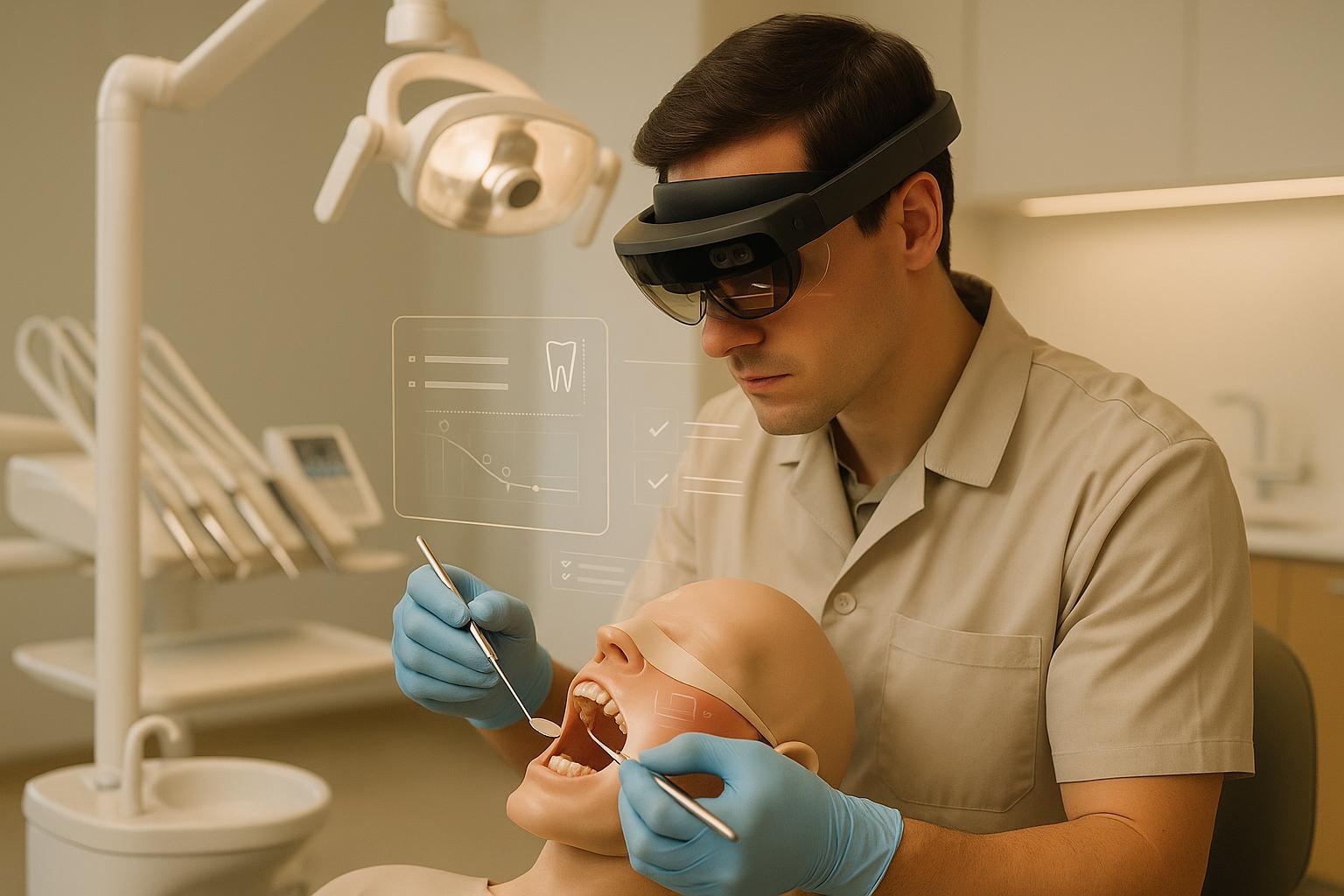
AR (Augmented Reality) is transforming dental education. It provides immersive, interactive 3D learning environments that address the limitations of traditional methods like lectures, wax carving, and extracted teeth. While conventional training builds foundational skills, AR offers enhanced visualisation, repeatable practice, and real-time feedback that boosts confidence and skill acquisition.
Key Insights:
- Traditional Methods: Relies on lectures, wax carving, and phantom heads but struggles with engagement, resource limitations, and ethical concerns.
- AR Benefits: Offers 3D visualisation, unlimited practice, and performance tracking, improving retention and procedural accuracy.
- Challenges: High setup costs, lack of standardisation, and potential reduction in face-to-face learning.
Quick Comparison:
| Aspect | AR Technology | Traditional Methods |
|---|---|---|
| Learning Retention | Higher test scores, better comprehension | Baseline performance |
| Confidence | Increased through real-time feedback | Standard confidence levels |
| Practice Opportunities | Unlimited, repeatable | Limited by resources and irreversible errors |
| Cost Efficiency | Lower long-term costs after setup | High recurring costs for materials |
| Student Preference | 93% favour AR for 3D visualisation | Limited engagement with static methods |
Blending AR with conventional training could provide the best of both worlds – technical precision with hands-on experience. The future of dental education lies in this balance.
Using Augmented Reality to Train Dental Students
Traditional Dental Training Methods
For decades, dental schools across Australia have leaned heavily on hands-on learning and direct instruction to train future dentists. These time-tested methods have shaped countless professionals. However, as the demands of modern dentistry evolve, these approaches are being scrutinised for their ability to keep up with today’s fast-paced advancements.
Core Components of Traditional Training
Traditional dental education blends theory with practical skill-building, offering students a structured pathway to develop both knowledge and technique. A prime example is dental anatomy, where learning is divided between classroom lectures and hands-on modules designed to refine both cognitive and motor abilities [6].
The journey typically starts with didactic lectures, where educators use visual aids, diagrams, and two-dimensional images to introduce students to dental structures. This foundational knowledge is crucial before moving on to practical applications. Research from the UK and Ireland reveals that 81.25% of educators dedicate just zero to ten hours annually to teaching tooth morphology through lectures [6].
Practical modules form the backbone of traditional training. Students engage with 3D illustrations, extracted human teeth, and plastic models to grasp dental anatomy and morphology. Tooth carving on wax or soap blocks is a key exercise, helping students develop the fine motor skills necessary for dental procedures.
Phantom heads are another staple of traditional training. These mechanical simulators allow students to practise drilling, filling, and other procedures in a controlled setting before working on real patients. The tactile feedback from these simulators helps students understand the physical demands of dentistry.
Extracted human teeth remain an essential teaching tool. They provide authentic morphology and natural variations that plastic models simply can’t replicate. However, their use does raise ethical and health-related concerns [6].
Here’s a quick comparison of these methods, highlighting their strengths and limitations:
| Teaching Method | Main Advantages | Main Drawbacks |
|---|---|---|
| Didactic lectures | Offers a clear overview, uses visual aids | Limited interactivity, relies on two-dimensional images, reduces engagement |
| Wax carving pedagogy | Builds motor skills, teaches 3D tooth architecture | Time-intensive, lacks natural diversity, limited anatomical accuracy |
| Plastic teeth | Easy to access, realistic sizing | Lacks natural anatomical variation, doesn’t mimic real dental tissues |
| Extracted human teeth | Authentic morphology and variations | Ethical concerns, hygiene issues, and difficulty in sourcing quality samples |
While these techniques have long been the foundation of dental education, they face growing challenges in addressing the needs of modern practice.
Problems with Traditional Methods
Despite their established track record, traditional dental training methods come with a range of limitations that can hinder their effectiveness in preparing students for the realities of modern dentistry.
Supply and quality issues are a major hurdle when it comes to using extracted teeth. Finding specimens that are free from caries, fillings, or other damage is increasingly difficult. This scarcity often forces schools to use subpar samples, which may not accurately reflect ideal dental anatomy.
Irreversible learning experiences present another significant challenge. Mistakes made on physical models or extracted teeth can’t be undone, leading to wasted resources and missed opportunities to correct errors or repeat procedures.
Engagement and retention struggles are common in lecture-based teaching. With limited interactivity, traditional lectures often fail to hold students’ attention, resulting in lower grades and attendance rates [8].
Insufficient preparation for diverse patient populations is a growing concern. Traditional methods may not adequately expose students to scenarios involving geriatric, paediatric, or medically complex patients. This gap between classroom learning and real-world practice can leave new graduates feeling overwhelmed [7].
Financial pressures add to the mix. By 2023, the average dental school graduate in Australia faced a debt of $280,700 [3]. High costs for physical training facilities, materials, and equipment replacement only compound the financial burden.
The disconnect between academic and clinical practice further complicates matters. Dental schools often lag behind private clinics in adopting new technologies, leaving graduates unprepared for the tools and techniques they’ll encounter in the workforce [7].
Finally, health and safety concerns associated with extracted teeth create additional challenges. Strict hygiene protocols, sterilisation requirements, and potential risks of exposure make their use more complicated and resource-intensive.
In light of these challenges, dental educators are increasingly turning to new technologies, such as augmented reality, to complement or even replace traditional methods. These innovations aim to bridge the gap between outdated practices and the demands of modern dentistry.
AR Technology in Dental Training
Augmented reality (AR) is reshaping dental education by integrating digital overlays with real-world settings, addressing the challenges of conventional training methods. Unlike static models, AR introduces interactive, risk-free environments where students can practise and refine their skills. This technology offers new ways to explore, practise, and excel in dental procedures, making training both engaging and effective.
Through AR, students gain access to immersive learning experiences, interacting with detailed three-dimensional dental structures without the limitations of physical models. Traditional methods often rely on static setups and irreversible practice sessions, but AR provides dynamic, repeatable scenarios tailored to individual learning needs.
"AR offers significant advantages in dental education by providing an immersive and interactive learning experience… This approach enhances the understanding of complex concepts, improves visual and kinesthetic memory, and allows students to acquire practical skills more effectively." [10]
By bridging the gap between theory and practice, AR enables students to gain hands-on experience without jeopardising patient safety. This is especially valuable as they develop motor skills and clinical judgement. Let’s explore how AR’s 3D visualisations and practice modules are setting a new benchmark in dental training.
3D Visualisation and Learning Benefits
AR transforms the way dental anatomy is taught by creating detailed three-dimensional models that surpass the limitations of two-dimensional images and static examples. Students can explore dental structures in layers, examining internal anatomy with unmatched clarity.
These capabilities allow students to superimpose virtual images onto real-world models, offering realistic simulations of surgical procedures without needing physical specimens. For instance, King’s College London‘s Dental Institute employs AR through their holo-lens project, enabling students to interact with holographic images to learn oral surgery and orthodontics [5].
"AR offers real-time, 3D visualisations that allow trainees to dissect each layer of the human dentition without the limitations of 2D images or the need for physical models." [9]
Such advancements not only improve understanding but also boost student confidence and practical abilities across a range of dental procedures.
Repeatable Practice Sessions
One of AR’s standout features is the ability to offer unlimited, resettable practice opportunities. Traditional training often faces setbacks when errors lead to wasted resources – like damaged wax carvings or extracted teeth – but AR eliminates these concerns.
For example, Case Western Reserve University, in collaboration with Cleveland Clinic, has developed an AR-based curriculum that replaces cadaver-based learning with adaptable, virtual experiences. This allows students to repeatedly practise complex procedures, helping them build muscle memory and confidence without exhausting physical materials [5]. Notably, students using AR for root canal training showed significant improvements in accuracy and efficiency, with 93% reporting enhanced comprehension of root canal anatomy [11].
Real-Time Performance Tracking
AR doesn’t just offer practice; it also provides immediate feedback on performance. By monitoring factors such as hand positioning, pressure, and procedural accuracy, AR systems help students identify and correct mistakes in real-time. This ensures that proper techniques are reinforced early on.
For instance, AR navigation systems can display precise angles and locations directly in the surgeon’s field of view, significantly improving accuracy during procedures like dental implant placement [11]. Performance tracking also benefits educators by supplying detailed analytics on student progress, enabling targeted guidance. Additionally, 94% of postgraduate trainees found AR tools to be invaluable in enhancing their surgical expertise [4].
AR vs Traditional Training Comparison
Augmented Reality (AR) is reshaping dental training, consistently delivering better results in technical skill development and offering additional benefits when paired with traditional techniques. Below, we break down how AR stacks up against conventional methods in terms of learning outcomes and resource efficiency.
Learning Results Comparison
Studies show that AR significantly improves both student learning outcomes and skill acquisition. For instance, one institution reported noticeable gains in comprehension and practical application when students used AR glasses.
AR also enhances knowledge retention compared to traditional methods. In oral and maxillofacial surgery training, students using VR surgery tools scored higher on tests (t = 2.331; df = 50; p = .024) and reported greater confidence (p = .034) than those trained with conventional approaches. Similarly, when practising Anterior Superior Alveolar infiltrations on paediatric patients, students using an AR mobile app completed procedures faster than those relying solely on theoretical lessons and plastic models (p < .05).
Student feedback strongly supports AR technology, with 93% of participants preferring 3D visualisation over traditional methods. Additionally, the presence of force feedback during operative tasks dramatically improved performance, as students without tactile feedback underperformed on assessments (p = .031 and p = .008).
| Training Aspect | AR Technology | Traditional Methods |
|---|---|---|
| Retention | Higher test scores (p = .024) | Baseline performance |
| Confidence | Increased (p = .034) | Standard confidence levels |
| Practical Speed | Faster procedure completion (p < .05) | Typical completion times |
| Student Preference | 93% favour 3D visualisation | Limited visual engagement |
| Skill Assessment | Improved with tactile feedback | Lower performance without feedback |
Cost and Resource Analysis
Beyond enhanced performance, AR presents financial advantages by cutting down on consumable materials and optimising training time. While the initial investment in AR can be significant, the long-term savings are substantial. In 2023, the dental simulator market was valued at USD $380.6 million and is expected to grow at an annual rate of 8.6% through 2032 [12]. Initial costs include purchasing AR headsets, software development, and faculty training.
However, these upfront expenses are offset by reduced operational costs. AR and VR tools eliminate the need for consumable materials, extensive lab space, and live patient sessions, leading to significant savings [1]. Students can practise repeatedly without consuming physical resources, reducing material waste and lowering ongoing costs.
Time efficiency is another key benefit. Research by Huang et al. found that AR guidance systems improved preparation accuracy by 37% compared to control groups [13]. This heightened precision shortens the time required for skill mastery, enabling institutions to train more students within the same timeframe.
Finally, AR modules offer excellent scalability. Once developed, virtual platforms can accommodate unlimited students simultaneously, unlike traditional methods that require additional physical resources as enrolment increases. This scalability makes AR a practical solution for expanding dental training programs efficiently.
sbb-itb-2be92ed
AR Training Challenges and Future Development
While AR technology has shown great promise in dental education, its widespread adoption faces several hurdles that need addressing. At the same time, emerging advancements suggest these challenges may be manageable with creative solutions and technological progress. Below, we explore the key barriers and the potential for future developments in AR-based training.
Current Implementation Barriers
One of the biggest obstacles to adopting AR in dental schools is the high upfront cost. Investing in equipment, software, and faculty training requires significant funding, which can be prohibitive for many institutions. Another issue is the lack of standardised systems. Unlike traditional methods with well-defined protocols, AR platforms vary widely between providers, making it hard to transfer knowledge or establish universal training standards.
Research in this area also remains inconsistent. While some aspects of AR in dental education have been studied, comprehensive data covering all dental specialties is still limited. Additionally, concerns around data privacy and ethics present another layer of complexity. Institutions need to create strong guidelines to address issues like data security, potential AI biases, and responsible use of technology to maintain trust and uphold educational standards [15].
Another concern is the potential reduction in face-to-face communication. Traditional dental training relies heavily on direct interactions between students, faculty, and patients, which is harder to replicate in AR or VR-based education. This raises questions about whether AR can adequately support the development of essential interpersonal skills [14].
Addressing these challenges is crucial for AR to become a reliable and effective part of dental education.
Future Development Opportunities
The future of AR in dental education looks promising, with advancements that could make it more accessible and effective. Future AR systems are expected to integrate seamlessly with existing learning management systems and case-based platforms, creating more interactive and data-driven learning environments [15].
One of the most exciting prospects is the combination of AR with AI. AI-powered simulations could make training smarter by analysing student performance in real time and offering instant, tailored feedback [5]. A study among Turkish dental students found that 74.6% supported including AI in undergraduate curricula, and 79.8% wanted it integrated into postgraduate programs [15]. This highlights growing enthusiasm for AI-enhanced learning.
Some institutions are already leading the way. For example, King’s College London’s Dental Institute is developing AR applications for oral surgery and orthodontics training. Similarly, Case Western Reserve University, in collaboration with Cleveland Clinic, has created an entire AR-based curriculum [5].
As hardware becomes more affordable and software more standardised, financial barriers will ease, making AR accessible even to smaller institutions. Gesture-based tools will enable precise interaction with 3D models, and AI-assisted robotic training could provide real-time corrections during simulations [15].
Remote training capabilities are another game-changer. AR can bring hands-on learning to students in rural or underserved areas, making quality education more accessible [5]. Future systems may also integrate AR-based assessments, offering a more accurate way to measure clinical skills compared to traditional exams [5].
With costs decreasing, technology improving, and institutional support growing, AR is on track to move from an experimental tool to a mainstream educational resource in dental training. The key to its success will be balancing cutting-edge innovation with the foundational principles of effective dental education.
Conclusion
Augmented reality (AR) and traditional dental training each bring their own strengths to the table when it comes to dental education. Traditional methods remain vital for developing hands-on skills and the interpersonal expertise needed in clinical practice. Meanwhile, AR technology introduces opportunities for greater precision, improved knowledge retention, and a safe space to practise complex procedures.
Research shows that 82% of participants improved their understanding of anatomy, 100% reported increased confidence in surgical skills, and 94% found AR to be an essential tool for postgraduate training [4]. These numbers underscore AR’s ability to elevate educational outcomes beyond what traditional methods can achieve on their own.
That said, neither approach should entirely replace the other. AR shines when it comes to providing real-time overlays of critical data during procedures, which can lead to better results in tasks like dental implant placements [2]. However, relying too heavily on AR could mean students miss out on the tactile experiences and practical, real-world learning that traditional methods provide [5].
The ideal solution lies in blending the best of both worlds. By integrating AR’s advanced visualisation tools and repeatable practice opportunities with the foundational skills taught through traditional methods, dental students can gain the full spectrum of technical and human-centred competencies. This approach ensures they not only master cutting-edge techniques but also develop the clinical judgement and empathetic care essential for patient interactions.
As AR technology becomes more affordable and accessible, its role in dental education is likely to grow. The challenge – and opportunity – will be striking the right balance between embracing new innovations and preserving the proven value of traditional teaching. This combination will help shape future dentists who excel technically while delivering compassionate, patient-focused care.
FAQs
How does augmented reality (AR) enhance dental training compared to traditional methods?
Augmented Reality in Dental Training
Augmented Reality (AR) is reshaping dental training by offering engaging and interactive learning experiences. Instead of relying solely on textbooks or static models, AR allows students to visualise and explore dental anatomy in three dimensions, which helps improve their spatial awareness and makes it easier to retain complex information.
Through AR, students can practise dental procedures in a safe, simulated environment, receiving real-time feedback to fine-tune their techniques. This practical, hands-on method not only speeds up skill development but also boosts confidence, ensuring they are well-prepared for real-life clinical challenges. By addressing the gaps in traditional training methods, AR is revolutionising dental education and paving the way for a new generation of highly skilled professionals.
What challenges do dental schools face when introducing augmented reality (AR) training, and how can these be addressed?
Dental schools face a range of challenges when bringing augmented reality (AR) into their training programs. These include the substantial upfront costs of AR equipment and software, the difficulty of blending AR with traditional teaching methods, and the need to properly train educators to use the technology. On top of that, ensuring uniformity and standardisation in AR content and dealing with potential technical glitches can add to the complexity.
A practical way to overcome these hurdles is by adopting a gradual implementation strategy. Schools can start with small pilot programs to test how AR fits into their curriculum and make adjustments as needed. Offering detailed training for faculty and working closely with technology providers can help simplify the process and control expenses. Creating standardised AR content ensures all students receive a consistent learning experience. By introducing AR step by step, dental schools can improve training outcomes while tackling these challenges head-on.
Can augmented reality replace traditional dental training, or is a combination better?
Augmented reality (AR) is making waves in dental education by providing immersive and interactive learning tools. These tools can help simplify intricate procedures, such as cavity preparation or root canal therapy, by offering advanced visualisations and simulations. But despite its potential, AR is unlikely to completely replace traditional methods. Practical, hands-on training is still crucial for developing the tactile skills and precision required in dentistry.
A blended learning approach – integrating AR with conventional training – appears to be the most effective strategy. AR enhances the learning process with its cutting-edge capabilities, while traditional methods ensure students gain essential real-world experience. This combination creates a well-rounded educational framework, equipping future dentists to handle both theoretical concepts and practical challenges with confidence.
Related Blog Posts
- Advances in Dental Adhesives: What to Know
- What Are Computer-Controlled Anesthetic Devices?
- Digital Dental X-Rays: How They Work
- How Wearables Help Prevent Dental Issues
Important Notice: Any surgical or invasive procedure carries risks. Before proceeding, you should seek a second opinion from an appropriately qualified health practitioner.
Individual results may vary. The information provided in this article is for educational purposes only and does not constitute medical advice.
Checkout Related Blogs




Get in touch with us
For more information, call us now to start feeling better. Or fill the form below to make appointment
The Latest News from Complete Smiles
How to Clean Clear Plastic Retainers
Checklist for Choosing Wearable Dental Devices
Checklist for Choosing Cloud AI Platforms in Dentistry

Complete Smiles Bella VistaAccepts All Major Health Funds, Including





