





AI-Driven Periodontal Risk Assessment Tools
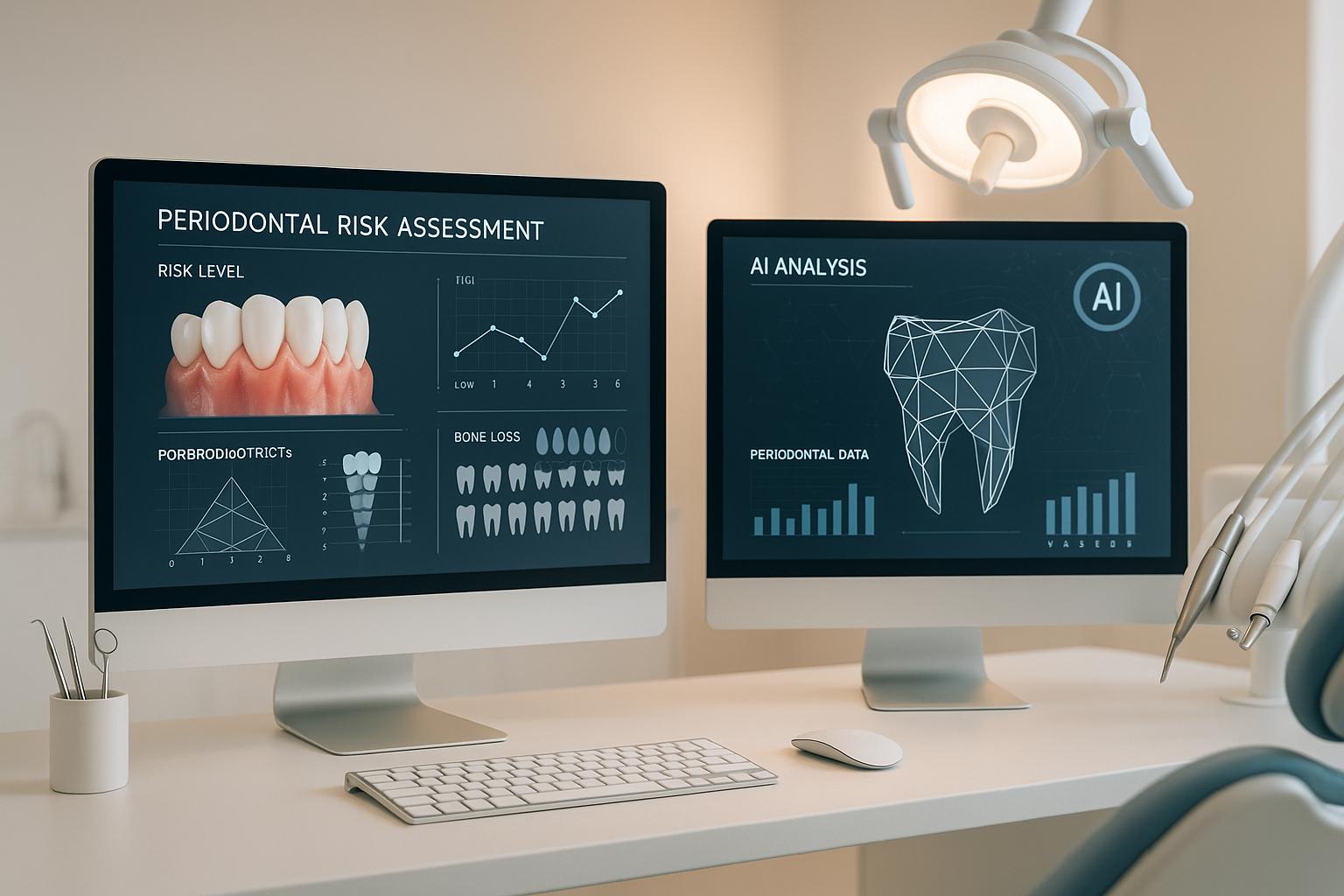
AI is reshaping dental care by offering faster, more accurate periodontal disease assessments. These tools analyse clinical data, radiographs, and patient histories to detect risks earlier and improve care efficiency. Here’s a quick overview of the key systems:
- AI-Powered Periodontal Risk Scorer: Predicts disease risk using patient data, achieving 91% sensitivity and 88% specificity. Cuts assessment time from 15 to 5 minutes.
- Deep Learning Periodontal Assessment Suite: Uses neural networks for enhanced radiographic analysis, delivering up to 91% diagnostic accuracy for bone loss detection.
- Predictive Dental AI Platform: Forecasts long-term outcomes by analysing 74 variables, outperforming older tools like PreViser in five-year risk predictions.
Each system integrates with Australian dental practices, adhering to privacy laws and boosting diagnostic precision. While the Risk Scorer is ideal for quick assessments, the Deep Learning Suite excels in image analysis, and the Predictive Platform focuses on preventive care. Balancing accuracy, usability, and compliance is key when selecting the right tool.
1. AI-Powered Periodontal Risk Scorer
The AI-Powered Periodontal Risk Scorer is designed to predict periodontal disease by combining multiple data sources with advanced machine learning techniques. This tool offers dental practices a faster and more precise way to evaluate patient risk. Let’s take a closer look at its technology, accuracy, and how it fits into clinical workflows.
Features and Technology
These systems rely on XGBoost, a powerful machine learning algorithm, to analyse both structured data (like test results and clinical measurements) and unstructured data (such as clinical notes) from electronic health records [1].
By pulling together a variety of inputs – clinical examination findings, radiographic images, patient medical and dental histories, lifestyle factors, and sometimes even genetic data – the system creates personalised risk scores tailored to each patient’s unique circumstances [1][2].
Additionally, the technology simplifies clinical decision-making by automating data entry and providing real-time scoring, which reduces manual work and improves efficiency [1].
Accuracy and Performance
The Perio-Risk Scoring System (PRSS) has shown a 70% predictive accuracy for five-year periodontal disease outcomes, outperforming other tools like PreViser (55%), PRA (35%), Phillips (35%), and Cigna (25%) [1]. Further validation studies have reinforced its strong performance, with AI-driven risk assessment tools achieving 91% sensitivity and 88% specificity in identifying high-risk cases of periodontal disease [4].
Usability and Integration
This tool isn’t just accurate – it’s also designed to integrate seamlessly into everyday dental practice. Studies conducted in postdoctoral periodontal clinics highlight that the AI-Powered Periodontal Risk Scorer fits smoothly into existing workflows. Dental professionals, including periodontal residents and practising dentists, have found the system intuitive and helpful in reducing administrative burdens [1].
One of the standout benefits is the reduction in risk assessment time – from 15 minutes down to just 5 minutes – making it a time-saving addition to clinical routines [4]. For Australian dental practices, the system is compatible with local electronic health record standards, ensuring that risk scores are generated automatically, securely stored, and meet privacy regulations [1].
2. Deep Learning Periodontal Assessment Suite
The Deep Learning Periodontal Assessment Suite takes periodontal risk assessment to the next level, leveraging advanced neural networks to analyse dental radiographs and clinical data. Unlike basic machine learning tools, it uses convolutional neural networks (CNNs) and specialised segmentation models to provide dental professionals with reliable diagnostic support. This suite builds on earlier AI innovations by offering improved imaging segmentation and seamless data integration.
Features and Technology
This suite refines radiographic analysis through deep learning, aiming to minimise subjective variability often found in manual assessments. At its core is automated radiograph analysis, powered by deep learning frameworks uniquely tailored for dental imaging. Specifically, it employs Multi-Label U-Net and Mask R-CNN models for image segmentation, with Multi-Label U-Net excelling in segmentation accuracy [2].
The system evaluates bone loss for individual teeth in accordance with the 2017 Classification of Periodontal and Peri-implant Diseases and Conditions. It processes digital radiographs in the standard DICOM format, ensuring compatibility with most dental imaging systems used in Australia [2].
Beyond imaging, it integrates clinical measurements, patient histories, and notes to deliver a thorough assessment [1][2]. Designed with privacy in mind, it adheres to local data protection laws and works seamlessly with widely used dental practice management software.
Accuracy and Performance
Thanks to its advanced segmentation models, this suite delivers consistently high diagnostic accuracy. Clinical studies report accuracy rates ranging from 85% to 91% for detecting periodontal bone loss and staging periodontitis. It achieves a sensitivity of 91% and a specificity of 88%, ensuring reliable results [2][4].
The system’s reliability is underscored by a Cohen’s kappa statistic of 0.89, reflecting strong agreement with human experts. Its margin of error for bone loss measurements is 10.69%, which aligns with current inter-observer variations among dental professionals [2][4]. By standardising measurements across cases, the suite reduces variability and enhances diagnostic consistency [2].
Usability and Integration
Designed to complement the AI-Powered Periodontal Risk Scorer, this suite significantly reduces assessment time, taking only 5 minutes per patient, while ensuring standardised measurements across practices [4]. Real-world validation, involving over 27,000 patient records, highlights its practical benefits in clinical settings [1].
The system features automated data entry and an intuitive user interface, making it user-friendly for dental teams. It integrates effortlessly with existing electronic health records, automatically generating risk scores and storing them securely in line with Australian privacy standards [1][2].
Additionally, it supports personalised treatment planning, offering tailored intervention recommendations based on each patient’s specific risk profile. This approach not only streamlines assessments but also supports evidence-based decision-making, helping dental professionals provide targeted care efficiently [2].
3. Predictive Dental AI Platform
This platform takes dental risk assessment to the next level by forecasting future periodontal outcomes. Unlike earlier tools that zeroed in on current risk factors, the Predictive Dental AI Platform uses advanced algorithms like XGBoost and CNNs to analyse vast datasets, including electronic health records, patient demographics, and clinical histories. By combining structured and unstructured data, it delivers personalised predictions about periodontal health trajectories.
Features and Technology
The platform’s standout feature is its ability to pull data from multiple sources simultaneously. Using natural language processing (NLP), it extracts valuable insights from clinical notes and combines these with radiographs and patient demographics. This comprehensive approach creates a well-rounded risk profile [1][2]. It factors in periodontal measurements, imaging, lifestyle habits, and biomarkers to build a detailed picture of patient health.
The Perio-Risk Scoring System (PRSS) showcases the platform’s predictive power by analysing 74 variables from patient records. This deep dive into data uncovers patterns and risk factors that traditional assessments might miss [1]. Additionally, it simplifies data collection by pulling information directly from existing records.
One of the platform’s key advantages is its real-time risk scoring. As new patient data gets added, the system updates its predictions instantly. This ensures dental professionals always have the most up-to-date insights into a patient’s periodontal health [1][2].
Accuracy and Performance
When it comes to accuracy, this platform outshines traditional methods. The PRSS boasts a 70% accuracy rate in predicting five-year periodontal disease outcomes, outperforming tools like PreViser (55%) and PRA (35%) [1]. Its ability to analyse complex data relationships gives it a significant edge over manual assessments.
For radiographic bone loss detection, the platform achieves diagnostic accuracies between 85% and 91%, with some implementations reaching as high as 99% accuracy for staging bone loss on periapical radiographs [2][3]. It also maintains 91% sensitivity and 88% specificity, ensuring reliable identification of patients at both ends of the risk spectrum [4].
The platform’s positive predictive value (85%) and negative predictive value (92%) further enhance its reliability, giving dental professionals confidence in its assessments. These metrics help prioritise treatments with precision, ensuring resources are allocated effectively [4].
Usability and Integration
Designed to fit seamlessly into existing workflows, the platform integrates effortlessly with practice management systems [1]. Its implementation has been validated in real-world settings, where it has improved risk prediction accuracy and enabled earlier, targeted interventions [1]. This efficiency allows dental teams to identify high-risk patients sooner and focus resources where they’re needed most.
The platform’s intuitive interface simplifies complex data analysis. Risk scores and recommendations are presented through clear visualisations, making them easy to understand for the entire dental team. Automated report generation integrates with patient records, supporting treatment planning and continuity of care [1][2].
For Australian dental practices, the platform adheres to local data privacy laws while using familiar clinical terminology and metric measurements. Its compatibility with DICOM format radiographs ensures smooth integration with standard imaging equipment commonly used in Australia [2]. Just like earlier AI tools, this platform prioritises seamless workflows and minimal disruption, making it a valuable addition to any practice.
sbb-itb-2be92ed
Advantages and Disadvantages
Choosing the right AI tool for your dental practice means weighing up the pros and cons of each option. Here’s a breakdown of the key features, limitations, and performance metrics for three leading tools:
| Tool | Key Advantages | Primary Limitations | Accuracy Performance | Clinical Integration |
|---|---|---|---|---|
| AI-Powered Periodontal Risk Scorer | 91% sensitivity and 88% specificity; reduces assessment time to 5 minutes per patient; high agreement with clinicians (Cohen’s kappa: 0.89) | Requires diverse training datasets and high-quality input data | 85% positive predictive value, 92% negative predictive value | Seamless integration with existing systems |
| Deep Learning Periodontal Assessment Suite | 85–91% diagnostic accuracy for bone loss detection; standardises measurements across clinicians; automated radiographic analysis | Needs standardised methodologies and significant computational resources | Up to 99% accuracy for staging bone loss on periapical radiographs | Automated workflow requiring staff training |
| Predictive Dental AI Platform | 70% accuracy in five-year predictions (vs PreViser 55%, PRA 35%); analyses 74 variables | Transparency concerns with complex algorithms and reproducibility challenges | Outperforms traditional tools in long-term forecasting | A complex integration requirement |
The table provides a snapshot of each tool’s performance, but how do these features translate into everyday clinical practice?
The AI-Powered Periodontal Risk Scorer stands out for its ability to streamline decision-making. By cutting down risk assessment time by 10 minutes per patient, it significantly boosts efficiency in clinical workflows [4]. Its high sensitivity and specificity make it a reliable option for quick assessments, but it does demand access to diverse, high-quality datasets to maintain accuracy.
On the other hand, the Deep Learning Periodontal Assessment Suite excels in diagnostic accuracy, particularly for detecting bone loss in radiographs. However, its performance varies depending on the imaging modality. For instance, CBCT-based models achieve 81–83% specificity but only 45–72% sensitivity, highlighting the challenges of standardisation across different imaging technologies [2][3]. Additionally, implementing this tool often requires significant investment in computational resources and staff training.
Data privacy and compliance are critical considerations, especially for Australian practices. Tools must align with the Privacy Act 1988 and AHPRA guidelines, which mandate strong encryption and clear patient consent protocols [2]. Costs also vary widely – risk scoring systems typically involve lower upfront costs but ongoing licensing fees, making them more accessible for smaller practices. In contrast, deep learning suites often require substantial initial investment in hardware and software upgrades.
The Predictive Dental AI Platform offers a broad analysis of 74 variables, enabling a detailed risk assessment. While this comprehensive approach is a strength, it also introduces challenges. Its complexity can disrupt workflows and necessitates additional staff training [1]. Moreover, its CNN-based system has a 10.69% margin of error for bone loss measurements, reflecting the inherent variability in clinical scenarios [2].
Each tool also presents unique integration challenges. Risk scoring systems generally integrate smoothly with existing electronic health record systems, while deep learning suites may require workflow adjustments to accommodate automated image analysis. Predictive platforms, with their reliance on data from multiple sources, often demand more extensive integration efforts.
For Australian practices, like Complete Smiles Bella Vista, these tools offer opportunities to enhance personalised care and adopt advanced treatment strategies while staying compliant with local regulations. However, selecting the right tool involves carefully balancing accuracy, workflow compatibility, and regulatory requirements to ensure successful implementation.
Conclusion
This analysis underscores the distinct advantages of each tool. The AI-Powered Periodontal Risk Scorer stands out as a practical option, seamlessly integrating with existing systems. It’s particularly well-suited for Australian dental practices looking to streamline workflows and achieve immediate improvements [4].
On the other hand, the Deep Learning Periodontal Assessment Suite shines in diagnostic accuracy, especially when it comes to analysing radiographs and identifying bone loss stages. Its performance in radiographic evaluation makes it a strong candidate for practices focused on precise diagnostic capabilities [2][3].
Meanwhile, the Predictive Dental AI Platform excels in long-term risk prediction. By outperforming traditional methods, it proves invaluable for clinics prioritising preventive care and patient education, offering a forward-thinking approach to dental health management [1].
In addition to functionality, regulatory compliance is a critical factor for Australian practices. Any adopted system must align with the Privacy Act 1988 and adhere to AHPRA guidelines. Opting for tools with transparent algorithms and robust clinical validation ensures informed, risk-aware decisions.
For practices like Complete Smiles Bella Vista, these tools can elevate personalised care and introduce advanced treatment strategies without disrupting existing workflows. Adopting a phased approach – starting with risk scoring systems and gradually incorporating more advanced platforms – allows clinics to build expertise over time. This strategy not only optimises patient outcomes but also ensures that AI-driven periodontal tools fulfil their primary goal: improving clinical decision-making and enhancing patient care within Australia’s dynamic digital health landscape.
FAQs
How do AI-powered tools enhance periodontal disease risk assessment in dental care?
AI-powered tools for assessing periodontal risk are transforming dental care by offering a faster and more precise way to detect potential issues. By processing extensive patient data, these tools can evaluate key factors like gum health, bone density, and past dental history, giving dentists a more detailed insight into a patient’s oral health.
These tools not only speed up the diagnostic process but also allow dentists to create tailored treatment plans based on accurate risk assessments. This personalised approach supports better long-term oral health outcomes. As this technology advances, it’s becoming an essential part of modern dental care in Australia.
What privacy factors should Australian dental practices consider when using AI tools for periodontal risk assessments?
When incorporating AI tools for periodontal risk assessments, dental practices in Australia must place a strong emphasis on patient privacy and adhere to the Privacy Act 1988 (Cth) and the Australian Privacy Principles (APPs). These laws set clear guidelines for collecting, storing, and using personal health information, ensuring that patient data is managed securely and transparently.
To meet these requirements, practices should prioritise AI tools equipped with strong data encryption and strict access controls to safeguard sensitive information. It’s equally critical to confirm that any third-party AI providers comply with Australian privacy regulations and avoid storing or processing data in countries with weaker privacy protections. Always seek informed consent from patients before using AI-based tools, providing a clear explanation of how their data will be utilised and protected.
What should dental practices consider when choosing an AI tool for periodontal risk assessment?
When choosing an AI-powered tool for periodontal risk assessment, dental practices should prioritise factors like accuracy, ease of use, and integration with existing systems. It’s essential to select tools backed by solid clinical research that deliver dependable predictions to support diagnosis and treatment planning.
The tool should be straightforward for both clinicians and support staff to operate, fitting smoothly into your current workflow. It’s also important to check if it works well with your existing dental software and provides clear, actionable insights that can guide care decisions. Don’t overlook the tool’s cost – it should align with your practice’s budget while supporting your goals for patient care.
By weighing these considerations, dental practices can choose a solution that improves patient outcomes and simplifies periodontal care.
Related Blog Posts
- AI Research in Oral Disease Detection: Key Findings
- AI in Dentistry: Predicting Periodontal Disease
- AI in Dentistry: Benefits of Personalised Oral Health Insights
- How AI Predicts Periodontal Bone Loss
Important Notice: Any surgical or invasive procedure carries risks. Before proceeding, you should seek a second opinion from an appropriately qualified health practitioner.
Individual results may vary. The information provided in this article is for educational purposes only and does not constitute medical advice.
Checkout Related Blogs




Get in touch with us
For more information, call us now to start feeling better. Or fill the form below to make appointment
The Latest News from Complete Smiles
How to Clean Clear Plastic Retainers
Checklist for Choosing Wearable Dental Devices
Checklist for Choosing Cloud AI Platforms in Dentistry

Complete Smiles Bella VistaAccepts All Major Health Funds, Including





