





How AI Predicts Periodontal Bone Loss
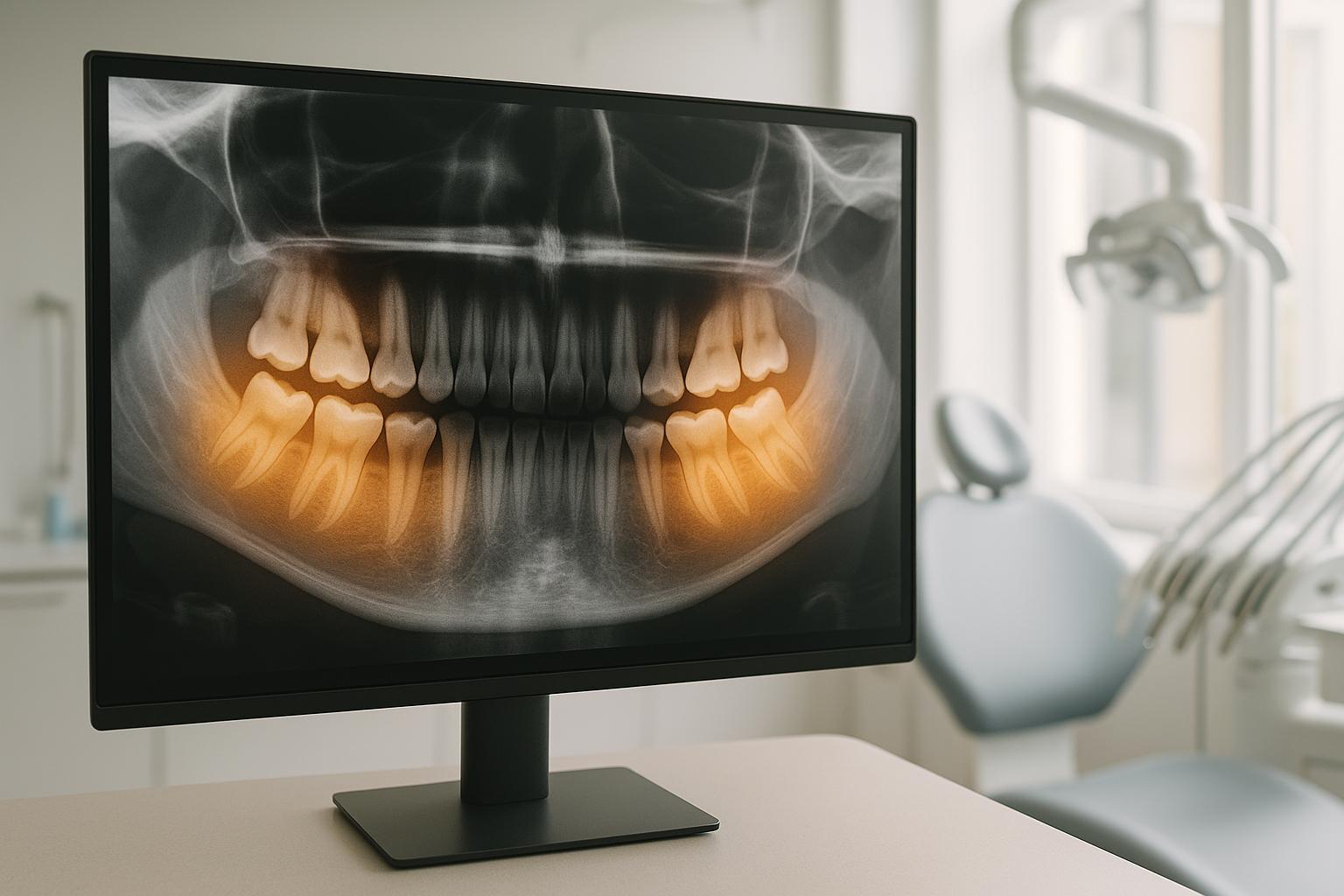
AI is transforming dental care by offering faster, more accurate ways to detect periodontal bone loss. This condition, caused by gum disease, often progresses silently until severe symptoms like tooth loss appear. Early detection is critical to prevent costly and invasive treatments. AI tools, especially deep learning models like CNNs and YOLOv8, analyse dental X-rays with impressive accuracy – up to 98% in some cases – outperforming manual methods. These systems measure bone loss and help dentists plan personalised treatments, improving patient outcomes while saving time.
Key points:
- Periodontal bone loss: Gradual damage to the bone supporting teeth, often linked to gum disease.
- AI tools: Analyse X-rays (IOPA and OPG) to detect early signs of bone loss.
- Accuracy: AI models achieve up to 98% accuracy, with high sensitivity and specificity.
- Workflow: AI processes include image acquisition, enhancement, segmentation, and measurement.
- Ethical use: In Australia, AI is regulated to ensure patient data privacy and professional oversight.
AI doesn’t replace dentists but supports them with faster, objective diagnostics. While larger clinics are leading adoption, smaller practices face challenges like cost and infrastructure. As AI evolves, it’s expected to play a bigger role in dental care beyond bone loss detection.
[IPCAI 2021] Oral: Automating Periodontal Bone Loss Measurement via Dental Landmark Localisation
Types of Dental Images Used for AI Analysis
AI relies on two main types of radiographic imaging – Intraoral Periapical Radiographs (IOPA) and Panoramic Radiographs (OPGs) – to detect and evaluate periodontal bone loss. Each method offers specific advantages, helping clinicians choose the most suitable approach for AI analysis.
Intraoral Periapical Radiographs (IOPA)
IOPA radiographs are detailed images that capture a single tooth and its surrounding bone, from the crown to the root tip. These high-resolution images make it easier to detect even subtle changes in bone levels. They focus on the alveolar bone that supports individual teeth, providing precise data for AI analysis.
AI models working with IOPA radiographs can assess both the severity and pattern of alveolar bone loss, which is vital for creating personalised treatment plans[1]. By measuring the distance between the cemento-enamel junction (CEJ) and the alveolar bone crest, these models can identify bone loss with impressive precision. This makes IOPA radiographs particularly useful for early diagnosis and targeted treatments.
Panoramic Radiographs (OPGs)
While IOPA images focus on specific teeth, OPGs provide a wide-angle view of the entire dentition and supporting bone structure in one image. This makes them ideal for assessing overall bone loss patterns across the dental arch.
A 2024 study involving 2,000 panoramic radiographs demonstrated the effectiveness of AI in analysing these images. The AI achieved 97% accuracy in teeth segmentation, with 90% sensitivity and 96% specificity. It also reached 98% accuracy and 100% sensitivity for identifying the cemento-enamel junction and bone levels[2]. These results highlight the efficiency of panoramic radiographs for large-scale screenings and monitoring disease progression over time. By examining the full dentition, AI can identify patterns and interconnections between different areas of bone loss that might be missed when focusing on individual teeth.
Consistent Imaging Protocols
For accurate AI analysis, standardised imaging protocols are essential. This includes using calibrated imaging devices and consistent acquisition techniques. Preprocessing adjustments – such as enhancing contrast, brightness, and reducing noise – also play a key role in improving image quality. These steps make it easier for AI to identify critical landmarks like the cemento-enamel junction and alveolar bone crest[2][4].
Regular calibration of imaging equipment ensures diagnostic reliability. Uniform preprocessing enhances the clarity of anatomical details, reducing variability and minimising errors in AI segmentation and measurement.
| Imaging Type | Field of View | Resolution | Primary AI Use Case | Key Strengths |
|---|---|---|---|---|
| IOPA | Single tooth/region | High | Precise bone loss quantification | High detail, localised analysis |
| Panoramic (OPG) | Full jaw | Moderate | Comprehensive assessment | Full arch overview, efficient screening |
Although advanced 3D imaging techniques like CBCT are available for complex cases, 2D radiographs remain the go-to option for AI-based periodontal bone loss analysis in Australia. They are cost-effective, involve less radiation exposure, and are widely accessible in dental practices across the country.
AI Technologies and Algorithms in Bone Loss Prediction
AI has made significant strides in analysing dental radiographs to detect periodontal bone loss. What started as basic image processing has evolved into advanced neural networks that offer rapid and consistent analysis.
Key AI Models and Techniques
Using standardised imaging protocols, modern AI systems extract detailed insights from radiographs. At the heart of these systems are Convolutional Neural Networks (CNNs), which are particularly effective for identifying subtle patterns and changes in bone structure. This makes them ideal for detecting periodontal bone loss[2].
One standout model is YOLOv8, a cutting-edge object detection tool used in dental imaging. It excels at quickly segmenting critical structures like teeth, the cemento-enamel junction (CEJ), and alveolar bone levels. A study analysing 2,000 panoramic radiographs found YOLOv8 achieved an impressive 98% accuracy, 100% sensitivity, and 98% specificity when segmenting the CEJ and bone levels[2][4]. These results highlight its potential for efficient diagnostic use.
Another widely used tool is U-Net, which focuses on semantic segmentation, offering precise pixel-level mapping of dental and bone structures. This detailed mapping is essential for accurately measuring bone loss and identifying early signs of periodontal disease[4].
Hybrid models combine the strengths of different AI techniques, such as pairing CNNs with support vector machines (SVM) or decision trees (DT). These models have shown accuracy rates between 91% and 94%, with sensitivity and specificity often exceeding 88%[3][4]. By integrating multiple approaches, hybrid models enhance diagnostic precision and reliability.
Strengths and Limitations of AI Approaches
AI systems bring several benefits to the table, including speed, consistency, and objectivity. Research shows that AI can achieve an F1 score of 75%, outperforming the clinical average of 69% among dental practitioners[3]. In addition, some studies report 91% accuracy in detecting bone destruction, demonstrating AI’s potential as a dependable diagnostic tool.
However, there are challenges. Detecting early-stage bone loss remains difficult, as subtle changes often lack sufficient contrast for reliable identification. The effectiveness of these systems also heavily depends on high-quality, annotated training data. Performance can vary with different imaging equipment or patient demographics[4].
| AI Model | Accuracy | Sensitivity | Specificity | F1 Score | Primary Strengths |
|---|---|---|---|---|---|
| CNN | 81–94% | 84–94% | 88–98% | 81–91% | Strong at recognising patterns |
| YOLOv8 | 98% | 100% | 98% | 0.90 | Real-time detection and segmentation |
| Hybrid Models | 91–94% | 90–94% | 92–98% | 0.91 | Increased precision and reliability |
AI System Workflow
AI systems follow a structured workflow to turn raw radiographic data into actionable clinical insights. It begins with image acquisition, where high-quality panoramic or intraoral radiographs are captured using calibrated equipment and standardised protocols.
Next, preprocessing enhances the images by adjusting brightness, contrast, and noise levels to highlight important anatomical features.
During the AI analysis phase, models like YOLOv8 or U-Net segment teeth, identify key structures, and map bone levels across the dental arch. These segmentation results are then converted into measurable data, such as distances between landmarks, to classify the severity of bone loss.
Finally, clinical interpretation involves dental professionals reviewing AI-generated data alongside the patient’s clinical history. This collaborative approach ensures that the diagnostics are both objective and aligned with expert clinical judgement, improving overall accuracy and reliability.
sbb-itb-2be92ed
How AI Predicts Periodontal Bone Loss: Step-by-Step
AI takes dental radiographs and transforms them into precise diagnostic insights through a structured process.
Image Acquisition and Preprocessing
Accurate AI analysis begins with capturing high-quality dental radiographs. Dental clinics use IOPA or panoramic (OPG) radiographs, ensuring they meet strict quality standards for reliable AI evaluation.
During this stage, dental professionals follow detailed protocols to minimise artefacts and maintain consistent exposure settings. In Australia, clinics like Complete Smiles Bella Vista adhere to local regulatory guidelines, ensuring both diagnostic accuracy and patient safety [2][5].
Once the images are captured, the preprocessing phase refines the raw radiographic data. Automated systems adjust brightness and contrast to highlight critical anatomical features while reducing background noise. Image normalisation ensures that radiographs from various equipment or settings maintain consistent quality for optimal AI interpretation. Noise reduction algorithms further enhance the clarity of the images, sharpening edges around teeth and bone structures. This ensures that even minor imperfections don’t interfere with accurate bone loss analysis.
These optimised images lay the groundwork for precise AI-based segmentation.
AI‑Based Image Segmentation
The segmentation phase is where AI demonstrates its technical prowess in periodontal diagnostics. Advanced models like YOLOv8 and CNNs are employed to segment key anatomical structures.
The AI focuses on three essential landmarks: individual teeth, the cementoenamel junction (CEJ), and the alveolar bone crest. Each of these requires specialised techniques to identify subtle features. For instance, the CEJ is often a faint transition zone, demanding sophisticated pattern recognition for accurate detection.
Studies have reported segmentation accuracies surpassing 97% [2]. The pixel-level maps generated during this step act as a digital blueprint, clearly marking the boundaries between healthy bone and areas showing potential loss.
This precise segmentation is crucial for the next phase, where detailed measurements and classifications are made.
Measurement, Classification, and Review
In this final phase, the AI measures the vertical distance between the CEJ and the alveolar bone crest, presenting this data in millimetres or as a percentage of root length.
These measurements are then compared to established clinical thresholds to determine the severity of bone loss. Based on the results, the AI categorises the findings into levels such as mild, moderate, or severe, helping dental professionals quickly assess the situation and plan treatment priorities.
AI systems can process and evaluate entire radiographic sets much faster than manual assessments [1][2]. Studies show these models achieve accuracy rates between 91% and 98%, with sensitivity and specificity both often exceeding 90% [2][3][4]. Results are presented through annotated images and detailed reports, pinpointing areas of concern and providing precise measurements for each affected tooth.
However, professional oversight remains vital throughout the process. Dental practitioners review AI-generated reports alongside clinical examinations, ensuring that the automated insights complement their expertise. In Australian dental practices, this collaborative approach ensures adherence to ethical and regulatory standards while leveraging AI’s capabilities.
Clinical Integration and Ethical Considerations in Australia
Australian clinics are incorporating AI tools into their practices, guided by a strict ethical and regulatory framework. Especially in dental care, this integration balances technological advancements with the need for compliance and patient-centred care.
AI Adoption in Australian Dental Practices
AI technology is gaining traction in metropolitan dental clinics across Australia, particularly in larger practices and specialist centres. These tools are used to analyse radiographs, enabling the early detection of periodontal bone loss with speed and objectivity.
By providing consistent and standardised assessments, AI supports early intervention and personalised treatment plans. Patients benefit from clearer insights into their oral health, while clinicians gain a reliable tool to track disease progression over time.
However, the adoption of AI isn’t uniform. While metropolitan clinics are leading the charge, smaller regional practices face challenges such as high costs, limited training opportunities, and inadequate infrastructure. For those that have embraced AI, the benefits are clear: improved diagnostic accuracy, streamlined workflows, and better patient engagement. Visual explanations of conditions like bone loss help patients understand their diagnoses, while faster detection supports more effective preventive care.
Regulatory and Ethical Guidelines
The integration of AI in Australian dental practices is governed by a detailed regulatory structure, overseen by the Australian Health Practitioner Regulation Agency (AHPRA) and the Dental Board of Australia. These organisations mandate that AI tools must be evidence-based, validated for clinical use, and implemented under appropriate supervision.
A critical aspect of this framework is data privacy compliance. Clinics are required to follow strict security measures, including encryption, secure storage, and controlled access to radiographic images and AI-generated reports. Adherence to the Privacy Act 1988 (Cth) is non-negotiable, and patients must be informed about the use of AI in their diagnosis.
Another cornerstone of ethical practice is informed consent. Patients need to understand how AI contributes to their diagnosis, including its strengths and limitations. Beyond compliance, ethical considerations also address algorithm biases, equitable access to diagnostic advancements, and transparent communication about AI’s role in care. These measures ensure AI remains a supportive tool, reinforcing a patient-focused approach.
Professional Oversight and Patient-Centred Care
Under these regulations, dental practitioners must ensure that AI serves as a decision-support tool, not a replacement for professional judgement. The Dental Board of Australia requires clinicians to critically assess AI outputs, integrate them with clinical findings, and take full responsibility for patient outcomes.
This approach safeguards personalised care. AI insights are combined with the clinician’s expertise, patient history, and individual circumstances to create tailored treatment plans. The technology enhances the human element of dental care rather than replacing it.
Building trust with patients is essential, and this relies on clear communication about what AI can and cannot do. Most clinicians view AI as a helpful diagnostic aid, though concerns about over-reliance and the need for ongoing validation remain. Patients, on the other hand, generally respond positively when the benefits – such as early detection and personalised care – are clearly explained.
As AI technology continues to evolve, ongoing professional development is vital. Dental practitioners must stay informed about advancements, understand the limitations of these systems, and maintain the clinical expertise needed to interpret AI results effectively. This balanced approach ensures that Australian dental practices can utilise AI’s capabilities without compromising the personalised care patients expect.
Conclusion
Tackling the challenges of early periodontal detection has always been a priority in dental care. Now, with the integration of AI, Australian dental practices are seeing faster and more precise ways to detect periodontal bone loss, pushing preventive care to new heights.
Key Takeaways
AI systems have shown they can outperform traditional manual methods in diagnosing bone loss, achieving accuracy rates between 81% and 98%, with sensitivity reaching as high as 100% [2]. These tools provide consistent, objective results and enable real-time consultation reviews. However, it’s essential to remember that AI isn’t a replacement for professional expertise. Instead, it acts as a valuable supplement to clinical judgement, ensuring compliance with regulations like those outlined by AHPRA and the Dental Board.
The potential of AI in dentistry doesn’t stop here – it’s only just beginning.
Future of AI in Dentistry
AI’s current achievements are paving the way for even more advanced diagnostic capabilities. Emerging models aim to predict disease progression, enabling proactive treatments [4].
The integration of multiple data sources – such as radiographic imaging, clinical records, patient history, and even genetic information – offers the promise of comprehensive risk assessments and tailored treatment plans [4]. Beyond periodontal care, AI is branching into areas like caries detection, orthodontic evaluations, and oral cancer screening, broadening its role in diagnostic support as these technologies continue to develop [4].
Australian clinics, like Complete Smiles Bella Vista, are already embracing these advancements. By combining AI-driven diagnostic tools with the expertise of skilled clinicians, practices can deliver precise diagnoses and effective treatments while maintaining the personal touch that defines quality dental care.
As regulatory frameworks evolve and validation studies expand to reflect Australia’s diverse population, the adoption of AI in dentistry is expected to grow rapidly. These tools are poised to become an integral part of dental practices across the country, making advanced and accessible diagnostics a reality for more Australians.
FAQs
How does AI help in predicting and diagnosing periodontal bone loss more accurately and efficiently?
AI is reshaping how dental professionals approach the diagnosis and prediction of periodontal bone loss. By analysing dental images like X-rays, AI can pick up on subtle shifts in bone density and structure – details that might escape even the most trained human eye. This means bone loss can be identified earlier and with greater precision.
Unlike traditional methods, AI-powered tools handle large amounts of data quickly and consistently, minimising the risk of human error. This not only boosts diagnostic accuracy but also speeds up the process, allowing dentists to create personalised treatment plans faster. These advancements are paving the way for improved care and better outcomes in modern dental practices.
What ethical guidelines and regulations apply to using AI in Australian dental practices?
The integration of AI into Australian dental practices must strictly follow ethical and regulatory standards to safeguard patient safety and maintain trust. This involves adhering to the guidelines established by the Dental Board of Australia and AHPRA, which focus on evidence-based care, protecting patient privacy, and ensuring informed consent.
Transparency is key when using AI tools, with dentists retaining complete accountability for all clinical decisions. Furthermore, any AI technology employed must comply with Australian laws concerning data security and patient confidentiality, ensuring that sensitive information is managed with care. By sticking to these principles, dental practices can responsibly embrace AI while keeping patient care at the forefront.
How does AI use dental X-rays like IOPA and OPG to predict periodontal bone loss?
AI tools are transforming the way dental X-rays, like intraoral periapical radiographs (IOPA) and orthopantomograms (OPG), are analysed. These images offer detailed insights into the teeth, jawbone, and surrounding structures, enabling AI algorithms to spot patterns and measure bone levels with impressive accuracy.
By analysing these radiographs, AI can uncover early signs of bone loss that might otherwise go unnoticed. This allows dentists to pinpoint periodontal issues more precisely and create customised treatment plans to support better oral health outcomes.
Related Blog Posts
- AI Research in Oral Disease Detection: Key Findings
- AI in Dentistry: Predicting Periodontal Disease
- AI in Dentistry: Benefits of Personalised Oral Health Insights
- AI vs Radiographs: Caries Detection Accuracy
Important Notice: Any surgical or invasive procedure carries risks. Before proceeding, you should seek a second opinion from an appropriately qualified health practitioner.
Individual results may vary. The information provided in this article is for educational purposes only and does not constitute medical advice.
Checkout Related Blogs




Get in touch with us
For more information, call us now to start feeling better. Or fill the form below to make appointment
The Latest News from Complete Smiles
How to Clean Clear Plastic Retainers
Checklist for Choosing Wearable Dental Devices
Checklist for Choosing Cloud AI Platforms in Dentistry
Complete Smiles Bella VistaAccepts All Major Health Funds, Including





