





Advancements in Nanocoatings for Dental Restorations

Nanotechnology is transforming dental restoration durability by addressing common issues like wear, bacterial infiltration, and polymerisation shrinkage. These ultra-thin coatings, made from materials such as nano-hydroxyapatite, silver nanoparticles, and titanium dioxide, enhance durability, aesthetics, and antibacterial properties without compromising strength. Here’s a quick breakdown of their impact:
- Durability: Materials like zirconia and silica improve toughness and wear resistance.
- Aesthetics: Nanofillers ensure restorations mimic natural teeth in translucency and polish.
- Antibacterial Benefits: Silver nanoparticles and titanium dioxide coatings combat harmful oral bacteria, reducing secondary caries and infections.
- Remineralisation: Nano-hydroxyapatite promotes tooth surface repair and biocompatibility.
- Improved Adhesion: Enhanced bond strength minimises restoration failures over time.
Recent advancements include hybrid nanocoatings, which combine organic and inorganic materials for better performance, and nanorobots capable of sealing dentine tubules, offering promising solutions for sensitivity and decay prevention. While challenges like biocompatibility and regulatory concerns remain, nanocoatings are reshaping restorative dentistry with enhanced bioactivity and functionality.
Nanocomposites & Composite Warming: How New Trends in Restoratives Lead to Better Clinical Outcomes
sbb-itb-2be92ed
Primary Nanomaterials Used in Dental Nanocoatings
When it comes to dental restorations, the choice of nanomaterials plays a key role in improving both mechanical strength and antimicrobial properties. Different materials bring unique benefits, and here’s a closer look at four commonly used options.
Silica and Zirconia Nanofillers
Silica (SiO₂) and zirconia (ZrO₂) nanofillers are widely used to enhance the structure and aesthetics of dental composites. Thanks to their nanoscale size (less than 0.8 µm), these fillers minimise light scattering, resulting in restorations that closely mimic the natural translucency of teeth [4]. Silica-coated zirconia, for instance, achieves an average bond strength of 15 MPa (dropping to 11.97 MPa after thermocycling), compared to untreated zirconia, which bonds at 8.45 MPa (6.41 MPa after thermocycling) [3]. Over time, these nanofillers disperse into smaller particles rather than detaching from the resin, maintaining a smooth and glossy surface [4].
Nano-Hydroxyapatite (nHA) Coatings
Nano-hydroxyapatite (nHA) is valued for its close resemblance to natural dental tissues. While traditional hydroxyapatite tends to be brittle, nHA particles (smaller than 100 nm) combined with matrices like ZrO₂ or SiO₂ improve strength, toughness, and wear resistance [1][4]. For example, a composite coating of 20% ZrO₂ and 80% HA offers exceptional corrosion resistance [1]. Additionally, nHA’s high surface-area-to-volume ratio supports translucency and promotes apatite deposition, aiding in the remineralisation of dental surfaces [1][4].
Silver Nanoparticles (AgNPs)
Silver nanoparticles are celebrated for their antimicrobial properties, effectively targeting oral pathogens like Streptococcus mutans (responsible for cavities), Enterococcus faecalis (linked to endodontic failures), and Porphyromonas gingivalis (associated with periodontitis) [5][8]. These nanoparticles work by attaching to bacterial cell walls, infiltrating them, and releasing silver ions that disrupt enzymes and generate reactive oxygen species [6][8]. As James Butler from the University of Plymouth explains:
"Nanoparticles act as a reservoir of ions which go on to interact intracellularly with ribosomes, nucleic acids, and enzymes, disrupting normal function." [6]
Incorporating just 1% AgNPs in dental composites significantly boosts antibacterial activity against S. mutans [8]. In endodontic treatments, a solution containing 100 ppm AgNPs has proven more effective against bacteria than a 2.5% sodium hypochlorite solution. Furthermore, dental adhesives with synthesised AgNPs retain their antibacterial properties for at least a year [7]. However, silver-based additives may cause discolouration or alter optical properties, driving research into hybrid approaches that balance aesthetics with antimicrobial effectiveness [7][8].
Titanium Dioxide (TiO₂) Nanocoatings
Titanium dioxide (TiO₂) nanocoatings offer photocatalytic antimicrobial effects, making them a valuable addition to dental restorations. Under light exposure, TiO₂ generates reactive oxygen species that combat bacterial colonisation, providing long-term protection without the aesthetic drawbacks of metallic nanoparticles. For instance, adding just 1% TiO₂ by weight to acrylic resin can increase tensile and impact strength by 7 MPa [4]. Combined with nHA, TiO₂ not only resists bacterial attacks but also supports biocompatibility and remineralisation [1]. These properties make TiO₂ especially useful for implant surfaces and restorations in patients prone to infections, as its self-cleaning ability helps reduce bacterial biofilm formation and the risk of secondary caries or peri-implantitis [1].
Research Evidence on Nanocoating Performance
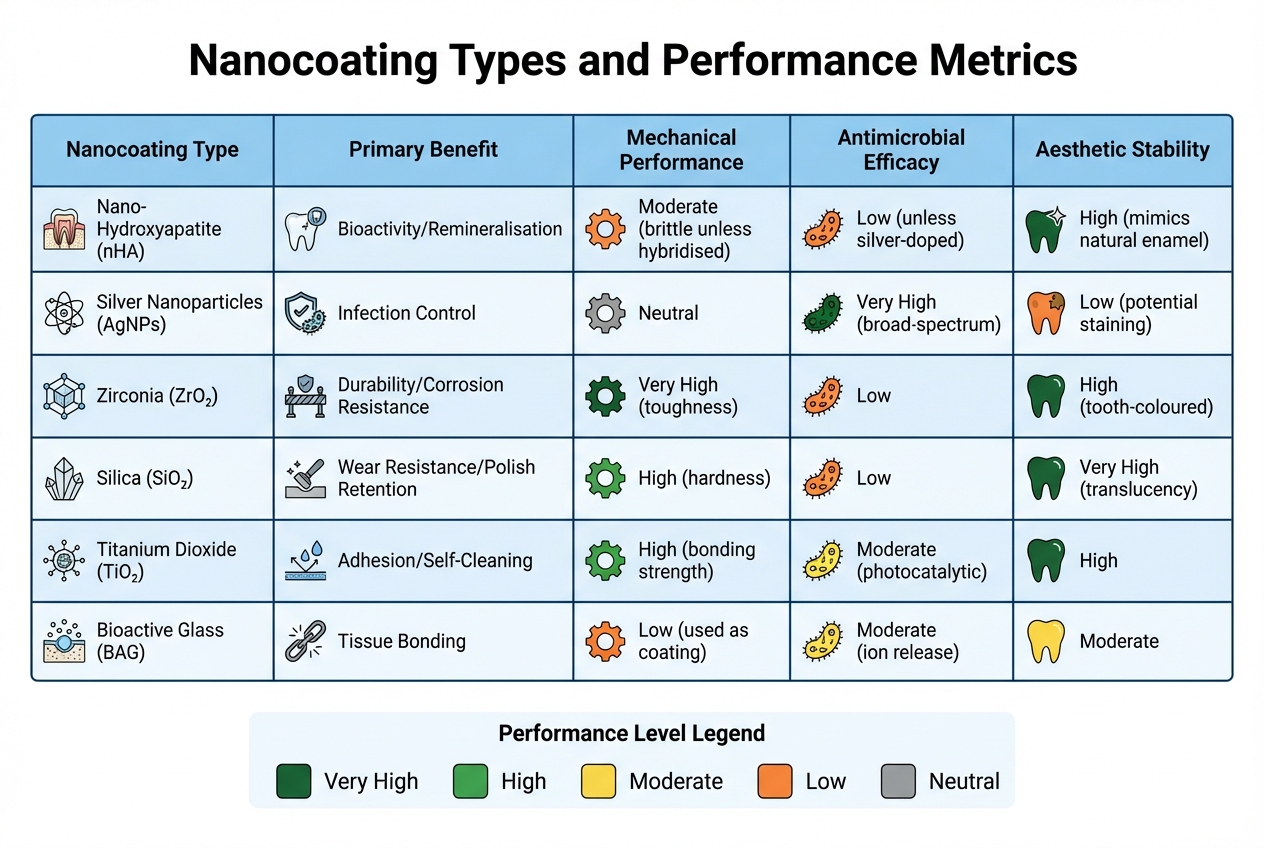
Performance Comparison of Dental Nanocoating Materials
How Nanocoatings Compare to Conventional Materials
Recent studies highlight that nanocoatings outperform traditional materials in both adhesion and antibacterial capabilities. Nanofilled composites, which utilise particles ranging from 5–75 nm and nanoclusters around 1.3 µm, exhibit a unique stress response. Instead of particles being dislodged from the resin matrix, nanoclusters break into smaller primary particles. This feature enhances mechanical reinforcement, ensuring the long-term durability of restorations [4]. This advanced stress distribution results in significantly improved bond strengths.
For instance, silica-coated zirconia achieves an average bond strength of 15 MPa, compared to 8.45 MPa for untreated zirconia. After undergoing thermocycling (a process simulating artificial ageing), silica-coated surfaces retain a bond strength of 11.97 MPa, whereas untreated zirconia drops to 6.41 MPa [3]. These improved bond strengths help minimise restoration failures and reduce the likelihood of secondary decay.
Beyond mechanical advantages, nanocoatings also demonstrate exceptional antimicrobial properties. In January 2025, researchers from the University of El Salvador tested a remineralising coating combining silver nanoparticles, chitosan gel, and fluoride varnish on 96 enamel blocks. This treatment significantly reduced laser fluorescence scores from 72.5 (indicating severe demineralisation) to just 4.75 after 168 hours, far outperforming standard fluoride varnish [9]. Similarly, experimental adhesives incorporating 0.2% amorphous calcium phosphate–polydopamine–silver nanoparticles achieved a shear bond strength of 11.89 ± 1.27 MPa, surpassing the clinical minimum of 7.8 MPa [11].
Nanocoatings also address polymerisation shrinkage by increasing filler loading. A March 2024 study conducted at the Agharkar Research Institute demonstrated that coatings applied via DC sputtering achieved 100% antibacterial activity against periodontal pathogens like Porphyromonas gingivalis over 21 days, all while maintaining biocompatibility [10].
Table: Nanocoating Types and Performance Metrics
The table below outlines the performance characteristics of various nanocoating types.
| Nanocoating Type | Primary Benefit | Mechanical Performance | Antimicrobial Efficacy | Aesthetic Stability |
|---|---|---|---|---|
| Nano-Hydroxyapatite (nHA) | Bioactivity/Remineralisation | Moderate (brittle unless hybridised) | Low (unless silver-doped) | High (mimics natural enamel) |
| Silver Nanoparticles (AgNPs) | Infection Control | Neutral | Very High (broad-spectrum) | Low (potential staining) |
| Zirconia (ZrO₂) | Durability/Corrosion Resistance | Very High (toughness) | Low | High (tooth-coloured) |
| Silica (SiO₂) | Wear Resistance/Polish Retention | High (hardness) | Low | Very High (translucency) |
| Titanium Dioxide (TiO₂) | Adhesion/Self-Cleaning | High (bonding strength) | Moderate (photocatalytic) | High |
| Bioactive Glass (BAG) | Tissue Bonding | Low (used as coating) | Moderate (ion release) | Moderate |
How Nanocoatings Are Used in Restorative Dentistry
Nanocoatings in Dental Composites
Nanocoatings play a key role in enhancing dental composites, using either top-down methods (breaking particles into smaller sizes) or bottom-up approaches (building structures atom by atom). These nanoparticles, typically between 5–100 nm in size, are embedded in resin matrices like Bis-GMA, TEGMA, and UDMA, closely mimicking the enamel’s natural hydroxyapatite content (96%) [12].
The mechanical advantages are noteworthy. For instance, adding just 1% titanium dioxide nanoparticles can improve tensile and impact strength by approximately 7 MPa. Similarly, bimodal mesoporous silica fillers can support filler loads up to 60%, compared to 35% for unimodal fillers, which significantly enhances durability and reduces shrinkage during polymerisation.
Beyond mechanical improvements, nanocoatings bring additional benefits. Silver nanoparticle-doped hydroxyapatite nanowires strengthen the bond between filler particles and the resin matrix while offering antibacterial protection. Meanwhile, introducing 1% quaternised copolymer-functionalised nanodiamonds helps prevent biofilm formation without harming the tooth structure [12]. These advancements also improve materials like glass ionomer cements and sealants, addressing their natural brittleness.
Glass Ionomers and Sealants with Nanocoatings
Nanocoatings extend their utility to glass ionomer cements (GICs) and dental sealants, enhancing both strength and antibacterial properties. A study by Ashour et al. (Oct 2022) demonstrated that incorporating 0.5% silver nanoparticles into GC Fuji IX GP, a Type II restorative GIC, increased compressive strength to 45.9 MPa compared to 44.2 MPa for the control. These modified cements also created inhibition zones of 24 mm against Staphylococcus aureus and 20 mm against Streptococcus mutans within 24 hours [13].
Higher concentrations of silver nanoparticles, such as 5%, can further boost compressive strength to about 150 MPa (up from 117 MPa for unmodified cement) and improve microhardness from 56.6 VHN to 90.4 VHN. Silica nanofillers, approximately 40 nm in size, improve wear resistance, surface polish, and reduce the initial setting time. Adding 5% halloysite nanotubes enhances compressive strength, hardness, and wear resistance, though it slightly decreases fluoride release [13][14].
However, there are limitations. High concentrations of silver nanoparticles or multi-walled carbon nanotubes may cause noticeable colour changes (ΔE > 3.3), restricting their use in visible restorations. Additionally, while low levels of silver nanoparticles enhance mechanical properties, exceeding 0.4% can negatively affect bonding with primary dentine [13].
Nanocoatings for Implant Surfaces
Nanocoatings are also applied to dental implant surfaces using methods like layer-by-layer self-assembly, anodisation to create TiO₂ nanotubes, and atomic layer deposition [15][17][18]. These nanoscale modifications mimic the natural extracellular matrix, encouraging faster bone formation and improved blood vessel growth around the implant.
Nano-hydroxyapatite coatings, for example, have shown impressive clinical results. Implants with these coatings achieved around 50% bone-to-implant contact within two weeks, compared to 30% for traditional double acid-etched surfaces [16]. Such advancements support quicker osseointegration, allowing for immediate loading protocols. As Zar Chi Soe from Chulalongkorn University’s Faculty of Dentistry explained:
"Nanoscale modifications displayed unique properties which could significantly enhance the properties of dental implants and further accelerate revascularisation, and osseointegration whilst facilitating early implant loading" [15].
Combining zinc oxide and hydroxyapatite nanoparticles in coatings can eliminate about 60% of Staphylococcus aureus bacteria on implant surfaces. Additionally, excimer laser surface modification on Ti-6Al-4V alloys has been shown to increase corrosion resistance by up to seven times. These nanocoated surfaces improve early protein adsorption and osteoblast adhesion – critical factors during the healing process [15][17][18][19]. These benefits are especially important during the first 2–6 weeks post-implantation, particularly in cases involving low-density bone or immediate loading scenarios [15][17][18][19].
Emerging Developments in Dental Nanocoatings
Building on earlier discussions about improved mechanical and antibacterial properties, recent advancements are expanding how nanocoatings are applied in dentistry.
Progress in Hybrid Nanocoatings
Hybrid nanocoatings combine organic polymers with inorganic materials to address the limitations of single-component coatings. These systems use flexible organic polymers – like chitosan, collagen, and polycaprolactone (PCL) – blended with sturdy inorganic materials such as hydroxyapatite, bioactive glass, and titanium dioxide. This combination helps mitigate the brittleness of pure ceramics while reinforcing the mechanical weaknesses of polymers [1].
A study from January 2025 demonstrated the potential of such hybrids. By combining silver nanoparticles, chitosan gel, and fluoride varnish, researchers significantly improved enamel remineralisation. Laser fluorescence values dropped from 72.5 to just 4.75 within 168 hours, restoring the calcium–phosphorus balance [9]. Similarly, for corrosion resistance, hybrid coatings of hydroxyapatite and zirconia performed best at a 20% zirconia to 80% hydroxyapatite ratio [1].
These advancements reflect the broader growth in nanodentistry technologies.
Market Growth and Industry Insights
The global nanodentistry market was valued at US$838.53 million in 2022 and is projected to grow at an annual rate of 10.2%, reaching US$1.8 billion by 2030. This growth is propelled by an ageing population and rising dental tourism, particularly in the Asia Pacific region. Australia and its neighbouring countries are expected to lead this expansion, with a forecasted annual growth rate of 11.0% through 2030 [20].
Among materials, nano fillers are emerging as a standout segment, with a projected growth rate of 10.8%. As of 2022, tooth restoration accounted for the largest application share, contributing 35.2% of the market’s revenue [20].
Nanorobots in Restorative Dentistry
Nanotechnology is also making strides beyond coatings, particularly with nanorobotic systems aimed at therapeutic applications. In February 2026, researchers from the Indian Institute of Science and Theranautilus introduced magnetic nanorobots, nicknamed "Calbots." These 400-nanometre robots, constructed from calcium silicate bioceramics, can penetrate 300–500 micrometres into human dentine tubules. Guided by external magnetic fields, they successfully sealed tubules in animal trials, allowing mice with dental sensitivity to drink cold water without discomfort after just a 20-minute treatment [22]. Co-founder Shanmukh Peddi shared:
"We didn’t want to create a slightly better version of what already exists. We wanted a technology that solved a real problem in a way that no one had tried before" [22].
Looking ahead, nanorobots could revolutionise dentistry with applications like precision drug delivery, targeted plaque removal, and even regenerative microsurgery at the cellular level. However, challenges such as biocompatibility, navigating the oral cavity, and the lack of unified global regulatory standards remain significant hurdles [21].
Conclusion
Nanocoatings are reshaping the landscape of dental restorations. By integrating materials like nano-hydroxyapatite, silver nanoparticles, and bioactive glass, these coatings tackle challenges such as polymerisation shrinkage, secondary caries, and wear. This progress highlights a broader shift from using passive materials to adopting active, biologically engaging systems, as discussed throughout this article.
The move from biopassive to bioactive dentistry represents a major leap forward. Instead of merely substituting lost tooth structure, modern nanocoatings actively promote remineralisation and biological integration. As Murtada A. Ahmed explains:
"Nanotechnology has catalysed a shift from biopassive to bioactive dentistry, solving the critical failures of polymerization shrinkage, secondary caries, and mechanical wear" [2].
This bioactive focus is paving the way for cutting-edge restorative solutions.
Looking ahead, the field is advancing beyond basic material enhancements. Emerging technologies, such as smart systems that release protective ions during acid exposure and AI-guided 3D bioprinting for tailored restorations, hold immense potential. These innovations could redefine how dentistry approaches restoration.
However, further research is essential to confirm long-term effectiveness, establish standardised protocols, and address issues like biocompatibility and regulatory hurdles. The ultimate aim is to progress from prosthetic replacements to fully regenerating biological teeth, transforming the future of restorative dental care.
FAQs
Are nanocoatings safe in the mouth long-term?
Research indicates that nanocoatings in dentistry are typically safe and compatible with biological tissues, even over extended periods. Studies have shown that these coatings can improve the durability of dental materials and help minimise bacterial adhesion, all without causing notable side effects. This progress holds potential for enhancing the success of dental restorations while adhering to strict safety protocols.
Will nanocoatings change the colour or look of my filling or crown?
Nanocoatings are crafted to boost the durability and wear resistance of dental restorations, all while preserving their natural colour and appearance. These specialised coatings help fillings and crowns stay looking natural, offering extended lifespan without compromising aesthetics.
Which dental restorations can use nanocoatings (fillings, sealants, implants)?
Nanocoatings are used in dental restorations, including fillings, crowns, bridges, and implants. These coatings enhance key properties such as wear resistance, durability, and antibacterial capabilities, which help extend the lifespan and improve the performance of dental materials.
Related Blog Posts
- Nanomaterials in Dentistry: Wear Resistance Explained
- How Hybrid Coatings Improve Osseointegration
- How Nanotechnology Improves Dental Restoration Durability
- How Surface Coatings Prevent Implant Corrosion
Important Notice: Any surgical or invasive procedure carries risks. Before proceeding, you should seek a second opinion from an appropriately qualified health practitioner.
Individual results may vary. The information provided in this article is for educational purposes only and does not constitute medical advice.
Checkout Related Blogs




Get in touch with us
For more information, call us now to start feeling better. Or fill the form below to make appointment
The Latest News from Complete Smiles
How to Clean Clear Plastic Retainers
Checklist for Choosing Wearable Dental Devices
Checklist for Choosing Cloud AI Platforms in Dentistry

Complete Smiles Bella VistaAccepts All Major Health Funds, Including





