





How Surface Coatings Prevent Implant Corrosion
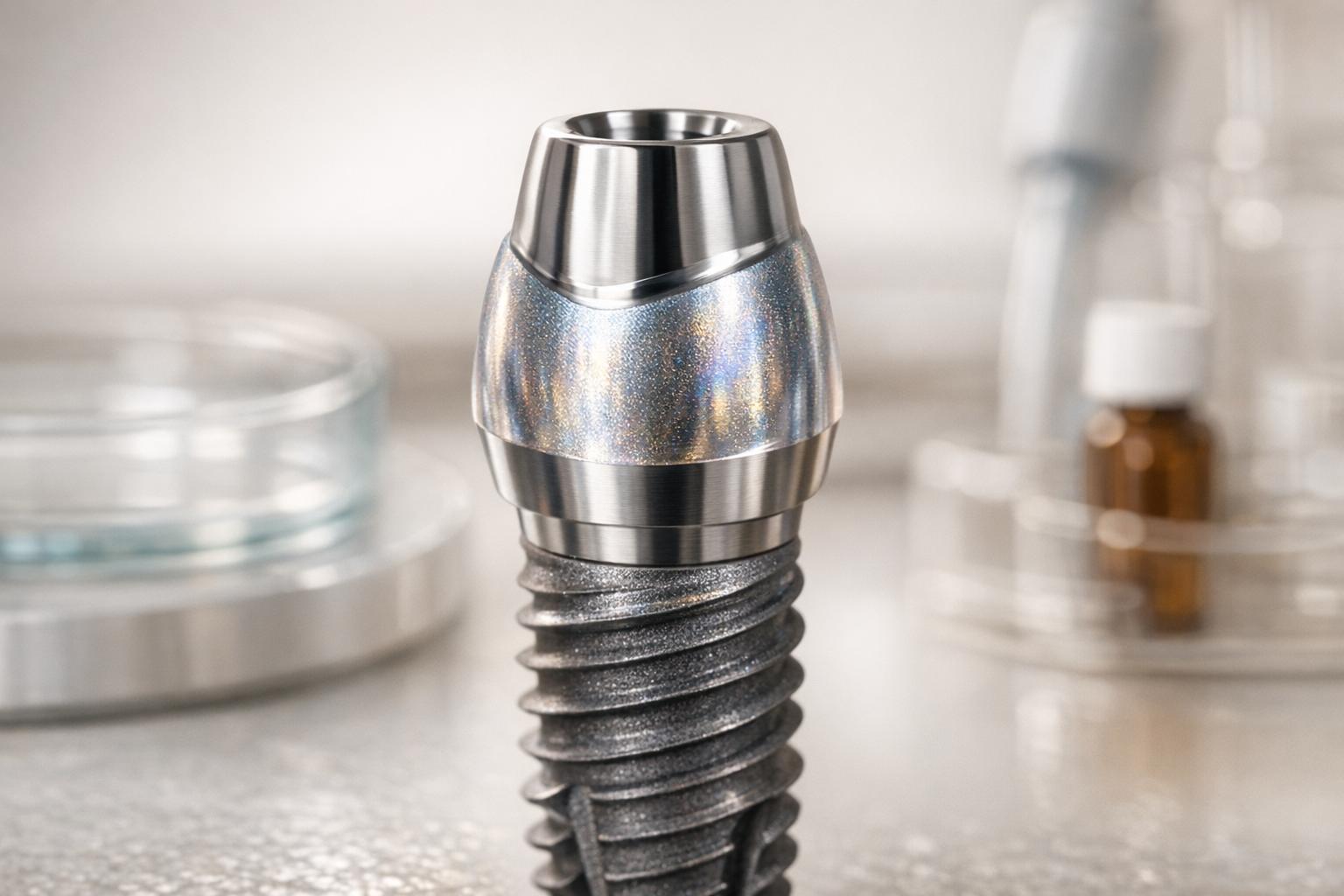
Dental implants, often made from titanium, are durable but face challenges in the oral environment. Factors like saliva (an electrolyte), pH changes, bacterial biofilms, and chewing wear down the natural oxide layer that protects titanium. Corrosion releases metal ions, which can lead to inflammation, bone loss, and implant failure. Surface coatings address these issues by:
- Strengthening Protection: Coatings like titanium nitride (TiN) or hydroxyapatite form stronger barriers than titanium’s natural oxide layer, resisting corrosion and wear.
- Reducing Bacterial Growth: Antimicrobial coatings (e.g., silver, zinc) prevent biofilm formation, a key cause of implant degradation.
- Improving Longevity: Coatings enhance bone integration and reduce risks of loosening or peri-implantitis, improving success rates.
Coating methods like plasma spraying, PVD, and anodisation create durable, corrosion-resistant layers tailored to the implant’s needs. These advancements ensure implants last longer and perform reliably in the challenging oral environment.
How Surface Coatings Protect Dental Implants from Corrosion
What Causes Corrosion in Dental Implants
How the Oral Environment Affects Implants
Dental implants face challenging conditions in the mouth, where they are exposed to factors that promote corrosion. Saliva acts as an electrolyte, making it easier for corrosion to occur. Consuming acidic foods and drinks can lower the oral pH, creating an environment that attacks the implant surface [9].
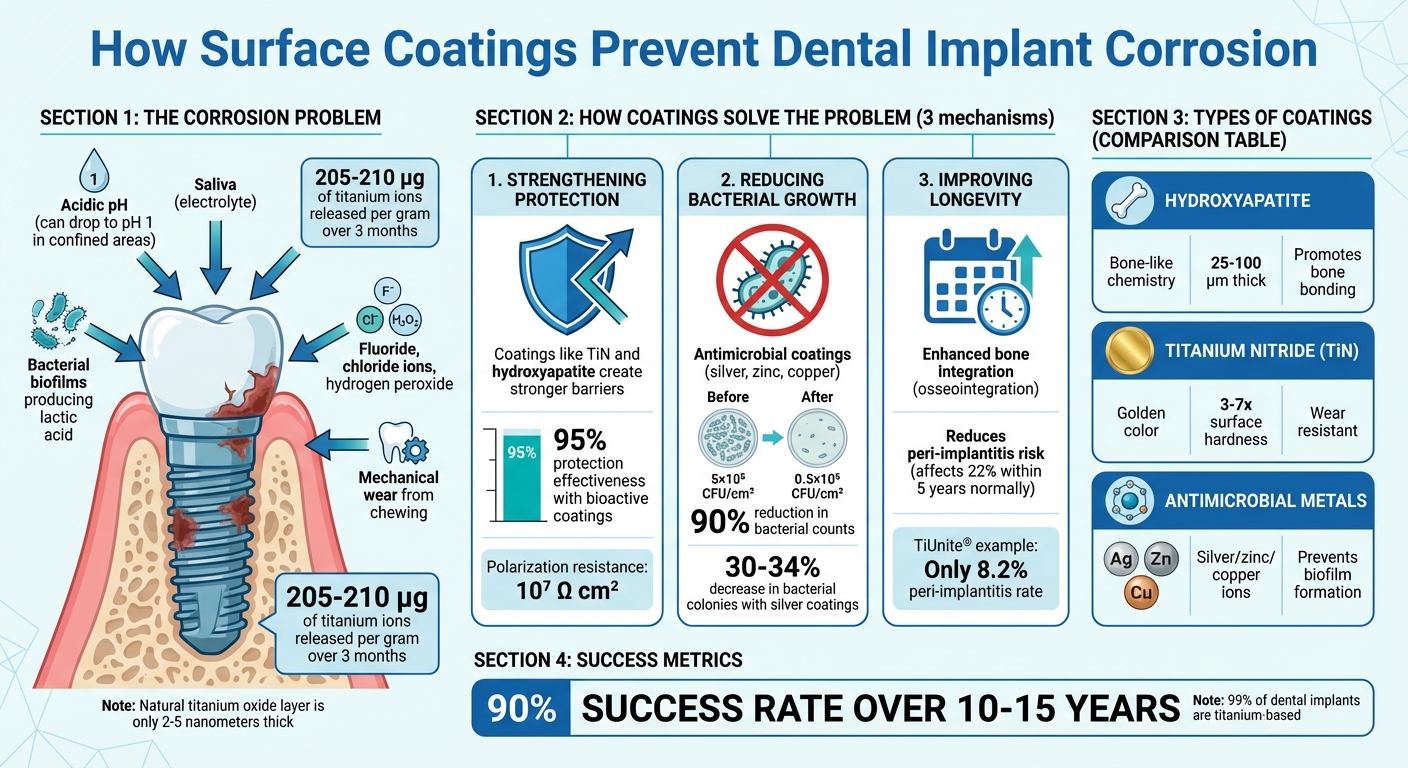
Bacterial biofilms also pose a serious threat. These biofilms produce organic acids, such as lactic acid, when breaking down sugars. This effect is particularly intense in confined areas, like the junction between the implant and the abutment, where the pH can drop drastically – sometimes as low as 1 [9].
"In these restricted contacting areas, physiological fluid will become acidic, due to the presence of free H ions in the medium. When H ions are free to interact with electrons, the pH drops significantly, and active metal dissolution can occur." – Danieli C. Rodrigues, Department of Bioengineering, University of Texas at Dallas [9]
Other factors, like fluoride in toothpastes, chloride ions, and hydrogen peroxide, can weaken titanium’s protective layer. Inflammatory conditions such as peri-implantitis further worsen the situation by creating an acidic environment that accelerates oxidation and damages the oxide film permanently [9].
A study from November 2013 highlighted the extent of this damage, documenting a 4.8 mm titanium implant removed after just four weeks of severe inflammation. The implant showed visible pitting and discolouration caused by a rapid bacterial-induced acid attack [9].
These findings highlight the importance of understanding how titanium’s natural defences work to combat corrosion.
Titanium’s Natural Oxide Layer
Titanium naturally forms a thin 2–5 nm titanium dioxide (TiO₂) layer that acts as a shield against oxidation. However, this protective layer has its limitations. Its amorphous structure and inherent defects make it vulnerable to aggressive electrolytes and low oxygen levels in the body. When combined with mechanical stress, these factors expose the titanium to corrosion.
| Environmental Factor | Effect on Titanium Oxide Layer |
|---|---|
| Neutral pH (7.4) | Maintains stability and allows the TiO₂ layer to reform. |
| Acidic pH (< 4.0) | Leads to active dissolution and disrupts bone integration. |
| Fluoride Exposure | Creates soluble compounds that replace the stable TiO₂ layer. |
| Mechanical Loading | Accelerates the removal of the protective layer. |
Chewing and micromovements add another layer of stress, causing tribocorrosion – where mechanical wear speeds up the loss of the oxide layer. Over three months of normal use, each gram of an implant can release around 205–210 µg of titanium ions and particles into the surrounding bone [10].
"The corrosive process can lead to permanent breakdown of the oxide film, which, besides releasing metal ions and debris in vivo, may also hinder re-integration of the implant surface with surrounding bone." – Danieli C. Rodrigues, Department of Bioengineering, University of Texas at Dallas [9]
Sol-gel Coating Technology: A Tool for Long-Term Implants Lifetime Improvement
How Surface Coatings Prevent Corrosion
Surface coatings enhance titanium’s natural oxide layer, offering stronger protection against the harsh environment of the mouth. These specialised coatings work in two main ways: by creating tougher physical barriers and by actively stopping bacterial growth that leads to corrosion.
Creating Protective Barriers
Engineered coatings act as a dense shield, boosting the protection provided by titanium’s natural 5-nanometre oxide layer. Techniques like anodisation and passivation significantly thicken and stabilise this layer [2].
The results of these coatings are impressive. For example, bioactive Vitamin D3 coatings, which combine physical protection with properties that aid bone integration, have shown a polarisation resistance of about 10⁷ Ω cm². This means they provide around 95% protection from corrosive attacks in artificial saliva [4]. The key lies in the compact, well-organised structure of these coatings, which blocks corrosive ions from reaching the metal surface.
"The bioactive coating effectively prevented a corrosive attack on the underlying titanium (polarization resistance in order of 10⁷ Ω cm²) with ~95% protection effectiveness." – MDPI Coatings [4]
Other coatings, such as Titanium Nitride (TiN) and Diamond-Like Carbon (DLC), offer additional benefits. These ceramic barriers minimise the release of metallic ions into surrounding tissues, reducing inflammation and the risk of implant loosening. They also provide chemical resistance to acidic or alkaline conditions commonly found in the mouth. Some passivation treatments even allow the oxide layer to self-heal after minor mechanical damage, ensuring long-term durability [11].
This strong physical protection works hand-in-hand with methods that actively prevent bacterial growth.
Preventing Bacterial Growth
Antimicrobial coatings play a critical role in countering biofilm-induced acidity, which accelerates corrosion. Coatings made with metals like silver, zinc, or copper release ions that generate reactive oxygen species (ROS). These ROS create oxidative stress, breaking down bacterial cell membranes and stopping their growth [12].
The impact is clear. A 2024 study by Mathew et al. found that traditional sand-blasted and acid-etched implants had over 5 × 10⁵ colony-forming units (CFU) of bacteria per cm². In contrast, nano-textured implants reduced bacterial counts to 0.5 × 10⁵ CFU/cm² – an impressive 90% reduction [12]. Additionally, silver-coated implants showed a 30% to 34% decrease in bacterial colonies compared to untreated surfaces [12].
Superhydrophilic surfaces take a different approach by altering surface energy, making it harder for bacteria to attach in the first place. Unlike organic coatings that can wear off, antibacterial metals retain their properties throughout the material’s lifespan [12]. This combination of reducing bacterial attachment and limiting corrosion significantly extends the longevity of implants.
Types of Surface Coatings for Dental Implants
Surface coatings play a crucial role in enhancing the durability of dental implants by providing a physical barrier and reducing bacterial activity. Manufacturers typically rely on three main types of coatings, each designed to address specific challenges related to corrosion. These coatings differ in their chemical make-up, protective properties, and how they interact with bone tissue and bacteria.
Hydroxyapatite Coatings
Hydroxyapatite (HA) coatings are chemically similar to the inorganic structure of human bone (Ca₁₀(PO₄)₆(OH)₂), making them highly effective for promoting direct bonding with bone tissue. They also shield the titanium core of the implant from corrosive body fluids, reducing the release of potentially harmful metallic ions[8][5].
The thickness of the HA coating is a critical factor in its effectiveness. Plasma-sprayed HA coatings, which range between 25 and 100 micrometres, offer strong protection. However, coatings thicker than 150 micrometres may develop micro-cracks, compromising their integrity[8]. Alternatively, sol-gel methods produce thinner, more uniform coatings (as thin as 0.05 micrometres and up to 15 micrometres). These coatings require heat treatment at temperatures between 375°C and 500°C to stabilise the layer and avoid thermal cracking during application[8].
Titanium Nitride Coatings
Titanium nitride (TiN) coatings form a golden-coloured, hardened surface layer that provides excellent resistance to both mechanical wear and chemical degradation[13]. These coatings are specifically effective against tribocorrosion, which involves the combined effects of mechanical forces from chewing and chemical attacks from saliva[1][5].
TiN coatings not only enhance the biocompatibility of the implant but also perform well under acidic oral conditions, reducing abrasive wear caused by mastication. This makes them particularly durable, especially under high occlusal forces, where mechanical stress is significant.
Antimicrobial Metal Ion Coatings
Antimicrobial coatings incorporate ions such as silver, copper, or zinc to combat bacterial growth. These ions are released gradually, preventing biofilm formation – a major contributor to peri-implantitis[3][5]. This approach is vital, as bacterial infections account for nearly 20% of dental implant failures[5].
The challenge lies in maintaining the right ion concentration: it must be sufficient to inhibit bacterial activity without harming surrounding healthy tissues[5]. Striking this balance is essential for the long-term success and safety of implants.
sbb-itb-2be92ed
Methods for Applying Surface Coatings
The way a surface coating is applied plays a crucial role in determining its durability, cost-efficiency, and protective qualities. Here’s a closer look at some commonly used techniques.
Plasma Spraying and Physical Vapour Deposition (PVD)
Plasma spraying is a widely used method, especially for applying thick bioactive coatings. It works by injecting materials like hydroxyapatite or titanium into a plasma torch that can reach temperatures as high as 10,000 K[8]. The material melts instantly and is sprayed onto the surface, creating a porous coating about 30 micrometres thick[5]. This technique is fast and relatively economical, making it a popular choice. Notably, plasma-sprayed hydroxyapatite has been approved by the US-FDA[15]. However, extreme temperatures exceeding 5,000°C can lead to material decomposition or micro-cracks in coatings thicker than 150 micrometres[8].
On the other hand, physical vapour deposition (PVD), particularly magnetron sputtering, involves vaporising the coating material in a vacuum chamber. The vaporised material condenses onto the surface as argon ions knock molecules free from the target material[15]. This method produces a dense, durable coating with excellent adhesion strength, often exceeding the US-FDA standard of 50 MPa. PVD is particularly effective for applying hard coatings like titanium nitride, which can enhance surface hardness by three to seven times. However, it’s a slower and more expensive process compared to plasma spraying[15].
Electrochemical Anodising
Electrochemical anodising is another important technique, designed to enhance the natural oxide layer on titanium. By anodising in an acidic electrolyte such as H₂SO₄ or H₃PO₄, the oxide layer is thickened from its usual 2–5 nanometres to a sturdier, microporous structure[5].
A more advanced version of this process, known as plasma electrolytic oxidation (PEO) or microarc oxidation, takes things a step further. By applying voltages that exceed the dielectric breakdown of the oxide layer, plasma microdischarges are generated. These create a hard, porous bioceramic coating with improved resistance to wear and corrosion[22,23]. A notable example is the TiUnite® implant from Nobel Biocare, introduced in 2000. This was the first commercially successful PEO-coated dental implant, showing excellent long-term performance, with only 8.2% of implants affected by peri-implantitis[8,22]. Additionally, this process can incorporate bioactive elements like calcium and phosphorus directly from the electrolyte in a single step. However, ensuring the mechanical stability of the anodic layer remains a challenge[5].
These advanced coating methods significantly enhance the durability and functionality of implants, helping them withstand the demanding conditions of the oral environment.
How Surface Coatings Extend Implant Lifespan
Surface coatings play a key role in addressing common causes of implant failure, such as corrosion, bacterial infections, and poor bone integration. By forming a protective barrier, these coatings prevent biological fluids from causing degradation. They also minimise ion leakage, which can lead to inflammation and bone loss [16][6]. This dual action not only shields implants from corrosion but also creates a favourable environment for better integration with surrounding bone.
The improvements in clinical outcomes are striking. Bioactive coatings, like hydroxyapatite, encourage faster bone ingrowth by mimicking the natural chemistry of bone. This creates a chemical bond that enhances implant stability [16][7]. As a result, the risk of implant loosening over time is significantly reduced. Additionally, antimicrobial coatings prevent bacterial colonisation and biofilm formation – key factors behind peri-implantitis, which affects 22% of patients within five years [18].
The importance of strong integration is underscored by Guang Zhu:
"The ability of an implant to achieve osseointegration to a large extent determines its long‐term success in the body." – Guang Zhu, Research Centre for Human Tissues & Organs Degeneration [16]
Recent innovations are further extending implant lifespans. For instance, Vitamin D₃ coatings have shown promising results, reducing the incidence of peri-implantitis and enhancing durability. These coatings provide about 95% protection against corrosion in artificial saliva, with polarisation resistance reaching 10⁷ Ω cm² [4]. Long-term studies on the TiUnite® implant from Nobel Biocare revealed that only 8.2% of cases experienced peri-implantitis [5][14]. Hydrophilic surface modifications also stand out, achieving significantly higher bone-to-implant contact percentages compared to traditional machined surfaces. This leads to faster healing and improved initial stability [17].
Smart coatings are now taking things a step further by combining bone growth promotion with infection prevention. For example, nanotopography techniques are used to create TiO₂ nanotubes, which act as reservoirs for controlled drug release. These coatings not only fight infection but also maintain structural integrity. Such advancements ensure that implants can endure the harsh oral environment – characterised by both chemical and mechanical stress – for many years without compromising their performance.
Conclusion
Surface coatings are essential for shielding dental implants from the harsh conditions within the oral cavity. By creating a protective barrier, they help minimise the release of potentially harmful ions, such as nickel, aluminium, and vanadium, into surrounding tissues [6][8]. This is particularly relevant since nearly 99% of today’s dental implants are made from titanium or titanium alloys [1].
Beyond protection, these coatings contribute to the impressive success rates of modern implants – about 90% over a span of 10–15 years – by improving osseointegration and reducing the risk of peri-implantitis [5].
Advancements like smart coatings with controlled drug release and nanotextured surfaces designed to encourage bone cell attachment further boost implant durability. These features help combat bacterial growth while ensuring implants can endure years of chewing, chemical exposure, and biological stress without losing their structural integrity or function.
These developments highlight the resilience and dependability of modern dental implants, offering reassurance about their long-term performance.
FAQs
How do surface coatings help protect dental implants from corrosion?
Surface coatings like hydroxyapatite, titanium dioxide (TiO₂), or polymer-based layers create a protective shield on dental implants. This shield helps prevent corrosion, limits the release of metal ions, and improves resistance to wear. Beyond protection, these coatings also encourage stronger integration between the implant and the surrounding bone, boosting stability and potentially increasing the implant’s longevity.
By offering protection against corrosion and aiding bone integration, these coatings are essential for preserving the durability and functionality of dental implants over the long term.
How do antimicrobial coatings protect dental implants from corrosion and infection?
Antimicrobial coatings on dental implants play a crucial role in preventing infections and protecting the implants from corrosion. These coatings work by creating a surface that makes it harder for bacteria to stick and form biofilms – both of which are major contributors to implant-related infections like peri-implantitis. By keeping bacterial growth in check, these coatings help implants achieve stable osseointegration, which is vital for their long-term success.
Advanced coatings, such as titanium dioxide nanocomposites or silver-based films, offer even more benefits. They not only fight bacteria but also improve corrosion resistance by reducing the release of metal ions. This dual action promotes healthier tissue around the implant and helps extend its lifespan. Dental clinics across Australia often incorporate these cutting-edge coatings into their implant procedures, ensuring patients receive treatments backed by the latest research and technology.
Why is titanium nitride used in coatings for dental implants?
Titanium nitride is widely used as a coating for dental implants due to its ability to create a tough, corrosion-resistant layer. This layer not only boosts the implant’s durability but also helps limit wear and reduces the release of metal ions, ensuring the implant stays compatible with the surrounding tissues.
By shielding the implant from corrosion and wear, titanium nitride plays a key role in enhancing the performance and lifespan of dental implants, making it a dependable option for long-term success.
Related Blog Posts
- Electrochemical Deposition for Titanium Implants
- How Hybrid Coatings Improve Osseointegration
- Wear-Resistant Coatings for Dental Implants: Overview
- Advances in Biocompatible Implant Coatings
Important Notice: Any surgical or invasive procedure carries risks. Before proceeding, you should seek a second opinion from an appropriately qualified health practitioner.
Individual results may vary. The information provided in this article is for educational purposes only and does not constitute medical advice.
Checkout Related Blogs




Get in touch with us
For more information, call us now to start feeling better. Or fill the form below to make appointment
The Latest News from Complete Smiles
How to Clean Clear Plastic Retainers
Checklist for Choosing Wearable Dental Devices
Checklist for Choosing Cloud AI Platforms in Dentistry

Complete Smiles Bella VistaAccepts All Major Health Funds, Including





