





How Heat Affects Bioceramic Sealers
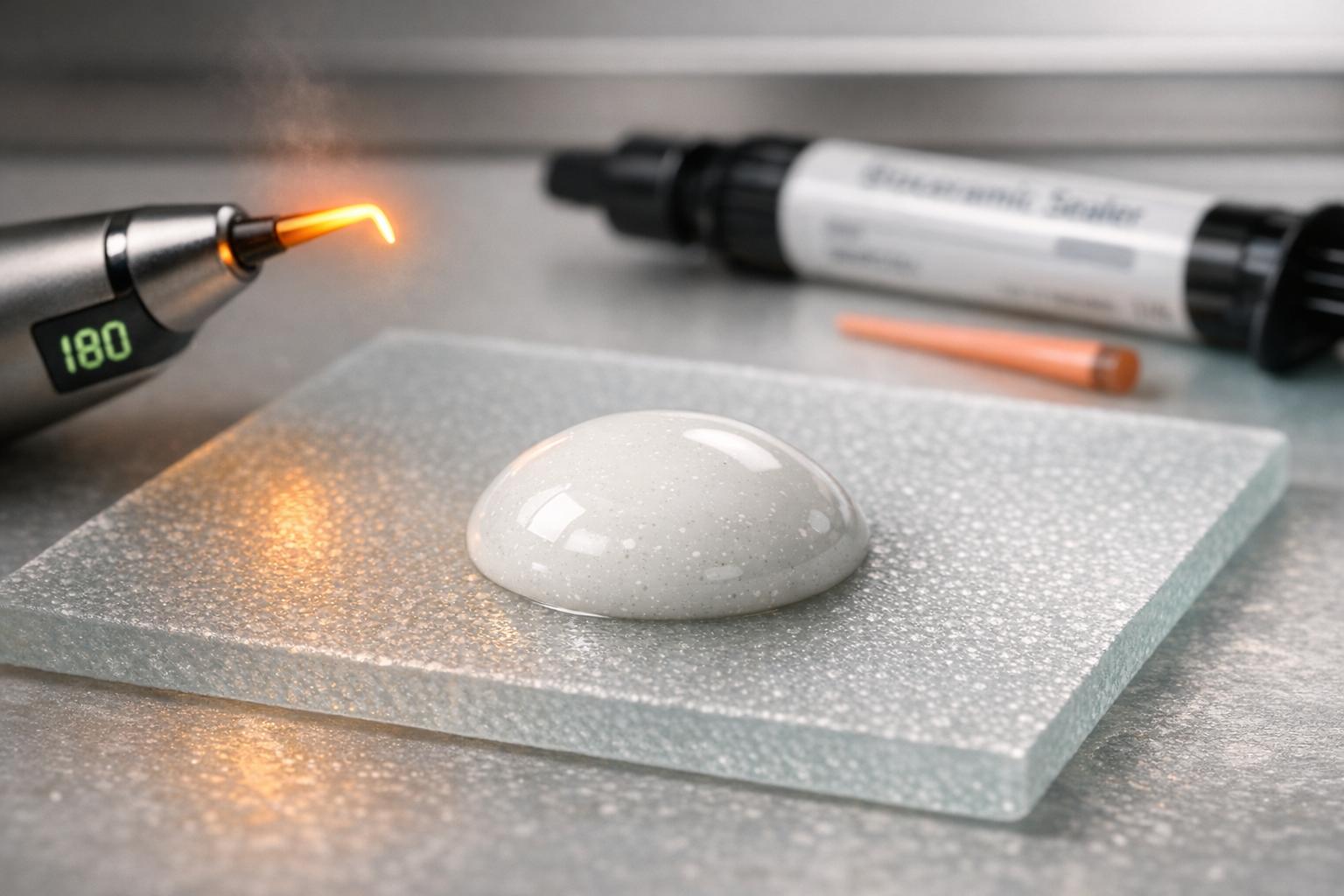
Bioceramic sealers, widely used in root canal treatments, are impacted by heat during procedures like warm vertical compaction. Heat changes their physical properties – such as setting time, flowability, and viscosity – while their chemical structure largely remains stable. Some sealers can handle heat better, like TotalFill BC HiFlow, while others, like BioRoot RCS, lose effectiveness when exposed to temperatures above 77°C.
Key Takeaways:
- Heat accelerates setting time but reduces flowability, affecting how sealers fill canal spaces.
- Premixed sealers (e.g., TotalFill BC HiFlow) perform better under heat than powder-liquid types (e.g., BioRoot RCS).
- Choose sealers based on the obturation technique: warm vertical compaction requires heat-stable sealers, while cold obturation suits others.
For successful outcomes, match the sealer to the technique and limit heat exposure to avoid premature setting or reduced performance.
Heat Exposure in Root Canal Treatments
Where Heat Comes From During Procedures
During obturation, heat is introduced through methods like warm vertical compaction, continuous wave condensation, and carrier-based systems such as Thermafil. While heat pluggers can reach temperatures as high as 180°C–230°C, much of this heat dissipates through the tooth structure, typically lowering the canal temperature to below 100°C [3][6]. Research shows that the external root surface usually maintains a temperature range of 37°C to 41°C. This range is considered safe for the surrounding bone and periodontal tissues [7]. These temperature variations play a critical role in how different sealers react during the procedure.
How Bioceramic Sealers Respond to Temperature
Understanding how bioceramic sealers react to heat is crucial for their effective use. These sealers, primarily made of tricalcium and dicalcium silicate, rely on a hydration reaction when exposed to moisture. Heat speeds up this reaction, resulting in quicker setting times and reduced flowability [3][5].
The thermal tolerance of these materials can vary significantly between products. For example, heating standard sealers to 100°C for 60 seconds can drastically shorten their setting times. However, some sealers are specifically designed to retain their physical properties during warm obturation techniques [3]. The composition of the sealer, particularly its calcium silicate content – which can range from 5–15% to as much as 50% by weight – directly affects its behaviour under heat [3]. Understanding these thermal characteristics is essential for choosing the right sealer and ensuring successful clinical outcomes.
sbb-itb-2be92ed
How Heat Changes Bioceramic Sealers
Physical Property Changes
Heat has a profound impact on the physical properties of bioceramic sealers. Take AH Plus Bioceramic Sealer as an example – its setting time plummets from over 500 minutes at room temperature to just 2.4 minutes after being heated for 60 seconds at 100°C[3]. This dramatic reduction in setting time directly affects how the sealer flows and adapts during application.
Another key change is in flowability. When exposed to heat, bioceramic sealers become thicker and more viscous, which reduces their ability to flow into fine irregularities and lateral canals – critical areas for achieving a proper seal[3][5]. Heat also increases the film thickness of these materials. Both AH Plus Bioceramic and EndoSequence BC Sealer surpass the ISO standard of 50 µm when heated to 100°C[3].
Interestingly, BioRoot RCS responds differently. As a powder-liquid sealer, it shows stability up to 77°C, but heating it beyond this point for just 30 seconds triggers immediate setting[2]. David Donnermeyer from the Department of Periodontology and Operative Dentistry highlights:
Thermal treatment did not lead to any substantial chemical changes at all temperature levels, while physical properties of BR [BioRoot RCS] were compromised by heating[2].
Chemical Changes and Heat Breakdown
While heat significantly alters the physical properties of bioceramic sealers, their chemical structure remains largely intact under elevated temperatures. FT-IR spectroscopy and SEM/EDS analyses confirm that the calcium silicate components – the core of these materials – stay stable up to 100°C[2][3].
However, the organic components tell a different story. The thickening agents and vehicles responsible for the sealers’ initial flowability degrade under heat, which explains the observed changes in physical behaviour despite the stability of the core chemistry[1]. Notably, different sealers have varying thresholds for decomposition. For instance, Fill Root ST begins to break down at 91°C, ADseal at 135°C, while VDW.1Seal holds up until 145°C[8]. This difference is tied to crystallinity levels – VDW.1Seal and ADseal have higher crystallinity (73% and 74%, respectively) compared to Fill Root ST (67%), making them more resistant to heat[8]. Additionally, heating causes weight loss due to the evaporation of water and organic components[2][8].
What Heat Effects Mean for Patient Treatment
Bond Strength and Filling Quality
Heat can significantly affect how sealers bond to canal walls, potentially leading to weaker adhesion. For instance, standard sealers like the original EndoSequence BC Sealer and MTA Plus show reduced push-out bond strength when used with continuous wave condensation techniques[1]. The rapid setting and limited flow under heat can hinder their ability to adapt to canal irregularities, which may result in unwanted gaps[3][9].
That said, not all sealers react the same way to heat. Specialised "HiFlow" formulations, such as EndoSequence BC Sealer HiFlow, TotalFill BC, Bio C Sealer, and CeraSeal, retain their bond strength even during heat-based obturation[1]. Clinical studies back these findings, showing a 99% success rate after one year when premixed bioceramic sealers are used with continuous wave or carrier-based warm obturation. Similarly, AH Plus Bioceramic Sealer has demonstrated 82% complete healing when applied in carrier-based techniques[3]. These differences highlight the importance of selecting the right sealer for warm obturation procedures.
Using Warm Obturation with Bioceramic Sealers
To navigate the challenges heat poses, it’s essential to match the sealer to the specific obturation technique. For instance, BioRoot RCS is unsuitable for warm vertical compaction because it sets immediately above 77°C, which compromises bonding[2]. As David Donnermeyer from the Department of Periodontology and Operative Dentistry explains:
TFBC and TFHF can be considered suitable for warm obturation techniques, while BR should only be implemented with cold obturation techniques[2].
Timing also plays a crucial role when working with heat. Rapid setting due to thermal stress requires precise handling, and clinicians must choose sealers specifically designed for warm techniques to ensure proper flow and film thickness as per ISO standards[2][3]. These practical considerations emphasise the need to align material properties with the procedural demands of warm obturation methods.
Warm Vertical Compaction WVC with Bioceramic Sealer
Best Practices for Heat-Assisted Procedures
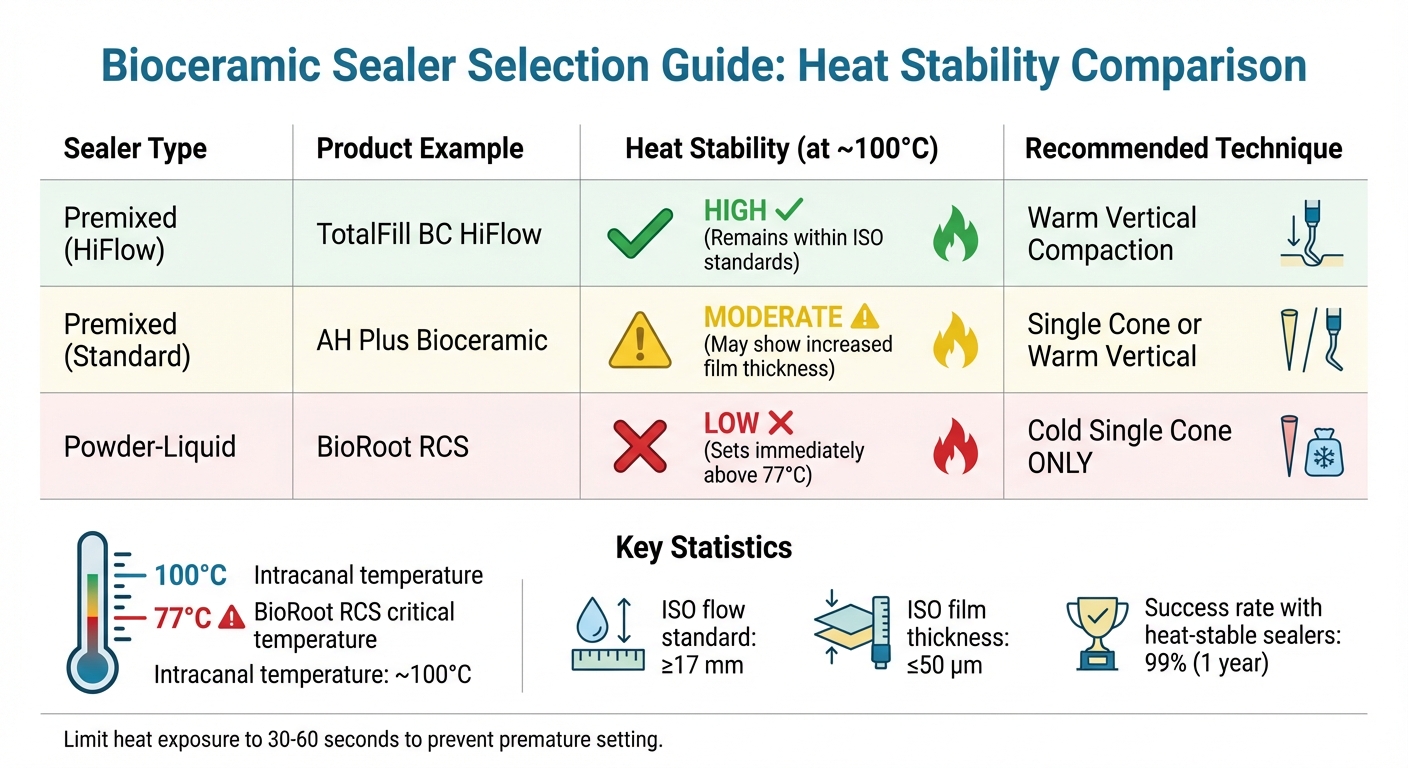
Bioceramic Sealer Heat Stability Comparison Chart for Root Canal Procedures
Choosing Heat-Stable Bioceramic Sealers
When working with heat-assisted techniques, the choice of sealer plays a crucial role. Premixed sealers generally handle heat better than two-component powder-liquid systems, making them a more reliable option [2]. For instance, TotalFill BC Sealer HiFlow and EndoSequence BC Sealer HiFlow maintain their flow and viscosity even under thermal stress [2].
The chemical composition of the sealer is another important factor. Sealers with higher tri-calcium silicate content tend to set much faster when exposed to heat, which can make them difficult to manage clinically [3]. TotalFill BC Sealer HiFlow, however, retains a manageable setting time of 22 hours across a temperature range of 37°C to 97°C [2].
Some sealers, like BioRoot RCS, are unsuitable for warm vertical compaction because they set too quickly at temperatures above 77°C [2]. Similarly, AH Plus Bioceramic Sealer may fail ISO flow standards (≥17 mm) after just 30 seconds of exposure to 100°C, and its film thickness can exceed the acceptable limit of 50 µm [3].
| Sealer Type | Product Example | Heat Stability (at ~100°C) | Recommended Technique |
|---|---|---|---|
| Premixed (HiFlow) | TotalFill BC HiFlow | High; remains within ISO standards [2] | Warm Vertical Compaction |
| Premixed (Standard) | AH Plus Bioceramic | Moderate; may show increased film thickness [3] | Single Cone or Warm Vertical |
| Powder‑Liquid | BioRoot RCS | Low; sets immediately above 77°C [2] | Cold Single Cone |
This comparison highlights why it’s essential to match the thermal properties of a sealer with the specific heat-assisted technique being used.
Applying Research to Clinical Practice
Selecting the right sealer is only part of the equation. Translating research findings into practical steps ensures better clinical outcomes. Given that intracanal temperatures typically hover around 100°C due to heat dissipation [3], it’s important to limit heat application to 30–60 seconds to avoid premature setting. For example, when using AH Plus Bioceramic Sealer, heating for 60 seconds at 100°C reduces its setting time to just 2.4 minutes [3]. This requires adjusting your workflow to accommodate the faster setting.
Josette Camilleri from the University of Birmingham offers this insight:
TotalFill BC sealer is recommended for use with warm vertical compaction technique as it is cheaper and as effective as the HiFlow [6].
This recommendation provides a cost-effective solution without compromising clinical performance, especially for practices handling a high volume of cases. By aligning the thermal properties of a sealer with the chosen obturation technique, clinicians can enhance both efficiency and outcomes.
Conclusion
Understanding how heat impacts bioceramic sealers is essential for improving root canal procedures. Heat can significantly influence physical properties like setting time and flow when sealers are exposed to temperatures around 100°C. However, their core chemical structure remains unaffected [2][4].
Choosing the right sealer for your technique is key. For warm vertical compaction, premixed sealers like TotalFill BC HiFlow maintain their performance under thermal stress. On the other hand, BioRoot RCS begins setting immediately above 77°C, making it suitable only for cold techniques [2]. If you’re using warm obturation, limit heat exposure to under 30 seconds to avoid premature setting. Also, keep in mind that the heat carrier’s dial setting might not accurately reflect the actual intracanal temperature [3][6]. Ensure your sealer complies with ISO standards for flow (≥17 mm) and film thickness (≤50 µm) even after heat exposure [3].
Studies show that heat-stable bioceramic sealers, when paired with warm condensation techniques, can deliver a 99% success rate within one year [3]. Achieving this level of success hinges on selecting the right material and using heat carefully. By matching sealer properties to the technique, clinicians can ensure more dependable results.
FAQs
What intracanal temperature is reached during warm obturation?
During warm obturation, the temperature within the canal can climb to around 180°C when the warm plugger is placed about 3 mm from the apex. At the root apex itself, the temperature generally surpasses 40°C. These heat levels play a critical role in ensuring the effective use of bioceramic sealers during endodontic treatments.
How can I prevent a bioceramic sealer setting too fast with heat?
To keep a bioceramic sealer from setting too fast because of heat, it’s essential to steer clear of applying too much or direct heat during procedures. Heat speeds up the setting process and may change the sealer’s characteristics. Make sure to monitor both the temperature and the length of heat exposure carefully to ensure the sealer performs as intended.
Which obturation techniques suit heat-sensitive bioceramic sealers?
When using obturation techniques that involve heat, like warm vertical condensation, it’s possible to pair them with heat-sensitive bioceramic sealers. That said, it’s important to be cautious. Heat can speed up the setting process, reduce the sealer’s flow, and increase its film thickness, especially in calcium silicate-based sealers. To ensure these sealers perform effectively during endodontic procedures, it’s crucial to adjust the application process to limit unnecessary heat exposure.
Related Blog Posts
- Ceramic Bracket Bonding: Adhesive Types Compared
- 3D Bioprinting Materials for Endodontic Repair
- Heat-Treated NiTi Files: Benefits for Flexibility
- Bioceramic vs. Resin-Based Sealers: Comparison
Important Notice: Any surgical or invasive procedure carries risks. Before proceeding, you should seek a second opinion from an appropriately qualified health practitioner.
Individual results may vary. The information provided in this article is for educational purposes only and does not constitute medical advice.
Checkout Related Blogs




Get in touch with us
For more information, call us now to start feeling better. Or fill the form below to make appointment
The Latest News from Complete Smiles
How to Clean Clear Plastic Retainers
Checklist for Choosing Wearable Dental Devices
Checklist for Choosing Cloud AI Platforms in Dentistry

Complete Smiles Bella VistaAccepts All Major Health Funds, Including





