





Heat-Treated NiTi Files: Benefits for Flexibility
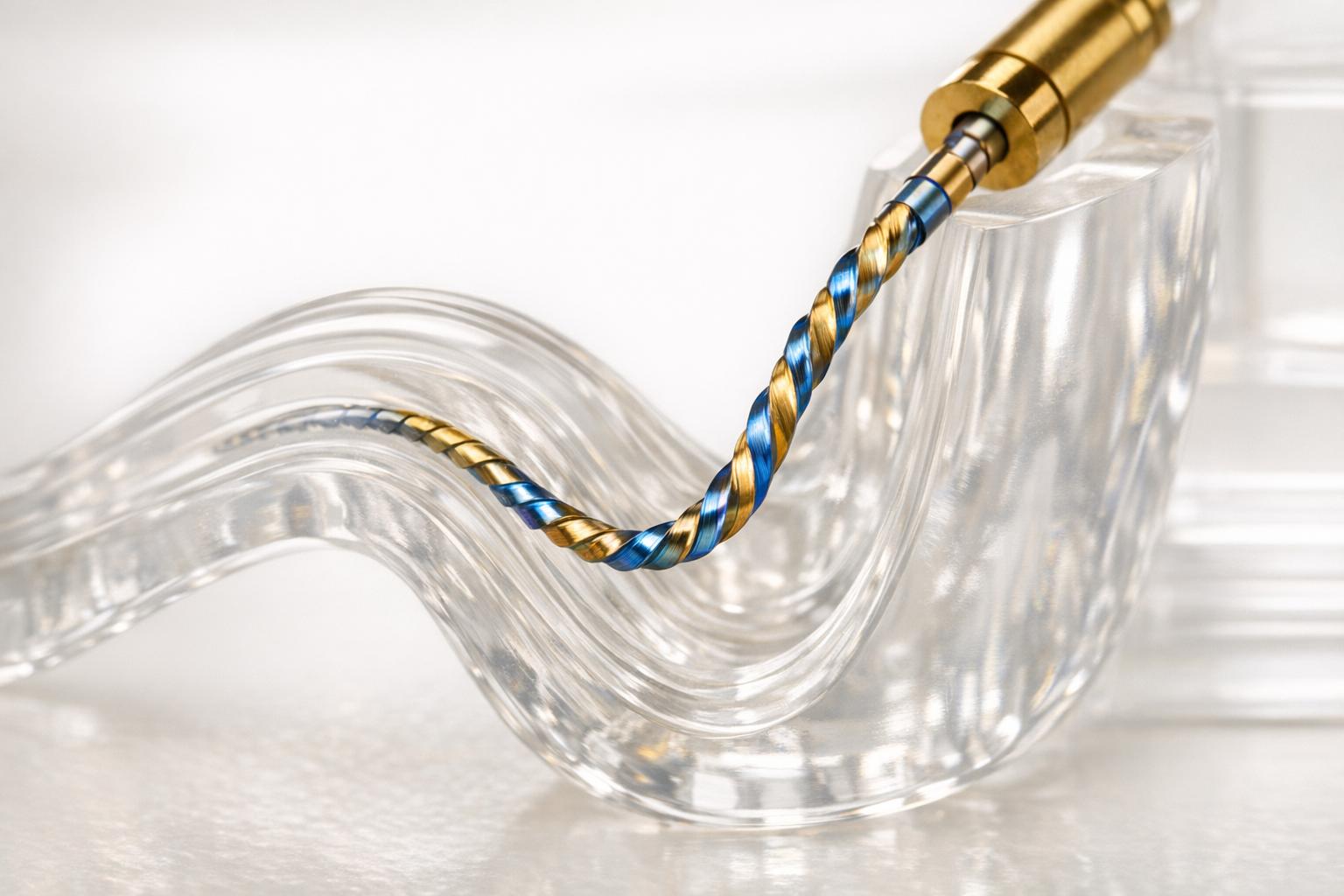
Heat-treated NiTi files are a game-changer in root canal treatments, offering greater flexibility and durability compared to standard options. By modifying the crystalline structure of nickel-titanium alloys through heat treatment, these files achieve higher resistance to fractures and cyclic fatigue, making them ideal for curved and complex canals. Here’s what you need to know:
- Flexibility Matters: Heat-treated NiTi files excel at maintaining the natural shape of root canals, reducing risks like ledging, zipping, or canal transportation.
- How It Works: Heat treatment optimises the balance between rigid (austenitic) and flexible (martensitic) phases, improving performance at body temperature.
- Clinical Benefits: Enhanced flexibility means better navigation of curves and fewer procedural errors, while visible deformation before breaking provides added safety.
- Examples: Systems like ProTaper Gold, TruNatomy, and One Curve demonstrate superior cyclic fatigue resistance and usability.
These advancements are transforming endodontics, offering safer and more reliable outcomes for patients.
Are HEAT TREATED rotary files more resistant to breakage?
The Science Behind Heat-Treated NiTi Files
NiTi Alloy Phase Comparison: Austenite vs Martensite vs R-Phase Properties
Heat treatment plays a pivotal role in transforming the microstructure of nickel-titanium (NiTi) alloys, particularly by altering the balance between crystalline structures. These modifications significantly enhance the flexibility and durability of endodontic files, which is why heat-treated instruments often perform better than their conventional counterparts. Let’s dive into how these metallurgical changes boost the performance of NiTi files.
Heat Treatment and Phase Transformation
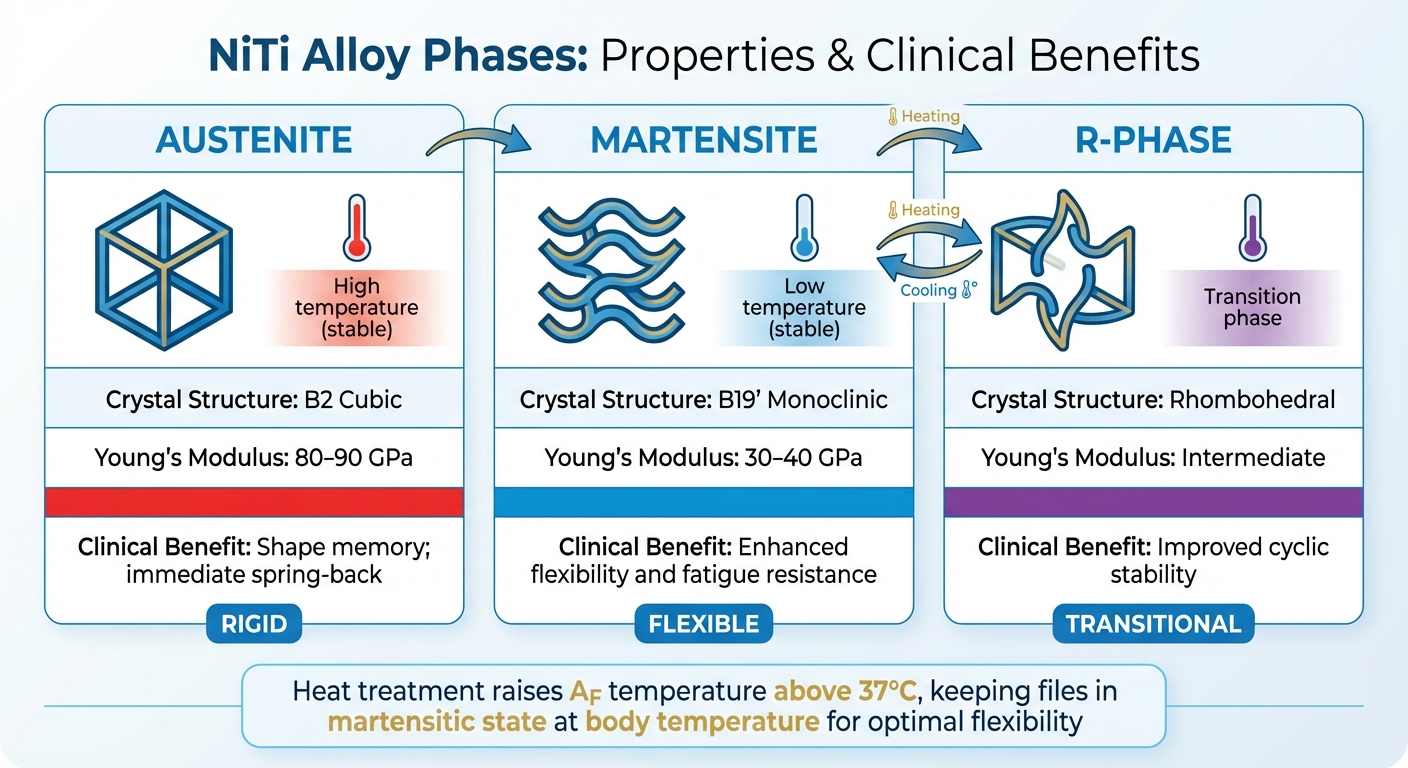
NiTi alloys exist in three distinct phases: austenite, martensite, and an intermediate R-phase. Each phase has unique properties:
- Austenite: Stable at higher temperatures, it features a B2 cubic crystal structure with a Young’s modulus of 80–90 GPa, making it relatively rigid.
- Martensite: Stable at lower temperatures, it has a B19′ monoclinic structure with a Young’s modulus of 30–40 GPa, offering enhanced flexibility.
- R-Phase: This intermediate rhombohedral phase provides improved cyclic stability during transformations.
Heat treatment shifts the transformation temperatures, often raising the Austenite Finish (Af) temperature above 37°C. This adjustment ensures that the file remains in a martensitic state during clinical use, which enhances its flexibility. For instance, Controlled Memory wires maintain their martensitic properties at body temperature, improving their ability to handle complex canal anatomies [5][3].
"The heat treatment process releases the internal strain of NiTi alloy and increases the phase transformation temperature of NiTi, resulting in more martensite phase at clinically relevant temperatures, which makes heat-treated NiTi instruments higher flexibility and fatigue resistance."
– Frontiers in Dental Medicine [5]
The twinning mechanism in NiTi alloys allows up to 8% strain recovery, a stark contrast to the 1% seen in stainless steel [5][2]. Even minor changes in alloy composition – just 0.1% – can shift the transformation temperature by as much as 10°C [2].
| Phase | Crystal Structure | Young’s Modulus | Temperature State | Clinical Benefit |
|---|---|---|---|---|
| Austenite | B2 Cubic | 80–90 GPa | High temperature | Shape memory; immediate spring-back |
| Martensite | B19′ Monoclinic | 30–40 GPa | Low temperature | Enhanced flexibility and fatigue resistance |
| R-Phase | Rhombohedral | Intermediate | Transition phase | Improved cyclic stability |
How Heat Treatment Changes Material Properties
Beyond phase transformation, heat treatment refines the overall properties of NiTi alloys by relieving internal stress. This process reduces work-hardening caused by mechanical grinding, making the files less brittle and more ductile. The result? Instruments that are more resistant to fracture under stress [4].
Heat treatment also influences the surface of NiTi files. When performed in specific atmospheres, it creates a titanium oxide (TiO₂) layer that enhances wear resistance and gives files their characteristic colours. For example, thicker oxide layers produce blue-coloured files (e.g., Reciproc Blue), while thinner layers result in gold-coloured files (e.g., ProTaper Gold) [5][6].
Different heat treatment protocols lead to varying transformation temperatures across file systems. For instance:
- TruNatomy files: Austenite Peak temperature of 25°C, remaining mostly austenitic at body temperature.
- EndoRoad files: Austenite Peak temperature of 40°C, predominantly martensitic during clinical use.
- ProTaper Gold files: Austenite Peak temperature of 42°C.
- HyFlex CM files: Austenite Peak temperature of 47–55°C, ensuring martensitic properties in clinical settings [3][2].
"Heat treatment temperature is the most critical factor influencing the flexibility and hysteresis size of the NiTi wire followed by the holding time, while the cooling method has a negligible effect."
– Ihssen Abdelmomen et al. [4]
Research supports that heating NiTi wires at 425°C for 30 minutes optimises their flexibility for endodontic applications [4]. Interestingly, the cooling method – whether water quenching or air cooling – has minimal impact on the final mechanical properties, making temperature and treatment duration the key variables manufacturers control [4].
Optimal Heat Treatment Parameters for Flexibility
Manufacturers have fine-tuned heat treatment techniques to improve the flexibility of NiTi endodontic files while maintaining their strength. Research from Université de Lorraine has pinpointed that heating NiTi wires at 425°C for 30 minutes achieves the best balance. This specific condition reduces the bending moment and increases ductility, making it ideal for navigating complex canals without compromising structural integrity [4].
Temperature Ranges and Treatment Duration
Temperature and treatment duration are key factors in enhancing file flexibility and fatigue resistance. Among these, temperature plays the most significant role. A treatment duration of 30 minutes results in greater flexibility compared to shorter treatments, like 15 minutes. However, extending the duration to 45 minutes can lead to increased stiffness due to changes during the martensitic transformation. Importantly, heat treatments below 600°C improve flexibility, but exceeding this temperature threshold can stiffen the alloy [4].
Cooling Methods and Their Effects
Interestingly, the method of cooling has little to no impact on the flexibility of the files. This means manufacturers can focus primarily on optimising temperature and holding time to achieve the desired results [4].
sbb-itb-2be92ed
Mechanical Advantages of Heat-Treated NiTi Files
Flexibility and Cyclic Fatigue Resistance
Fine-tuning heat treatment processes for NiTi files leads to significant mechanical benefits in clinical applications. Heat-treated NiTi files stand out for their improved flexibility and cyclic fatigue resistance – a critical factor when navigating curved canals. These advantages stem from an increased martensitic phase, which is naturally more flexible and ductile than the austenitic phase found in traditional files [2][4]. This enhanced flexibility helps minimise the risk of file separation during procedures.
Controlled Memory (CM) instruments, for instance, exhibit an impressive 300%–800% higher resistance to cyclic fatigue compared to conventional NiTi files [2]. A notable example is the One Curve rotary system, equipped with C-wire technology, which boasts cyclic fatigue resistance 2.4 times greater than the OneShape system [2]. Similarly, heat-treated files like ProTaper Gold and EdgeTaper Platinum outperform their non-heat-treated counterparts, delivering over 100% improvement in cyclic fatigue lifespan [8].
"The increase of transformation temperatures (Ms, Mf, As and Af) of NiTi results in a more martensite phase at clinically relevant temperatures, which makes heat-treated NiTi instruments more flexible and more resistant to fatigue than conventional NiTi instruments."
- Materials Journal (MDPI) [4]
Another benefit of heat treatment is the reduction of internal stresses during manufacturing, which enhances ductility [4]. This allows the files to navigate complex canal curvatures more effectively while maintaining their structural integrity. As a result, the likelihood of procedural issues like zipping, ledging, or canal transportation is significantly reduced [2][4].
However, while the increased flexibility of heat-treated files is a clear advantage, it does come with certain trade-offs, particularly in torsional performance, which are explored below.
Balancing Flexibility and Torsional Strength
While heat treatment enhances flexibility, it does slightly reduce torsional strength, making martensitic files more prone to fracture under lower torque [1][7][8]. However, this trade-off introduces a valuable safety feature: a higher angular deflection. Heat-treated files can visibly unwind or distort before breaking, giving clinicians a clear warning of potential failure [1][5][7]. Laboratory tests have shown that some instruments reach their fracture limit within 0.20–0.30 seconds when locked [8].
"The higher angular deflection failure that an instrument can tolerate, the higher the elastic and plastic deformation before it breaks. This can be a safety feature because an occurrence of plastic deformation can be visualised."
- Roberto Barreto Osaki et al., Department of Dentistry, University of São Paulo [7]
To strike the right balance between flexibility and torsional strength, manufacturers now use tailored heat treatments within a single system. Smaller files (ISO 20 or less), which naturally have less mass, are treated less intensively to maintain torsional strength. In contrast, larger files undergo more intensive heat treatment to maximise flexibility, making them better suited for navigating curved canals [1]. For instance, the Medidenta Genius Proflex system, introduced in 2020, employs three distinct heat treatments within a single sequence. Violet-coloured files (ISO 13–25) are designed for greater torsional resistance, while gold-coloured files (ISO 40–60) prioritise flexibility [1].
Clinical Applications in Endodontic Practices
Applications in Complex Canal Anatomy
Heat-treated NiTi files have become a game-changer for tackling tough clinical challenges, especially when dealing with severely curved or calcified canals. Thanks to their martensitic phase, these files offer controlled memory, allowing them to be pre-bent before use. This feature is a lifesaver when working on posterior teeth in patients with limited mouth opening, where straight files simply can’t do the job [2].
"Martensitic instruments are recommended to be used in curved canals once they are supposed to provide better maintenance of the original canal path."
- Dr. Carlos Ramos, Director of Clinical Affairs, Medidenta [1]
These files excel at maintaining the canal’s centre while navigating tricky curves, reducing procedural errors often associated with conventional files. Systems like One Curve, which use C-wire technology, can be pre-curved to match the canal’s shape. Unlike austenitic files, they don’t have the "spring-back" effect that causes straightening, making them especially effective for bypassing ledges [2].
Another standout is the TruNatomy file system. With a maximum flute diameter of just 0.8 mm compared to the standard 1.2 mm, these files preserve more peri-cervical dentin, a key factor for long-term tooth survival. By removing less tooth structure during preparation, they lower the risk of vertical root fractures – a catastrophic issue that often leads to tooth loss. These design features not only reduce procedural errors but also highlight the flexibility and fracture resistance that heat-treated files bring to the table. The clinical benefits of these systems are well-supported by research.
Evidence from Clinical Studies
Studies continue to back up the advantages of heat-treated files in demanding cases. In January 2025, BMC Oral Health published a study comparing three heat-treated systems – TruNatomy (Dentsply Sirona), EndoRoad (Maruchi), and ProTaper Gold (Dentsply Sirona) – at body temperature (37°C). Among the tested systems, EndoRoad demonstrated the highest cyclic fatigue resistance and toughness. The study concluded that these minimally invasive, heat-treated files are critical for preserving root dentin and reducing fracture risks, though the choice of file should match the specific canal anatomy [3].
"These heat-treated files have been reported to have several advantages, such as maintaining the centre of the canal well to prevent it and causing less transportation or development due to their lower stiffness and higher ductility than the files made of conventional NiTi alloy."
- BMC Oral Health [3]
Instrument separation rates in clinical practice range from 1.98% to 26% [1]. However, heat-treated files come with a built-in safety feature: they visibly deform – by unwinding or distorting – before breaking. This offers clinicians an early warning, a safeguard that conventional files lack [3]. Even in larger calibre cases (above ISO 25), heat-treated files maintain flexibility despite the added metallic mass [1]. These findings reinforce the material science improvements, showing consistency between lab results and clinical outcomes.
The Future of Heat-Treated NiTi Files in Dentistry
The clinical success of heat-treated NiTi files has paved the way for new technologies aimed at refining their performance even further. Among these innovations, cryogenic treatment – which involves exposing NiTi files to extremely low temperatures – has shown potential for enhancing surface hardness and improving thermal stability [5][6]. Another promising method is electrical discharge machining (EDM). By using high-frequency spark discharges, EDM creates a distinct surface texture that significantly increases resistance to cyclic fatigue compared to traditional grinding techniques [5][6]. Additionally, temperature-adaptive alloys like Max-Wire are making waves. These materials allow files to remain straight in their martensitic state at room temperature but transform into flexible, superelastic instruments when exposed to body temperature [2].
"Future research direction will lie in the use of nanotechnology."
- Wai-Sze Chan et al. [6]
Nanotechnology is emerging as an exciting area for the evolution of NiTi files. Researchers are investigating ways to enhance these instruments through surface modifications using nanostructures like nanotubes, nanopores, and nanospindles. These advancements aim to elevate performance beyond just mechanical improvements [6]. Additionally, optimising thermal properties remains a key focus, as evidenced by past studies [4].
However, challenges persist. Striking the right balance between flexibility and torsional strength is a constant hurdle, as is ensuring durability through repeated sterilisation cycles [9]. Another obstacle is the absence of universal standards for evaluating fracture resistance, which makes it difficult to objectively compare different systems [5].
Even with these challenges, the future looks bright. Heat-treated files are steadily advancing, becoming more durable, precise, and adept at navigating the intricate anatomies encountered in endodontics. For clinics like Complete Smiles Bella Vista (https://completesmilesbv.com.au), these advancements could mean safer procedures and more reliable outcomes during root canal treatments.
FAQs
What are the benefits of heat treatment for NiTi endodontic files?
Heat treatment changes the metallurgical structure of nickel-titanium (NiTi) endodontic files, improving their flexibility and durability. This adjustment boosts the alloy’s superelasticity and enhances its resistance to cyclic fatigue, which helps minimise the chance of fractures during use.
These improvements are especially useful in root canal therapy, where files often need to manoeuvre through curved or intricate canals. Thanks to heat treatment, NiTi files maintain their shape and perform reliably, offering both the flexibility and strength required for safer, more effective dental procedures.
What are the advantages of using heat-treated NiTi files in root canal treatments?
Heat-treated nickel-titanium (NiTi) files bring important advantages to root canal treatments. Thanks to their increased flexibility, they can better follow the natural curves of the root canal, which helps lower the chances of procedural mistakes. They also boast higher resistance to fractures and longer-lasting durability, making them safer and more efficient tools for dental procedures.
These mechanical improvements reduce stress on the files, ensuring they perform reliably even during complex endodontic work. By enhancing precision and contributing to better patient results, heat-treated NiTi files have become a valuable tool in modern dentistry.
How does heat treatment improve the flexibility of NiTi files used in dentistry?
Heat treatment changes the internal structure of nickel-titanium (NiTi) files through a process known as phase transformation. This process improves their ability to adapt to curved or complex root canals, reducing the risk of breakage during use.
Thanks to this treatment, NiTi files become more flexible and resistant to fractures, which makes root canal procedures both safer and more efficient. These qualities have made heat-treated NiTi files an essential tool in modern endodontics, particularly for handling challenging cases.
Related Blog Posts
- Cleaning Rotary Endodontic Instruments: Protocols
- Heat vs. Ultrasonic Tools in Root Canal Therapy
- Advances in Endodontic File Manufacturing
- How Alloy Design Improves Endodontic File Performance
Important Notice: Any surgical or invasive procedure carries risks. Before proceeding, you should seek a second opinion from an appropriately qualified health practitioner.
Individual results may vary. The information provided in this article is for educational purposes only and does not constitute medical advice.
Checkout Related Blogs




Get in touch with us
For more information, call us now to start feeling better. Or fill the form below to make appointment
The Latest News from Complete Smiles
How to Clean Clear Plastic Retainers
Checklist for Choosing Wearable Dental Devices
Checklist for Choosing Cloud AI Platforms in Dentistry

Complete Smiles Bella VistaAccepts All Major Health Funds, Including





