





How Alloy Design Improves Endodontic File Performance

Nickel-titanium (NiTi) alloys have transformed root canal treatments, offering flexibility, cutting precision, and reduced risk of file breakage compared to older stainless steel tools. The key lies in understanding the alloy’s microstructural phases – like austenite for strength and martensite for flexibility – and how heat treatments enhance their performance.
Here’s what you need to know:
- NiTi Phases Matter: Austenite (strong but stiff) and martensite (flexible and stress-resistant) phases affect how files handle curved canals or tough cases.
- Heat Treatments Tailor Performance: Modern methods like M-Wire, Controlled Memory (CM) Wire, and Gold/Blue treatments improve flexibility, fatigue resistance, and safety.
- Clinical Applications: Choose martensitic files for curved canals and austenitic ones for straight or retreatment cases to minimise complications.
- New Developments: Advances like Electrical Discharge Machining (EDM) and surface ion treatments boost cutting efficiency and durability, while nano-engineering explores antibacterial properties.
For Australian dentists, staying updated on these advancements ensures safer, more reliable root canal treatments tailored to each case’s needs.
How the Endodontic Files are Manufactured : Metallurgy of files
The Science of NiTi Alloys
NiTi Alloy Phases and Heat Treatments Comparison for Endodontic Files
NiTi alloys play a crucial role in the advanced performance of modern endodontic files. Their ability to exist in various crystallographic phases – specific atomic arrangements that influence mechanical behaviour – is key to their effectiveness during root canal treatments. Let’s explore how these phases impact clinical performance.
Austenitic and Martensitic Phases
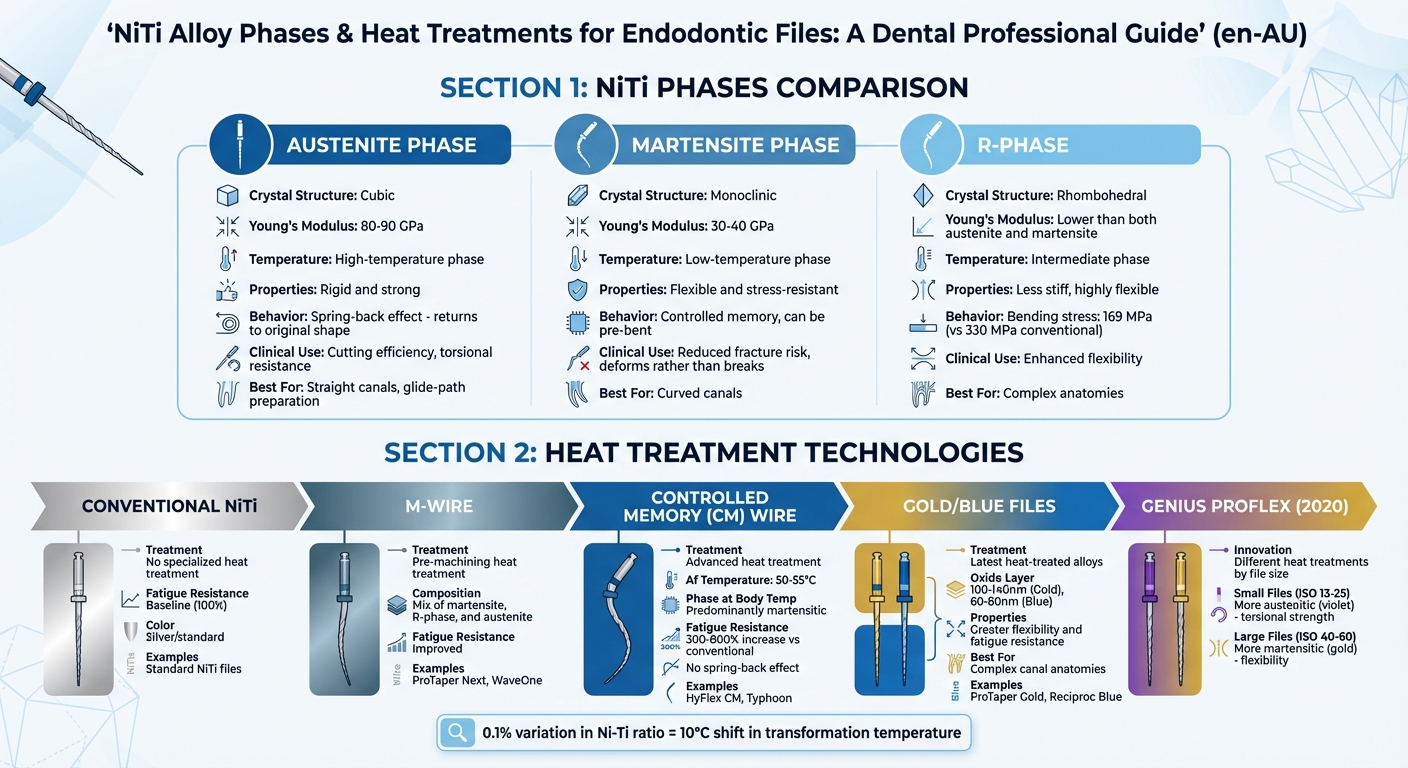
NiTi alloys transition between three main phases: austenite, martensite, and R-phase. Each phase has distinct crystal structures and mechanical properties that affect how files perform.
- Austenite: This high-temperature phase has a cubic crystal structure, making it rigid and strong, with a Young’s modulus of around 80–90 GPa [1]. Files in this phase exhibit a "spring-back" effect, meaning they naturally return to their original shape after bending. While this enhances cutting efficiency and torsional resistance, extra care is required when navigating curved canals.
- Martensite: In contrast, this low-temperature phase has a monoclinic structure and is much more flexible, with a Young’s modulus of just 30–40 GPa [1]. Files in this phase offer controlled memory, allowing pre-bending to match the canal’s curvature [2].
"The martensite phase also supports reducing the risk of file fracture under high stress conditions since it can be deformed rather than fractured." – Sang Won Kwak et al. [1]
- R-phase: This intermediate phase has a rhombohedral structure and is less stiff than both austenite and martensite. Finite element analysis has shown that bending stress drops significantly from 330 MPa in conventional NiTi to 169 MPa in R-phase models [6], highlighting its flexibility.
NiTi alloys can shift between these phases. For instance, under stress, austenite can transform into martensite, allowing the file to handle strain without permanent deformation. Once the stress is removed, the file returns to its original shape – a property known as superelasticity. These phase transitions are what make NiTi files flexible, fatigue-resistant, and efficient at cutting, all critical for successful root canal treatments.
How Heat Treatment Changes File Properties
Heat treatment is used to tailor the performance of NiTi files by influencing which phase dominates at body temperature (approximately 37°C).
- Conventional NiTi files: These receive no specialised heat treatment. While they offer decent cutting efficiency, they are more susceptible to cyclic fatigue in curved canals [1][4].
- M-Wire technology: This involves pre-machining heat treatment to create a mix of martensite, R-phase, and austenite. This blend improves cyclic fatigue resistance while maintaining good cutting efficiency. Files like ProTaper Next and WaveOne utilise this technology [1][5].
- Controlled Memory (CM) Wire: This technique pushes heat treatment further. These files have an Austenite finish (Af) temperature of about 50°C to 55°C [1][5], keeping them predominantly martensitic at body temperature. This eliminates the spring-back effect and increases cyclic fatigue resistance by 300% to 800% compared to conventional NiTi files [7]. Examples include HyFlex CM and Typhoon files.
- Gold and Blue files: These represent the latest advancements in heat-treated alloys, offering greater flexibility and fatigue resistance. They are particularly useful for navigating complex canal anatomies [2].
A noteworthy innovation is the Genius Proflex system, introduced in 2020. This system applies different heat treatments to various file sizes. Smaller files (ISO 13–25) are more austenitic (with a violet appearance) to provide torsional strength during early canal exploration, while larger files (ISO 40–60) are more martensitic (with a gold appearance) to maintain flexibility despite their size [2].
Understanding these heat treatment processes helps clinicians choose the right file for specific clinical needs.
Choosing Files Based on Phase Properties
Selecting the appropriate file depends on the dominant phase at body temperature and the specific requirements of the canal anatomy.
- Severely curved canals: Martensitic files are ideal. For example, a study comparing One Curve (martensitic) and One Shape (austenitic) files – both with identical designs but different metallurgy – found that One Curve files caused only 10.77% curvature straightening, compared to 17.30% with One Shape files. Apical transportation was also reduced (33.15 μm vs. 55.11 μm) [8].
- Straight canals and glide-path preparation: Austenitic files with smaller diameters (ISO 20 or below) are preferred. Their stiffness provides the torsional fatigue resistance needed for navigating calcified or resistant canal sections [2].
- Retreatment cases: Austenitic instruments are often the go-to choice due to their rigidity, which is advantageous when removing old filling materials. However, care must be taken to avoid cyclic fatigue in curved sections [2].
Even minor changes in the nickel-titanium ratio can significantly alter file performance. For instance, a 0.1% variation in the alloy composition can shift the transformation temperature by 10°C [7]. This highlights the importance of precise quality control in manufacturing NiTi files, as these metallurgical details directly impact their flexibility, cutting ability, and overall safety during endodontic procedures.
How Alloy Design Improves File Performance
Recent advancements in NiTi alloy design, particularly through precise heat treatments, have brought notable improvements to file flexibility, fatigue resistance, and the preservation of natural canal anatomy.
Flexibility and Preserving Canal Shape
Martensite-rich alloys have transformed the way files interact with curved canals. Unlike austenitic files, martensitic ones lack the spring-back effect, allowing them to be pre-bent to match the canal’s curvature. This reduces unnecessary pressure on canal walls[2][7].
"Martensitic instruments are recommended to be used in curved canals once they are supposed to provide better maintenance of the original canal path." – Dr. Carlos Ramos, Director of Clinical Affairs, Medidenta[2]
This flexibility not only helps maintain the canal’s natural shape but also increases resistance to cyclic fatigue.
Resistance to Cyclic Fatigue and File Lifespan
Cyclic fatigue occurs due to repeated tension and compression within curved canals. Advanced heat treatments have significantly improved resistance to this type of wear. For example, Controlled Memory instruments can show a 300%–800% increase in fatigue resistance. Systems like One Curve (C-Wire) and ProTaper Gold demonstrate extended time to failure compared to earlier designs[7][9][10]. Additionally, martensitic alloys deform under high stress rather than breaking immediately, often unwinding visibly before failure – providing a clear signal that the file needs replacement[2][7].
Cutting Performance and Durability
In addition to flexibility and fatigue resistance, alloy design has enhanced cutting performance and overall durability. While martensitic alloys are softer (NiTi VHN: 313–481 compared to stainless steel: 546–673)[5], advanced surface treatments ensure cutting efficiency is maintained. Techniques like EDM create a textured surface that improves cutting, while titanium oxide layers (60–80 nm in Blue wire, 100–140 nm in Gold wire)[11] and electropolishing eliminate surface defects that contribute to fatigue[2][4][7].
"The martensitic form of NiTi has an excellent fatigue resistance… it is soft and ductile and can easily be deformed." – Swati Srivastava, Assistant Professor, Qassim University[9]
A notable innovation came in 2016 when FKG Dentaire introduced Max-Wire in the XP-endo Shaper. This alloy remains martensitic at room temperature (20°C) but shifts to an austenitic phase at body temperature (35°C). This temperature-sensitive behaviour allows the file to expand and adapt to the irregularities of the root canal system[5]. Even a slight change in alloy composition – such as a 0.1% variation – can alter the transformation temperature by 10°C, enabling files to balance cutting efficiency and flexibility during procedures[7].
These advancements in alloy design give clinicians the tools to perform root canal treatments with improved precision, efficiency, and reliability.
sbb-itb-2be92ed
Selecting and Using Endodontic Files in Practice
After exploring the nuances of alloy phases and heat treatments, the next step is putting this knowledge into action by selecting the right files for clinical use.
Matching Alloy Properties to Different Cases
The benefits of heat-treated alloys are clear, but choosing the right alloy for specific canal anatomies is where the real challenge lies. Research shows that 84% of root canals are curved, with 17.5% displaying an "S-shaped" curvature[12]. This makes selecting the appropriate file crucial for achieving reliable results.
For severely curved canals (those with a Schneider angle exceeding 30°), files made from martensitic alloys like CM-wire (HyFlex CM), Blue heat-treated (Reciproc Blue), or Gold heat-treated (ProTaper Gold) are ideal[5]. These files can be pre-curved to follow canal trajectories, helping to minimise complications like ledging or transportation.
When dealing with calcified or constricted canals, stainless steel pathfinding files such as D-finders (Mani) or C+ Files (Dentsply) are better suited[13][14]. The hardness of stainless steel makes it effective for cutting through tight spaces. Once the canal is negotiated, martensitic NiTi files can take over for shaping.
| Clinical Scenario | Recommended Alloy Property | Example Instruments |
|---|---|---|
| Severely Curved (>30°) | Martensitic / CM-Wire / Blue Heat Treatment | HyFlex CM, Reciproc Blue, ProTaper Gold[5] |
| Calcified / Constricted | Work-hardened Stainless Steel / High Buckling Resistance | D-finders, C+ Files, Pathfinder CS[13][14] |
| Straight / Wide Canals | Austenitic NiTi / High Cutting Efficiency | Conventional NiTi, ProTaper Universal[5] |
| S-Shaped Canals | Martensitic with Reciprocating Motion | WaveOne Gold, HyFlex EDM[3][5] |
Success in file selection isn’t just about alloy properties – it also requires pairing the right file geometry and motion with each case.
Combining Alloy Design with File Geometry and Motion
The performance of an alloy improves when combined with the right file geometry and motion. For instance, triangular cross-sections offer better flexibility and can extend fatigue life by up to 300% compared to square cross-sections[16]. Lower-taper files are ideal for narrow or curved canals, as they maintain the natural anatomy while reducing stress on the instrument[15].
Motion plays a significant role too. Reciprocating motion – partial clockwise and counter-clockwise movements – reduces cyclic and torsional fatigue, making it especially useful for curved canals where file separation is a concern[15].
"The era of just relying on one or two file systems to manage all cases is long gone. Today… clinicians have the advantage of selecting the most appropriate system tailored to the specific demands of each case." – Dr. Matthew Malek[15]
For complex cases like C-shaped canals, MaxWire "3D-adaptive" files are a game-changer. These files adapt to irregular anatomies by shifting from martensitic at room temperature to austenitic at body temperature[15][9].
Sterilisation and Checking for Wear
Rotary NiTi files often show wear that’s invisible to the naked eye, so magnification is key for spotting signs of damage before fractures occur[7]. Watch for unwinding, which signals excessive torsional stress and potential failure[15].
CM wire files behave differently during sterilisation. While they regain their original shape after autoclaving, this recovery has limits. If a CM file fails to return to its original shape or shows inverted deformation after autoclaving, it’s time to discard it[17][4].
"CM-Wire is easily deformable under mechanical stress but will regain its original shape after heating in an autoclave, up to the point where an inverted deformation occurs… which is an indication that it should be discarded." – Ana-Belén Dablanca-Blanco et al., University of Santiago de Compostela[17]
Some manufacturers recommend using CM wire instruments only once to ensure safety[7]. During use, a "screwing-in" sensation is a red flag – it means the file is locking into dentine, increasing torsional stress and the risk of separation[17][4].
New Developments in Alloy Design
New Materials and Surface Treatments
Recent advancements like Electrical Discharge Machining (EDM) and Plasma Immersion Ion Implantation (PIII) are pushing the performance of dental files to new heights. EDM, a non-contact machining process, uses spark discharges to create a textured, crater-like surface. This unique surface boosts cutting efficiency and improves resistance to cyclic fatigue, making it a game-changer for dental instruments [7].
PIII, on the other hand, involves bombarding the alloy surface with ions such as nitrogen, argon, or boron. This treatment increases surface hardness and wear resistance while maintaining the file’s superelastic core. It effectively addresses the challenge of balancing flexibility with strength – two critical qualities for dental files [5].
Additionally, breakthroughs in nano-engineering are introducing antibacterial properties and promoting faster healing. Researchers at The University of Queensland are exploring the potential of nanotubes, nanopores, and nanospindles to deliver these benefits. As highlighted by Wai-Sze Chan, Karan Gulati, and Ove A. Peters:
"Future research direction will lie in the use of nanotechnology" [5].
Another notable innovation is deep dry cryogenic treatment, which involves cooling instruments to an extreme –196°C with liquid nitrogen. This process transforms the crystalline structure of the files, enhancing microhardness and cutting efficiency [9]. Meanwhile, proprietary alloys like T-wire (2Shape), C-wire (One Curve), and FireWire (EdgeEndo) are specifically designed to stabilise the martensitic phase, further improving flexibility and fatigue resistance [5].
These developments are shaping the future of dental tools, providing clinicians with more reliable and efficient options, while also paving the way for continued research and innovation.
What This Means for Australian Dental Practices
For dental professionals in Australia, staying informed about these advancements is more important than ever. With pioneering research into nano-engineering happening at The University of Queensland, local practices have a unique opportunity to access cutting-edge innovations directly [5]. By adopting these advanced materials and treatments, clinicians can deliver improved patient outcomes and minimise procedural risks.
To make the most of these developments, ongoing education is key. Professional courses, manufacturer-led training sessions, and peer-reviewed literature provide clinicians with the knowledge needed to evaluate and implement genuine advancements in their practice. As these new alloys and treatments continue to emerge, Australian dental practices are well-positioned to remain at the forefront of modern dentistry.
Conclusion
The evolution of alloy design has reshaped the performance of endodontic files, making root canal treatments safer, more reliable, and efficient. Modern heat treatments like M-wire, R-phase, and Controlled Memory alloys have significantly improved cyclic fatigue resistance – by as much as 300% to 800% compared to traditional NiTi instruments [9]. This increased resilience, paired with the ability of martensitic-phase files to maintain the natural shape of curved canals, helps reduce common procedural errors such as ledging, transportation, and perforation [2]. These advancements also open doors for further improvements through advanced surface treatments.
Surface treatments not only improve cutting efficiency and debris removal but also introduce visual indicators, such as unwinding, that signal when a file should be replaced to avoid separation [4][2]. As Swati Srivastava from Qassim University explains:
"Advancements in material processing appear to offer substantial benefits to the efficacy, efficiency, durability and safety of contemporary endodontic instruments." [9]
For Australian dental professionals, these technological advancements support a more precise and evidence-based approach to endodontics. With over 160 rotary NiTi systems on the market, understanding the metallurgical properties of files – especially their behaviour in either the austenitic or martensitic phase at body temperature – allows clinicians to select the most suitable instrument for the unique anatomy and complexity of each case [3]. By combining this metallurgical knowledge with proper technique and regular file inspections, practitioners can minimise risks and optimise outcomes in root canal procedures.
FAQs
How does heat treatment improve the performance of NiTi endodontic files?
Heat treatment improves the performance of NiTi endodontic files by altering the alloy’s microstructure. This process boosts the martensitic phase within the alloy, which increases flexibility and reduces rigidity. The result? Files that are better equipped to handle cyclic fatigue and torsional stress, making them more durable and reliable during root canal procedures.
These enhancements enable dentists to shape canals with greater efficiency while reducing the risk of file breakage, leading to safer and more effective outcomes for patients undergoing root canal treatment.
What are the advantages of using martensitic-phase endodontic files in curved root canals?
Martensitic-phase endodontic files are known for their flexibility and super-elasticity, making them particularly effective when working with curved root canals. These qualities help reduce cyclic fatigue and lower the chances of file breakage, ensuring safer and smoother procedures.
Another advantage is their ability to maintain canal centring, which significantly reduces procedural errors and helps preserve the tooth’s natural structure. Thanks to their advanced design, these files are especially beneficial for root canal treatments involving challenging, curved canals, leading to improved overall outcomes.
How have advancements in alloy design improved the performance and lifespan of endodontic files?
Advances in alloy design have significantly improved the performance of endodontic files, making them tougher and more dependable for dental procedures. Techniques like heat treatment, thermomechanical processing (such as M-wire, R-phase, and CM), and surface engineering methods like electropolishing and titanium-oxide coatings have boosted their flexibility, resistance to cyclic fatigue, and torsional strength.
These advancements not only increase the durability of the files but also make root canal treatments safer and more accurate, reducing the likelihood of instrument failure during procedures. This progress highlights the dedication to refining dental tools for better outcomes for both patients and practitioners.
Related Blog Posts
- Cleaning Rotary Endodontic Instruments: Protocols
- Advances in Endodontic File Manufacturing
- Key Insights into High-Precision Dental Milling
- 3D Bioprinting Materials for Endodontic Repair
Important Notice: Any surgical or invasive procedure carries risks. Before proceeding, you should seek a second opinion from an appropriately qualified health practitioner.
Individual results may vary. The information provided in this article is for educational purposes only and does not constitute medical advice.
Checkout Related Blogs




Get in touch with us
For more information, call us now to start feeling better. Or fill the form below to make appointment
The Latest News from Complete Smiles
How to Clean Clear Plastic Retainers
Checklist for Choosing Wearable Dental Devices
Checklist for Choosing Cloud AI Platforms in Dentistry

Complete Smiles Bella VistaAccepts All Major Health Funds, Including





