





Heat vs. Ultrasonic Tools in Root Canal Therapy
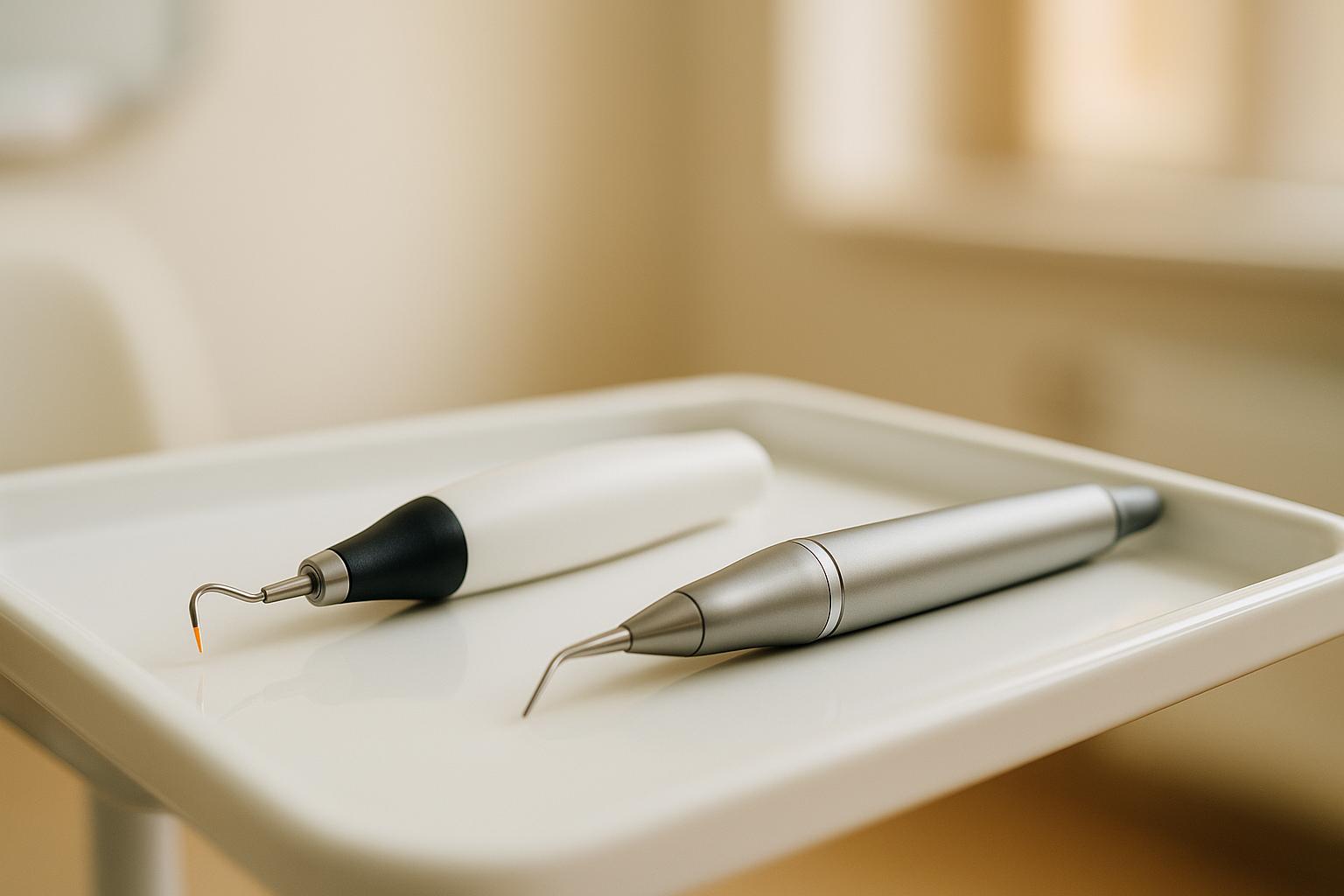
When performing root canal therapy, two key tools are heat-assisted devices and ultrasonic instruments. Both offer unique benefits for cleaning and preparing root canals, but they serve different purposes and come with distinct advantages and limitations.
- Heat-assisted tools: Use thermal energy to soften gutta-percha, improving material placement and reducing voids during obturation. They’re efficient for tasks like retreatment and filling removal but require careful handling to avoid overheating and tissue damage.
- Ultrasonic tools: Use high-frequency vibrations for cleaning, biofilm disruption, and instrument retrieval. They excel in hard-to-reach areas and curved canals, with success rates up to 93.3% for instrument retrieval. However, improper use can cause microcracks or excessive heat.
Quick Comparison
| Feature | Heat-Assisted Tools | Ultrasonic Tools |
|---|---|---|
| Primary Use | Softening gutta-percha, obturation | Cleaning, instrument retrieval |
| Mechanism | Controlled heating | High-frequency vibrations |
| Strengths | Precise obturation, reduced voids | Effective cleaning, high retrieval success |
| Risks | Tissue damage from overheating | Microcracks, excessive heat |
| Best For | Retreatment, obturation tasks | Cleaning, curved canal cases |
Both tools can be combined for improved outcomes, such as using ultrasonic cleaning followed by heat-assisted obturation. The choice depends on the tooth’s anatomy, the procedure’s complexity, and practitioner expertise. Proper technique and safety measures, like managing heat levels, are essential for successful treatment.
Heat-Assisted Tools in Root Canal Therapy
How Heat-Assisted Tools Work
Heat-assisted tools bring precision and efficiency to root canal therapy by applying controlled thermal energy directly to gutta-percha, the material used to seal root canals. These tools include heated pluggers and cordless heat carriers. Advanced systems, like the SuperEndo B&L α², can reach their peak operating temperature in as little as 5 seconds, making them highly efficient for clinical use[2].
The heat softens gutta-percha, allowing it to flow into even the most intricate parts of the canal anatomy. Cordless carriers are particularly effective, offering targeted heat application that reduces treatment time while ensuring the material is evenly distributed. This precise control over heat application lays the groundwork for improved outcomes in root canal therapy.
Benefits of Heat-Assisted Tools
Heat-assisted tools provide several clinical advantages. For example, using a modified cordless heat carrier (MSE) with ultrasonic tips can significantly cut root-end preparation time from an average of 99.8 ± 6.8 seconds to just 32.4 ± 1.0 seconds[2].
Additionally, these tools improve the marginal seal between the gutta-percha and canal walls, reducing the presence of gutta-percha remnants from 80% to 20%[2]. Another noteworthy benefit is the reduction in microcracks along the root surface – from 42 to 13 – which helps maintain the tooth’s structural integrity and lowers the risk of bacterial infiltration over time[2].
Drawbacks of Heat-Assisted Tools
While the benefits are clear, heat-assisted tools require careful handling to avoid complications. A key concern is the potential for thermal injury to surrounding tissues, such as the periodontal ligament and alveolar bone. Research shows that a temperature increase of more than 10°C above body temperature for over a minute can lead to irreversible tissue damage[1].
The thickness of the dentin also plays a crucial role in heat distribution. Variations in root wall thickness can lead to uneven heat transfer, making teeth with thinner roots more susceptible to complications.
Moreover, these modern rapid-heating devices demand precise control and technique. Without proper training, there’s a risk of thermal injury and compromised sealing, which could impact the overall success of the procedure. Mastering the use of these tools is essential to balance their efficiency with patient safety.
Ultrasonic Tools in Root Canal Therapy
How Ultrasonic Tools Work
Ultrasonic tools rely on high-frequency vibrations (usually between 25–30 kHz) generated by piezoelectric or magnetostrictive mechanisms to perform their tasks [5]. These vibrations, channelled through specialised tips, agitate irrigants to loosen debris and disrupt biofilm within the root canal system [5][8].
Piezoelectric tips are known for their precision and quiet operation, while diamond-coated tips excel in cutting tasks, making them especially useful for retrograde preparation and retrieving broken instruments [2]. The energy transfer through these tips enables them to navigate the intricate structure of root canals, reaching areas that traditional hand files or rotary tools often cannot [5][8]. This makes them particularly effective in accessing challenging sections of the canal.
Benefits of Ultrasonic Tools
Ultrasonic activation can reduce hard tissue debris by as much as 66.8%, outperforming sonic systems, particularly in complex canal structures [8]. This superior cleaning capability is due to acoustic streaming and cavitation, which create a more vigorous agitation of irrigants compared to manual or sonic methods.
Another major advantage is their effectiveness in retrieving broken instruments. In curved canals, ultrasonic tools have a success rate of up to 93.3%, significantly higher than the 66.6% achieved with conventional methods [4]. This success is attributed to their precise vibration patterns and the ability to remove minimal dentine, reducing the risk of perforation or further instrument separation.
Ultrasonic tools are versatile and used in various endodontic procedures. They are effective for removing fractured instruments, cleaning root canals, preparing root-end cavities during apical surgeries, and removing posts or root filling materials during retreatment [4][9]. Their ability to access challenging areas, such as lateral canals, isthmuses, and apical regions, makes them a valuable asset for achieving thorough canal preparation [5][8].
| Tool Type | Primary Application | Notable Benefit |
|---|---|---|
| Diamond-Coated Ultrasonic Tips | Root-end preparation, gutta-percha removal | Boosts cutting efficiency and reduces microcracks [2] |
| Stainless Steel Ultrasonic Tips | Instrument retrieval in curved canals | High success rate (up to 93.3%) [4] |
While these tools offer significant advantages, they must be used with care to avoid potential risks.
Drawbacks of Ultrasonic Tools
One of the main concerns with ultrasonic tools is the heat they generate, especially at higher power settings. Excessive heat can damage the root surface and surrounding tissues, potentially causing irreversible harm to the bone or periodontal structures if not managed properly [7]. This risk increases with prolonged use or overly high power settings.
Another issue is the potential for microcracks in the root structure due to extended activation. These microcracks can weaken the tooth over time and create openings for bacterial infiltration, compromising the tooth’s long-term health [2][7].
To minimise these risks, clinicians should adopt proper techniques. Using intermittent activation, applying minimal pressure, and ensuring sufficient irrigation or cooling during procedures can help manage heat generation [7]. Additionally, opting for thinner tips and limiting activation time are effective strategies to reduce temperature increases and prevent tissue damage.
Heat vs. Ultrasonic Tools: Direct Comparison
Performance and Uses
When it comes to root canal therapy, both heat-assisted and ultrasonic tools bring specific strengths to the table. Heat-assisted tools shine during obturation procedures. Their controlled thermal energy softens gutta-percha, allowing it to adapt snugly to canal walls and reducing the risk of voids. They also heat up quickly, making them a reliable choice for precise obturation tasks[2].
Ultrasonic tools, on the other hand, are better suited for cleaning and retrieving instruments. Their high-frequency vibrations improve irrigant penetration and effectively disrupt biofilm[5]. These tools are particularly successful in retrieving instruments from curved canals, outperforming conventional methods[4]. While heat-assisted tools are ideal for manipulating filling materials, ultrasonic tools excel at accessing hard-to-reach areas, ensuring a thorough debridement.
Here’s a side-by-side comparison to summarise their differences:
Side-by-Side Comparison
| Attribute | Heat-Assisted Tools | Ultrasonic Tools |
|---|---|---|
| Mechanism of Action | Thermal softening of filling materials | High-frequency vibration (typically 25–30 kHz) |
| Primary Applications | Obturation and gutta-percha manipulation | Cleaning, instrument retrieval, and post removal |
| Temperature Rise | Rapid, controlled heating; ultrasonics may cause variable rises[1] | Variable; can exceed 10°C at high power settings[1] |
| Success Rate (Retrieval) | Not applicable | Up to 93.3% in curved canals[4] |
| Risk of Microcracks | Minimal when used appropriately | Possible at high power settings[2] |
| Safety Profile | Localised heating with low tissue risk | Requires careful power management to limit thermal injury |
| Clinical Outcomes | Efficient obturation with fewer voids | Superior cleaning efficacy and instrument retrieval |
One key distinction lies in how these tools manage temperature. Research shows that ultrasonic tools can cause temperature rises ranging from 2.1°C (with low-power ProUltra tips) to as high as 22.8°C (with high-power Cric Dental IR3 tips) on external root surfaces[1]. In post removal, ultrasonic devices have been recorded generating surface temperatures of up to 125.3°C after 60 seconds, with root surface temperatures increasing by about 25.4°C after 45 seconds[7].
When to Use Each Tool
As outlined above, heat-assisted tools are best for obturation tasks. Their controlled thermal energy allows for the precise softening and adaptation of gutta-percha while keeping tissue risks low[2]. This makes them especially effective for retreatment cases or when working with complex canal systems.
Ultrasonic tools, however, are indispensable for cleaning and retrieval tasks. Whether it’s fractured instruments, post removal, or intensive cleaning, their high success rates – particularly in curved canals[4] – make them a go-to choice. Careful management of power settings and activation time is crucial to prevent excessive heat and potential tissue damage.
In some cases, combining both tools can yield better results. For example, starting with ultrasonic debridement for cleaning and finishing with heat-assisted obturation can streamline the process, improve cleaning outcomes, and minimise the risk of microcracks[2]. Ultimately, the decision to use one or both tools depends on the canal anatomy, the complexity of the case, and the specific needs of the patient, ensuring a tailored and effective treatment approach.
sbb-itb-2be92ed
Clinical Factors and New Developments
Choosing the Right Tool
When it comes to selecting the best endodontic tools, clinical factors play a key role alongside previous comparisons. The decision largely hinges on three main considerations: tooth anatomy, practitioner experience, and procedure type.
Tooth anatomy is often the most influential factor. Complex canal systems, like Vertucci type II configurations with multiple canals, require different tools and techniques compared to simpler canal structures[8]. For example, ultrasonic tools are particularly effective in these intricate systems. Tools like the IrriSafe 20, with their thinner ultrasonic tips, are designed to vibrate freely within the canal space without being dampened. This is especially true when paired with greater apical enlargement (size 30, 0.07 taper)[8]. The tool’s diameter and taper directly impact how well debris is removed, making a thorough anatomical assessment critical before selecting the instrument.
Practitioner experience also plays a crucial role in both tool selection and ensuring safety. Proper use requires a deep understanding of tip design, power settings, and the thermal effects of the tools[1]. The ability to manage these factors effectively can significantly impact outcomes, as both the choice of tip and power settings influence thermal safety.
The type of procedure further refines the choice of tools. For instance, heat-assisted tools are ideal for procedures that prioritise quick gutta-percha removal and minimal preparation time, such as root-end cavity preparation[2]. On the other hand, ultrasonic instruments excel at removing debris and retrieving instruments, achieving a 93.3% success rate in curved canals compared to 66.6% with conventional methods[4].
For Australian practitioners, this highlights the importance of ongoing education and adherence to evidence-based practices. Balancing these considerations ensures the right choice between heat-assisted and ultrasonic tools, paving the way for further advancements in endodontic technology.
New Developments in Endodontics
The field of endodontics continues to evolve, with new technologies addressing clinical challenges and improving outcomes. One such advancement is the Modified SuperEndo-α² (MSE), a heat-assisted device that reaches peak temperature in just 5 seconds. This allows for efficient gutta-percha softening with minimal risk to surrounding tissues, overcoming earlier limitations in retrograde preparation[2].
Improvements in ultrasonic tip design are also making waves. Newer, thinner, non-tapered instruments like the IrriSafe file minimise wall contact and reduce motion dampening compared to their tapered counterparts[8]. These changes enhance debris removal while lowering the risk of excessive heat generation.
Another promising innovation is the GentleWave system, a multisonic technology being explored as an alternative to traditional passive ultrasonic irrigation. Operating at flow rates of 45-50 mL/min with 5% sodium hypochlorite and 8% EDTA solutions, this system uses advanced fluid dynamics to improve cleaning effectiveness[3][6].
Hybrid approaches that combine heat-assisted and ultrasonic tools are also gaining attention. These methods aim to reduce preparation time while minimising structural damage to the tooth.
As these innovations continue to emerge, ensuring safety by adhering to Australian standards remains a priority.
Australian Standards and Safety
While endodontic tools become more advanced, maintaining strict safety standards is non-negotiable. Australian dental practitioners must prioritise patient safety and evidence-based practices when using these tools. A critical safety guideline to remember is that a temperature increase of more than 10°C above body temperature for over one minute can result in damage to periodontal or bone tissue[1].
Temperature monitoring is especially important when using ultrasonic tools, as they can raise the root surface temperature by up to 9.5°C in just 15 seconds – dangerously close to the threshold for irreversible bone injury[7]. This makes it essential for practitioners to use equipment that complies with Australian Standards and Therapeutic Goods Administration regulations.
Continuing professional development is key to staying informed about new technologies and safety protocols. Professional organisations recommend regular education on emerging tools, such as advanced ultrasonic systems and modified heat carriers, to ensure safe and effective use.
For practices offering comprehensive dental care, including root canal treatments, an evidence-based approach is essential. This includes assessing tooth anatomy and canal complexity, choosing tools based on procedural needs and temperature data, and prioritising safety by adhering to thermal thresholds and regulatory standards.
Practical safety measures like water cooling and refined techniques should also be implemented. Using adequate water cooling and applying minimal force can help reduce frictional heat[7]. Additionally, limiting ultrasonic vibration to short durations (15-30 seconds) minimises temperature increases at the root surface[7]. By combining these strategies with strict safety protocols, practitioners can achieve the best possible clinical outcomes.
ENDODONTIC RETREATMENT – REMOVAL OF GUTTA PERCHA BY HEAT & ROTARY FILE – ULTRASONIC ACTIVATION❗️
Conclusion
Choosing between heat-assisted and ultrasonic tools ultimately depends on the specific clinical scenario. Each technology brings its own strengths to the table, and when applied correctly, both can significantly boost treatment outcomes.
Heat-assisted tools are excellent for improving obturation efficiency while safeguarding tooth structure. They are especially useful in retrograde preparations, where preserving marginal integrity is a priority.
Ultrasonic tools, on the other hand, excel in instrument retrieval for both curved and straight canals. Their high-frequency vibrations are highly effective at removing debris and enhancing irrigation. These unique capabilities often make a combined approach the most effective solution.
By leveraging the strengths of both methods, practitioners can achieve better results. However, maintaining proper temperature control is critical to ensure safety and effectiveness.
For Australian practitioners, it’s important to weigh clinical goals against factors like tooth anatomy, personal expertise, and local regulatory guidelines. The key to successful endodontic therapy lies in making evidence-based decisions tailored to each patient’s needs.
As advancements like the GentleWave system and improved ultrasonic tips continue to evolve, mastering both heat-assisted and ultrasonic techniques will become even more essential. Whether you’re tackling stubborn gutta-percha or navigating complex canal systems, knowing when and how to use each tool will help deliver the best care possible.
Ultimately, effective root canal therapy is about blending advanced tools with sound clinical judgment.
FAQs
What’s the difference between heat-assisted and ultrasonic tools in root canal therapy, and how are they used?
Heat-assisted and ultrasonic tools play distinct roles in root canal therapy, each bringing its own advantages to the process. Heat-assisted tools are primarily used to soften and shape materials like gutta-percha during the filling stage, helping to achieve a snug and accurate seal within the root canal. Meanwhile, ultrasonic tools excel at cleaning and clearing debris, especially in the more intricate and hard-to-reach sections of the canal system, thanks to their precise vibration technology.
The decision to use one or both tools largely depends on the specific needs of the procedure. In most cases, dentists combine these tools to ensure the root canal is thoroughly cleaned and properly sealed. If you’re scheduled for root canal therapy, your dentist will determine the best approach based on the complexity of your treatment and your individual dental needs.
What precautions help prevent tissue damage when using heat-assisted or ultrasonic tools during root canal therapy?
During root canal therapy, dental professionals take meticulous steps to reduce the risk of tissue damage, especially when using heat-assisted or ultrasonic tools. For heat-assisted instruments, they carefully regulate the temperature to prevent overheating. Similarly, ultrasonic tools are handled with precision to avoid accidental contact with surrounding tissues.
To further ensure accuracy, clinicians use advanced imaging and magnification techniques, allowing them to work with greater precision. By adhering to strict safety protocols, they can deliver effective treatment while safeguarding the health of nearby tissues.
How do heat-assisted and ultrasonic tools enhance root canal therapy, and can they be used together?
Heat-assisted and ultrasonic tools play an important role in root canal therapy, each bringing its own strengths to the table. Heat-assisted tools are particularly effective for softening and removing gutta-percha during retreatments or for shaping canals with greater ease. Meanwhile, ultrasonic tools use high-frequency vibrations to clean and remove debris from areas of the root canal system that are otherwise difficult to access.
When these tools are used together, they can complement each other beautifully. Heat-assisted tools make material removal more straightforward, while ultrasonic tools ensure the canal is thoroughly cleaned and disinfected. This combination not only streamlines the procedure but also enhances precision, potentially leading to better long-term outcomes for patients.
Related Blog Posts
- Benefits of Ultrasonic Activation in Dentistry
- Real-Time Feedback in Ultrasonic Endodontics
- Cleaning Rotary Endodontic Instruments: Protocols
- How Ultrasonic Devices Manage Heat in Endodontics
Important Notice: Any surgical or invasive procedure carries risks. Before proceeding, you should seek a second opinion from an appropriately qualified health practitioner.
Individual results may vary. The information provided in this article is for educational purposes only and does not constitute medical advice.
Checkout Related Blogs




Get in touch with us
For more information, call us now to start feeling better. Or fill the form below to make appointment
The Latest News from Complete Smiles
How to Clean Clear Plastic Retainers
Checklist for Choosing Wearable Dental Devices
Checklist for Choosing Cloud AI Platforms in Dentistry

Complete Smiles Bella VistaAccepts All Major Health Funds, Including





