





3D Printed Dentures vs Traditional Dentures
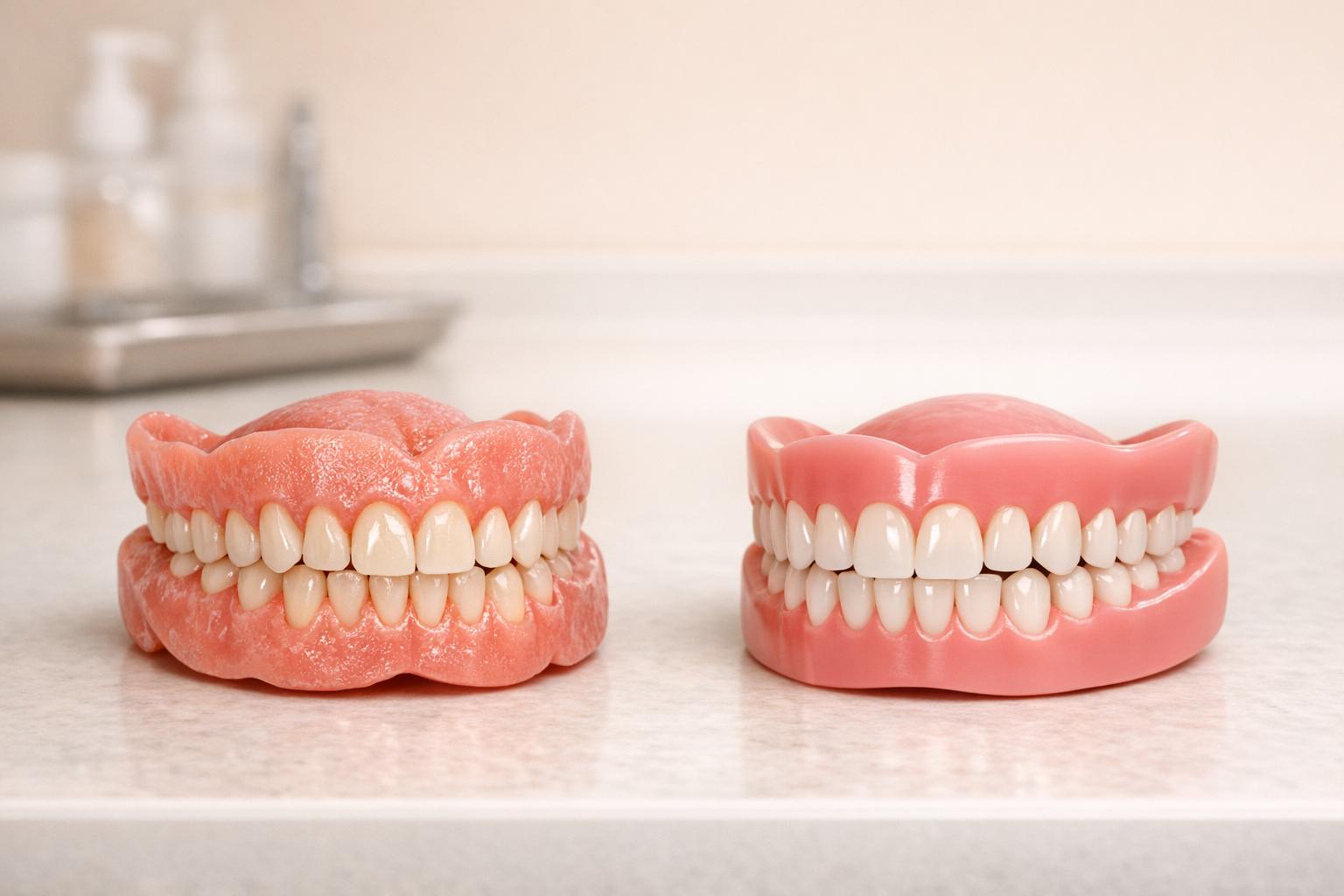
When comparing 3D printed dentures to conventional dentures, it’s all about balancing cost, durability, and comfort. Here’s what you need to know:
- Cost: Conventional dentures are cheaper, costing $2,500–$4,000 for a full set, while 3D printed options range from $5,000–$8,500+. However, 3D printed dentures save time with fewer appointments.
- Durability: Conventional dentures use heat-cured acrylic, which offers better tooth-to-base bonding. 3D printed dentures use resin, which can be less durable but meets strength standards.
- Comfort: Conventional dentures provide better retention and fit due to traditional impression techniques. 3D printed dentures are faster to make and more comfortable for patients with sensitive gag reflexes.
- Appointments: Conventional dentures require 5+ visits, while 3D printed dentures can be completed in 2–4 visits.
Quick Comparison:
| Factor | Conventional Dentures | 3D Printed Dentures |
|---|---|---|
| Cost (Full Set) | $2,500–$4,000 | $5,000–$8,500+ |
| Appointments | 5+ visits | 2–4 visits |
| Retention Force | 14.5–16.1 N | 6.2–6.6 N (scanned only) |
| Material Strength | Heat-cured PMMA (stronger) | Resin (ISO-compliant) |
| Replacement | Full process needed | Digital reprints possible |
Choosing the right option depends on your needs, budget, and priorities. Conventional dentures are better for complex oral structures and long-term reliability. 3D printed dentures are ideal if you value speed, convenience, and digital backup options.
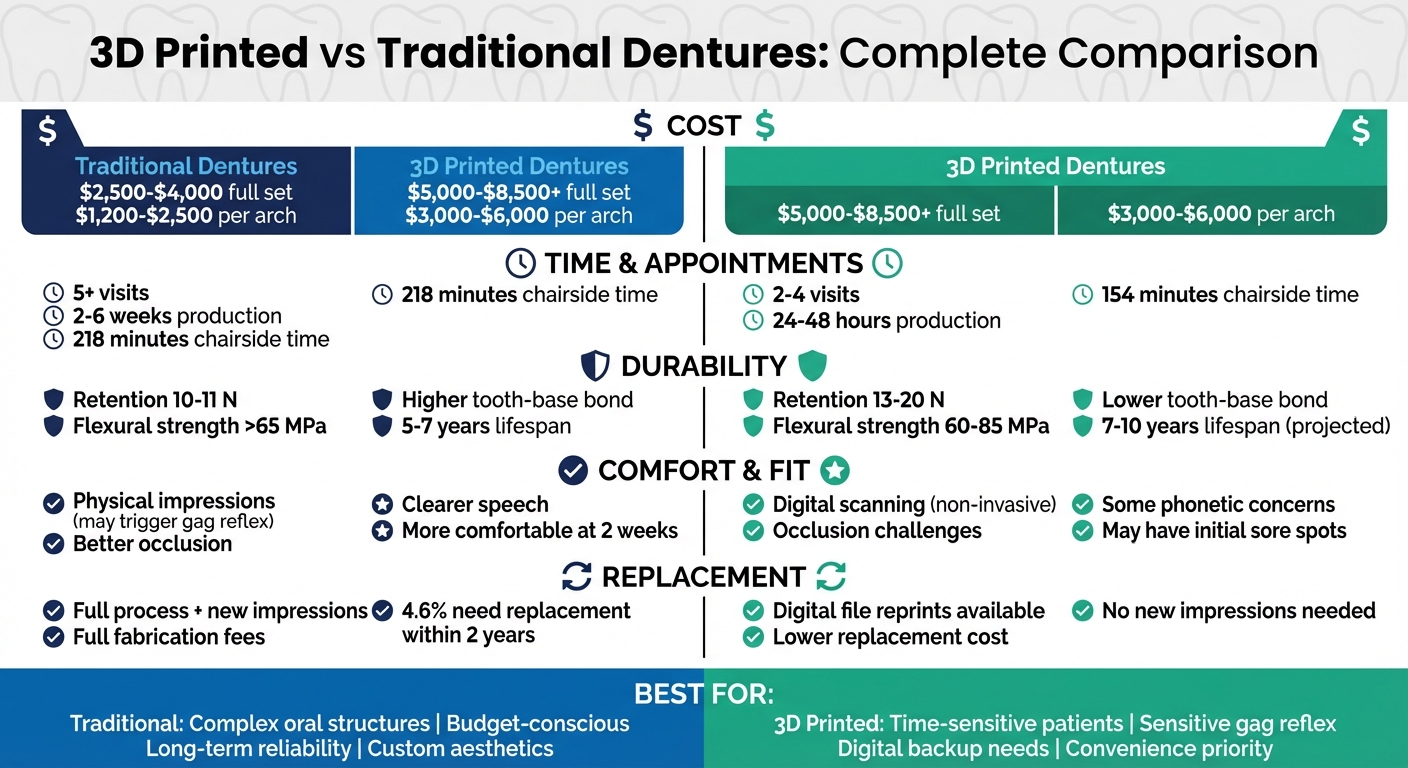
3D Printed vs Traditional Dentures: Cost, Time, and Performance Comparison
Conventional Dentures: How They’re Made and Their Drawbacks
Manufacturing Steps
Creating conventional dentures involves several stages, and the process can take weeks or even months. If tooth extractions are required, a healing period of 6–8 weeks is typically needed before impressions can be taken. These impressions use liquid or semi-solid materials to create a negative mould of the dental arches. Following this, the bite registration step uses wax blocks to determine the correct jaw alignment. Patients then undergo a wax try-in to evaluate the fit and appearance. Depending on factors like healing time and case complexity, the entire process can take anywhere from six weeks to three months [10]. Unfortunately, the lengthy process often leads to post-fitting discomfort for many patients.
Materials Used
Conventional dentures are mainly crafted from acrylic resin, specifically polymethylmethacrylate (PMMA). Partial dentures, on the other hand, often include a lightweight cobalt chrome frame for added support [11][12]. These materials are shaped using a heat-curing process within a plaster mould [1][13]. However, this method isn’t without its flaws. The heat-polymerisation process causes the resin to shrink, leading to distortion.
As researchers from the University of Leeds explain:
"The contraction which occurs on curing the resin produces distortion. This distortion may impact on the comfort and stability of the finished dentures, requiring further adjustment on fitting." [1]
In addition to shrinkage, PMMA has other limitations. It is prone to microbial growth, lacks radio-opacity, can cause allergic reactions, and its mechanical properties may degrade over time [5]. These material issues directly contribute to the challenges patients encounter with conventional dentures.
Problems Patients Face
The combination of manufacturing complexities and material limitations often results in dentures that don’t fit perfectly, requiring multiple adjustments. Poorly fitting dentures can lead to discomfort, irritation, and difficulties with speech and chewing until proper adjustments are made [2][11].
Once the dentures are in place, ongoing maintenance is crucial. Patients must clean them twice daily with mild soap (avoiding toothpaste, which can scratch the surface) and remove them at night to give the mouth a break [11]. Over time, changes in gum and bone structure can cause dentures to become loose, necessitating relining or even complete replacement every few years to ensure continued comfort [12].
3D Printed Dentures: How the Technology Works
Digital Design and Production
Traditional denture-making methods often face challenges like distortion, but digital workflows offer a much more precise alternative. Instead of relying on physical moulds or manual wax-ups, dentists can use intraoral scanners to capture detailed scans of a patient’s mouth. These scans are then used to create a virtual denture design with CAD software. Alternatively, physical impressions and casts can also be digitised to achieve the same result [3][14].
With the scans in hand, dental technicians use CAD tools to design the dentures virtually. They can arrange and adjust teeth, refine shapes, and even simulate jaw movements using virtual articulators like 3Shape or exocad [3][9]. For added accuracy, hybrid scanning methods combine data from both impressions and casts [1].
Once the design is finalised, the denture is constructed through additive manufacturing. This process builds the denture layer by layer from liquid resin, using materials efficiently and with minimal waste [14]. Compared to traditional methods, digital workflows significantly cut down on clinical visits – usually requiring two to four appointments instead of five. A 2025 study highlighted this efficiency, reporting an average chairside time of 154.31 minutes for digital dentures versus 218.00 minutes for conventional ones [9]. Beyond saving time, this streamlined process also improves material performance, as discussed below.
Materials Used in 3D Printing
The materials used for 3D printed dentures are biocompatible photopolymerising resins. These liquid resins harden when exposed to UV light, visible light, or lasers, setting them apart from the heat-cured polymethyl methacrylate (PMMA) used in traditional dentures [5][6].
Recent developments have further improved these resins. For example, adding 0.4% titanium dioxide (TiO₂) nanoparticles enhances their antibacterial properties and reduces the growth of Candida [5][6]. In terms of strength, the flexural strength of these resins typically ranges between 60 and 85 MPa, meeting the ISO minimum requirement of 65 MPa. As noted in BMC Oral Health:
The 3D printed resin had statistically significant lower flexural strength than the other materials tested… but it was within clinically acceptable limits (65 MPa) based on ISO standards [5].
A key step in the process is post-curing the dentures under UV light for 20–30 minutes. This step ensures the final product achieves the necessary strength and biocompatibility [16].
Accuracy and Production Time
Thanks to the precision of digital workflows, 3D printed dentures avoid the polymerisation shrinkage that often leads to distortion in conventional dentures. Brian J. Goodacre, writing in The International Journal of Prosthodontics, remarked:
While the ideal printed denture material does not currently exist, based on the published research, printed dentures have material strength that meets ISO standards, with denture base adaptation similar to conventionally processed dentures [15].
The accuracy of 3D printed dentures is impressive, with deviations between the printed product and the original design typically staying below 0.5 mm [3]. Additionally, the digital process reduces clinical time by 205–233 minutes and creates a permanent digital record. This means exact reprints can be made whenever necessary [3][7][14].
However, when it comes to retention, conventional impressions still have an edge. Dentures designed from border-moulded impressions achieve retention forces of 14.5–16.1 N, compared to 6.2–6.6 N for those created solely from intraoral scans [3].
Cost Comparison: What You’ll Pay
Upfront Costs
When it comes to upfront expenses, traditional handcrafted dentures are the more budget-friendly choice. In Australia, a single arch typically costs between $1,200 and $2,500, while a full set (both upper and lower) ranges from $2,500 to $4,000 [18][17]. If you opt for premium traditional dentures with enhanced aesthetics, the price can climb to as much as $3,500 per arch [18].
On the other hand, digital dentures made using 3D printing technology come with a steeper price tag. A single arch is priced between $3,000 and $6,000, and a full set can cost anywhere from $5,000 to $8,500 or more [18][7]. However, one key advantage of digital dentures is that they generally require just 2–3 clinical appointments [21]. This streamlined process not only saves time but also reduces indirect costs like travel and taking time off work.
Costs Over Time
The long-term costs of dentures can vary significantly depending on the type you choose, particularly when it comes to replacements and maintenance. Traditional dentures have a notable drawback: if they are lost or broken, you’ll need to start the entire process over, including taking new impressions and paying full fabrication fees [18]. On average, traditional complete dentures in Australia last around 6.06 years, with approximately 4.6% of them needing replacement within the first two years [19].
Digital dentures, however, offer a unique benefit. Thanks to their digital file storage, replacements can be manufactured directly from the existing file, eliminating the need for new impressions or redesigning [4][7]. This "digital spare" capability can lead to substantial savings on replacement costs. That said, the materials used in 3D printed dentures, such as resins with lower flexural strength, may result in higher maintenance expenses due to potential fractures or debonding issues [1][5].
Cost Comparison Table
Here’s a quick breakdown of the cost and process differences between traditional and 3D printed dentures:
| Factor | Traditional Dentures | 3D Printed Dentures |
|---|---|---|
| Cost Per Arch | $1,200 – $2,500 [18] | $3,000 – $6,000 [18] |
| Full Set | $2,500 – $4,000 [17] | $5,000 – $8,500+ [7] |
| Clinical Appointments | 5+ visits [21] | 2–3 visits [21] |
| Production Time | 2–6 weeks [20] | 24–48 hours [20] |
| Replacement Process | Full fee + new impressions [18] | Lower cost from stored file [18] |
| Average Lifespan | 5–7 years [20] | 7–10 years (projected) [20] |
Durability and Fit: How They Compare
How Well They Stay in Place
When deciding between traditional and digital workflows for dentures, durability and how well they stay in place are crucial considerations. Retention – how securely dentures remain in position during use – is a key factor for patient comfort and satisfaction.
Studies show that 3D printed dentures can achieve retention forces ranging from 13 to 20 N, which is stronger compared to the 10 to 11 N typically observed with traditional dentures [3]. However, the technique used during the fitting process can impact these results. For example, intraoral scans often result in lower retention compared to border-moulded impressions. Clinical outcomes can vary significantly, with some digital denture studies reporting that 37.5% of patients experienced retention issues, and 31.3% needed a complete denture remake [3]. Despite the precision offered by digital workflows, many patients still find conventional dentures more comfortable and stable, particularly for speaking and chewing [4]. This preference is often linked to challenges in achieving perfect occlusion (bite alignment) with 3D printed options.
Material Strength
The performance of dentures is closely tied to the materials used in their construction. Traditional dentures are made from heat-cured polymethyl methacrylate (PMMA), while 3D printed dentures use light-cured photopolymer resins. Earlier studies suggested that 3D printed resins had lower flexural strength (60–85 MPa). However, recent advancements have shown that optimised printing techniques – such as using a 90° printing angle and a 30-minute post-curing process – can produce materials with flexural and compressive strength that surpass conventional PMMA [16].
"3D printing can yield custom, high-precision prosthetic bases with improved mechanical properties." – Nature Scientific Reports [16]
One ongoing challenge is the bond strength between the denture teeth and the base. 3D printed resins often have weaker bonding compared to the chemical integration achieved with heat-cured acrylics, increasing the risk of teeth debonding [1][5]. To address this, some clinicians use hybrid approaches, combining 3D printed bases with conventionally manufactured teeth to achieve a balance of digital precision and material reliability.
Durability Comparison Table
| Factor | Traditional Dentures | 3D Printed Dentures |
|---|---|---|
| Retention Force | 10–11 N [3] | 13–20 N [3] |
| Flexural Strength | >65 MPa (standard) [5] | 60–85 MPa (variable) [5] |
| Water Absorption | Higher [16] | Lower (better stability) [16] |
| Tooth-to-Base Bond | Higher (chemical integration) [1] | Lower (debonding risk) [1] |
| Surface Hardness | Standard PMMA [16] | Higher (better wear resistance) [16] |
| Adjustment Needs | Standard [6] | Higher (occlusal errors) [6] |
sbb-itb-2be92ed
Patient Comfort: Daily Experience
Getting Impressions: Physical vs Digital
Traditional impressions involve using trays filled with alginate or silicone, which can be uncomfortable, often causing gag reflexes and requiring multiple lengthy appointments. On the other hand, digital workflows use intraoral laser scanning to capture the shape of the mouth without the need for bulky trays or messy materials. This method is quicker, non-invasive, and reduces both patient discomfort and the number of visits – typically requiring only 2 to 4 sessions compared to around 5 for conventional dentures [14][9].
That said, there’s a trade-off. While digital scanning is more comfortable, traditional physical border-moulded impressions deliver better retention. For example, maxillary denture bases created using conventional methods show retentive forces of 14.5 to 16.1 N, compared to only 6.2 to 6.6 N with intraoral scans alone [3]. To address this, some clinics now use a hybrid approach, combining traditional impressions with digital scanning to achieve both comfort and retention. This initial difference in comfort plays a key role in shaping how patients experience daily activities like speaking and chewing.
Speaking and Chewing
The choice of impression technique doesn’t just affect fit – it also impacts speaking and chewing performance, which are essential for daily life. Studies show that wearers of conventional dentures often report improved functionality within two weeks and feel "less handicapped" after three months compared to those using digital dentures [7].
"More patients favoured conventional dentures over 3D-printed dentures in terms of comfort. This is likely due to the challenge of correctly reproducing the occlusion in the 3D-printed dentures."
- Nature [1]
3D-printed dentures face difficulties in achieving balanced occlusion, which can influence chewing efficiency, even though bite force measurements are comparable. Additionally, some clinical reviews highlight phonetic challenges with 3D-printed dentures. Traditional dentures are often rated higher for clear speech, particularly in the early stages of use [7][6]. While these differences in comfort enhance the patient’s overall experience, they must be weighed against the retention and occlusal challenges already noted.
Comfort Comparison Table
| Comfort Factor | Traditional Dentures | 3D Printed Dentures |
|---|---|---|
| Impression Process | Trays with putty; may trigger gag reflex [7] | Digital laser scanning; quick and non-invasive [7] |
| Initial Adaptation | Generally more comfortable in the first 2 weeks [7] | May cause more initial pain or "sore spots" [7] |
| Chewing Efficiency | Reliable balanced occlusion; improved functionality at 2 weeks [7][6] | Comparable bite force, but occlusion errors can occur [1][9] |
| Speaking/Phonetics | Clear speech is a well-established standard [7] | Some concerns with phonetic accuracy [6] |
| Total Chairside Time | 218.00 ± 20.75 minutes [9] | 154.31 ± 13.19 minutes [9] |
| Number of Visits | Typically 5 clinical sessions [14] | 2 to 4 clinical sessions [14][9] |
Choosing the Right Denture
Main Differences
When it comes to picking the right denture, it’s all about balancing cost, durability, and comfort with your personal needs. Conventional dentures are generally more affordable but require multiple appointments to get just right. On the other hand, digital dentures are quicker and more convenient, cutting chairside time dramatically – sometimes reducing five visits to just two. However, this convenience comes with a higher price tag[8][9].
Traditional dentures are often preferred for patients with complex oral structures or those looking for highly customised aesthetics. They allow for precise tooth placement and detailed personalisation, making them a strong choice for those who want a natural-looking smile[7]. Meanwhile, 3D printed dentures shine in terms of speed and practicality. They come with the added benefit of a permanent digital record, making replacements faster if the original is lost or damaged[7][8]. That said, studies reveal that up to 31.3% of digital dentures may require remakes, and their retention can be less reliable when digital impressions skip traditional border-moulding techniques[3].
"If your jaw alignment does not conform to normal, you require individualised aesthetic solutions, or you’re seeking the best value for your investment, conventional dentures remain the gold standard." – Simone Hargrave, Northern Rivers Denture Clinic[7]
Ultimately, the choice comes down to your unique oral health needs, and expert advice can help you navigate these options effectively.
Getting Professional Advice
Before deciding on a denture type, it’s crucial to consult with a dental professional. If you have a sensitive gag reflex, a packed schedule, unusual jaw alignment, or specific aesthetic preferences, personalised guidance can help you find the best fit for your situation[7][2].
Complete Smiles Bella Vista provides in-depth denture consultations to assess your oral anatomy and recommend the most suitable solution. With a professional evaluation, you can ensure your denture offers the right balance of comfort, functionality, and long-term satisfaction.
3D Printing Dentures: Pros & Cons
FAQs
How do the maintenance needs of 3D printed dentures compare to traditional dentures?
Both 3D printed dentures and traditional dentures need the same level of care to keep them in good shape and working well. This means cleaning them daily to get rid of food debris and bacteria, as well as scheduling regular dental check-ups to ensure they fit properly and remain in good condition.
So far, there’s no proof that one type of denture is easier or harder to maintain than the other. Regardless of the choice, taking proper care of your dentures and visiting your dentist regularly are key to keeping your oral health and comfort on track.
How do 3D-printed dentures affect speaking and chewing compared to traditional dentures?
3D-printed dentures are created using highly accurate digital scans, delivering a precise fit and stable bite alignment. This level of precision not only helps improve speech clarity but also makes chewing easier, even with tougher or more complex foods.
While many patients report that the comfort of 3D-printed dentures is similar to traditional ones, the custom fit often minimises irritation and enhances overall ease of use. Like all dentures, some adjustments might still be necessary to ensure they meet individual needs perfectly.
Are 3D-printed dentures as effective as traditional dentures for complex oral structures?
3D-printed dentures offer a modern solution for creating dentures that fit complex oral structures with impressive precision, much like traditional methods. Thanks to advanced digital imaging and printing technologies, these dentures can be tailored to provide an accurate fit and personalised design, making them a practical choice for many individuals.
That said, highly irregular oral anatomy can sometimes present challenges, such as difficulties in achieving ideal tooth positioning or proper bite alignment. In such cases, dental professionals step in to make the necessary adjustments, ensuring the dentures meet both functional requirements and aesthetic expectations.
Related Blog Posts
- 3D Printing in Dental Implant Prototyping: How It Works
- Durability of 3D Printed Dentures vs Traditional Materials
- 3D Printing in Implants: Cost vs Benefits
- Types of Removable Dentures Explained
Important Notice: Any surgical or invasive procedure carries risks. Before proceeding, you should seek a second opinion from an appropriately qualified health practitioner.
Individual results may vary. The information provided in this article is for educational purposes only and does not constitute medical advice.
Checkout Related Blogs




Get in touch with us
For more information, call us now to start feeling better. Or fill the form below to make appointment
The Latest News from Complete Smiles
How to Clean Clear Plastic Retainers
Checklist for Choosing Wearable Dental Devices
Checklist for Choosing Cloud AI Platforms in Dentistry

Complete Smiles Bella VistaAccepts All Major Health Funds, Including





