





Top Privacy Concerns in AI Dental Imaging
AI dental imaging is transforming dentistry in Australia, offering precision in diagnostics and treatment planning. But with this progress comes serious privacy challenges. AI systems rely on sensitive patient data – like X-rays, medical histories, and even data from wearables – raising concerns about data security, consent, and fairness. Key risks include:
- Sensitive data handling: AI systems process highly personal information, including dental images and health records.
- Re-identification risks: Anonymised data can still be linked back to individuals in some cases.
- Compliance requirements: Dental practices must adhere to the Privacy Act 1988 and other regulations.
- Bias in AI models: Training datasets often lack diversity, leading to potential inequities in diagnosis.
Australia’s regulatory framework, including the Privacy Act and oversight from the Therapeutic Goods Administration (TGA), mandates strict safeguards. These include encryption, robust consent processes, and transparency in data use. Dentists must maintain accountability for AI outputs, ensuring human oversight remains central to care.
The balance between AI advancements and patient privacy depends on collaboration between developers, practitioners, and regulators. By prioritising secure data practices and transparent communication, dental AI can improve outcomes while respecting privacy.
Data Collection and Anonymisation Methods
Patient Data in AI Training
AI dental imaging systems depend on extensive datasets to develop their ability to detect cavities, plan treatments, and interpret X-rays. These datasets include a variety of sources, such as 2D radiographs, 3D Cone Beam Computed Tomography (CBCT) scans, intraoral clinical photographs (frontal, buccal, and occlusal views), and 3D intraoral scans [1][2][7]. Additionally, AI models often incorporate information from electronic health records, medical histories, and wearable devices [1][2].
The amount of data required can vary significantly. For instance, simple classification models – like those that identify healthy versus unhealthy teeth – may need only a few thousand images. In contrast, predictive models designed to foresee disease progression or treatment outcomes demand much larger datasets, often tens or even hundreds of thousands of data points, to ensure accurate performance [2]. A notable example comes from January 2026, when researchers at Pusan National University and Ulsan University Hospital reported a study using 3,100 intraoral photographs from 620 paediatric patients. Their automated system achieved an impressive 99.7% accuracy across five intraoral categories [7].
Ensuring datasets are diverse while protecting patient privacy is a complex balancing act. To avoid algorithmic bias, these datasets must reflect a wide range of demographics, including age, gender, and ethnicity. However, rare or underrepresented conditions can inadvertently increase the risk of identifying individuals [2][6]. This underscores the importance of implementing robust anonymisation methods, which are discussed below.
Anonymisation Techniques
In Australia, the Privacy Act 1988 (Cth) offers clear guidance: data that has been effectively de-identified is no longer classified as "personal information" [8]. This legal distinction allows dental practices and AI developers to use patient data for secondary purposes, such as AI training, without breaching privacy laws. However, proper de-identification involves more than just removing obvious identifiers like names and addresses.
The Office of the Australian Information Commissioner (OAIC) recommends a two-step approach to de-identification. First, direct identifiers – such as names, Medicare numbers, and addresses – should be removed. Next, quasi-identifiers, which include characteristics like rare dental conditions or distinctive anatomical features, must be addressed. These could potentially reveal someone’s identity when combined with other data [8][9]. Common techniques for this process include:
- Data masking: Obscuring sensitive information.
- Pseudonymisation: Replacing identifiers with coded alternatives.
- Rounding or aggregation: Grouping data into broader categories, such as age ranges (e.g., 25–35) instead of specific birth dates.
- Perturbation: Slightly altering data values while retaining their statistical relevance [8].
The OAIC defines data as de-identified when "the risk of an individual being re-identified in the data is very low in the relevant release context… there is no reasonable likelihood of re-identification occurring" [8]. This determination considers not only the data itself but also the environment in which it will be accessed and the potential motivations of third parties to re-identify it [8]. Furthermore, under APP 11.2, dental practices are legally obligated to either destroy or de-identify personal information once it is no longer required for its original clinical purpose [8].
Patient Consent and Transparency
Balancing technological advancements with privacy is a delicate act that hinges on consent and data transparency working seamlessly together. When dental practices use AI tools to interpret X-rays or assist in treatment planning, patients need a clear understanding of how their data is being utilised. While AI can enhance decision-making, the ultimate responsibility for clinical decisions remains firmly with dental practitioners, not the technology [6]. This makes it crucial for consent processes to explain that AI serves as a supportive tool, rather than a substitute for professional expertise [11][5].
Informed Consent Processes
For consent to be meaningful, it must clearly outline the benefits, risks, and limitations of the AI system, including the possibility of inaccuracies [11][12]. The Office of the Australian Information Commissioner (OAIC) offers specific guidance here:
Where a developer cannot clearly establish that a secondary use for an AI-related purpose was within reasonable expectations and related to a primary purpose, to avoid regulatory risk they should seek consent for that use [3].
Patients should also be informed about where their data is stored, how long it will be retained, and the security measures in place to protect it [2][12]. If patient data, such as radiographs or 3D scans, is intended to be used for AI training or system enhancement, this must be explicitly communicated. Additionally, patients should have the option to opt out without it impacting their clinical care [2][3]. Michelle Mason highlights the importance of ensuring patients are fully aware of how their data might be used for AI purposes and stresses the need for a straightforward opt-out mechanism [2]. These consent protocols establish a solid foundation for the transparent data practices discussed next.
Transparency in Data Use
Transparent policies around data usage are essential to building patient trust, especially when paired with robust consent procedures. Explaining how AI works in simple terms is critical for fostering confidence. However, a survey revealed that while 54.8% of Australian dentists and dental students were familiar with AI applications in dentistry, 70.3% were unable to name a specific AI software [13]. This knowledge gap can make it challenging to provide patients with the clarity they deserve about how their data is being used.
To address this, dental practices should revise their privacy policies to include precise details about AI-related activities, such as how data is processed and whether it is shared [3]. The Australian Dental Association underscores the importance of acknowledging the limitations of AI in clinical settings:
the known limitations of an AI system in clinical decision making should be clearly recognised and understood by Dental Practitioners and patients [5].
Patients need to understand that AI systems provide probabilistic recommendations based on patterns, not certainties. All AI outputs must be verified by a qualified dentist before being acted upon [3][12]. With 91.6% of Australian dental professionals viewing AI as a tool to assist rather than replace them [13], open communication about this collaborative approach is vital to ensuring patient confidence and understanding.
Technical Safeguards for Data Security
Building on established consent and transparency protocols, technical measures play a key role in safeguarding patient data. These include encryption, controlled access, and detailed auditing processes. Together, they form the foundation of privacy protection in AI-driven dental imaging systems. As the Australian Signals Directorate states:
Cybersecurity is a necessary precondition for the safety, resilience, privacy, fairness, efficacy and reliability of AI systems [14].
Below, we explore encryption methods and audit mechanisms that reinforce these safeguards.
Encryption and Access Control
AI dental imaging systems rely on multiple layers of encryption to protect sensitive data. For instance, end-to-end encryption ensures secure data transmission, which is especially vital during teledentistry consultations. Stored data is safeguarded with strong encryption protocols [15]. Advanced techniques like homomorphic encryption even allow AI models to process dental images without the need for decryption [14]. Meanwhile, cryptographic hashes and signatures protect the integrity of AI model weights, ensuring accurate diagnostics [14].
Access control is just as important. According to the Australian Dental Association:
Multi-factor authentication (MFA) is a critical security measure that enhances the protection of digital accounts and sensitive information [15].
MFA adds an extra layer of protection by requiring multiple forms of verification, such as a password (something you know), a security token (something you have), or biometric data (something you are). This significantly reduces the risk of unauthorised access compared to relying on passwords alone. Additionally, the principle of least privilege ensures that access to patient data and AI system functions is restricted to staff who genuinely need it for their specific roles [14]. These measures are further supported by robust audit trails to maintain accountability.
Audit Trails and Accountability
Detailed audit logs track every instance of patient data access and usage within AI systems. These logs capture system inputs, such as queries and inference requests, allowing practices to detect unusual activity and respond swiftly to potential security breaches [14]. For example, when I-MED Radiology Network collaborated with Annalise.ai for AI training, their monitoring protocols enabled Annalise.ai to promptly identify and address instances where personal information was mistakenly shared. This included immediate de-identification or deletion of the data [16]. Such practices highlight the value of audit trails in ensuring accountability in real-world applications.
Privacy Commissioner Carly Kind underscores the critical nature of these safeguards:
Developing an AI model is a high privacy risk activity when it relies on large quantities of personal information… Developers should take steps to ensure compliance with the Privacy Act, and first and foremost take a ‘privacy by design’ approach [16].
Additional measures, such as regular software updates, secure cloud storage within Australia, and privacy impact assessments, further enhance technical protections. These steps help dental practices comply with the Privacy Act 1988 while maintaining patient trust [15][3]. Together, these technical safeguards lay the groundwork for addressing broader challenges like algorithmic bias and ensuring fairness in AI systems.
sbb-itb-2be92ed
Algorithmic Bias and Equity
While technical measures can safeguard data, they don’t guarantee fairness in how AI performs across different patient groups. Bias in dental imaging AI often results in disparities in diagnostic accuracy, particularly for populations underrepresented in training datasets. These privacy protections, though necessary, do little to address the underlying biases in the data itself. As Zaid H. Khoury and colleagues highlight:
If responsibly developed, AI can reduce disparities in oral healthcare; if not, it risks worsening existing inequities [18].
This issue goes beyond just privacy – it directly impacts patient outcomes and trust in dental care systems. To tackle this, it’s crucial to explore the specific biases embedded in AI models used in dentistry.
Bias Challenges in AI Dental Models
A major hurdle is the skewed nature of many training datasets. AI models are frequently trained on data dominated by White, non-Hispanic individuals from high-income countries. As a result, diagnostic accuracy often declines for underrepresented groups [17]. The problem is further complicated by the complexity of advanced Convolutional Neural Networks. These systems are so intricate that it’s often unclear whether their outputs are based on genuine clinical indicators or reflect demographic biases [17].
Geographical bias adds another layer of difficulty. Much of the research in dental AI comes from countries like the United States, United Kingdom, and Germany. This focus can lead to models that fail to recognise disease patterns or clinical variations common in low-to-middle-income regions [4]. For instance, AI systems trained on such homogeneous datasets may misdiagnose conditions, overlook carious lesions, or mistakenly flag treatments like fissure sealants as cavities [19].
The composition of the dental workforce also plays a role. A lack of diversity among dental practitioners can influence data collection patterns, which in turn perpetuates existing biases. The Dental Board of Australia has underscored the importance of practitioner oversight in this context:
Regardless of what technology is used to advance healthcare, the practitioner remains responsible for delivering safe and quality care… Practitioners must apply human judgement to any output of AI [6].
Clearly, addressing these challenges requires proactive and intentional strategies.
Strategies for Ensuring Equity
To reduce these disparities, deliberate action is essential. As F. A. Malik and A. Shahbaz from Lahore Medical and Dental College explain:
Fairness is not an automatic property of AI models, but something that must be deliberately specified, evaluated and monitored [18].
Creating equitable AI begins with building diverse datasets that include a wide range of ethnicities, ages, socioeconomic backgrounds, and regions. This ensures the models can recognise a broader spectrum of clinical presentations [17]. Federated learning offers a promising solution by enabling multiple institutions to collaborate on model training without sharing raw patient data, thereby improving dataset diversity while maintaining privacy [1].
Regular bias audits are equally critical. Both dental practices and AI developers should routinely assess model performance across various demographic groups. This means going beyond general accuracy rates to evaluate specific metrics for minority populations. Transparent reporting of dataset demographics and subgroup performance is key, as it helps practitioners determine whether an AI tool is suitable for their patient population [18].
Explainable AI techniques, such as Class Activation Maps, can also play a vital role. These methods highlight the image regions that influence AI decisions, allowing practitioners to confirm that the model is focusing on clinically relevant features rather than irrelevant patterns [17]. Combining such tools with mandatory human-in-the-loop workflows – where dentists validate all AI outputs against their clinical assessments – can help avoid automation bias, the tendency to blindly trust AI results without thorough review [6].
Regulatory Frameworks and Emerging Standards
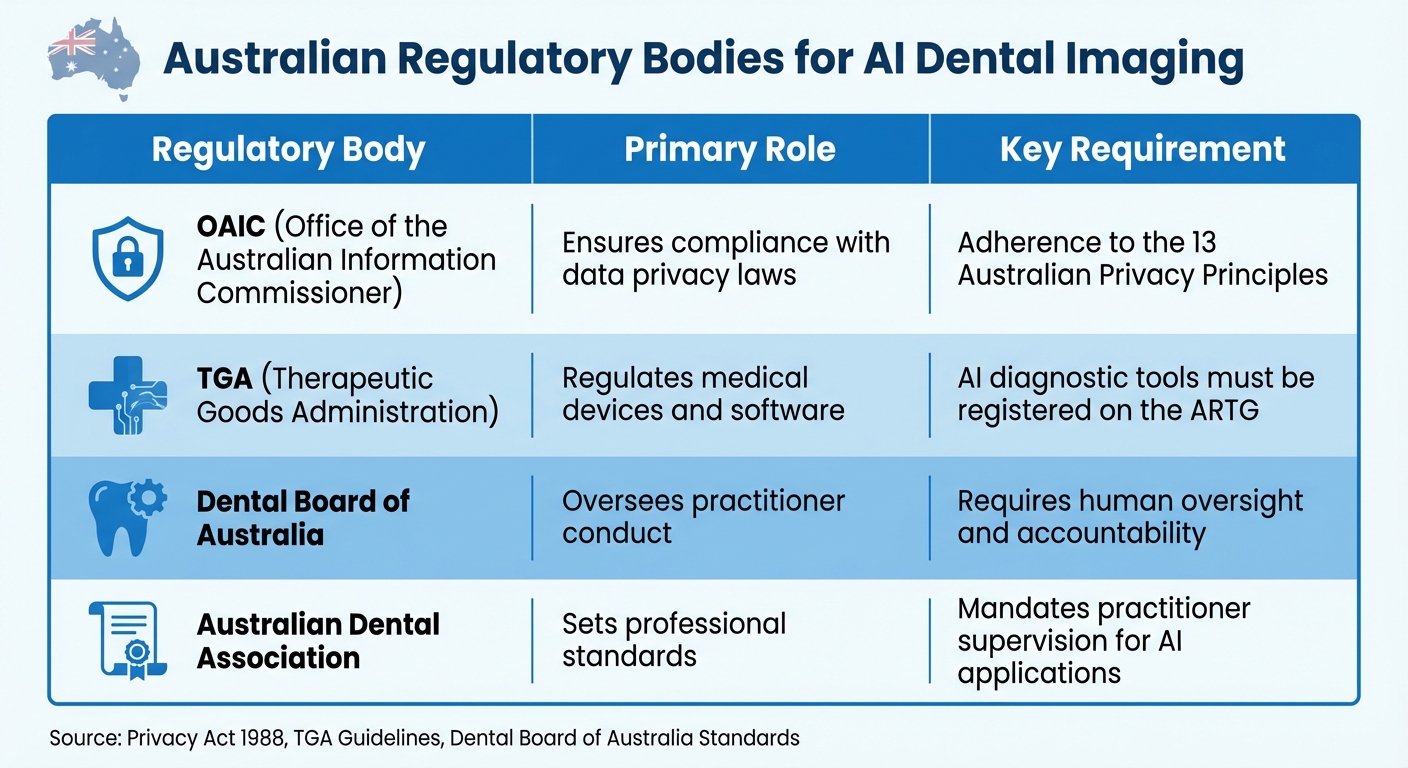
Key Australian Regulatory Bodies Governing AI in Dental Imaging
In Australia, dental practices operate under a structured regulatory framework designed to protect patients while allowing room for advancements. For practices exploring the use of AI, understanding these frameworks is critical.
Key Regulations and Guidelines
The Privacy Act 1988 sets out 13 Australian Privacy Principles (APPs), which impose strict guidelines for handling sensitive patient data. As "health service providers", dental practices must adhere to these rules when managing sensitive information like dental records and radiographs [9].
The Therapeutic Goods Administration (TGA) adds another layer of oversight. Any AI software used for diagnostics, such as analysing radiographs or planning treatments, is classified as a medical device and must be registered on the Australian Register of Therapeutic Goods (ARTG). Following the Government’s final report on AI in Health Care released on 23 July 2025, scrutiny over AI medical devices has increased [20].
The Dental Board of Australia focuses on regulating practitioners rather than the technology itself, while the Australian Dental Association stresses that AI tools in clinical settings must be supervised by a registered dental practitioner. Algorithms cannot replace clinical responsibility [5].
Here’s a quick look at the roles of key regulatory bodies:
| Regulatory Body | Primary Role | Key Requirement |
|---|---|---|
| OAIC | Ensures compliance with data privacy laws | Adherence to the 13 Australian Privacy Principles |
| TGA | Regulates medical devices and software | AI diagnostic tools must be registered on the ARTG |
| Dental Board of Australia | Oversees practitioner conduct | Requires human oversight and accountability |
| Australian Dental Association | Sets professional standards | Mandates practitioner supervision for AI applications |
Another critical aspect is consent for secondary use. Using patient data to train or refine AI models often qualifies as a "secondary purpose" under the Privacy Act. The Office of the Australian Information Commissioner (OAIC) has made it clear:
Just because data is publicly available or otherwise accessible does not mean it can legally be used to train or fine-tune generative AI models or systems. [3]
In May 2025, the OAIC released Version 2.0 of its Guide to Health Privacy, which specifically addressed handling genetic and sensitive health information [9]. This guidance pushes for a "privacy by design" approach, requiring dental practices to conduct Privacy Impact Assessments (PIAs) before introducing new AI tools. These assessments help identify risks like data breaches or re-identification [3].
Emerging Standards for AI Governance
Beyond established regulations, emerging standards are beginning to shape AI governance in dental care. The Australian Government introduced a Voluntary AI Safety Standard in 2024–2025, providing 10 guardrails to guide organisations in deploying AI responsibly [3]. While these standards are not mandatory, they indicate how future regulations may evolve, especially for high-risk healthcare applications.
The OAIC now considers the development of generative AI models a "high privacy risk activity" when they rely on extensive personal data [3]. Dental practices must conduct a Privacy Threshold Assessment (PTA) to determine if a full PIA is necessary before proceeding with an AI project [10].
Validation benchmarks are also gaining traction as a way to ensure AI accountability. These benchmarks evaluate whether AI systems produce reliable, explainable outputs based on clinically relevant features, rather than relying on irrelevant patterns [5]. The Australian Dental Association’s policy framework underscores the need for "responsible AI" principles, which include dentist involvement in model training and a focus on risk management [5].
Governance frameworks are also adopting data minimisation and Privacy Enhancing Technologies (PETs). These practices ensure that only the necessary data is processed for each clinical use case [10]. This aligns with APP 10, which requires dental practices to take reasonable steps to ensure personal information used by AI systems is accurate, complete, and current [3].
Transparency is becoming increasingly important. Dental practices must update privacy policies to explicitly outline how AI is used, how patient data is processed, and whether any data is employed for training models [3]. According to recent OAIC guidance, patients have the right to know when AI plays a role in their care, particularly for high-stakes diagnostic decisions.
For Australian dental practices, staying compliant means keeping up with both current regulations and emerging standards. This involves conducting PIAs, ensuring AI tools are TGA-approved, updating privacy policies, and maintaining human oversight of AI outputs. Together, these measures form a robust framework for protecting patient privacy and ensuring accountability in AI-driven dental care.
Conclusion: Balancing Innovation with Privacy
AI-powered dental imaging holds the potential to improve diagnostic precision and patient outcomes, but this promise can only be realised if privacy concerns are treated as a top priority. Achieving this balance requires a shared commitment from developers, practitioners, and regulatory bodies. Developers must integrate privacy safeguards into their systems from the outset, using methods like federated learning and differential privacy. At the same time, dental practitioners must ensure they exercise human oversight over all AI-generated outputs. As the Dental Board of Australia emphasises:
…the practitioner remains responsible for delivering safe and quality care and must apply human judgement to any output of AI [6].
This collaborative effort forms the cornerstone of the technical, ethical, and regulatory measures explored earlier.
For AI in dentistry to succeed, collaboration is key. Developers, clinicians, and regulators must work together to ensure the technology is both effective and aligned with privacy standards. Clinician input and independent oversight are crucial to continuously monitor and refine AI systems [5]. Regulatory bodies like the OAIC and TGA must continue to offer clear, updated guidance to help dental practices navigate the complexities of integrating advanced technology within privacy laws.
While technical measures such as encryption, access controls, and audit trails are critical, the ethical foundation of AI integration lies in transparency and informed consent. Patients need to understand when AI is involved in their care, how their data is being used, and what protections are in place. Without this trust, even the most advanced technologies risk rejection.
The Australian Dental Association’s policy framework encapsulates this approach well:
Applications of Artificial Intelligence in dentistry should prioritise patient safety, quality of care, continuity of care, and data privacy and security [5].
This isn’t a matter of choosing between innovation and privacy – they must advance together. When developers, practitioners, and regulators unite in their efforts, AI can transform dental care while safeguarding the essential right to privacy.
As the field progresses, maintaining vigilance is non-negotiable. A patient-first approach – anchored in human oversight, strong safeguards, and transparent communication – will be essential to preserving trust and ensuring safe, effective care.
FAQs
How is patient privacy protected in AI-powered dental imaging?
AI-powered dental imaging prioritises patient privacy through robust security protocols and adherence to Australian legal standards. Before processing, images are typically de-identified – meaning personal details such as names, dates of birth, or Medicare numbers are removed or replaced with randomised codes. This ensures the data cannot be traced back to individuals. These de-identified files are then stored on encrypted servers, which utilise multi-factor authentication and maintain detailed access logs to prevent any unauthorised access.
Many AI systems also employ privacy-preserving techniques like federated learning. In this approach, algorithms are trained locally at dental clinics, and only the learned parameters – never the raw images – are shared with central systems. This method significantly lowers the risk of data breaches by keeping sensitive data within the clinic’s secure environment.
In Australia, dental practices must comply with the Australian Privacy Principles outlined in the Privacy Act 1988 and the Health Records Act 2001. These regulations mandate that explicit patient consent is obtained before any images are used for AI analysis. Practices are also required to clearly explain how data will be stored and protected, implementing measures like encryption, regular security assessments, and secure data backups. Together, these safeguards ensure that AI dental imaging can improve diagnostic accuracy while upholding the confidentiality and trust of patients in Australia.
What are the main risks of bias in AI dental imaging, and how can they be addressed?
AI dental imaging models aren’t immune to bias, often reflecting limitations in the data or methods used to develop them. For instance, if training datasets don’t include a wide variety of individuals – like Indigenous Australians, older adults, or patients with distinct anatomical features – the accuracy of these algorithms can drop significantly for these groups. Similarly, models trained using data from specific imaging devices or a single clinic might falter when applied to different equipment or in broader clinical environments.
To tackle these challenges, it’s crucial to rely on diverse, multi-centre datasets that encompass a broad spectrum of patients and imaging conditions. Clear and transparent reporting, thorough testing across various Australian populations, and continuous monitoring are all vital to ensuring that AI tools deliver fair and dependable outcomes in everyday dental practice.
How can I ensure my dental imaging data is used responsibly with AI systems?
To make sure your dental imaging data is handled responsibly, start by checking if the clinic adheres to the Privacy Act 1988 and the Australian Privacy Principles (APPs). These regulations require clinics to obtain clear consent before collecting, storing, or sharing your personal health information. It’s a good idea to ask for the clinic’s privacy policy, which should explain how your data is safeguarded and whether it’s de-identified or anonymised before being used in AI systems.
Here are a few steps you can take:
- Verify data de-identification: Ensure your data is anonymised before being used for AI training to reduce privacy risks.
- Inquire about security measures: Ask about protections like encryption and access controls to prevent unauthorised access to your information.
- Opt out if needed: You have the right to decline data sharing for research or AI development if you’re not comfortable with it.
If you’re unsure or have concerns, bring them up with the clinic’s staff. They should be able to explain how your data is managed responsibly and in line with Australian privacy laws.
Related Blog Posts
- Real-Time AI in Dental Imaging: What to Know
- How AI Detects Periodontal Disease Early
- Real-Time Oral Risk Assessment for Kids: Benefits of AI
- AI Tools Transforming Multidisciplinary Dental Care
Important Notice: Any surgical or invasive procedure carries risks. Before proceeding, you should seek a second opinion from an appropriately qualified health practitioner.
Individual results may vary. The information provided in this article is for educational purposes only and does not constitute medical advice.
Checkout Related Blogs




Get in touch with us
For more information, call us now to start feeling better. Or fill the form below to make appointment
The Latest News from Complete Smiles
How to Clean Clear Plastic Retainers
Checklist for Choosing Wearable Dental Devices
Checklist for Choosing Cloud AI Platforms in Dentistry

Complete Smiles Bella VistaAccepts All Major Health Funds, Including





