





AI Tools Transforming Multidisciplinary Dental Care

AI is reshaping dental care by improving collaboration among specialists like orthodontists, periodontists, oral surgeons, and prosthodontists. It integrates diagnostic tools, treatment planning systems, and workflow platforms to streamline processes, increase precision, and save time. Here’s a quick summary:
- Diagnostics: AI detects issues like caries and oral lesions with up to 95% accuracy, standardises visuals for better communication, and reduces variability in diagnoses.
- Treatment Planning: Predictive modelling optimises implant placement, orthodontic forces, and prosthetic designs, cutting planning times significantly.
- Workflow Management: Automates tasks like documentation and scheduling, saving hours daily while improving team communication.
Despite its advantages, challenges include reliance on retrospective studies, algorithmic bias, data privacy concerns, and the need for human oversight to ensure safe and ethical use. AI supports, but does not replace, clinical expertise.
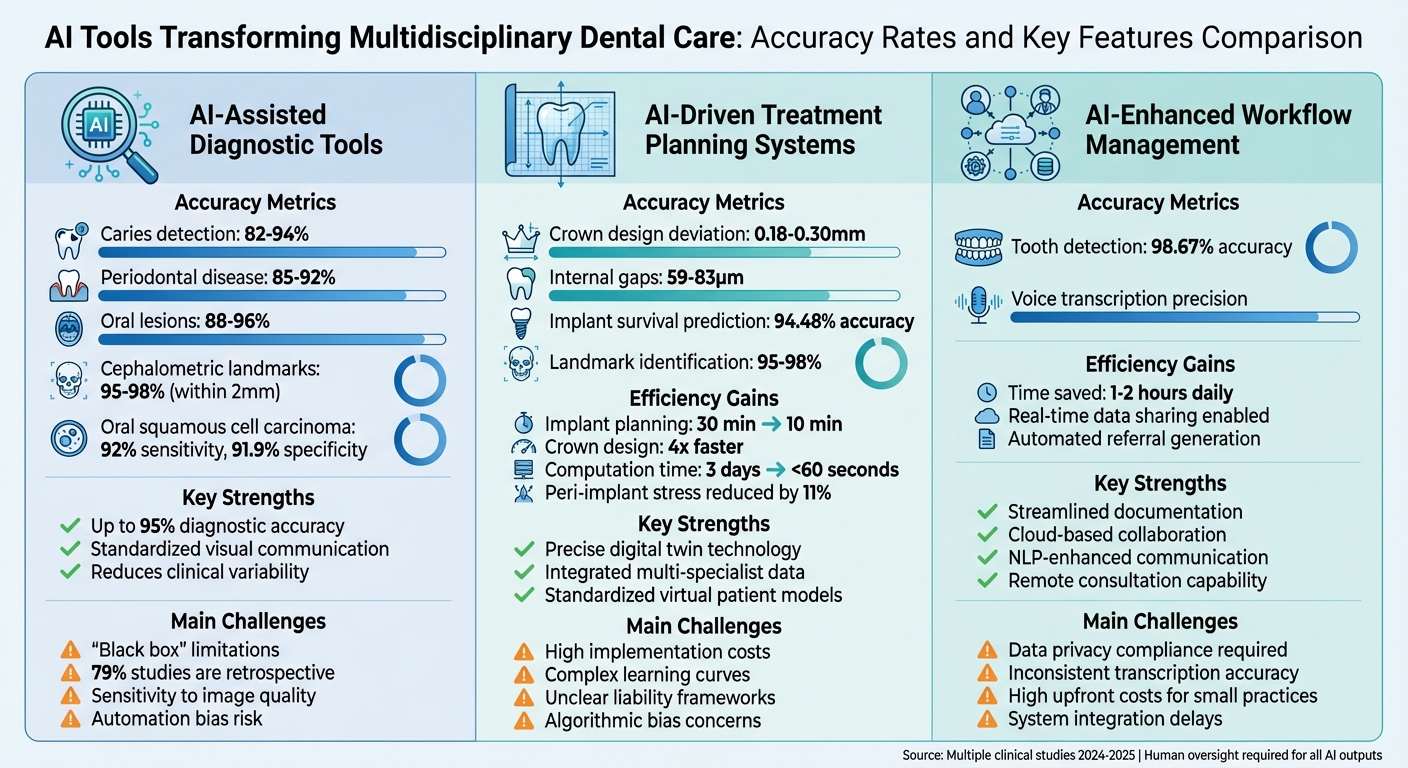
AI Tools in Dental Care: Accuracy Rates and Key Features Comparison
1. AI-Assisted Diagnostic Tools
Accuracy and Reliability
AI-powered diagnostic systems, such as Convolutional Neural Networks (CNNs), have shown impressive diagnostic accuracy, ranging from 82% to 95% [9]. For instance, these tools can detect caries with 82–94% accuracy, evaluate periodontal disease with 85–92% accuracy, and identify oral lesions at 88–96% accuracy [7].
In orthodontics, AI achieves 95% to 98% accuracy in identifying cephalometric landmarks within a 2 mm tolerance [7]. For oral squamous cell carcinoma (OSCC), AI-assisted detection has demonstrated a pooled sensitivity of 92% and a specificity of 91.9% [3].
Recent studies have consistently validated these systems against clinical benchmarks [2].
Beyond improving diagnostic precision, these tools also enhance collaboration among dental professionals by providing a shared framework for communication.
Specialist Collaboration Features
Accurate diagnostics play a crucial role in fostering collaboration by creating a unified visual language among dental practitioners.
AI diagnostic tools bridge the gap between general dentists and specialists through features like coloured overlays and annotations on radiographs. These overlays highlight key areas such as bone loss, carious lesions, or suspicious abnormalities [10]. By standardising diagnostic visuals, these tools reduce clinical variability and establish a consistent baseline for diagnosis across different practitioners [5].
A practical example comes from Apple Tree Dental, which implemented Overjet AI in 2025. This tool improved diagnostic communication through AI-generated visual aids. Lyubov D. Slashcheva from Apple Tree Dental explained:
AI-based software can be used with dental radiographs to facilitate dental providers’ diagnoses and to educate patients about their oral health conditions. [10]
Additionally, Natural Language Processing (NLP) plays a key role in converting unstructured clinical notes into structured fields within Electronic Health Records (EHRs). This transformation enhances decision-making and ensures seamless data sharing between generalists and specialists [3]. For instance, when a general dentist refers a patient, the specialist receives consistent, data-driven insights rather than subjective interpretations, ensuring better continuity of care.
Implementation Challenges
Despite its potential, AI in diagnostics faces several challenges. A significant limitation is that 79% of current AI studies are retrospective and conducted in controlled environments, which may not align with real-world clinical settings [7]. Furthermore, many AI systems are trained on homogeneous datasets, often dominated by Asian populations, raising concerns about their applicability to Australia’s diverse patient demographics [2][3].
Another issue is automation bias, where practitioners may overly rely on AI outputs without thorough verification, especially during periods of high workload [6]. The Dental Board of Australia has emphasised that practitioners must remain accountable for patient care, regardless of the technology used:
Regardless of what technology is used to advance healthcare, the practitioner remains responsible for delivering safe and quality care and for ensuring their own practice meets the professional obligations set out in their Code of Conduct. [6]
Data privacy is another critical concern, requiring strict compliance with Australian Privacy Principles. Additionally, the "black box" nature of deep learning algorithms makes it challenging for clinicians to explain AI-driven decisions to patients [3]. It is essential for clinicians to ensure that the algorithm’s training data reflects their patient population and to maintain human oversight for every AI-generated output [6][8].
While AI significantly enhances diagnostic accuracy and promotes collaboration, these challenges highlight the importance of professional judgment and oversight in ensuring safe and effective patient care.
2. AI-Driven Treatment Planning Systems
Accuracy and Reliability
While diagnostic tools focus on improving detection, AI-powered planning systems are transforming how treatment strategies are refined, supporting a more cohesive, multidisciplinary approach [1].
These systems bring consistency to dental care by reducing the variability that often comes with manual planning [1]. For instance, in prosthodontics, AI can design crowns with occlusal and morphological deviations of just 0.18–0.30 mm and internal gaps between 59–83 μm. This precision not only improves outcomes but also slashes planning times [1]. Implant planning, which typically takes 30 minutes, can now be completed in just 10 minutes, and crown design processes have seen up to a fourfold reduction in time [1].
In December 2025, a study by Chen et al. showcased the efficiency of an ANN-PSO (Artificial Neural Network-Particle Swarm Optimisation) model. Trained on 2,800 simulations, this system optimised full-arch implant placement, cutting computation time from three days to under 60 seconds and reducing peri-implant stress by 11% [1]. Another example comes from Lyakhov et al., who developed a multilayer perceptron neural network trained on data from 1,646 patients covering 112 clinical factors. This model achieved an impressive 94.48% accuracy in predicting the survival of single dental implants [1].
Specialist Collaboration Features
AI treatment planning systems are also enhancing teamwork among dental and medical specialists, building on advancements in diagnostics.
These platforms integrate a wide range of data – like CBCT scans, intraoral 3D scans, radiographs, and electronic health records – into a single diagnostic interface accessible to multiple specialists [1][3][5]. Using digital twin technology, high-fidelity virtual patient models allow orthodontists and surgeons to simulate physiological responses and test different intervention scenarios collaboratively [3]. Automated segmentation ensures all specialists work from the same standardised "virtual patient", creating a consistent starting point for decision-making [12][2].
General practitioners can leverage these systems to flag complex conditions, such as oral cancer or metastatic disease, for specialist input, speeding up multidisciplinary treatment pathways [2]. Visual simulations of post-operative outcomes become a shared reference for the clinical team and the patient, enabling clearer communication and more aligned treatment plans [4][5]. While these integrated systems hold great promise for streamlining care, they also bring technical and regulatory hurdles.
Implementation Challenges
Despite their potential, AI-driven treatment planning systems face several obstacles. One key issue is the "black box" nature of deep learning models, which can make their decision-making processes difficult to interpret. Additionally, algorithmic bias is a concern, especially when datasets fail to represent Australia’s diverse population. High implementation costs are another barrier [3][6].
The Australian Dental Association underscores the need for professional oversight:
A decision to action an AI system’s result should only be made by a Dental Practitioner taking into account a patient’s clinical presentation, including history, examination and relevant tests. [8]
Data privacy and regulatory compliance are also critical considerations [3][4][6]. Notably, much of the evidence supporting AI treatment planning comes from retrospective simulations rather than real-world clinical trials [12][1]. The lack of standardised technological infrastructure and evolving regulatory frameworks, such as TGA medical device classifications, add further complexity [3][6]. Clinicians must ensure that AI tools are registered as Software-as-a-Medical-Device (SaMD) and maintain human oversight in all treatment decisions [3][6].
3. AI-Enhanced Workflow Management Platforms
Accuracy and Reliability
AI-powered workflow platforms are revolutionising how dental practices manage their operations, particularly by simplifying administrative tasks. These systems leverage tools like voice recognition to transcribe dental conversations with precision, boasting an impressive 98.67% accuracy in tooth detection. By automating such processes, dental practices can save between 1–2 hours daily, freeing up time for more patient-focused activities [5][14].
In June 2024, Software of Excellence introduced the "Second Opinion" AI into its EXACT system, offering nearly 6,000 customers across Australia, the UK, Ireland, and New Zealand access to real-time, AI-verified diagnostics [13]. However, these platforms are designed to assist, not replace, clinical judgment. As Dr. Adam Burr of Elite Dental Partners explains, while tools like Denti.AI Scribe can generate detailed notes, clinicians must thoroughly review and finalise these transcripts to meet legal and professional standards [14][4].
Beyond improving efficiency, these platforms are also enhancing communication within multidisciplinary teams.
Specialist Collaboration Features
AI workflow platforms are bridging the gap between general dentists and specialists by improving the way data is shared and interpreted. Natural Language Processing (NLP) ensures referral information is consistent and accurate [3]. Cloud-based tools take this a step further, enabling real-time data sharing and remote consultations. This is especially beneficial for patients in rural areas who might otherwise face limited access to specialist care [11]. Automated referral letters further streamline communication between practitioners, saving time and reducing errors [14].
In August 2025, the startup Trust AI secured US$6 million in seed funding to accelerate the shift of dental services to the cloud. Their focus? Enhancing information management with large language models [11]. Federated learning is another promising approach, allowing multiple practices to contribute to AI model improvements without sharing raw patient data. This method fosters what some call "collective intelligence", all while protecting patient privacy [3].
Implementation Challenges
Despite their advantages, integrating AI workflow platforms into dental practices isn’t without hurdles. Compliance with data privacy laws such as the Australian Privacy Act, GDPR, and HIPAA requires explicit patient consent when using data for AI training [8][4][6]. There’s also the risk of algorithmic bias when models are trained on datasets that fail to reflect Australia’s diverse population [3][6]. As the Dental Board of Australia points out:
Regardless of what technology is used to advance healthcare, the practitioner remains responsible for delivering safe and quality care and for ensuring their own practice meets the professional obligations set out in their Code of Conduct. [6]
For smaller practices, high upfront costs and the need for robust digital infrastructure can be prohibitive [3][6]. Another concern is automation bias, where clinicians might overly rely on AI outputs, even when errors occur [6]. It’s also critical for practitioners to confirm whether AI systems store or merely transcribe recordings to meet data protection standards [4][14]. The Australian Dental Association underscores that AI should complement, not replace, collaboration among clinical colleagues [8].
sbb-itb-2be92ed
Embracing AI in Dentistry: Inside the Dental Parlour
Advantages and Disadvantages
Let’s break down the key benefits and challenges of the main AI tool categories in multidisciplinary dental practices.
AI-Assisted Diagnostic Tools
AI diagnostic tools are impressive when it comes to accuracy – achieving up to 95% in some cases. These tools excel at spotting subtle lesions, reducing the likelihood of missed pathologies. However, their "black box" nature raises concerns, as it can be difficult to understand how they arrive at their conclusions [3][5][7]. Another issue is their performance variability; they may struggle when image quality is poor or when applied to patient groups different from those used during training. This can be particularly relevant in Australia’s diverse patient population [3][6].
AI-Driven Treatment Planning Systems
These systems shine in precision, especially for tasks like identifying cephalometric landmarks and improving implant placements. They also promote collaboration among specialists through standardised digital planning. However, they come with challenges: high costs, steep learning curves, and unresolved questions around liability [3][4]. Additionally, about 79% of AI research in dentistry has been retrospective, underscoring the need for more prospective studies that consider diverse patient populations [7].
AI-Enhanced Workflow Management Platforms
Workflow platforms help streamline administrative tasks, such as record-keeping and documentation, which can be a game-changer for multidisciplinary teams. But they’re not without flaws. Issues like inconsistent transcription accuracy and delays in integrating with existing systems can slow adoption [3][4]. Moreover, strict compliance with the Australian Privacy Act is essential to address data privacy concerns [3][4].
Overarching Challenge: Automation Bias
One challenge cuts across all AI tools – automation bias. This happens when practitioners overly rely on AI-generated outputs, potentially overlooking errors or blindly following incorrect recommendations [6]. The Dental Board of Australia stresses that clinicians must always apply their professional judgment and remain accountable for patient care, regardless of what the AI suggests [6].
Comparison of AI Tools
Here’s a quick look at how these tools stack up in terms of strengths and challenges:
| AI Tool Category | Strengths | Challenges |
|---|---|---|
| Diagnostic Tools | Up to 95% accuracy in caries detection; high sensitivity for pathologies. | "Black box" limitations, sensitivity to image quality, and demographic variability. |
| Treatment Planning Systems | 95–98% landmark accuracy; faster crown fabrication; precise implant placement. | High costs, complex learning curves, and unclear liability frameworks. |
| Workflow Management Platforms | Improved record-keeping and streamlined documentation. | Inconsistent voice-to-text accuracy, slow system integration, and data privacy concerns. |
AI tools are undoubtedly transforming dental care, but their successful adoption requires careful oversight, rigorous validation, and a strong focus on protecting patient data.
Conclusion
AI tools are transforming the way dental professionals work together across various specialties, driving noticeable improvements in both accuracy and efficiency. Machine learning studies have demonstrated impressive diagnostic accuracy and sensitivity in identifying common dental conditions [7][3]. By automating tasks like radiographic analysis and administrative duties, these tools allow practitioners to dedicate more time to patient care [15].
In Australia, however, innovation must be balanced with accountability. The Dental Board of Australia underscores this responsibility:
Regardless of what technology is used to advance healthcare, the practitioner remains responsible for delivering safe and quality care… Practitioners must apply human judgement to any output of AI [6].
This thoughtful approach ensures that technological advancements remain grounded in safety and professional oversight, paving the way for further developments in dental AI.
Emerging technologies such as digital twins, federated learning, and AI-powered teledentistry are already showing promise, particularly in improving access to specialist care in remote regions [3][11]. However, integrating these tools into practice requires compliance with the Therapeutic Goods Administration‘s registration standards [15] and adherence to the Australian Privacy Principles [6].
While the advantages of AI in dentistry are evident, its successful integration hinges on careful application, ongoing human oversight, and ensuring equitable access for all patients. Dr. Arosha Weerakoon from The University of Queensland highlights the potential of these advancements:
AI will allow multiple practitioners in different locations to practice and problem solve your surgery or intervention before performing the procedure on you [15].
This collaborative and forward-thinking approach is gradually becoming a reality, strengthening the role of AI as a supportive tool in multidisciplinary dental care.
FAQs
How is AI enhancing collaboration among dental specialists?
Artificial intelligence is transforming the way dental professionals collaborate, making data sharing and interpretation faster and more efficient. With machine learning, specialists can analyse radiographs, intra-oral scans, and health records in record time, spotting potential issues and predicting how diseases might progress. This means orthodontists, periodontists, and other dental experts can align their treatment plans with ease, cutting down delays and boosting accuracy.
Beyond diagnostics, AI tools are also simplifying the administrative side of things. Tasks like generating reports and syncing schedules can be automated, ensuring every practitioner works from a unified, evidence-based plan. This not only smooths out workflows but also improves patient care. In addition, AI-powered teledentistry platforms are bridging the gap between urban and regional practices in Australia, offering real-time consultations and resources. The result? A more seamless, patient-focused dental care experience.
What challenges do dental practices face when adopting AI technology?
Adopting AI in dental care presents several challenges that must be tackled to ensure its safe and effective use. One of the most pressing concerns is regulatory and professional responsibility. Dentists must remain fully accountable for all diagnoses and treatments, even when using AI tools. These tools must align with Australian regulations, and any suggestions provided by AI systems should always be reviewed and confirmed by qualified clinicians.
Another critical issue is data privacy and ethical considerations. AI systems rely on vast amounts of data, which raises questions about patient consent, data security, and the anonymisation of sensitive information. Dental practices must strictly adhere to Australian privacy laws while also addressing potential biases within AI systems to ensure fair and equal care for all patients.
Lastly, practical implementation and costs can create obstacles. Incorporating AI into existing workflows demands significant investment in technology, staff training, and ongoing support. For clinics in regional areas, limited IT infrastructure and resources can make this integration even more challenging.
How does AI protect patient privacy in dental care?
AI plays a crucial role in safeguarding patient privacy by working on secure, encrypted platforms that adhere to Australian privacy laws and standards. These platforms incorporate features such as role-based access controls, audit trails, and data de-identification to reduce the chances of unauthorised access or data breaches.
In dental practices, AI systems are specifically designed to manage sensitive information responsibly. They ensure patient confidentiality remains a top priority while staying fully compliant with local regulations.
Related Blog Posts
- AI Research in Oral Disease Detection: Key Findings
- AI-Powered Dental Imaging: Future Trends
- How AI Improves Diagnostic Consistency in Dentistry
- AI in Dentistry: Benefits of Personalised Oral Health Insights
Important Notice: Any surgical or invasive procedure carries risks. Before proceeding, you should seek a second opinion from an appropriately qualified health practitioner.
Individual results may vary. The information provided in this article is for educational purposes only and does not constitute medical advice.
Checkout Related Blogs




Get in touch with us
For more information, call us now to start feeling better. Or fill the form below to make appointment
The Latest News from Complete Smiles
How to Clean Clear Plastic Retainers
Checklist for Choosing Wearable Dental Devices
Checklist for Choosing Cloud AI Platforms in Dentistry

Complete Smiles Bella VistaAccepts All Major Health Funds, Including





