





Real-Time Oral Risk Assessment for Kids: Benefits of AI

AI is transforming kids’ dental care in Australia. It helps spot tooth decay early, offers personalised prevention plans, and improves access to care – especially for families in rural areas. Here’s why it matters:
- Early detection: AI identifies cavities earlier than traditional methods, reducing the need for fillings or extractions.
- High accuracy: AI tools detect decay with over 97% accuracy, even from parent-taken photos.
- At-home monitoring: Smartphone apps let parents track their child’s oral health, bridging gaps between dental visits.
- Better access: Families in remote areas can use AI tools for basic screening, cutting down travel and wait times.
AI isn’t replacing dentists but supports them with faster, more precise tools. It also ensures consistent care while addressing Australia’s unique challenges, like high childhood caries rates and limited access in rural communities. With proper oversight and local validation, AI can improve oral health outcomes for kids across the country.
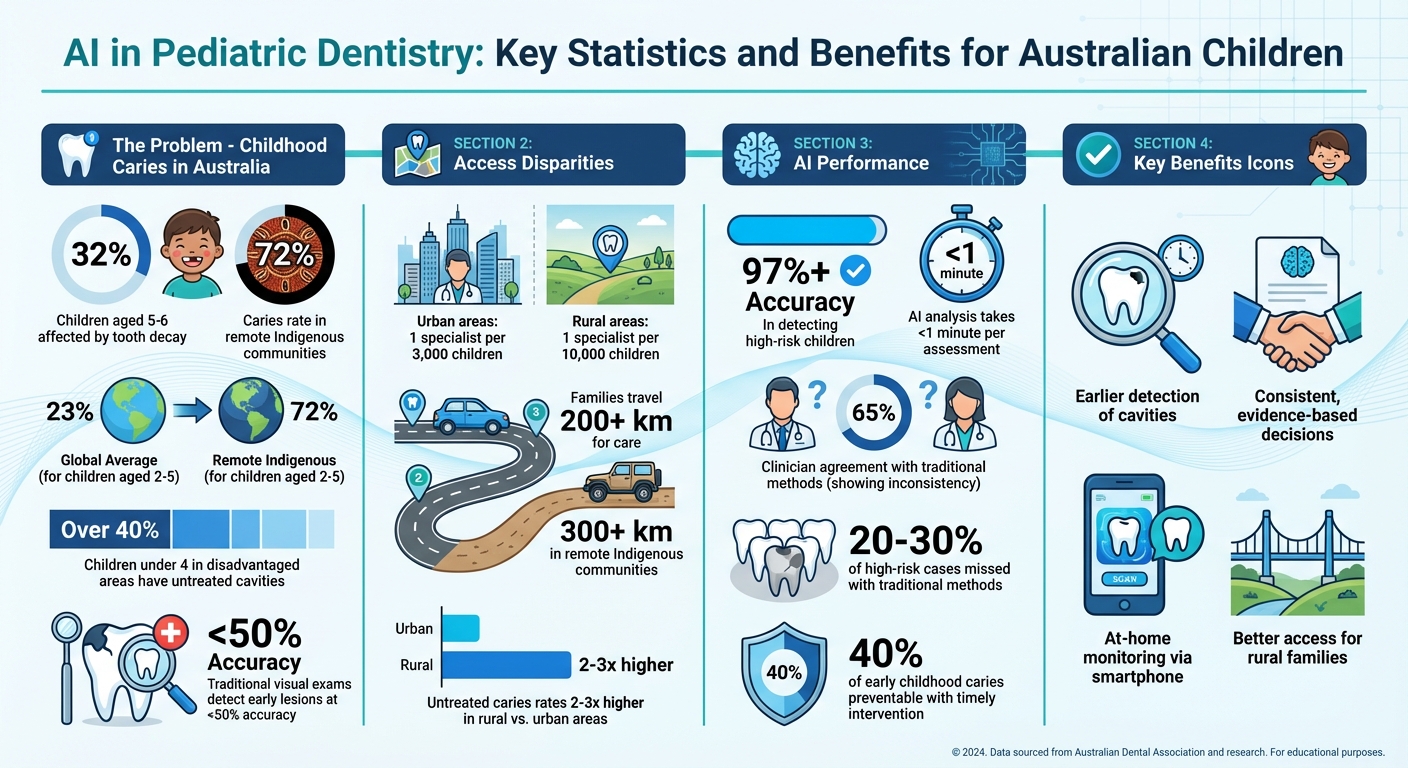
AI in Pediatric Dentistry: Key Statistics and Benefits for Australian Children
Problems with Traditional Paediatric Oral Risk Assessment
High Childhood Caries Rates and Late Diagnosis
In Australia, tooth decay in early childhood is alarmingly prevalent. Around 32% of children aged 5–6 are affected, with rates skyrocketing to 72% in some remote Indigenous communities. To put this into perspective, the global average for children aged 2–5 is just 23% [1][2]. Traditional visual exams often fail to catch early signs, such as subtle demineralisation, with detection rates for early lesions falling below 50% [3]. According to the Australian Dental Association, over 40% of children under 4 years old in disadvantaged areas have untreated cavities. Many of these cases are only diagnosed when problems like pain or abscesses have already developed [2]. This highlights how late-stage diagnosis and limited access to care exacerbate the issue.
Limited Access and Low Parental Awareness
Access to paediatric dental specialists is another major hurdle, particularly in rural and remote areas of Australia. While urban centres have approximately one specialist per 3,000 children, rural areas face a stark disparity, with just one specialist per 10,000 children [1]. Families in these regions often face arduous journeys – travelling over 200 km, or in some remote Indigenous communities, more than 300 km – to access care. This lack of access contributes to untreated caries rates that are 2–3 times higher in rural areas compared to cities, with caries rates nearing 70% in some remote Indigenous communities [1][2].
Parental awareness also plays a significant role. Many parents underestimate the risks associated with a sugary diet or the benefits of fluoride, delaying essential treatment for their children [4]. Misconceptions about the importance of primary teeth – especially among low-income families – further delay care-seeking [1][2]. Even in clinical settings, time constraints often prevent thorough risk evaluations, leaving gaps in early intervention.
Inconsistent Assessments and Time Pressures
Even when children make it to a dental clinic, the quality of oral risk assessments can vary widely. Traditional methods rely heavily on subjective factors like diet history and enamel condition. Studies have shown that agreement between clinicians can be as low as 65% [2][3]. Time constraints compound the problem – most consultations last only 15–20 minutes, with just 2–3 minutes dedicated to risk evaluation [2][3]. This rushed approach means 20–30% of high-risk cases can go unnoticed, despite evidence suggesting that up to 40% of early childhood caries could be prevented with timely intervention [2]. These challenges underscore the pressing need for better diagnostic tools that are both accurate and efficient.
How AI Provides Real-Time Oral Risk Assessment for Children
AI Risk Prediction Models
AI has revolutionised how we assess oral health risks in children by analysing a mix of clinical, behavioural, and demographic data. Models like Multilayer Perceptron (MLP), Random Forest (RF), and Support Vector Machine (SVM) process inputs from dental exams, lifestyle habits, genetic history, and parental questionnaires to categorise children by their risk of developing caries. These systems have demonstrated impressive accuracy, with classification rates exceeding 97% in identifying high-risk children based on early childhood data [2]. By combining multiple risk factors into a single, evidence-backed score, AI allows dental clinics to pinpoint at-risk children earlier. This means preventive measures, such as fluoride varnishes or dietary counselling, can be implemented sooner, potentially stopping serious issues before they arise. Beyond prediction, AI is also enhancing diagnostic precision through advanced imaging techniques.
AI Analysis of Dental Images and X-Rays
Convolutional neural networks (CNNs) are transforming the analysis of dental images, including bitewing, periapical, and intraoral scans. These networks, trained on thousands of images, can detect early signs of caries and other abnormalities that might escape notice during routine check-ups. By providing immediate feedback during consultations, this technology aids clinicians in making quicker and more accurate diagnoses. AI-powered imaging tools not only outperform traditional methods in identifying issues on radiographs but also leverage advanced 3D technology to spot childhood tooth decay with remarkable speed and precision. This consistency across practitioners ensures more reliable, evidence-driven treatment plans. But AI’s impact doesn’t stop at the clinic – it’s also empowering parents to take a more active role in their children’s oral health.
AI Tools for Parents to Monitor at Home
AI-driven smartphone apps, like AICaries, are making it easier for parents to monitor their children’s oral health between dental visits. Using a standard smartphone, parents can take pictures of their child’s teeth, which the AI then analyses for early signs of caries. These apps also provide interactive risk assessments and personalised prevention tips. Research shows that most parent-taken photos are high-quality enough for AI analysis, with the entire process typically taking less than a minute [5]. This is especially valuable for families in rural or remote areas, where access to dental care might be limited. By bridging the gap between clinic visits, these tools not only improve access to care but also encourage children and caregivers to stay engaged in oral health practices. Early detection through these home-based tools can lead to timely interventions, preventing minor issues from escalating.
Benefits of AI Real-Time Risk Assessment for Families and Clinics
Earlier Detection and Preventive Treatment
AI systems can spot subtle enamel changes and early signs of decay that might go unnoticed during a quick visual check-up. By identifying non-cavitated lesions, dentists can take action early – using fluoride varnish, applying sealants, or offering dietary advice – all of which can help avoid invasive procedures down the line. For children identified as high-risk, AI-enabled smartphone tools make it possible for clinicians to review photos taken at home and quickly recommend preventive measures.
More Consistent and Evidence-Based Decisions
AI takes much of the guesswork out of risk assessment. Instead of relying solely on subjective judgement, it provides structured risk scores aligned with established clinical guidelines. This helps dentists make decisions like setting recall intervals – shorter ones for high-risk kids and longer gaps for those at lower risk – and crafting tailored preventive strategies. Studies show that AI can match or even surpass the diagnostic accuracy of traditional visual exams, offering consistent results across different clinicians. This consistency is especially helpful in practices where multiple providers are involved in a child’s care, ensuring everyone is on the same page. It’s also a game-changer for improving care access, especially for families in remote locations.
Better Access and Support for Families
AI-powered tools significantly improve access to care for families, particularly those in rural or underserved areas. With AI running on smartphones or tablets, basic caries screening can be done without a dentist physically present. Community health workers, school nurses, or Aboriginal health practitioners can assist in capturing images and data, which AI then pre-screens. Dentists only need to review cases flagged as higher risk. These tools make at-home screening reliable, cutting down on travel, reducing wait times, and helping prioritise appointments for children who need immediate attention. Plus, they support ongoing monitoring between in-person visits, ensuring families stay connected to care.
sbb-itb-2be92ed
Ethical and Practical Considerations for AI in Australian Paediatric Dentistry
Clinical Responsibility and Professional Oversight
AI tools are designed to assist, not replace, a dentist’s expertise. According to the Australian Dental Association (ADA) and AHPRA guidelines, all AI-generated outputs must be carefully reviewed and validated by qualified dentists before making any diagnostic or treatment decisions. For instance, tools like AICaries, which can detect cavities from smartphone photos, still require a dentist to confirm the findings before recommending treatments like fluoride varnish or sealants[1][4]. The responsibility for patient care ultimately rests with the clinician, ensuring AI remains a support tool rather than an independent decision-maker. Alongside this professional oversight, maintaining stringent data protection measures is equally critical.
Data Privacy and Security
Safeguarding children’s health data is non-negotiable. AI systems handling paediatric dental information must adhere to the Privacy Act 1988 and the Australian Privacy Principles (APPs)[6]. Parents or guardians need to provide written informed consent, which should clearly outline how the AI processes images, where the data is stored, and how long it will be retained. Best practices include anonymising images – removing identifiable facial features – and employing end-to-end encryption during data transmission[1][4]. Additionally, when parents take photos at home for AI screening, providing clear guidance ensures the images are of sufficient quality for accurate analysis.
Addressing Algorithm Bias and Local Validation
AI models developed overseas may not fully account for the diverse needs of Australian children, especially those from Indigenous or multicultural backgrounds. Bias in algorithms can arise when training data lacks representation of diverse populations, potentially leading to unequal care outcomes. To address this, local validation is essential. AI tools should be tested on Australian paediatric datasets that reflect the country’s varied demographics, dietary habits, and fluoride exposure. For example, machine learning models like Multilayer Perceptron and Random Forest have achieved over 97% accuracy in identifying high-risk children, but only after being validated with local data[2].
Conclusion
AI-driven real-time oral risk assessment is changing the way dental care is approached by tackling late diagnoses, inconsistent evaluations, and limited access to services. By allowing earlier intervention and prevention, this technology opens up new possibilities. Research shows that diagnostic-quality photos taken by parents using smartphones can be analysed by AI to spot issues while cavities are still reversible. This enables timely preventive steps and customised advice[5]. Such early action sets the stage for more consistent, evidence-based care in paediatric dentistry.
AI also improves diagnostic accuracy and consistency. Studies reveal that AI models can match or even outperform traditional methods used by different practitioners[8]. For Australian families, particularly those in underserved areas, at-home monitoring apps provide an accessible way to screen oral health. Features like gamification not only make the process engaging for children but also help instil lasting oral health habits[9].
However, ethical considerations are crucial. Dentists must oversee all AI-generated outputs to ensure the technology complements professional judgement rather than replacing it. Compliance with Australian Privacy Principles, such as encrypted data storage and obtaining informed consent from parents, is vital to safeguard children’s health information[7]. Moreover, validating AI tools on diverse paediatric populations, including Indigenous and multicultural groups, is necessary to prevent algorithmic bias and ensure fair care for all Australian children[8].
AI is no longer just about detecting early dental issues – it’s also about enabling personalised prevention tailored to Australia’s diverse communities. By incorporating validated AI tools alongside professional expertise, Australian dental practices can enhance care quality. With appropriate oversight, training, and attention to capturing high-quality images, AI has the potential to support healthier smiles for children and families across the country.
FAQs
How does AI help detect tooth decay in children early?
AI technology is proving to be a game-changer in spotting tooth decay in children. By analysing dental images and data in real time, it can identify even the faintest signs of decay that might go unnoticed during a standard dental check-up.
Catching these issues early means dentists can step in with preventive treatments sooner, helping to avoid more serious dental problems down the track. This not only safeguards children’s oral health but also sets them up for healthier smiles in the long run.
How do AI-powered apps support oral health monitoring at home?
AI-driven apps are transforming at-home dental care by providing real-time evaluations of your oral health. These apps can spot early warning signs of problems like cavities or gum disease and offer tailored advice to enhance your daily oral hygiene practices.
By using these tools, families can take charge of their dental health, maintaining better care routines and bridging the gap between regular dental check-ups.
What are the privacy considerations when using AI for children’s dental assessments?
When incorporating AI into children’s dental assessments, protecting privacy is absolutely crucial. Sensitive information, like health records, needs to be managed with the utmost care to maintain confidentiality and comply with Australian privacy laws. This means implementing measures such as data encryption, limiting access to authorised personnel, and strictly following the Australian Privacy Principles.
Parents can rest assured that trusted dental practices take these privacy safeguards seriously, ensuring patient data is secure while leveraging AI to improve oral health outcomes for children.
Related Blog Posts
- How AI Improves Remote Dental Care
- AI in Dentistry: Benefits of Personalised Oral Health Insights
- AI in Oral Cancer Detection: How It Works
- AI vs Radiographs: Caries Detection Accuracy
Important Notice: Any surgical or invasive procedure carries risks. Before proceeding, you should seek a second opinion from an appropriately qualified health practitioner.
Individual results may vary. The information provided in this article is for educational purposes only and does not constitute medical advice.
Checkout Related Blogs




Get in touch with us
For more information, call us now to start feeling better. Or fill the form below to make appointment
The Latest News from Complete Smiles
How to Clean Clear Plastic Retainers
Checklist for Choosing Wearable Dental Devices
Checklist for Choosing Cloud AI Platforms in Dentistry

Complete Smiles Bella VistaAccepts All Major Health Funds, Including





