





Sonic vs. Ultrasonic: Root Canal Cleaning Comparison

When it comes to cleaning root canals, both sonic and ultrasonic systems improve results compared to traditional syringe irrigation. However, they work differently and are suited to specific cases:
- Sonic systems use low-frequency vibrations (up to 6,000 Hz) with flexible polymer tips to agitate cleaning solutions. They’re safer for curved canals and easier to use but less effective in the apical third (the narrowest part of the canal).
- Ultrasonic systems operate at higher frequencies (25–40 kHz), creating powerful fluid movement and cavitation. They excel at removing debris and smear layers, especially in straight canals and the apical region, but require more skill and carry a higher risk of damaging canal walls.
Both methods outperform manual or syringe-only irrigation, but the choice depends on the tooth’s anatomy, the clinician’s expertise, and patient needs.
Quick Comparison
| Feature | Sonic Systems | Ultrasonic Systems |
|---|---|---|
| Frequency | Low (1–6 kHz) | High (25–40 kHz) |
| Tip Material | Flexible polymer | Rigid metal |
| Cleaning Power | Effective in coronal/middle thirds | Superior in apical third |
| Ease of Use | Simple, shorter learning curve | Requires precision and skill |
| Patient Comfort | Minimal vibration and noise | More noticeable vibration and sound |
| Cost | Lower equipment costs | Higher upfront investment |
| Best For | Curved or narrow canals | Straight canals, retreatments, complex cases |
Sonic systems are ideal for general cases, while ultrasonic systems are better for detailed cleaning in challenging situations. Using the right tool for the case can improve outcomes and reduce complications.
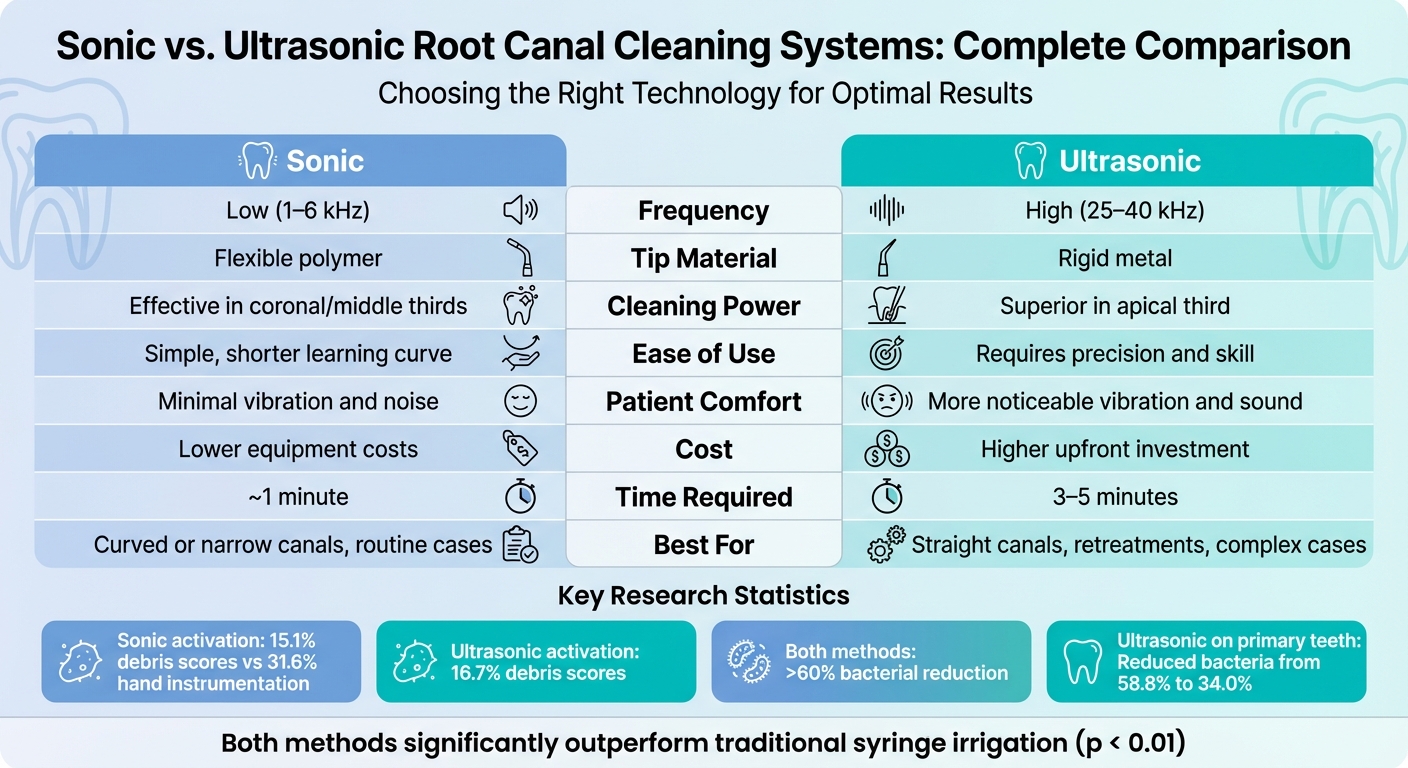
Sonic vs Ultrasonic Root Canal Cleaning Systems Comparison Chart
Sonic vs Ultrasonic irrigation (endoactivator vs ultra x)
How Sonic and Ultrasonic Cleaning Work
Building on the earlier definitions, here’s a closer look at how each cleaning method functions in practice.
Sonic Cleaning Mechanism
Sonic endodontic devices operate at lower frequencies, typically between 1–6 kHz, using a flexible vibrating tip that moves inside the canal. Instead of cutting dentine, this oscillating tip creates motion that effectively stirs the irrigant. Systems like EDDY use polymer tips specifically designed to vibrate safely against canal walls while transferring energy into the fluid. The larger vibration amplitude generates a sweeping motion, enhancing the exchange of the irrigant throughout the canal system. This helps the cleaning solution reach intricate areas like fins and isthmuses, especially in the coronal and middle thirds of the canal. Since sonic devices operate at lower energy levels compared to ultrasonic systems, clinicians often move the tip in short, 2–3 mm strokes. This technique maintains fluid flow while minimising the risk of the tip binding to the canal walls. Ultrasonic devices, however, take a different approach, using higher frequencies to intensify fluid movement.
Ultrasonic Cleaning Mechanism
Ultrasonic devices utilise specialised units to drive a metal file or smooth tip at much higher frequencies, typically between 25–40 kHz. These high-frequency vibrations transfer energy directly into the irrigant, creating powerful hydrodynamic effects without relying on mechanical scraping. In passive ultrasonic irrigation (PUI), the activated file remains loose within the canal, usually about 1 mm short of the working length. This allows the primary cleaning effect to come from fluid movement rather than cutting dentine. Ultrasonic vibrations generate rapid acoustic streaming, which increases shear stress on the canal walls, helping to dislodge the smear layer and debris. Additionally, the high-frequency pressure changes can induce cavitation – where microscopic vapour bubbles form and collapse within the irrigant – further enhancing cleaning efficiency.
Fluid Movement Comparison
When comparing these two methods, the differences in fluid dynamics become clear. Ultrasonic activation, with its higher frequency and energy output, produces stronger and more focused streaming. This results in greater shear forces, which are particularly effective at removing debris and reducing the smear layer. Cavitation is primarily associated with ultrasonic activation, whereas sonic devices rely more on bulk oscillation for fluid movement, providing gentler agitation. Despite this, sonic devices remain valuable in clinical settings, particularly when paired with chelating agents and sufficient irrigant volume. For instance, a controlled study involving 60 curved molar canals found that passive sonic activation reduced debris scores to 15.1%, compared to 31.6% with hand instrumentation alone. Passive ultrasonic activation achieved a comparable score of 16.7%. Both methods significantly outperformed traditional hand instrumentation (p < 0.01) [1].
Cleaning Performance and Clinical Results
Research on Cleaning Performance
Clinical studies have consistently shown that both sonic and ultrasonic activation outperform traditional syringe irrigation when it comes to removing debris and smear layers from root canals. Among the two, ultrasonic systems deliver better results, particularly in eliminating smear layers. The reason lies in the way ultrasonic devices work – they create acoustic microstreaming and cavitation, producing powerful shear forces against the canal walls. This process dislodges debris more effectively than sonic systems.
For instance, a study on primary teeth revealed that ultrasonic activation reduced residual bacteria in single-rooted canals from 58.8% to 34.0% – a clear improvement over conventional filing techniques [5]. When combined with standard cleaning methods, three minutes of ultrasonic activation was able to eliminate over 60% of intraradicular bacteria [5]. While both sonic and ultrasonic systems enhance bacterial removal, ultrasonic activation consistently achieves greater reductions. These findings highlight the importance of considering canal anatomy when evaluating cleaning efficacy.
Performance in Different Canal Areas
The effectiveness of these technologies varies depending on the region of the canal. Both sonic and ultrasonic systems perform better in the coronal and middle thirds of root canals, where the wider canal diameters allow for easier irrigation. However, the apical third – especially the final 1–3 mm – remains the most difficult area to clean. This challenge stems from the narrower anatomy and the formation of vapour locks, which limit the exchange of irrigants in these confined spaces. Although ultrasonic activation shows superior results across all sections of the canal, neither method achieves complete removal of debris or smear layers in the apical region [2][3][8].
Challenges with Complex Canal Shapes
Complex canal shapes, such as curves, isthmuses, fins, and lateral canals, pose significant challenges for both methods. Ultrasonic tips, while effective, may struggle to navigate highly curved canals due to their rigidity. On the other hand, sonic tips are more flexible but often lack the energy needed to remove debris from recesses and irregular spaces. A systematic review found that ultrasonic irrigation excels in straight canals, whereas both methods perform similarly in curved canals [7]. The apical third of curved canals is particularly problematic, as vapour lock formation further restricts irrigant flow. Despite these hurdles, both sonic and ultrasonic activation still offer noticeable improvements compared to non-activated irrigation, even in anatomically complex cases.
sbb-itb-2be92ed
Sonic vs. Ultrasonic: Strengths and Weaknesses
Side-by-Side Comparison Table
Sonic and ultrasonic activation methods each bring distinct benefits, depending on the clinical scenario. The table below highlights their key differences, helping practitioners make informed choices.
| Factor | Sonic Systems | Ultrasonic Systems |
|---|---|---|
| Cleaning Power | Effective at removing debris; some studies show comparable results when paired with ProTaper NEXT [2]. | Typically excels in smear layer removal due to acoustic microstreaming and cavitation [4]. |
| Apical Third Performance | Performs adequately in the coronal and middle thirds but less effective in the apical third. | Offers better penetration in the apical region, though complete debridement remains challenging [5]. |
| Complex Canals | Flexible polymer tips navigate curved canals with reduced risk of ledging [2]. | Rigid metal tips are less effective in severely curved canals but perform well in straighter anatomies. |
| Ease of Use | Simpler technique with a shorter learning curve, making it more user-friendly for general practitioners [2]. | Requires more precision and skill to maintain free oscillation without contacting canal walls [4]. |
| Time Required | Generally takes around 1 minute [2] [3]. | May take 3–5 minutes to achieve significant bacterial reduction [5]. |
| Equipment Cost | Lower initial investment with specialised devices [4]. | Higher upfront cost but often multifunctional for various procedures [4]. |
| Patient Comfort | Lower frequencies (1–6 kHz) result in minimal vibration and noise [3]. | Higher frequencies (25–30 kHz) can produce more noticeable vibration and sound [3] [4]. |
| Safety Profile | Non-cutting polymer tips reduce risks of canal transportation and dentine damage [2] [3]. | Improper use may cause microcracks or ledges due to contact with metal tips [2] [4]. |
When to Use Each Technology
Understanding these differences can guide clinicians in tailoring their approach to specific cases. Sonic activation is particularly effective in curved or narrow canals, where the flexibility of polymer tips allows safe navigation to the working length. Studies have shown that sonic systems perform well in removing debris from curved canals [2]. They are also highly effective in clearing calcium hydroxide, often outperforming both ultrasonic and manual methods [3]. This makes sonic systems a practical, cost-efficient choice for general practices, especially when treating patients sensitive to noise or vibration.
Ultrasonic activation, on the other hand, is ideal for cases requiring maximum cleanliness – such as retreatments or patients with complex medical conditions. Research on primary teeth has demonstrated ultrasonic activation’s ability to significantly reduce bacteria, with three minutes of use removing over 60% of intraradicular bacteria [5]. Clinics like Complete Smiles Bella Vista (https://completesmilesbv.com.au) often incorporate ultrasonic systems into their protocols to achieve high standards of care. Its powerful acoustic microstreaming is especially valuable in straight canals, where even small improvements in irrigant penetration can make a big difference.
In Australia, many clinicians combine these technologies – using sonic activation for routine cases and ultrasonic methods for more intricate anatomies. This balanced approach aligns with contemporary clinical practices and ensures treatment is tailored to the complexity of each case and the needs of individual patients.
Considerations for Australian Dental Practices
Meeting Australian Clinical Standards
Dentists in Australia are required to adhere to protocols approved by the Therapeutic Goods Administration (TGA) and align their practices with guidelines from AHPRA and the Dental Board of Australia. For instance, techniques like passive ultrasonic irrigation – performed for 30–60 seconds using a combination of sodium hypochlorite and EDTA – should be documented thoroughly, along with obtaining informed consent from patients. These measures ensure compliance while creating opportunities to integrate newer technologies into daily practice.
Advanced Endodontic Tools in Australia
Platforms like GentleWave, which use a closed-system with multi-frequency fluid delivery, are gaining traction in Australia for their ability to thoroughly remove tissue and bacteria from necrotic canals [6]. While these systems come with higher costs for equipment and consumables, they are particularly suitable for practices with a strong focus on endodontic referrals or those operating in specialist environments. Many clinics take a pragmatic approach – utilising sonic or ultrasonic activation for routine cases and reserving advanced systems for more complex scenarios, such as challenging anatomies, retreatments, or patients with unique medical needs. These advancements allow practitioners to adapt treatments to better suit individual cases.
Tailoring Treatment to Individual Patients
Sonic and ultrasonic technologies have proven benefits, but treatment protocols often depend on the complexity of the tooth. For example, single-rooted premolars might only require standard sonic activation, while necrotic molars with intricate anatomies may need extended ultrasonic activation and modified irrigant concentrations. Clinics like Complete Smiles Bella Vista (https://completesmilesbv.com.au) incorporate these technologies into wider treatment strategies to achieve better outcomes for their patients.
When choosing the right technology, several factors come into play: the complexity of the canals (e.g., highly curved or narrow canals may benefit more from ultrasonic methods), the presence of calcifications or persistent infections, the overall prognosis of the tooth, restorative plans, and patient-specific considerations such as their ability to tolerate longer procedures and financial constraints. Proper documentation of the chosen activation method, along with any deviations from standard protocols, is essential. This not only supports continuity of care but also provides medico-legal protection for the practice.
Conclusion
Main Points Summary
Sonic and ultrasonic activation have proven to be highly effective in improving root canal cleaning compared to traditional syringe irrigation. Both methods excel at removing debris and the smear layer from canal walls, with ultrasonic systems often showing better performance in the apical third and complex canal anatomies. This is largely due to their high-frequency vibrations, which drive powerful acoustic streaming and cavitation effects [2][4]. On the other hand, sonic devices can sometimes outperform ultrasonic systems, particularly when removing calcium hydroxide from the coronal and middle thirds or when used with systems like ProTaper NEXT [2][3].
Despite these advancements, no single technology can achieve perfectly clean canals on its own. Successful root canal treatment relies on a combination of accurate diagnosis, proper shaping, effective irrigation, and high-quality obturation [2][3]. Sonic and ultrasonic activation should be viewed as complementary tools that enhance disinfection and minimise the risk of persistent infection, rather than as stand-alone solutions. Adhering to established protocols remains crucial for achieving optimal outcomes.
For Australian dental practices, the decision between sonic and ultrasonic activation depends on factors such as case complexity, the clinician’s expertise, and available resources. Ultrasonic activation is often the preferred choice for challenging cases, such as those with highly curved canals, retreatments, or situations requiring thorough cleaning in the apical third [3][4]. Meanwhile, sonic systems, with their simpler operation and flexible polymer tips that reduce the risk of canal damage, are well-suited for routine cases [2][3]. Choosing the right tool should align with the clinical demands without unnecessarily complicating straightforward treatments.
Irrigant activation has become an essential part of modern endodontics [2][3][4]. For Australian clinicians, staying informed about advancements in both sonic and ultrasonic systems ensures alignment with international best practices. Clinics such as Complete Smiles Bella Vista (https://completesmilesbv.com.au) integrate these advanced techniques into their root canal therapy protocols, tailoring treatments to individual patient needs and canal anatomy. This approach highlights the practical application of these technologies in everyday clinical practice.
Ultimately, combining the appropriate tool with evidence-based techniques leads to significant improvements in canal cleanliness and treatment outcomes. The key lies in selecting the right method for each clinical scenario, using effective irrigants, and maintaining thorough documentation to meet Australian clinical standards.
FAQs
What’s the difference between sonic and ultrasonic technologies in root canal cleaning?
Sonic and ultrasonic technologies are two widely-used approaches for cleaning root canals, each operating with its own unique method and benefits.
Sonic cleaning relies on low-frequency sound waves to produce vibrations. These vibrations help loosen debris and bacteria within the root canal. While effective, this method tends to be less powerful compared to ultrasonic alternatives.
Ultrasonic cleaning, in contrast, employs high-frequency sound waves to create stronger vibrations. This process leads to cavitation, where tiny bubbles form in the cleaning solution. These bubbles significantly improve the solution’s ability to remove debris and bacteria, especially in the more challenging, hard-to-reach areas of the root canal. Ultrasonic cleaning is often preferred for its efficiency and thoroughness, particularly in more complex cases.
Each technique has its strengths, and the choice between them depends on the specific requirements of the procedure. Your dentist will determine the best approach to ensure the treatment is both effective and comfortable.
What factors determine whether a dentist uses ultrasonic or sonic cleaning for a root canal?
Dentists use sonic and ultrasonic cleaning methods depending on the specific demands of a root canal procedure. Ultrasonic cleaning is often favoured for its ability to produce high-energy vibrations, which can effectively remove debris and bacteria from intricate root canal systems. On the other hand, sonic cleaning, though less powerful, can be a suitable option for simpler cases or situations where a gentler method is needed.
Each technique comes with its own set of strengths and limitations. The choice typically hinges on factors like the complexity of the tooth’s structure, the amount of debris present, and the dentist’s professional judgement. Rest assured, your dentist will use the method best suited to achieve thorough cleaning and a successful treatment.
How do sonic and ultrasonic technologies affect comfort during a root canal procedure?
Sonic and ultrasonic systems are designed to make root canal cleaning not only more effective but also more comfortable for patients. Sonic systems work at lower frequencies, creating gentler vibrations and a quieter environment. This can help ease anxiety for patients who might be sensitive to the sounds or sensations of dental procedures.
In contrast, ultrasonic systems operate at higher frequencies, delivering more intense vibrations. While these sensations might be slightly more noticeable, they allow for incredibly precise cleaning, especially in the more intricate areas of the root canal.
Both technologies aim to reduce discomfort by shortening treatment times and improving the thoroughness of the cleaning process. Dentists select the method that best suits your specific needs, ensuring the procedure is as comfortable and effective as possible.
Related Blog Posts
- Benefits of Ultrasonic Activation in Dentistry
- Real-Time Feedback in Ultrasonic Endodontics
- Heat vs. Ultrasonic Tools in Root Canal Therapy
- Passive Ultrasonic Irrigation: Faster Root Canal Cleaning
Important Notice: Any surgical or invasive procedure carries risks. Before proceeding, you should seek a second opinion from an appropriately qualified health practitioner.
Individual results may vary. The information provided in this article is for educational purposes only and does not constitute medical advice.
Checkout Related Blogs




Get in touch with us
For more information, call us now to start feeling better. Or fill the form below to make appointment
The Latest News from Complete Smiles
How to Clean Clear Plastic Retainers
Checklist for Choosing Wearable Dental Devices
Checklist for Choosing Cloud AI Platforms in Dentistry

Complete Smiles Bella VistaAccepts All Major Health Funds, Including





