





Simulation Tools for Robotic Dental Training
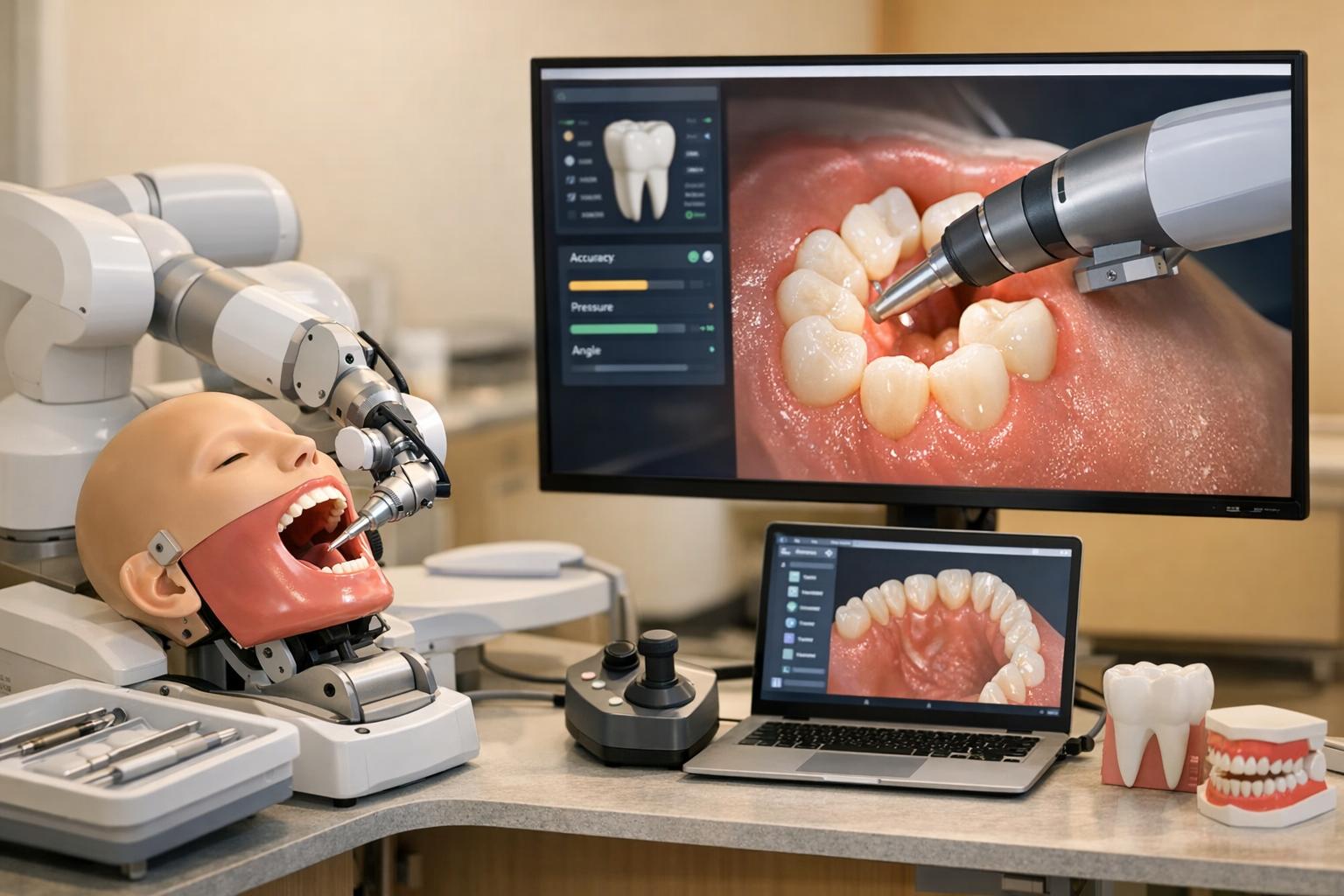
Simulation tools are transforming dental training by offering a risk-free, virtual environment to develop skills required for robotic-assisted procedures. These platforms mimic clinical settings, provide real-time feedback, and help practitioners refine techniques without relying on patients or physical models. From VR systems like Simodont to AR tools like DentSim, these technologies enhance precision, reduce training costs, and improve learning efficiency.
Key Takeaways:
- Realistic Practice: Virtual environments simulate clinical procedures with life-sized visuals and haptic feedback.
- Skill Development: Tools improve motor control, hand-eye coordination, and spatial awareness.
- Efficiency: Automated feedback reduces instructor time by up to fivefold.
- Cost Challenges: Systems can cost over A$100,000, limiting accessibility.
- AI Integration: Emerging AI features adjust difficulty and provide detailed performance analysis.
While these tools face limitations like high costs and occasional discomfort, their integration with AI and expanding applications in dentistry signal a promising future for robotic dental training.
Live demo of Virteasy Dental V2 and VR
Key Features of Simulation Tools for Robotic Dental Training
The best simulation tools for robotic dental training share essential features that bring theoretical knowledge closer to practical expertise, creating a bridge between classroom learning and real-world application.
Realistic Virtual Environments
Modern dental simulators rely on advanced 3D imagery to mimic real clinical settings. These virtual environments include features like indirect vision through virtual mirrors, adjustable translucency to expose internal tooth structures like the pulp chamber and dentine, and even auditory feedback that replicates the sound of dental turbines [5] [9].
For example, Simodont systems display instruments and teeth at life-size proportions. They also allow users to adjust transparency to reveal internal features, enabling repeated practice of delicate, high-risk procedures without ethical dilemmas or material waste.
Haptic Feedback Systems
Touch is a critical sense in dentistry, especially when working in areas with restricted visibility. Haptic feedback systems simulate the varying resistance of dental tissues – enamel has high resistance, dentine offers moderate resistance, and carious lesions feel softer [5] [9]. The DENTIFY simulator, for instance, delivers up to 3.3 N of feedback force, helping students refine their force control. In a study conducted at the European University of Valencia, 70.6% of 173 students noted that these simulators provided realistic tactile feedback [10].
These systems also facilitate bimanual coordination, allowing students to operate a virtual mirror with one hand while using a handpiece with the other [3] [9]. Beyond tactile realism, they include adaptable training modules for diverse learning needs.
Customisable Training Modules
Simulation platforms cater to a wide range of exercises, from simple tasks like drilling basic shapes to more advanced procedures such as Class I and II cavity preparations, pulpotomies, and crown preparations [5] [8] [9]. Many systems provide access to online libraries featuring rare or complex cases, offering students the opportunity to practise scenarios they might not encounter otherwise.
A particularly useful feature is the ability to create "save points" during procedures. This allows students to revisit and refine challenging steps without starting over [5] [6]. In a study conducted at Wuhan University, 98.36% of students appreciated the automatic scoring and real-time feedback provided by these simulators. The systems measured critical performance metrics, such as drill-tooth contact time, cavity depth, and unintended damage to neighbouring structures [3] [5] [6].
Popular Simulation Tools for Robotic Dental Training
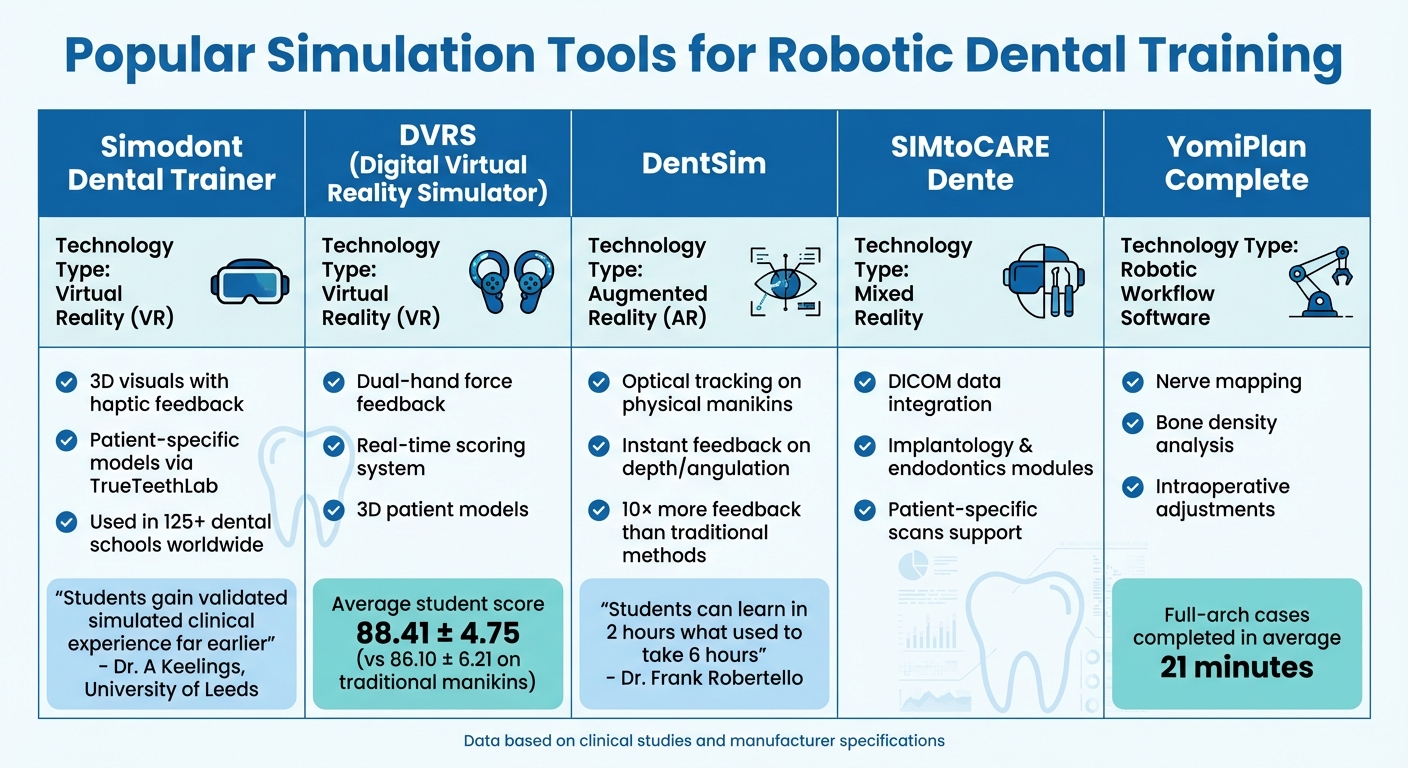
Comparison of Leading Dental Simulation Platforms and Their Key Features
Advancing robotic dental training involves a range of cutting-edge simulation platforms designed to enhance both technical skills and clinical understanding.
Virtual Reality (VR) Platforms
The Simodont Dental Trainer has become a staple in over 125 dental schools worldwide [11]. This system blends 3D visuals with haptic feedback to simulate tissue resistance, providing a highly realistic training environment. It also integrates with TrueTeethLab, an AI-powered tool that converts CBCT or micro-CT scans into detailed, patient-specific models, complete with features like enamel and pulp chambers [11].
"Our students gain validated simulated clinical experience far earlier in the course than was previously possible and they love the exercises." – Dr. A Keelings, University of Leeds [11]
Another standout is the Digital Virtual Reality Simulator (DVRS), which offers dual-hand force feedback. This feature allows trainees to experience the hardness of teeth and bone structures while receiving real-time scores on their performance [3]. A 2022 study at Wuhan University’s Hospital of Stomatology found that students using DVRS scored an average of 88.41 ± 4.75, compared to 86.10 ± 6.21 for those practising on traditional manikins. Additionally, all participants reported the VR system as user-friendly [3].
Augmented Reality (AR) Systems
DentSim takes a unique approach by overlaying virtual data onto physical manikins using optical tracking. This system provides instant feedback on critical aspects like preparation depth, wall angles, and cavity shapes. Remarkably, it offers up to 10 times more feedback than traditional preclinical methods [13].
"I would guess that students can learn in two hours what used to take six hours on benchtop. They develop the skill to learn operative dentistry." – Dr. Frank Robertello, Dentist [13]
SIMtoCARE Dente combines virtual and physical training, offering modules for implantology, endodontics, and oral surgery. It supports patient-specific scans in DICOM format, allowing for a more personalised learning experience [12][16].
While VR and AR systems excel in tactile and visual learning, specialised software platforms focus on honing technical precision and workflow efficiency.
Simulation Software for Robotic Systems
Specialised software plays a pivotal role in robotic dental training, enabling precise planning and execution.
YomiPlan Complete and YomiPlan Go are the core software tools for the Yomi robotic system. These platforms guide users through digital treatment planning, incorporating features like nerve mapping and bone density analysis [14]. They also allow for real-time adjustments during simulated procedures, teaching skills that static surgical guides cannot replicate [15]. Notably, Yomi users can complete full-arch cases in an average of 21 minutes [14].
Complementing these tools is Yomi University (Yomi U), an on-demand learning platform designed to build expertise in robotic-assisted implantology. Its "Mastery Program" includes detailed guides and clinical webinars to prepare trainees before hands-on practice. In August 2023, the University of Sydney demonstrated its commitment to advanced simulation by investing A$9.4 million in a new Simulation Centre, featuring 61 dental simulation units and dedicated XR training rooms [6].
| Software/Platform | Technology Type | Key Training Features |
|---|---|---|
| Simodont Dental Trainer | Virtual Reality | 3D visuals, haptic feedback, patient-specific models via TrueTeethLab [11] |
| DVRS | Virtual Reality | Dual-hand force feedback, real-time scoring, 3D patient models [3] |
| DentSim | Augmented Reality | Optical tracking, instant feedback on depth/angulation, 10× more feedback [13] |
| SIMtoCARE Dente | Mixed Reality | DICOM data integration, implantology/endodontics modules [12][16] |
| YomiPlan Complete | Robotic Workflow | Nerve mapping, bone density analysis, intraoperative adjustments [14] |
sbb-itb-2be92ed
Advantages and Limitations of Simulation Tools
Advantages
Simulation tools offer a safe and controlled environment for practising complex procedures without risking patient safety [8]. Trainees can repeatedly refine their skills, building both competence and confidence before working on real patients. These tools are particularly effective in improving fine motor skills and hand-eye coordination, thanks to high-fidelity haptic feedback that simulates the tactile sensation of drilling into various tooth structures [4].
Another major benefit is the efficiency of feedback. With automated and immediate feedback systems, students can self-assess and correct their techniques in real time, significantly reducing the need for instructor intervention – by as much as fivefold [4]. A study comparing traditional manikins and a Digital Virtual Reality Simulator found that students using the simulator scored an average of 88.41 ± 4.75, outperforming those using manikins, who scored 86.10 ± 6.21. Furthermore, 98.36% of students reported the simulator’s feedback as timely and helpful [3].
"A cost-effective tool that allows repetitive training in a risk-free environment." – Student response, Frontiers in Oral Health [8]
Simulation tools also contribute to resource conservation. They eliminate the dependence on extracted human teeth and expensive plastic typodont models, providing an unlimited supply of virtual teeth for practice [5]. This not only reduces waste but also ensures students have ample opportunities to hone their skills.
Limitations
Despite their advantages, simulation tools face several barriers to widespread adoption. The high cost of acquisition and maintenance is a significant hurdle. For example, stand-alone simulators like the dV-Trainer and RobotiX Mentor cost approximately $110,000 and $137,000, respectively. Additionally, the cost of a surgical learning curve in operating room time can exceed $200,000 [2].
Technical and physical limitations also pose challenges. Many simulators struggle to replicate the nuanced tactile sensations of different tissues, such as distinguishing between healthy and decayed tooth structures or mimicking the feel of gingiva [4]. Extended use of 3D VR environments can lead to discomfort, including headaches, vertigo, and eye strain. Moreover, trainees cannot use magnifying loupes while wearing 3D glasses [8]. Maintenance requirements, such as frequent software updates and stringent cleaning protocols for shared VR headsets and haptic devices, add to the complexity [9].
"The technology is impressive. However, it does not equip the students with the appreciation of human anatomical variation, infection control measures, empathy and communication skills." – Academic staff member, Griffith University [8]
To make simulation tools a more integral part of robotic dental training, these limitations need to be addressed effectively.
Future of Simulation Tools in Robotic Dental Training
Integration of AI and Machine Learning
Artificial intelligence (AI) is transforming simulation tools into dynamic, interactive training platforms. These systems analyse student performance in real time, adjusting the training difficulty to help learners master essential skills [19]. By monitoring precision, hand stability, and technique consistency during simulated procedures, AI provides instant feedback and corrections. This allows students to practise repeatedly until they achieve the required level of expertise [19].
"AI is not just an enhancement to dental education; it’s becoming a foundation for modern learning." – Pearl Team, Pearl AI [19]
Machine learning adds another layer of sophistication by predicting student competency through performance data analysis. It can identify trainees who may need additional support early in their training [19]. For example, the Medical University of South Carolina has incorporated AI tools into its dental programme, enabling students to plan treatments visually and receive real-time diagnostic guidance [19]. AI also grants access to databases filled with rare and complex cases, covering diverse demographics and pathologies that students might not encounter during traditional clinical practice [19].
The pace of technological advancement is remarkable. AI systems can now process dental images 79 times faster than human clinicians. Diagnostic tools powered by AI have achieved a sensitivity of 67.9% for detecting periapical lesions and an AUC-ROC of 96.2% for identifying various dental conditions [18]. In a groundbreaking achievement, Perceptive completed the world’s first fully automated crown-cutting procedure using robotic arms and AI, finishing the task in just 15 minutes with approximately 90% accuracy [18].
These advancements are opening doors to even broader applications across other areas of dentistry.
Expanded Applications in Dentistry
The impact of AI-driven simulation tools is extending beyond general dentistry into specialised fields like orthodontics, prosthodontics, and endodontics. In orthodontics, AI is being used to predict tooth movement and treatment outcomes, with prediction accuracy reaching roughly 73% [17]. For prosthodontics, AI is enhancing the design of crowns, bridges, and dentures. Meanwhile, researchers are exploring the use of microrobots made from iron oxide nanoparticles, controlled magnetically, to navigate and treat hard-to-reach areas, such as root canals in endodontics [21].
A notable breakthrough came in August 2022, when researchers at Penn Dental Medicine showcased microrobots for endodontic treatments. These robots, guided by magnetic fields, were able to access and clean root canal structures with impressive precision [21]. Additionally, voice-command technology is being integrated into workflows, simplifying procedures and reducing the need for additional staff [21]. As Dr. Fabrizia Luongo, a Board Member of the Digital Dentistry Society, aptly puts it:
"The dentist of the future will need to be not only a skilled clinician but also a knowledgeable technologist and thoughtful communicator" [20].
Conclusion
Simulation tools have become a game-changer in robotic-assisted dental training. They allow students to build essential skills like fine motor control, hand–eye coordination, and spatial awareness – all in a risk-free environment that avoids the need for real patients or excessive resource use[1][4]. With repeated practice and instant feedback, these systems are reshaping the way technical training is approached in dental education.
The results back up their effectiveness. For instance, students using virtual reality simulators consistently outperformed those trained on traditional manikins, with 98.36% highlighting the value of automated scoring for its timely feedback[3]. At the University of Sydney’s Dental School, simulation-based training has become so integral that students now spend about 50% of their hands-on training time in the simulation centre, underscoring growing trust in these tools[6].
The integration of advanced features like haptic feedback and customisable modules using patient-specific 3D models from CT scans further equips students for tackling complex dental procedures[3][5][7]. These advancements are setting the stage for even greater possibilities as technology continues to evolve.
With AI and machine learning advancing rapidly, simulation platforms are likely to incorporate even more sophisticated feedback systems and broaden their use across various areas of dentistry. Future dental professionals will not only refine their clinical techniques but also develop a high level of technological expertise, making these simulation tools a cornerstone of modern dental training.
FAQs
What are the key advantages of using simulation tools for training in robotic dental surgery?
Simulation tools bring a host of advantages to robotic dental surgery training. They’re designed to replicate the feel and operation of real robotic systems, helping trainees sharpen their motor skills and enhance spatial awareness. This creates an opportunity for hands-on practice in a completely safe and controlled setting, free from any risks.
Another major plus is the availability of customised training exercises. These come with detailed performance metrics, offering tailored feedback to guide learners and support ongoing improvement. Plus, these tools make it possible for trainees to practise on their own, without needing direct access to expensive robotic consoles. This adds a level of flexibility and convenience that can make the entire learning process much smoother.
How does AI improve the performance of dental simulation tools?
AI is transforming dental simulation tools by offering real-time feedback, evaluating performance, and customising training to fit individual learning needs. These advanced tools replicate dental procedures with impressive precision, allowing professionals to refine essential skills like spatial awareness and fine motor control.
On top of that, AI boosts diagnostic accuracy by interpreting radiographic images to identify issues such as cavities and gum disease with improved reliability. This capability not only enhances the learning process but also aids in making better clinical decisions. By weaving AI into dental simulation, these tools provide a more tailored and effective educational experience, which ultimately leads to improved patient care and outcomes.
What challenges do dental schools face when adopting simulation technologies for training?
Dental schools face several obstacles when bringing simulation technologies into their training programs. One of the biggest challenges is the steep cost associated with acquiring and maintaining advanced tools like virtual reality systems and robotic simulators. These expenses can put considerable pressure on budgets and resources. On top of that, access to these simulators is often limited due to high demand or shared use in clinical environments, which can leave students with fewer opportunities to practise.
Another significant issue is the need to revamp existing curricula to integrate simulation-based learning effectively. This process often involves extensive planning and training for faculty members to ensure they can confidently operate the technology and interpret its results. Complicating matters further, the lack of standardised guidelines and comprehensive research on the use of simulation in dentistry makes it harder to implement these tools consistently across programs. Overcoming these hurdles calls for careful investment, robust support for educators, and continued research to maximise the benefits of these cutting-edge technologies in dental education.
Related Blog Posts
- AR vs. Traditional Dental Training
- AR in Dental Care: Patient Education Tools
- Robotic Dental Surgery: Benefits vs. Limitations
- VR in Dentistry: What Patients Should Know
Important Notice: Any surgical or invasive procedure carries risks. Before proceeding, you should seek a second opinion from an appropriately qualified health practitioner.
Individual results may vary. The information provided in this article is for educational purposes only and does not constitute medical advice.
Checkout Related Blogs




Get in touch with us
For more information, call us now to start feeling better. Or fill the form below to make appointment
The Latest News from Complete Smiles
How to Clean Clear Plastic Retainers
Checklist for Choosing Wearable Dental Devices
Checklist for Choosing Cloud AI Platforms in Dentistry

Complete Smiles Bella VistaAccepts All Major Health Funds, Including





