





Precision in Endodontics: Hybrid Heat and Ultrasonic Tools
Hybrid heat and ultrasonic tools are transforming root canal treatments by improving cleaning precision, reducing debris, and enhancing seal quality. These tools combine ultrasonic vibrations and heat to activate irrigants like sodium hypochlorite, which dissolves organic material more effectively. Key benefits include:
- Improved Cleaning: Ultrasonic energy reaches hard-to-access areas like lateral canals and isthmuses.
- Enhanced Seal Strength: Heat softens materials like gutta-percha, creating a tighter seal and reducing leakage.
- Better Bonding: Ultrasonic activation strengthens sealer adhesion to dentine.
Research shows ultrasonic activation significantly reduces voids in obturation and enhances disinfection, especially in complex canal shapes. Tools like the XP-Endo Finisher and EDDY tip are already available in Australia, offering reliable solutions for modern endodontic challenges. By integrating these systems into practice, dentists can achieve more predictable and lasting outcomes.
The Role of Ultrasonics in Endodonitcs
sbb-itb-2be92ed
What Are Hybrid Heat and Ultrasonic Tools?
Hybrid tools are designed to combine ultrasonic vibration and heat, creating a more efficient approach to root canal treatment. Instead of relying on just one method, these tools can alternate between or simultaneously apply both forces, depending on the specific clinical requirement.
How These Tools Work
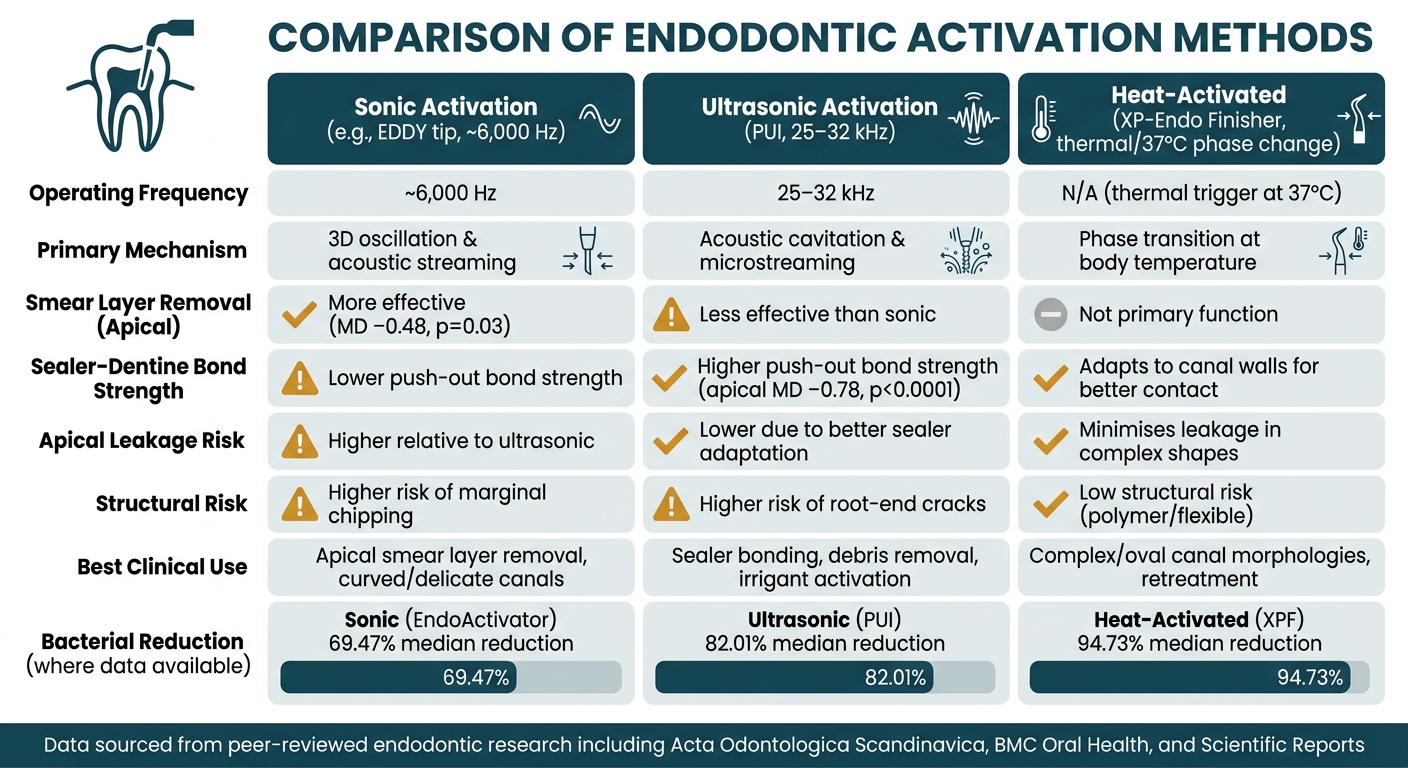
Ultrasonic units operate by generating high-frequency vibrations, typically between 25–32 kHz. When the activated tip interacts with the irrigating solution inside the canal, it produces microstreaming and cavitation. These processes help propel the irrigant into areas that traditional files can’t reach, such as secondary canals and isthmuses [1][3].
Ultrasonic agitation also raises the temperature of the irrigant, which enhances the effectiveness of sodium hypochlorite. Additionally, heat activation can modify specific instruments like the XP-Endo Finisher. For instance, the Max-Wire technology in this tool undergoes a transformation at body temperature (37°C), allowing it to adapt better to complex canal shapes. This phase change ensures more thorough contact with canal walls, improving the precision of hybrid systems during treatment [3].
By combining these mechanisms, hybrid tools enhance both the cleaning and obturation phases of endodontic procedures.
Key Uses in Endodontics
When it comes to general dental treatments like cleaning, the process typically starts with canal exploration using stainless steel files, followed by shaping with Ni-Ti rotary instruments. Passive ultrasonic irrigation (PUI) is then used to drive the irrigant into hard-to-reach areas, such as flattened root regions and the apical third of the canal. Ultrasonic agitation applied at targeted intervals has shown to significantly reduce debris in these challenging zones [1].
Beyond cleaning, hybrid tools also improve obturation by strengthening sealer bonding and increasing push-out bond strength in the mid and apical regions. Heat plays a critical role here by softening gutta-percha, which allows for a more effective three-dimensional seal of the canal space. Together, these mechanisms help minimise apical leakage and support more reliable long-term treatment outcomes [2].
| Technology | Operating Frequency | Primary Mechanism | Key Application |
|---|---|---|---|
| Passive Ultrasonic (PUI) | 25–32 kHz | Acoustic cavitation & microstreaming | Debris removal & sealer condensation [3] |
| Sonic Activation (EDDY) | ~6,000 Hz | Three-dimensional oscillation | Smear layer removal [3] |
| Heat-Activated (XP-Endo Finisher) | N/A (thermal) | Phase transition at 37°C | Cleaning complex canal morphologies [3] |
Research Findings on Ultrasonic Activation
Recent research highlights the benefits of ultrasonic activation in improving sealer adaptation, bond strength, and reducing voids in various canal anatomies.
Ultrasonic Condensation of Bioceramic Materials
The hybrid approach of combining heat and ultrasonic energy has shown promising results. Studies confirm that ultrasonic activation significantly enhances the push-out bond strength of calcium silicate-based sealers, particularly in the challenging apical third of the canal – a region where traditional tools often fall short [5]. For instance, a 2026 study demonstrated that just 20 seconds of ultrasonic activation notably improved the apical bond strength for AH Plus (p=0.004) and VDW.1Seal (p=0.015) [5].
In clinical practice, this means denser sealer tags and a more uniform adhesive interface, as the sealer penetrates deeper into dentinal tubules [5][6]. The benefits even extend to teeth exposed to 70 Gy of radiation therapy, where ultrasonic activation still led to higher bond strength and better interfacial quality [7].
However, the impact of ultrasonic activation varies depending on the material. While it enhances performance with certain sealers, some materials, like premixed calcium silicate cements such as Endocem MTA, show less favourable results. For example, indirect ultrasonic activation with these cements did not reduce void formation and was linked to increased leakage [9].
Next, let’s look at how ultrasonic vibration improves thermoplastic obturation in complex canal shapes.
Ultrasonic Welding in Thermoplastic Obturation
Ultrasonic vibration has shown remarkable results in complex canal anatomies, like C-shaped canals. Research comparing obturation techniques in mandibular molars with C-shaped anatomy found that sealer-based obturation combined with ultrasonic vibration (SBU) achieved a lower mean total void volume (4.43% ± 1.12%) compared to the continuous wave technique (CWT) (6.84% ± 1.35%) and standard sealer-based obturation (SBO) (7.00% ± 2.17%) [8].
| Obturation Technique | Total Void Volume (%) | Apical Third Voids (%) | Middle Third Voids (%) |
|---|---|---|---|
| Continuous Wave (CWT) | 6.84% ± 1.35% | 9.54% ± 1.77% | 6.14% ± 1.64% |
| Sealer-Based (SBO) | 7.00% ± 2.17% | 7.44% ± 2.64% | 6.84% ± 2.48% |
| Sealer-Based + Ultrasonic (SBU) | 4.43% ± 1.12% | 5.46% ± 1.33% | 3.84% ± 1.24% |
| (Source: C-shaped canal data [8]) |
Ultrasonic vibration works by generating compressive impulses that lower surface friction and allow trapped air to escape. This enables the sealer to flow into narrow isthmuses and web-like structures that other techniques struggle to access [8]. As one study from BMC Oral Health noted:
"Sealer-based obturation with ultrasonic vibration resulted in better filling quality in mandibular molars with C-shaped canals. Therefore, it can be an effective option for the treatment of C-shaped canals." – BMC Oral Health [8]
It’s worth noting, however, that ultrasonic activation can lead to a higher incidence of sealer extrusion – reaching up to 60% in experimental models when using high-flow sealers [10]. This is particularly important near anatomical landmarks like the mandibular nerve, where excess sealer beyond the apex poses clinical risks.
Hybrid Systems for Canal Cleaning
Combining Ultrasonic Energy with Heat and Irrigant Activation
Hybrid systems are transforming canal cleaning by pushing irrigants into hard-to-reach areas like isthmuses, lateral canals, and dentinal tubules that mechanical instruments struggle to access [12].
When sodium hypochlorite (NaOCl) is paired with ultrasonic energy, its ability to dissolve tissue improves significantly. The combination of physical agitation and heat generated by ultrasonic waves makes NaOCl even more effective [12].
"The action of sodium hypochlorite to dissolve organic material was increased when passive ultrasonic irrigation was performed, due to the agitation itself, and the temperature increase promoted by the ultrasonic waves." – Restorative Dentistry & Endodontics [12]
One notable technique is a 60-second ultrasonic agitation cycle during final irrigation, which has been shown to reduce debris in the apical third far better than traditional syringe irrigation [12]. This method enhances both disinfection and debris removal, setting the stage for better treatment outcomes.
For cases requiring heat-activated files, tools like the XP-Endo Finisher (XPF) offer additional cleaning advantages. A 2024 study in Scientific Reports examined its performance on 84 mesial roots of mandibular first molars infected with Enterococcus faecalis. The results were striking: XPF achieved a median bacterial reduction of 94.73% in main canals, compared to 82.01% with Passive Ultrasonic Irrigation (PUI) and 69.47% with the EndoActivator [13]. Moreover, XPF outperformed PUI in deeper dentinal tubules (100–150 µm), especially in isthmus regions [13].
These hybrid systems not only clean more effectively but also improve obturation outcomes, as discussed earlier.
Ultrasonic Tips for Access Cavity Preparation
Selecting the right ultrasonic tip can make a big difference, particularly in flattened or oval-shaped canals. Tips like Flatsonic and Clearsonic are designed to clean infected dentinal walls that standard rotary files often miss [11].
In a January 2025 study published in Clinical Oral Investigations, researchers from the Bauru School of Dentistry (University of São Paulo) tested these tips alongside Continuous Ultrasonic Irrigation (CUI) using an Irrisonic tip. The results were clear: CUI significantly outperformed conventional syringe irrigation in intracanal decontamination. Even saline, typically considered ineffective on its own, achieved meaningful intratubular cleaning when activated by CUI [11].
"The use of Flatsonic and Clearsonic ultrasonic tips is promising for root canal disinfection." – Clinical Oral Investigations [11]
However, metal ultrasonic tips contact canal walls only about 20% of the time, which can reduce energy efficiency and risk dentin wear or secondary smear layer formation [4]. Polymer-based alternatives like EDDY (made from polyamide) offer a safer option. These tips generate three-dimensional oscillations and acoustic streaming without causing damage, making them ideal for curved or delicate canals where preserving tooth structure is critical [3].
Safety, Limitations, and Practical Considerations
Sonic vs Ultrasonic vs Heat-Activated Tools in Endodontics
Heat Generation and Tissue Safety
Ultrasonic tools produce heat during use, but studies suggest that, when applied correctly, the temperature increase is minimal and manageable. Overheating can damage delicate periodontal tissues, which are slow to heal, but research shows this risk is often overestimated.
For example, when passive ultrasonic irrigation (PUI) is used with a solution starting at 20°C, the external root surface temperature only rises by 0.6°C[12]. To minimise friction and heat buildup, the ultrasonic tip should move freely within the canal rather than pressing against the walls. Additionally, limiting activation to 60 seconds ensures effective cleaning without excessive heat generation[12]. Continuous irrigant flow during ultrasonic use is also essential, as it prevents heat from accumulating and helps flush debris from the canal[1].
These thermal precautions, combined with attention to material performance, are crucial for successful treatment outcomes.
Material Properties and Long-Term Outcomes
The precision of hybrid endodontic tools is enhanced by advanced cleaning and obturation techniques. Ultrasonic activation improves the bonding of sealers to dentinal walls, which reduces both apical leakage and the risk of fractures. Research published in Acta Odontologica Scandinavica found that ultrasonic activation significantly increases the push-out bond strength between sealers and dentine compared to sonic activation. This improvement was observed at both the middle level (MD −0.69; 95% CI −1.13, −0.25; p = .002) and the apical level (MD −0.78; 95% CI −1.09, −0.46; p < .0001)[2].
"Ultrasonic activation resulted in significant cohesion between the sealers and the dentine tubules, decreasing the vulnerability of apical leakage and tooth fracture." – Acta Odontologica Scandinavica[2]
However, ultrasonic tools are not without their challenges. Studies show that ultrasonic root-end preparations can lead to a higher incidence of root-end cracks compared to conventional bur techniques. Sonic instrumentation, on the other hand, may cause more marginal chipping[14]. There’s also a trade-off when it comes to smear layer removal. While sonic activation is more effective at the apical level (MD −0.48; 95% CI −0.92, −0.04; p = .03)[2], ultrasonic activation excels in enhancing sealer adhesion. In cases where thorough apical cleaning is critical, combining both methods – using sonic activation for smear layer removal followed by ultrasonic activation for better sealer bonding – can be an effective strategy.
| Feature | Sonic Activation | Ultrasonic Activation |
|---|---|---|
| Smear layer removal (apical) | More effective[2] | Less effective than sonic[2] |
| Sealer–dentine bond strength | Lower push-out bond strength[2] | Higher push-out bond strength[2] |
| Apical leakage risk | Higher relative to ultrasonic[2] | Lower due to better sealer adaptation[2] |
| Structural risk | Higher risk of marginal chipping[14] | Higher risk of root-end cracks[14] |
For effective results, passive ultrasonic irrigation should always be paired with chemical irrigants like sodium hypochlorite, which helps dissolve organic material within the canal[1].
Using These Tools in Australian Endodontic Practice
Applying Research to Clinical Decision-Making
Making sound clinical decisions in endodontics means aligning the right tools with specific anatomical challenges. For example, ultrasonic activation is ideal when the goal is to enhance sealer-to-dentine bonding. On the other hand, sonic activation tools like the EDDY tip (operating at 6,000 Hz) are particularly effective for clearing the apical smear layer [2].
In retreatment cases, especially those involving calcium silicate-based sealers, conventional needle irrigation often falls short. Advanced tools such as EDDY, Passive Ultrasonic Irrigation (PUI), and the XP-Endo Finisher R consistently deliver better results, particularly in removing residual filling material from the apical third of the canal [3]. The XP-Endo Finisher R stands out due to its ability to adapt to canal walls in oval-shaped canals, thanks to its temperature-triggered phase change [3].
A practical approach involves starting with manual stainless steel files for initial canal exploration. Once the canal is navigable, transitioning to Ni-Ti rotary systems like ProTaper can help shape the canal while reducing the risk of sudden file fractures. After biomechanical preparation, a 60-second PUI cycle (keeping the tip 1 mm short of the working length) can activate irrigants more effectively, ensuring thorough cleaning [1]. These steps form a reliable protocol for incorporating hybrid systems into daily practice.
To ensure compliance with Australian standards, it’s important to source equipment from trusted suppliers like Henry Schein. Devices such as the Vista EndoUltra Cordless Kit should meet local requirements [15]. Additionally, maintaining ultrasonic tips and handpiece batteries is crucial, as inconsistent power output can undermine the activation of irrigants and the overall disinfection process [15].
The Role of Advanced Dental Clinics
Advanced dental clinics are leading the way in integrating these protocols with precision-calibrated equipment and specialised training. Successfully adopting hybrid endodontic tools requires torque-controlled motors, fine-tuned ultrasonic units, and clinicians skilled in navigating complex canal anatomies [1][3]. This combination of evidence-based methods and cutting-edge tools is shaping the future of endodontic care in Australia.
Clinics like Complete Smiles Bella Vista exemplify this approach. By employing advanced techniques, such as non-surgical retreatment of canals filled with bioceramic sealers, they are well-equipped to manage even the most challenging cases [3]. This integration of expertise and technology underscores the evolution of endodontic practice, ensuring patients receive the highest standard of care.
Conclusion: Where Hybrid Endodontic Tools Are Headed
Recent studies highlight an exciting direction for hybrid heat and ultrasonic tools in endodontic treatment. Tools like the XP-Endo Finisher R showcase how temperature-responsive designs can tackle complex anatomical challenges. Meanwhile, high-frequency sonic tools such as EDDY, operating at 6,000 Hz, provide cleaning performance that surpasses traditional needle irrigation methods [3]. These advancements align with a growing focus on precision and safety in endodontic techniques.
Ultrasonic agitation, for example, has shown promising results. Just 60 seconds of ultrasonic activation can significantly reduce apical debris while increasing the external root surface temperature by only about 0.6°C. This balance between effectiveness and safety underscores its clinical potential , especially when supported by real-time feedback systems [1].
That said, there are notable differences between sonic and ultrasonic activation. Sonic tools tend to excel at removing the apical smear layer, while ultrasonic activation offers stronger bonding between the sealer and dentine. A study published in Acta Odontologica Scandinavica captures this trade-off:
"Sonic activation accomplished advancement relative to ultrasonic agitation in removing the smear layer, while ultrasonic activation resulted in significant cohesion between the sealers and the dentine tubules." [2]
These differences make it crucial to tailor the activation method to the specific needs of each case.
In Australia, the growing use of calcium silicate-based sealers is pushing the demand for more advanced retreatment tools. As bioceramic sealers become more popular due to their biocompatibility, there’s a greater need for activation systems that can effectively remove these materials. Continued research into instruments designed for challenging canal shapes, such as oval or flattened canals, will be vital for improving clinical outcomes [3]. These advancements are paving the way for Australian endodontic practices to adopt more evidence-based and effective retreatment protocols. Ongoing innovation in tool design and activation methods will undoubtedly enhance outcomes and ensure safer retreatment processes across the country.
FAQs
Are hybrid heat and ultrasonic tools safe for teeth and gums?
Hybrid heat and ultrasonic tools are widely recognised as safe and effective for endodontic treatments when used appropriately. Research shows they can boost cleaning efficiency without sacrificing safety, as long as correct procedures are adhered to. These tools allow for greater precision, contributing to improved treatment results while safeguarding the health of both teeth and gums.
When should sonic activation be used instead of ultrasonic activation?
Sonic activation works well in scenarios where achieving lower smear layer scores and reduced push-out bond strength is the priority. These devices are especially effective for disinfection and cleaning, particularly when used at higher power settings.
On the other hand, ultrasonic activation stands out for its ability to provide better debris removal and enhanced cleaning performance during final irrigation. This makes it the preferred choice when a more thorough cleaning is required.
Can these tools improve outcomes in complex canals or retreatments?
Hybrid heat and ultrasonic tools have proven to be highly effective in tackling complex canals and retreatments. Research highlights their ability to efficiently remove residual filling materials, even in tricky situations like curved or oval-shaped canals. This precision plays a crucial role in achieving better outcomes during retreatment procedures.
Related Blog Posts
- Benefits of Ultrasonic Activation in Dentistry
- Heat vs. Ultrasonic Tools in Root Canal Therapy
- Advances in Endodontic File Manufacturing
- Ultrasonic Activation for Biofilm Removal: Research Insights
Important Notice: Any surgical or invasive procedure carries risks. Before proceeding, you should seek a second opinion from an appropriately qualified health practitioner.
Individual results may vary. The information provided in this article is for educational purposes only and does not constitute medical advice.
Checkout Related Blogs




Get in touch with us
For more information, call us now to start feeling better. Or fill the form below to make appointment
The Latest News from Complete Smiles
How to Clean Clear Plastic Retainers
Checklist for Choosing Wearable Dental Devices
Checklist for Choosing Cloud AI Platforms in Dentistry

Complete Smiles Bella VistaAccepts All Major Health Funds, Including





