





Peri-Implantitis Treatment Options Explained

Peri-implantitis, an inflammatory condition affecting the tissues and bone around dental implants, can threaten implant stability if not addressed early. Unlike peri-implant mucositis, which is reversible, peri-implantitis leads to permanent bone loss and may result in implant failure. Early diagnosis and tailored treatments are crucial to managing this condition effectively.
Key Points:
- Non-Surgical Treatments: Include mechanical cleaning, antiseptics like chlorhexidine, and antibiotics for managing early-stage peri-implantitis.
- Surgical Treatments: Necessary for advanced cases, options include access flap surgery, resective techniques for pocket reduction, and regenerative procedures to rebuild bone.
- Post-Treatment Care: Proper dental implant maintenance and regular monitoring are critical for preventing recurrence.
Quick Overview:
| Treatment Type | Focus | Best For |
|---|---|---|
| Non-Surgical | Inflammation control | Early-stage peri-implantitis |
| Surgical | Cleaning and bone repair | Advanced cases |
| Maintenance | Long-term implant health | All implant patients |
For optimal outcomes, treatment plans must consider the extent of bone loss, implant location, and patient-specific factors like smoking or diabetes. Consistent care and early intervention are key to preserving implant health.
Peri-Implantitis Treatment: Clinical Pearls and New Evidence with Dr. George Kotsakis
sbb-itb-2be92ed
Non-Surgical Treatment Options
Early peri-implantitis often benefits from non-surgical approaches. These treatments aim to reduce inflammation, control bacterial growth, and stabilise implants, all without the need for surgery. While these methods can’t reverse bone loss that’s already occurred, they can help stop further damage.
Mechanical Debridement
At the heart of non-surgical treatment is mechanical debridement, which involves physically removing biofilm and calculus from the implant’s surface. Specialised tools are essential here, as standard metal scalers can scratch titanium, creating rough spots where bacteria can easily reattach. Instead, clinicians rely on instruments like titanium curettes, plastic tips, or carbon-fibre tools to clean the implant surface while avoiding further harm [3].
Air-polishing systems using glycine powder are often paired with manual instruments. Studies show that these systems can lead to greater reductions in bleeding on probing and pocket depth compared to manual debridement alone [3].
Antiseptic and Antibiotic Support
Mechanical cleaning alone is rarely enough. Chlorhexidine (CHX) is the most commonly used antiseptic for support. It comes in forms like a 0.12% rinse or a 0.2% gel. A 12-week study highlighted that using a 0.2% chlorhexidine gel reduced the number of residual pockets to 33%, compared to 55% in patients who didn’t use it [3][4].
For additional surface cleaning, clinicians may use sodium hypochlorite (NaOCl) gels, such as Perisolv, or apply supersaturated citric acid with cotton pellets [3]. Systemic antibiotics like azithromycin are typically reserved for acute infections or used post-surgery, rather than as a standard first-line treatment [2][4].
When Non-Surgical Treatment Works Best
"Non-surgical approaches for the treatment of peri-implant diseases have been proved to be reliable in reducing clinical signs of peri-implant inflammation (e.g., BoP), although with limited capability to achieve complete disease resolution." – Springer Nature [3]
Non-surgical methods are most effective for peri-implant mucositis and early-stage peri-implantitis, where pocket depths remain shallow and bone loss is minimal. However, as the disease progresses, the intricate surface of implants makes thorough cleaning much harder without surgical access. Even so, non-surgical therapy plays a critical role in controlling inflammation and improving soft tissue health before surgical options are considered [3][4]. For cases where these efforts fall short, the next section will explore surgical treatments.
Surgical Treatment Options
When non-surgical treatments don’t work and pocket depths exceed 5 mm, surgery becomes necessary. The focus shifts from managing inflammation to directly cleaning the implant surface and, in some cases, repairing the lost structures. These surgical methods are typically reserved for advanced cases where non-surgical care has failed.
Access Flap Surgery
Known as open flap debridement (OFD), this is a cornerstone of most surgical protocols for peri-implantitis. The procedure involves making an incision and lifting the gum tissue to expose the implant and surrounding bone. This direct access allows for a level of cleaning that non-surgical methods simply can’t achieve.
Once exposed, the site is cleaned by removing granulation tissue and decontaminating the implant surface using tools like titanium brushes, saline irrigation, or other cleaning agents. This method can reduce bleeding on probing by 67% to 73% [6]. However, be aware that it may lead to about 1.8 mm to 1.9 mm of soft tissue recession after surgery [5]. It’s important to weigh this trade-off with your clinician.
Regenerative vs Resective Surgery
The choice between these two approaches depends on the type of bone defect.
- Resective Surgery: This is ideal for horizontal bone loss where the goal is to reduce deep pockets. The surgeon reshapes the bone and lowers the gum tissue to make cleaning easier. While probing depth reductions can reach up to 75% [6], this method is usually reserved for areas that aren’t visible, as it can result in longer-looking dental implant crowns.
- Regenerative (Augmentative) Surgery: This approach focuses on rebuilding lost bone using grafting materials like xenografts, alloplasts, or autogenous bone, often paired with a barrier membrane. It’s most effective for contained defects with a depth of at least 3 mm [5] and can improve marginal bone levels by approximately 2.0 mm [5]. This method causes less visible gum recession, making it a better choice for areas where aesthetics matter.
"For the time being, no particular surgical protocol or material can be considered as superior in terms of long-term peri-implant tissue stability." – Current Oral Health Reports [5]
Interestingly, around 79% of peri-implantitis cases involve a combined defect – part intrabony, part suprabony [5]. Because of this, many clinicians use a mix of regenerative and resective techniques during the same procedure.
Implantoplasty
Implantoplasty is often used alongside resective or combined surgical methods. This involves mechanically smoothing and polishing the exposed, rough surfaces of the implant above the bone line. A smoother surface makes it harder for bacteria to stick and cause inflammation.
"Implantoplasty performed adjunctively at supracrestally and buccally exposed rough implant surfaces has been shown to efficiently attenuate soft tissue inflammation compared to control sites." – Current Oral Health Reports [5]
When paired with augmentative grafting for the intrabony portion of a defect, implantoplasty can lead to a radiographic defect fill of 87% to 93% [5]. However, like resective surgery, it carries a risk of increased gum recession (about 1.94 mm) [5], so it’s generally reserved for areas where appearance isn’t a primary concern.
Factors That Influence Treatment Choice
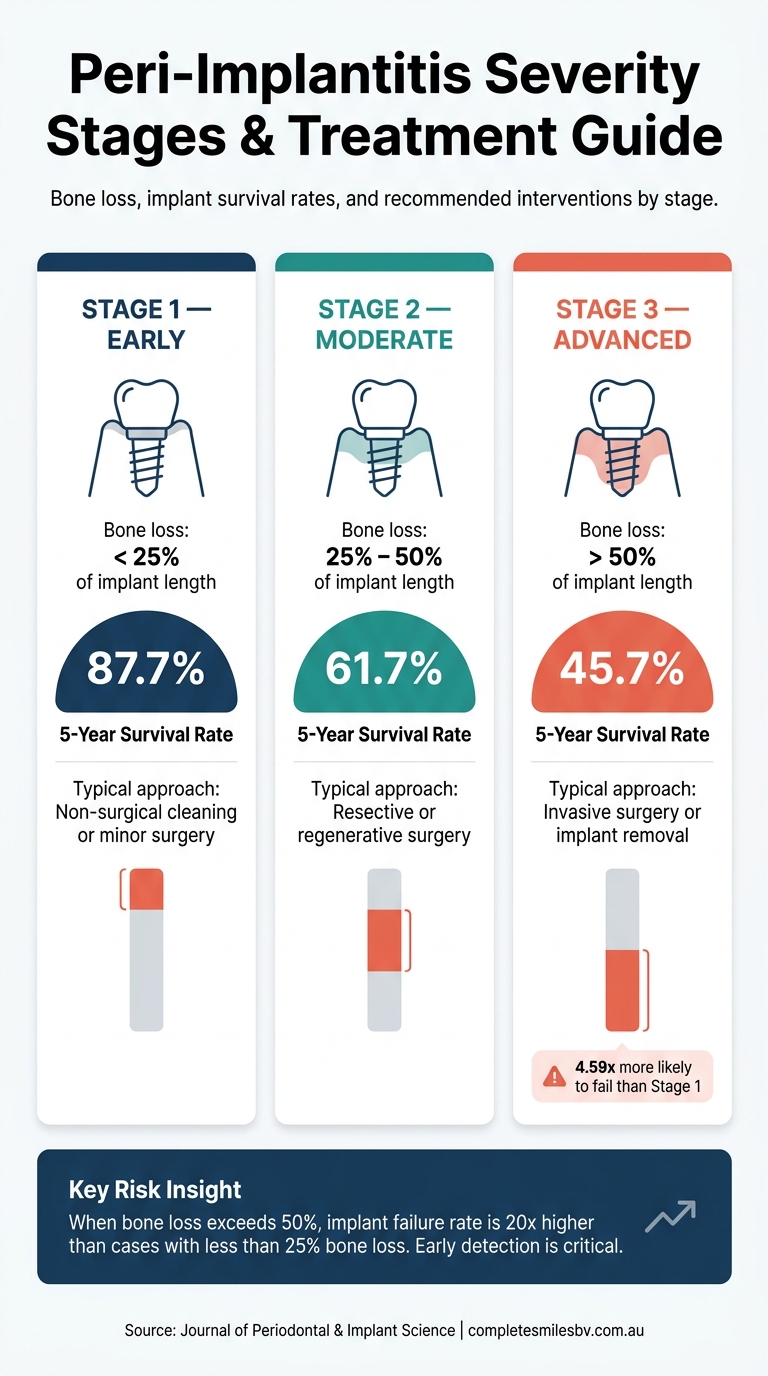
Peri-Implantitis Stages: Bone Loss, Survival Rates & Treatment Options
Treating peri-implantitis isn’t a one-size-fits-all process. Each case requires a tailored approach, with clinicians weighing factors like bone loss, patient habits, and implant-specific characteristics. These elements help shape both non-surgical and surgical treatment strategies, aligning the disease’s clinical presentation with its management.
Severity of Disease and Bone Loss
Peri-implantitis is classified into three stages, based on the extent of bone loss relative to the implant’s length [8]:
| Stage | Bone Loss | 5-Year Implant Survival Rate | Typical Approach |
|---|---|---|---|
| Stage 1 (Early) | Less than 25% of implant length | 87.7% | Non-surgical cleaning or minor surgery [8] |
| Stage 2 (Moderate) | 25% – 50% of implant length | 61.7% | Resective or regenerative surgery [8] |
| Stage 3 (Advanced) | More than 50% of implant length | 45.7% | Invasive surgery or implant removal [8] |
The likelihood of implant failure increases significantly with advanced stages. For instance, Stage 3 implants are 4.59 times more likely to fail than those in Stage 1, with a median survival time of just 3.63 years after surgical intervention [8]. At this stage, deciding whether to save or remove the implant requires a careful and informed clinical decision [2].
Patient-Specific Factors
A patient’s overall health and lifestyle play a major role in determining the most suitable treatment. Conditions like uncontrolled diabetes, osteoporosis, post-radiation therapy, and smoking can hinder healing and exacerbate bone loss [2]. For smokers, cessation counselling often becomes a key part of the treatment plan [2].
Good oral hygiene is non-negotiable. Surgical interventions are typically only considered once a patient demonstrates consistent home care and a commitment to minimising risk factors [2][7]. Parafunctional habits, such as bruxism, also require attention. Excessive biting forces can worsen bone loss, so additional measures like occlusal splints or prosthesis adjustments might be needed [2].
"It is important for patients to understand that regenerations are neither predictable nor reliable on an integrated and restored implant. Patients must be involved in the decision to save or replace the implant." – Dr. Andrea Hsu, DMD, FRCD(C) and Dr. Jung-Wan Martin Kim, DMD, FRCD(C) [2]
These patient-specific considerations are critical for planning surgical interventions.
Implant and Defect Characteristics
The success of early management often hinges on a detailed assessment of the implant and defect. The defect’s shape and size influence the choice of surgical technique. Horizontal bone loss often points to resective approaches, while vertical or angular defects with intact surrounding bone walls are better candidates for regenerative grafting [8][2]. Accessibility also plays a role – implants located in hard-to-reach areas, like the back of the mouth, may limit the effectiveness of certain instruments.
It’s also essential to check for complications from the initial placement, such as retained cement or prosthetic designs that make cleaning difficult [2]. These factors can complicate treatment and must be addressed to optimise outcomes.
Post-Treatment Maintenance and Care
After treatment, keeping up with follow-up care is essential to maintain the results and prevent any setbacks. This ongoing care helps preserve the improvements made and reduces the chances of complications, ensuring the long-term health of your implants.
Professional Supportive Care
Regular visits to your dental professional play a key role in maintaining your implants. These appointments typically include cleanings, probing, and X-rays to monitor bone health and stability [1].
"Implant maintenance is an essential aspect of implant therapy to help prevent the development of peri-implant disease." – British Dental Journal [9]
The timing of these visits depends on your individual needs. Factors like whether you smoke, have diabetes, or the severity of any previous issues will determine how often you should see your dentist [9].
At-Home Oral Hygiene Practices
Caring for implants at home requires more effort than looking after natural teeth. Standard brushing alone may not be enough to keep plaque at bay around implants [9]. Tools like interdental brushes are especially effective for improving oral health for cleaning around implant abutments and larger gaps. Water flossers can also help clean under the gumline, where a toothbrush might not reach.
| Tool | Purpose | Frequency |
|---|---|---|
| Electric/manual toothbrush | Removing biofilm from teeth and implants | Twice daily |
| Interdental brushes | Cleaning around abutments and wide spaces | Once daily |
| Water flosser | Reaching hard-to-clean areas with water pressure | Once daily |
| Chlorhexidine rinse | Antimicrobial support during healing | As prescribed (short-term) |
Note: Flossing around implants can sometimes cause damage. Check with your dentist to find the safest and most effective cleaning method [9].
"Patient education is essential, with clear messaging that looking after implants is as important as looking after natural teeth." – British Dental Journal [9]
In addition to professional care, keeping an eye on your implants at home can help you catch issues early.
Long-Term Monitoring
Peri-implant mucositis, a mild inflammation that’s still reversible, can be treated if caught early. However, if left unchecked, it can progress to peri-implantitis, which causes irreversible bone loss [1]. This highlights the importance of regular monitoring – spotting problems early can prevent permanent damage.
Signs like bleeding, bad breath, or a metallic taste could indicate issues and should prompt a visit to your dentist. Patients with a history of periodontitis are at double the risk of implant failure [10], so consistent check-ups are especially important for them.
Conclusion
Managing peri-implantitis effectively hinges on early detection and personalised treatment strategies. Research underscores the importance of timing: when alveolar bone loss exceeds 50%, the failure rate is 20 times higher compared to cases with less than 25% bone loss. Acting promptly not only preserves treatment options but also improves overall outcomes [11].
There isn’t a universal treatment protocol for peri-implantitis [7]. The best approach varies based on factors like the extent of bone loss, defect shape, and patient-specific considerations such as smoking or diabetes. Treatment plans should be customised, starting with non-surgical methods and advancing to surgical interventions as needed.
Regular maintenance plays a pivotal role in preventing recurrence. Studies highlight that adherence to supportive care programs significantly reduces the likelihood of peri-implantitis returning and ensures long-term success [11].
"Compliance of patients with the maintenance program reduces the recurrence of peri-implantitis and sustains clinical success after treatment." – Inpyo Hong et al., Journal of Periodontal & Implant Science [11]
For those with dental implants, it’s essential to watch for warning signs like bleeding, swelling, or discomfort and to prioritise routine dental visits. For a personalised monitoring and care plan, Complete Smiles Bella Vista offers tailored solutions. Combining a customised treatment approach with consistent maintenance is key to ensuring the long-term health of dental implants.
FAQs
How do I know if my implant infection is peri-implantitis?
Peri-implantitis can present with symptoms like redness, swelling, bleeding gums, gum recession, and even loose implants. Dentists usually confirm the condition by checking for bleeding during probing and using X-rays to detect bone loss of 2mm or more. If you spot any of these warning signs, it’s important to see your dentist as soon as possible for a proper evaluation and treatment plan.
Can peri-implantitis be treated without surgery?
Yes, peri-implantitis can often be managed without surgery, particularly if caught early. Common treatments include thorough mechanical cleaning of the affected area, using antimicrobial agents to fight infection, and enhancing oral hygiene routines. These steps are designed to control the infection and safeguard the implant and nearby tissues from further harm.
When does an implant need to be removed instead of treated?
When an implant is affected by severe or ongoing peri-implantitis leading to substantial bone loss, or if it becomes mobile and cannot be stabilised, removal is often necessary. In these situations, treatment alone is unlikely to restore the implant’s function or provide adequate support.
Related Blog Posts
- Impact of Implantoplasty on Implant Fatigue Resistance
- Non-Surgical vs. Surgical Periodontal Treatments: Key Differences
- Ultimate Guide to Dental Implant Maintenance
- Preventing Gum Disease Around Dental Implants
Important Notice: Any surgical or invasive procedure carries risks. Before proceeding, you should seek a second opinion from an appropriately qualified health practitioner.
Individual results may vary. The information provided in this article is for educational purposes only and does not constitute medical advice.
Checkout Related Blogs




Get in touch with us
For more information, call us now to start feeling better. Or fill the form below to make appointment
The Latest News from Complete Smiles
How to Clean Clear Plastic Retainers
Checklist for Choosing Wearable Dental Devices
Checklist for Choosing Cloud AI Platforms in Dentistry

Complete Smiles Bella VistaAccepts All Major Health Funds, Including





