





Neurostimulation: Future of Dental Pain Relief
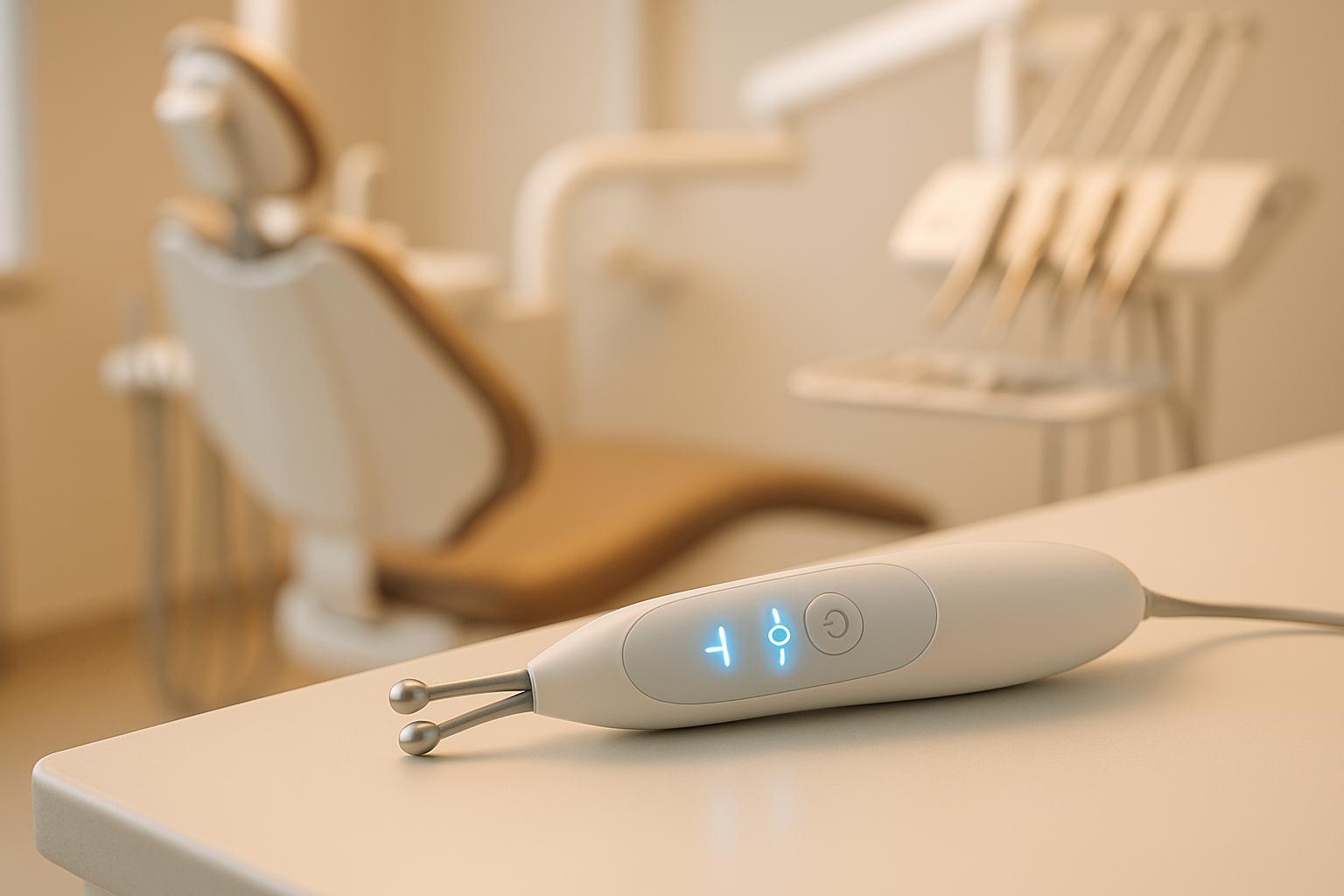
Dental pain relief is changing, offering drug-free and needle-free options like neurostimulation. This technique uses electrical or light-based stimuli to block pain signals, improving patient comfort and reducing anxiety. Here’s what you need to know:
- TENS (Transcutaneous Electrical Nerve Stimulation): Uses electrical pulses to block pain and release endorphins. Effective for procedures like TMJ treatment, trigeminal neuralgia, and even increasing salivary flow.
- Photobiostimulation (PBM): Uses lasers to promote healing and reduce pain by stimulating cells. Often used after surgery or for hypersensitivity.
- Research Highlights: TENS is preferred by 53–78% of children over local anaesthesia, with 83.7% of trigeminal neuralgia patients seeing improvement. PBM also reduces post-surgical pain significantly.
- AI Integration: Emerging tools are making neurostimulation more precise, offering personalised, real-time adjustments for better outcomes.
Quick Comparison:
| Technique | How It Works | Best For | Key Benefits |
|---|---|---|---|
| TENS | Electrical pulses block pain signals | TMJ, trigeminal neuralgia, xerostomia | Drug-free, reduces anxiety, self-administered |
| Photobiostimulation (PBM) | Light stimulates cellular healing | Post-surgery, hypersensitivity, wound healing | Promotes healing, reduces inflammation |
Neurostimulation is transforming dental care by offering safer, non-invasive alternatives to traditional pain relief methods. Stay informed about these advancements to make better choices for your dental health.
InterX Pain Management Webinar 1 of 3 – Introduction to InterX Technology
Current Neurostimulation Techniques Used in Dentistry
In dental practices across Australia, neurostimulation techniques are gaining traction as effective, drug-free options for managing pain. Two key methods stand out, each offering unique mechanisms suited to different clinical needs.
Transcutaneous Electrical Nerve Stimulation (TENS)
TENS is a well-established method in dentistry, approved by the FDA for pain management [1]. This system includes a pulse generator, wires, and electrodes, which can be placed either on the skin (extraoral) or inside the mouth (intraoral). By delivering pulsed electrical currents through the skin, TENS stimulates superficial nerves, providing localised pain relief [1].
Clinically, TENS has shown impressive results. For instance, 83.7% of patients with trigeminal neuralgia reported significant improvement after using TENS. Additionally, it has been used to increase salivary flow in patients suffering from xerostomia [1].
"TENS units represent a groundbreaking advancement in dental pain management… TENS units offer patients and dentists a noninvasive, drug‐free approach to pain relief, enhancing the overall dental experience."
– Lisa Curbow, BAAS, RDH, CDP [2]
Patients with chronic conditions like TMJ disorders can self-administer TENS under guidance. However, it’s not suitable for everyone – contraindications include cardiac pacemakers, cerebrovascular conditions, epilepsy, and pregnancy [3]. While TENS is a trusted method, newer approaches like photobiostimulation are opening up additional possibilities.
Photobiostimulation Using Diode LASER
Photobiostimulation is an emerging technique that leverages light to stimulate cellular processes, particularly by boosting ATP production in mitochondria [5]. In dentistry, GaAlAs diode lasers with wavelengths of 810 nm (near-infrared) and 660 nm (visible red) are commonly used. Red lasers directly affect mitochondria through photochemical reactions, while infrared lasers work via photophysical effects [4].
Clinical studies highlight the effectiveness of combining these wavelengths. For example, a December 2021 study in the Journal of Photochemistry and Photobiology examined the use of 660 nm and 810 nm lasers after dental implant surgery. Sites treated with laser therapy showed better wound healing and less pain compared to placebo, with significantly lower pain scores recorded at 12 hours (p < 0.008), 24 hours (p < 0.04), 48 hours (p < 0.008), and 72 hours (p < 0.02) [4].
"PBM can improve clinical outcomes and decrease pain in patients after dental treatment."
– Angie Wallace, RDH [5]
Beyond post-surgical care, photobiostimulation is also effective for treating dentinal hypersensitivity and temporomandibular disorders.
Comparing TENS and Photobiostimulation
When comparing these techniques, their effectiveness can vary depending on the situation. A study published in Lasers in Medical Science (April 2025) evaluated 104 children undergoing bilateral orthodontic extractions. It found that TENS outperformed photobiostimulation in reducing pain and anxiety. TENS also led to a faster onset of local anaesthesia (96.15 seconds ± 13.9 vs. 155.38 seconds ± 91, p < 0.05) and produced significantly lower pain scores during needle insertion, anaesthesia administration, and extractions [6].
"Both TENS and PBST proved to be effective alternatives to topical anesthesia, TENS therapy with the Synapse Dental Pain Eraser (DPE) demonstrated greater effectiveness in reducing pain and anxiety, reflecting it as a promising option for paediatric patients."
– [6]
Ultimately, the choice between TENS and photobiostimulation depends on the clinical context, patient preferences, and the practitioner’s expertise. Both techniques represent valuable, non-invasive pain management tools in modern dental care.
Recent Research and Clinical Trials
In recent years, neurostimulation research has made significant strides, particularly in pain management. Clinical trials have highlighted its effectiveness, especially in spinal cord stimulation for chronic pain. These findings not only validate its current applications but also pave the way for exploring its potential in managing dental pain. While the focus has been on chronic pain, the insights gained could be instrumental in adapting neurostimulation for dental analgesia.
Key Findings From Recent Studies
Clinical trials have consistently shown promising results for neurostimulation technologies. Many studies report a 50% reduction in pain levels, along with notable improvements in daily activities. For instance, the SOLIS trial by Boston Scientific revealed that 85% of patients who experienced pain relief also reported improved daily functioning [7]. Similarly, the FAST Therapy study found that 88% of spinal cord stimulation patients achieved at least a 50% reduction in pain [7].
"Continued positive results from the SOLIS study illustrate the need for early and effective pain treatment when just the standard of care is not enough. Backed by consistently strong clinical evidence, our transformative pain management solutions help individualise care and improve the quality of life for the many people living with chronic pain today."
– Jim Cassidy, president of neuromodulation at Boston Scientific [7]
The COMBO protocol study led by Wallace MS also reported encouraging outcomes. At the 3-month mark, 88% of patients in the COMBO group and 71% in the monotherapy group achieved at least 50% pain reduction without increasing opioid use. Long-term results were equally compelling, with responder rates of 84% at one year and 85% at two years [8].
A global study on spinal cord stimulation for Painful-Diabetic Peripheral Neuropathy noted that 81% of participants experienced a 50% reduction in pain [7]. These results underscore the potential for applying similar neurostimulation techniques to conditions like dental neuralgia and other orofacial pain disorders.
Another breakthrough came with FAST-SCS therapy, which demonstrated strong long-term results. In a multicentre observational study, 87% of patients reported at least 50% pain relief over an average follow-up period of 1.6 years. Even at the 2-year mark, 67% remained high responders, showing sustained pain relief and improved quality of life [11]. These advancements in chronic pain management could hold promise for dental pain treatments as well.
AI-Driven Advances in Neurostimulation
Artificial intelligence is reshaping the landscape of neurostimulation, offering a level of precision that could redefine pain management, including in dental care. By analysing extensive patient data, AI enables personalised treatments tailored to individual pain patterns and predicted outcomes [9].
Wearable sensors, powered by AI, now allow real-time monitoring of pain through metrics like heart rate, blood pressure, electromyography (EMG), and electrodermal activity (EDA). Machine learning algorithms analyse this data to adjust treatment strategies dynamically, ensuring more effective and safer pain management [9]. Additionally, genetic markers are being integrated with wearable device data to further refine treatment plans in real time [9].
Despite these advancements, AI is not without its limitations. It still struggles to fully grasp the complexity of human emotions and psychological states, which are critical in pain perception – particularly in dental settings where anxiety often plays a significant role [9].
One notable example of AI in action is the TRANSCEND trial at Mount Sinai, which uses AI to optimise stimulation parameters for patients with treatment-resistant depression undergoing deep brain stimulation [10]. This innovative approach demonstrates how AI can enhance neurostimulation by tailoring it to individual patient responses.
Currently, there are 79 spinal cord stimulator devices in development, with 54 already in clinical trials [7]. This wave of innovation suggests that AI-driven neurostimulation technologies will continue to evolve, potentially offering advanced solutions for dental pain management in the near future.
sbb-itb-2be92ed
Future Directions for Neurostimulation in Dentistry
The field of neurostimulation is evolving at a rapid pace. The global neuromodulation market is expected to grow from USD 6.2 billion in 2023 to USD 11.0 billion by 2028, with a compound annual growth rate of 12.0% [15]. This growth is opening up exciting possibilities for its use in dental care.
Expanding Applications in Dental Procedures
Recent clinical successes and technological advancements are driving neurostimulation’s role in dentistry forward. Techniques like Transcutaneous Electrical Nerve Stimulation (TENS) are being applied to a variety of dental treatments, including temporomandibular joint disorders, post-surgical pain, and radiation-induced dry mouth. Developments in miniaturisation, wireless technology, and closed-loop systems are leading to smaller, more responsive devices that improve patient comfort and enable personalised pain management [15].
Innovations such as remote monitoring and self-administered TENS devices could reduce the need for frequent dental visits. Notably, TENS therapy avoids the lingering numbness associated with local anaesthesia, and studies indicate that 53–78% of children prefer TENS over traditional anaesthetic methods [1].
Challenges and Opportunities
Despite these promising advancements, several hurdles remain. High equipment costs can deter smaller practices from adopting these technologies, as they require significant investment in devices and training. Additionally, the success of neurostimulation treatments depends heavily on patients’ understanding and active participation [1].
Safety remains a critical concern, particularly for patients with implanted medical devices like deep brain stimulators. In such cases, dental professionals must take precautions, such as opting for manual teeth cleaning instead of ultrasonic scaling and avoiding electric dental tools near neurostimulators [13]. Regulatory challenges and the need for more rigorous clinical studies to establish safety and efficacy protocols further complicate widespread adoption [12]. Ethical considerations, including data privacy and informed consent, must also be prioritised as these technologies develop.
On the brighter side, research continues to validate the effectiveness of neurostimulation. One study found that 93.3% of patients preferred TENS over local anaesthesia for specific procedures, even though clinicians sometimes regarded local anaesthesia as more effective [1]. Efforts are underway to design dental-specific neurostimulation devices that prioritise ease of use, precision, and patient comfort [2].
Dr. Mayank Gupta, Guest Editor of the Biomedicines Special Issue, highlighted the potential of neurostimulation, stating:
"Several studies have reported that nerve stimulation therapies safely and effectively provide pain relief with fewer side effects, as well as minimise the need for opioids and the utilisation of healthcare resources." [14]
Emerging technologies like artificial intelligence and machine learning are poised to further enhance neurostimulation by enabling personalised treatment adjustments based on individual patient responses. Additionally, as production scales up and technological advancements lower costs, the financial barriers to adopting neurostimulation devices may become less daunting for dental practices.
Conclusion
Neurostimulation has emerged as a promising development in managing dental pain, offering an effective and drug-free alternative to traditional methods. Techniques like Transcutaneous Electrical Nerve Stimulation (TENS) provide reliable pain relief while steering clear of the risks tied to injectable anaesthetics and opioid-based medications.
Research strongly supports the use of TENS in dental care. For instance, 93.3% of patients reported preferring TENS over local anaesthesia, with success rates reaching 83% for soft-tissue procedures and 76% for restorative treatments [1].
The integration of AI and machine learning is pushing neurostimulation even further. By enhancing traditional TENS, AI-powered tools like EcoAI can adjust stimulation settings in real time, improving outcomes for patients. These advancements not only help manage pain effectively but also address cognitive factors often associated with chronic pain conditions [16]. This blend of technology and medicine is reshaping how dental professionals approach pain management.
For dentists, keeping up with these advancements is critical. Given that dental practitioners account for 9% of opioid prescriptions, embracing neurostimulation offers a more responsible and sustainable way to manage pain [17].
As these technologies evolve, the focus is shifting from simply addressing pain to delivering holistic care that prioritises both physical comfort and mental well-being. Non-invasive, personalised treatments with the potential for remote monitoring are set to redefine dental care. These innovations mark a turning point in how pain relief is approached, making it essential for both professionals and patients to stay informed about these transformative developments.
FAQs
How does neurostimulation stack up against traditional methods for dental pain relief?
Neurostimulation, especially Transcutaneous Electrical Nerve Stimulation (TENS), is gaining attention as an alternative to traditional methods of dental pain relief, such as local anaesthesia. Studies show that TENS can significantly ease pain during procedures like tooth extractions and surgeries for impacted molars, with reported success rates ranging from 53% to 85.8%.
When it comes to safety, TENS stands out as a non-invasive and low-risk option with very few side effects. This makes it a safer choice compared to some medications, which can lead to adverse reactions. Additionally, TENS has proven effective in managing postoperative pain, offering relief without the risks linked to opioid use. This approach provides a reliable way to improve patient comfort both during and after dental procedures.
Can neurostimulation methods like TENS and photobiostimulation help with all dental treatments?
Neurostimulation techniques, including TENS (Transcutaneous Electrical Nerve Stimulation) and photobiostimulation, have shown promise in helping manage pain and anxiety during certain dental procedures. These methods can be particularly helpful for procedures such as administering local anaesthetics, performing tooth extractions, or addressing temporomandibular joint (TMJ) disorders.
That said, these techniques aren’t a one-size-fits-all solution for every dental treatment. Their effectiveness often hinges on the specific procedure and the individual needs of the patient. Researchers are actively investigating ways to refine and expand the use of neurostimulation in dental care to make it more widely applicable.
How is artificial intelligence improving the accuracy and personalisation of neurostimulation for dental pain relief?
Artificial intelligence (AI) is changing the game in neurostimulation for dentistry, bringing more precision and a tailored touch to treatments. By diving into patient data and predicting how individuals might respond, AI enables customisation of therapies like TENS (Transcutaneous Electrical Nerve Stimulation) to better match each patient’s specific needs. The result? Pain relief that’s more effective and targeted.
What makes AI even more impressive is its ability to handle complex data in real time. It can adjust treatment plans on the fly, using factors like pain levels and patient feedback to guide changes. This dynamic, personalised approach not only boosts treatment success but could also cut down on the reliance on traditional painkillers, offering a smarter, patient-focused way to manage dental pain.
Related Blog Posts
- Advances in Dental Adhesives: What to Know
- What Are Computer-Controlled Anesthetic Devices?
- Gene Therapy in Dental Implants: Overview
- How Wearables Help Prevent Dental Issues
Important Notice: Any surgical or invasive procedure carries risks. Before proceeding, you should seek a second opinion from an appropriately qualified health practitioner.
Individual results may vary. The information provided in this article is for educational purposes only and does not constitute medical advice.
Checkout Related Blogs




Get in touch with us
For more information, call us now to start feeling better. Or fill the form below to make appointment
The Latest News from Complete Smiles
How to Clean Clear Plastic Retainers
Checklist for Choosing Wearable Dental Devices
Checklist for Choosing Cloud AI Platforms in Dentistry

Complete Smiles Bella VistaAccepts All Major Health Funds, Including





