





Future of Periodontal Antibiotic Treatments
Gum disease treatments are evolving with new antibiotics and delivery methods challenging traditional approaches. Here’s what you need to know:
- Gum Disease Prevalence: Affects 30% of Australian adults aged 15+; severe cases impact 16% of urban populations. Globally, over 1 billion cases exist.
- Current Treatments: Antibiotics like amoxicillin and metronidazole are common but face issues like bacterial resistance, biofilm barriers, and patient non-compliance.
- Challenges: Biofilms protect bacteria, making them up to 1,000x more resistant to antibiotics. Systemic antibiotic use risks side effects and resistance.
- New Developments:
- Topical Gels: Products like Ambrilux Dental Gel promote bone regrowth while reducing harmful bacteria.
- Targeted Antibiotics: FP-100 eliminates specific pathogens without harming beneficial bacteria.
- Advanced Delivery: Light-activated gels and nanocarriers improve penetration into gum pockets, increasing efficacy.
- Future Directions: Personalised treatments, smart delivery systems, and biological therapies like bacteriophages aim to minimise resistance and improve outcomes.
These advancements could transform gum disease management, making treatments more precise and effective.
A new adjunct to periodontal therapy… sulfonated phenolics, with Perio DT.
sbb-itb-2be92ed
Problems with Current Antibiotic Treatments for Gum Disease
Despite being widely used, antibiotics face several hurdles when it comes to treating gum disease. The unique environment of periodontal pockets and the tough bacterial communities within them make effective treatment a real challenge.
Bacterial Resistance to Antibiotics in Gum Disease
The bacteria responsible for gum disease form intricate communities called biofilms – better known as dental plaque. These biofilms are encased in an extracellular polymeric substance (EPS) matrix, which acts like a shield. This barrier blocks antibiotics from penetrating deeply, often requiring higher doses to be effective [3][4].
Adding to the complexity, bacteria in these biofilms often shift into a dormant state. Since most antibiotics target actively dividing cells, these dormant "persister" cells can survive treatment. Once the antibiotic is gone, they can recolonise the area, reigniting the infection [3]. To put it into perspective, mature biofilms can contain between 10⁸ and 10¹¹ microbial cells per gram of wet weight [5], making them incredibly resilient.
Another issue is patient non-compliance. Skipping doses or not completing a prescribed course of antibiotics can lead to antimicrobial resistance in periodontal bacteria [8]. As Niroshani S. Soysa from the University of Peradeniya explains:
Systemic antimicrobials… presents numerous disadvantages that limit its routine application. These include the requirement for good patient compliance, potential systemic adverse effects, increased risk of bacterial resistance, inability to attain adequate concentrations at pathological sites, and the need for high systemic doses [8].
These challenges highlight the limits of current antibiotic approaches and the pressing need for alternative strategies.
Why Antibiotics Struggle to Remove Bacterial Biofilms
Biofilms are not just clusters of bacteria – they’re highly organised structures with multiple layers of defence. The EPS matrix not only blocks antibiotics from entering but also creates microenvironments within the biofilm. Bacteria in the deeper layers, deprived of nutrients, slow down their metabolism, making them less vulnerable to antibiotics that target actively growing cells [6][4].
On top of that, bacteria in biofilms have their own defence mechanisms. They use efflux pumps, which are proteins that actively push antibiotics out of their cells, lowering the drug’s effectiveness [4]. Some bacteria also produce enzymes like β-lactamases, which can neutralise antibiotics such as penicillin before they even reach their target [4]. To make matters worse, the dense structure of biofilms allows bacteria to quickly share resistance genes, spreading their ability to withstand antibiotics [4].
The oral environment poses additional challenges. Saliva and gingival crevicular fluid wash away antibiotics quickly, making it difficult to maintain the high concentrations needed for long enough to be effective [5]. Researchers from the International Journal of Oral Science emphasise this point:
Existing antimicrobial agents still fail to address the critical issue of eradicating bacteria in the deeper layers of biofilms [6].
In fact, bacteria living in biofilms can be up to 1,000 times more resistant to antibiotics than free-floating bacteria [7]. This explains why traditional treatments often fail to completely eliminate periodontal infections.
New Developments in Antibiotic Treatments for Gum Disease
Researchers are pushing the boundaries of antibiotic treatments for gum disease by addressing challenges like biofilm resistance, preserving beneficial bacteria, and encouraging bone regeneration.
New Topical Antibiotic Gels
One exciting development is Ambrilux Dental Gel by Oral Biolife. This gel not only fights bacteria but also promotes bone regrowth. It uses barium titanate fillers, a piezoelectric material that generates tiny electrical charges when you chew or talk. These charges stimulate osteoblasts – cells that help form new bone tissue.
Dr Stella Vnook, Founder and President of Oral Biolife, describes the process:
The piezo material in Ambrilux Dental Gel provides mechanical stimulation of osteoblasts every time we chew or talk. The beauty of that is, after light curing, it remains in place and continues to stimulate the formation of new tissue [10].
A study conducted in October 2024 showed 100% of patients treated with this gel experienced bone regeneration within 60 days, compared to just 33% in the control group [11]. On top of that, the gel reduced harmful biofilm biomass by 41% and cut the metabolic activity of harmful bacteria by 75% [10].
Another promising innovation is FP-100 (Hygromycin A), created through a partnership between Flightpath Biosciences and the ADA Forsyth Institute. Unlike broad-spectrum antibiotics, FP-100 targets a specific gum disease pathogen, Fusobacterium nucleatum, without affecting beneficial bacteria. By March 2026, studies in mice confirmed this treatment effectively eliminated the pathogen while leaving the rest of the oral and gut bacteria untouched [12][1].
Dr Alpdogan Kantarci, Senior Scientist at ADA Forsyth, highlighted the clarity of these results:
This type of black-and-white data almost never happens. The results were so clear [12][1].
Another breakthrough involves succinate-blocking gels, which address inflammation directly. These gels block succinate receptors – molecules that trigger inflammation and bone loss during gum disease. By targeting this pathway, the treatment may slow disease progression without relying on traditional antibiotics [12].
These advancements in topical treatments are paving the way for more precise and effective approaches to gum disease, such as advanced contouring for tissue health.
Customised Antibiotic Treatments Based on Individual Patients
Personalised antibiotic regimens are also gaining traction, focusing on tailoring treatments to each patient’s unique bacterial profile. Researchers at the University of Valencia conducted a double-blind randomised clinical trial between September 2019 and May 2022, involving 64 patients. They used a system called Real-Time Cell Analysis (RTCA), which evaluates how a patient’s biofilm reacts to various antibiotics in just 4 hours [13].
The results were eye-opening. Antibiotic choices changed in over 80% of cases when RTCA was used instead of traditional DNA hybridisation methods. Patients treated with antibiotics selected through RTCA testing saw better plaque reduction and a more significant increase in beneficial bacteria compared to those on standard treatments [13].
This method addresses a key limitation of traditional techniques, which only identify the bacteria present without predicting their antibiotic response. By analysing the entire biofilm, clinicians can choose antibiotics that are better suited to each patient’s needs [13].
New Methods for Delivering Antibiotics to Gum Tissue
The challenge of delivering antibiotics deep into periodontal pockets has led to the development of new methods aimed at improving drug penetration and effectiveness. Traditional solutions like rinses or gels are often inadequate because bacteria in gum tissue form biofilms that act as protective barriers. To address this, researchers are exploring advanced delivery systems that use light, photothermal effects, and cutting-edge materials to target antibiotics directly at the infection site.
Light-Activated Gels and Photodynamic Therapy
Photodynamic therapy (aPDT) is one promising approach. It uses light to activate photosensitizers, which generate reactive oxygen species (ROS) capable of disrupting bacterial cell membranes. Unlike conventional antibiotics, aPDT works through a physical-chemical mechanism, reducing the risk of resistance development [14][15].
The FotoSan 630 system is a standout example. In a 2025 clinical trial, 30 patients with Stage II and III periodontitis were treated using a medium-density photosensitizer and a 630 nm dental lamp. Each root surface underwent three 20-second light treatments over seven days. The results? A 73.3% reduction in bleeding on probing and a marked decrease in pathogens like P. gingivalis and T. forsythia [16].
Fibre-optic systems enhance these treatments by reaching periodontal pockets as deep as 6–12 mm. The light not only disinfects but also helps antibiotics penetrate bacterial cell walls more effectively [9][15].
Smart materials are taking this concept even further. For instance, gold nanocages combined with phase-change materials can release antibiotics like tetracycline "on demand" when triggered by near-infrared light. Similarly, cationic dyes such as Methylene Blue bind to negatively charged bacterial membranes, allowing deeper penetration into biofilms than traditional antibiotics [9][14]. These advancements are paving the way for more precise and effective drug delivery methods.
Probiotics and Advanced Materials in Gum Disease Treatment
Beyond light-activated therapies, advanced materials and nanocarriers are being designed to improve how antibiotics are retained and work within periodontal pockets. Biocompatible polymers like chitosan and methacrylated poly-γ-glutamic acid (MPGA) can be applied as liquids and hardened with dental blue light in just 60 seconds. These polymers form stable matrices that release antibiotics directly at the infection site [17].
Some nanocarriers are engineered to adapt to the conditions of infected gum tissue. For example, they may carry a negative charge in healthy tissue but switch to a positive charge in the acidic environment of an infected pocket. This charge reversal allows them to stick to bacterial cell walls and deliver antibiotics precisely where needed [6].
The size of these carriers is another crucial factor. Dental biofilms have water-filled channels as wide as 1,000 nm, and nanocarriers designed at around 100 nm can navigate these pathways to reach bacteria deep within the biofilm. This targeted approach can achieve antibiotic concentrations up to 100 times higher than systemic treatments, all while using smaller doses overall [17].
Innovative designs continue to emerge, such as adhesive particles inspired by abalone shells that remain stable in saliva and nanogels mimicking macrophage membranes to target pathogens like P. gingivalis. When paired with probiotics, these strategies not only combat bacterial overgrowth but also help restore a healthier balance of oral bacteria [9]. Together, these methods represent a leap forward in treating gum disease effectively and efficiently.
Comparing Traditional and New Antibiotic Treatments
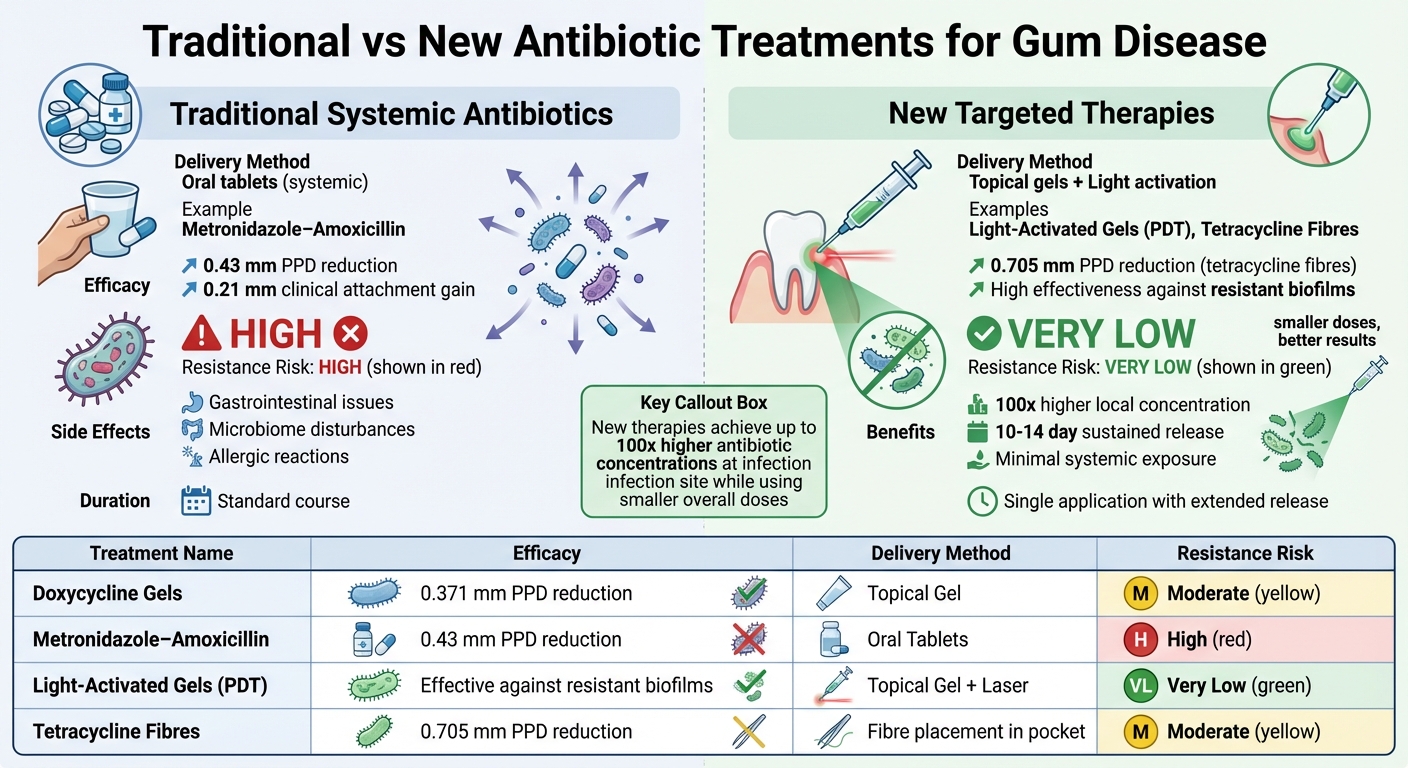
Traditional vs New Antibiotic Treatments for Gum Disease Comparison
New antibiotic therapies for gum disease are changing the game by delivering high drug concentrations directly to the affected area while keeping systemic exposure to a minimum. This shift has spurred the development of targeted topical treatments and innovative delivery systems. In contrast, systemic antibiotics require higher doses to reach periodontal pockets effectively, which can lead to broader body-wide effects like gastrointestinal issues, microbiome disturbances, and even severe allergic reactions [2][9].
Topical treatments, such as gels and microspheres, are applied right at the infection site. This method allows for high local concentrations with smaller overall doses, significantly reducing systemic side effects [8][9][18]. These local therapies have shown measurable improvements in reducing probing depths when used alongside other treatments. Additionally, they can sustain drug release in the gingival crevicular fluid for up to 10–14 days, making them particularly effective against the persistent nature of periodontal biofilms [8].
Emerging therapies take a different approach altogether. For instance, light-activated gels used in photodynamic therapy (PDT) rely on a physical mechanism rather than traditional chemical antibiotic actions. This shift dramatically lowers the risk of antimicrobial resistance. As highlighted by Frontiers in Pharmacology:
Due to its physical mode of action, PTT [Photothermal Therapy] presents a reduced risk of bacterial resistance, positioning it as a promising antimicrobial strategy [9].
Another promising advancement is macrophage-mimicking nanogels. These nanogels target specific pathogens, such as Porphyromonas gingivalis, while also restoring immune function in the affected area. They offer excellent biocompatibility and represent a novel way to tackle gum disease [9].
On the other hand, the standard systemic treatment – amoxicillin combined with metronidazole – yields a clinical attachment level gain of 0.21 mm and a probing pocket depth (PPD) reduction of 0.43 mm [2]. However, this method carries a higher risk of resistance compared to newer topical or light-activated options [2][9].
The table below breaks down the differences between traditional and newer treatments:
Treatment Comparison Table
| Treatment Name | Efficacy | Delivery Method | Resistance Risk |
|---|---|---|---|
| Doxycycline Gels | Moderate (0.371 mm PPD reduction) | Topical Gel | Moderate |
| Metronidazole–Amoxicillin | Moderate (0.43 mm PPD reduction) | Oral Tablets | High |
| Light-Activated Gels (PDT) | High (effective against resistant biofilms) | Topical Gel + Laser | Very Low |
| Tetracycline Fibres | High (0.705 mm PPD reduction) | Fibre placement in pocket | Moderate |
These comparisons highlight how newer therapies not only improve outcomes but also tackle challenges like antibiotic resistance, offering a fresh perspective on treating periodontal diseases.
The Future of Antibiotic Treatments for Gum Disease
Periodontal treatments are moving towards more precise therapies that focus on harmful bacteria while preserving the beneficial ones. A standout example is FP 100 (Hygromycin A), which specifically targets certain pathogens without disrupting the overall microbiome balance [20][1].
Beyond precision antibiotics, biological therapies are gaining traction. Options like bacteriophage therapy and predatory bacteria (BALOs) present exciting alternatives. These methods utilise viruses or naturally occurring bacteria to eliminate specific periodontal pathogens, leaving the healthy bacteria untouched. Such approaches are vital in tackling the challenge of antimicrobial resistance in gum disease.
Innovations in smart delivery systems are also reshaping periodontal care. Scientists are developing hydrogels that release antibiotics only when triggered by environmental changes, such as acidic pH or bacterial enzymes in inflamed tissues. This method aims to minimise systemic side effects while enhancing treatment effectiveness [9][21]. These advancements complement light-activated therapies, adding another layer of precision in drug delivery.
Light-activated therapies are even beginning to transition from clinics to home use. The Lumoral device, currently in clinical trials in Kaunas, Lithuania, is set to conclude by autumn 2025. This device pairs a specialised mouthwash with dual-light therapy, and early results show promise – 54% of users achieved healthy gums compared to only 22% in control groups [19]. These developments suggest that cutting-edge antibacterial treatments may soon become part of everyday oral care, potentially transforming how gum disease is managed.
FAQs
Are topical gels safer than oral antibiotics for gum disease?
Topical gels, including locally applied antibiotics, have been shown to be an effective option for managing gum disease, especially in cases involving deep gum pockets. By delivering treatment directly to the affected area, these gels reduce systemic exposure compared to oral antibiotics. This targeted method not only addresses the problem more precisely but may also lower the risk of side effects often associated with oral medications.
Can new treatments work if bacteria are in a biofilm?
Innovative treatments are paving the way for better management of periodontal disease, especially when it comes to tackling bacteria within biofilms. Options like nanocarriers, narrow-spectrum antibiotics (such as FP-100), and bacteriophage therapies are gaining attention. These methods focus on breaking through the protective barrier of biofilms, potentially offering more efficient solutions for combating gum disease.
When will options like photodynamic therapy or targeted antibiotics be available in Australia?
Photodynamic therapy and targeted antibiotics are gaining attention as potential treatments and are expected to become more widely available in Australia in the near future. By late 2025, research has reported notable progress in photothermal strategies, offering new possibilities for periodontal care. These advancements point toward exciting improvements in the field.
Related Blog Posts
- Antimicrobial Nanocomposites for Tooth Regeneration
- Types of Antibiotics for Gum Disease
- Recent Advances in Biomaterials for Periodontal Regeneration
- Advances in Periodontal Antimicrobial Therapy
Important Notice: Any surgical or invasive procedure carries risks. Before proceeding, you should seek a second opinion from an appropriately qualified health practitioner.
Individual results may vary. The information provided in this article is for educational purposes only and does not constitute medical advice.
Checkout Related Blogs




Get in touch with us
For more information, call us now to start feeling better. Or fill the form below to make appointment
The Latest News from Complete Smiles
How to Clean Clear Plastic Retainers
Checklist for Choosing Wearable Dental Devices
Checklist for Choosing Cloud AI Platforms in Dentistry

Complete Smiles Bella VistaAccepts All Major Health Funds, Including





