





Applications of LLLT in Orthodontics
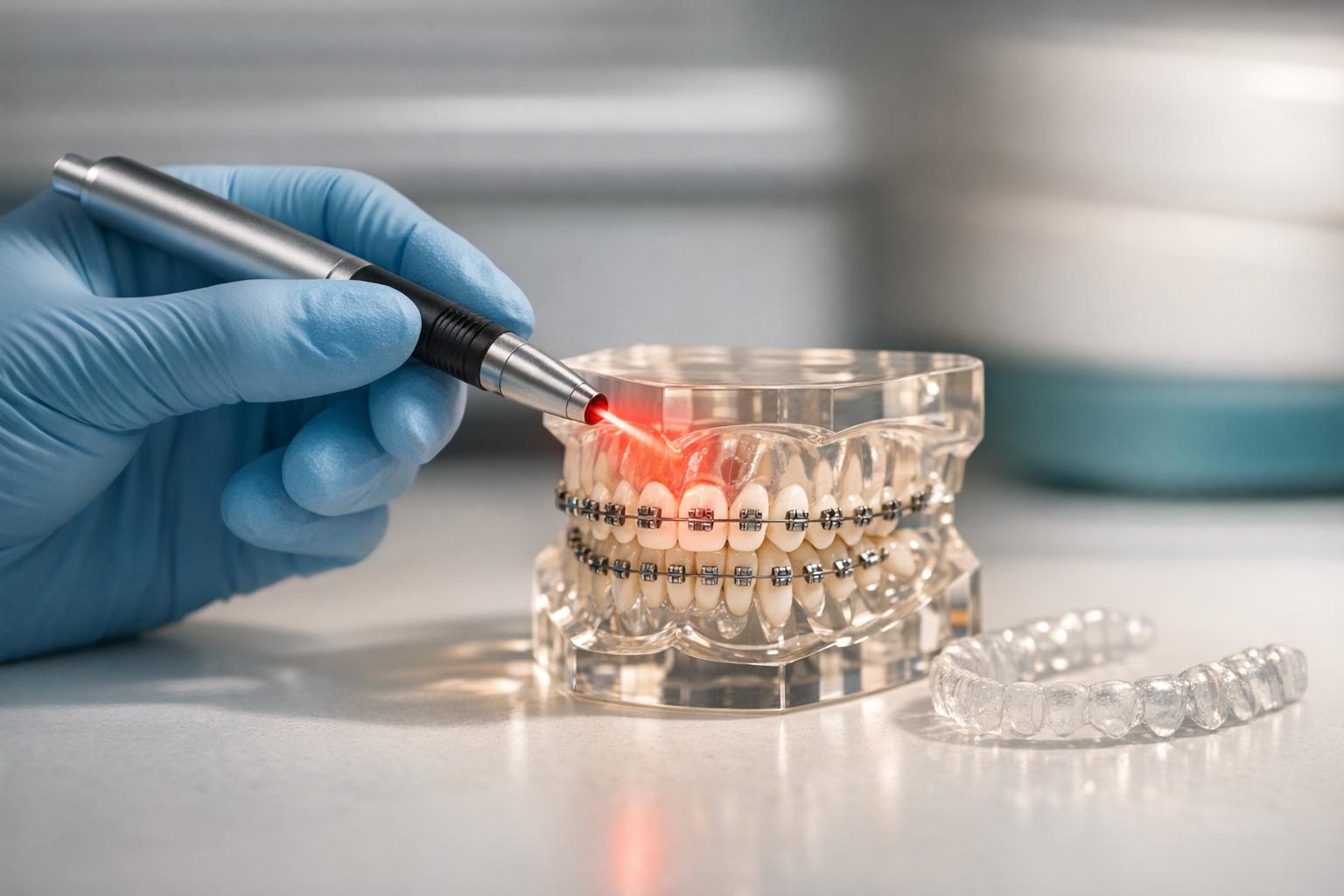
Low-Level Laser Therapy (LLLT), also known as photobiomodulation, is becoming a popular tool in orthodontics. It helps reduce pain, speeds up tooth movement, and promotes healing without the risks associated with medications like NSAIDs. By using specific light wavelengths (810–980 nm), LLLT stimulates cellular repair and improves blood flow, making orthodontic treatment more comfortable and efficient.
Key Benefits:
- Pain Relief: Reduces inflammation, lowers prostaglandin levels, and releases beta-endorphins for natural pain management.
- Faster Tooth Movement: Enhances bone remodelling and cellular activity, shortening treatment time.
- Healing Support: Improves tissue recovery by stimulating osteoblasts and fibroblasts.
Quick Facts:
- Pain Reduction: Patients report relief within 6–48 hours after treatment.
- Treatment Time: LLLT can accelerate tooth movement by up to 35%.
- Safety: No thermal damage as tissue temperatures stay below 36.5°C.
Although promising, LLLT lacks standardised protocols, and its effectiveness can vary depending on laser settings and treatment phases. Research continues to refine its applications and long-term benefits.
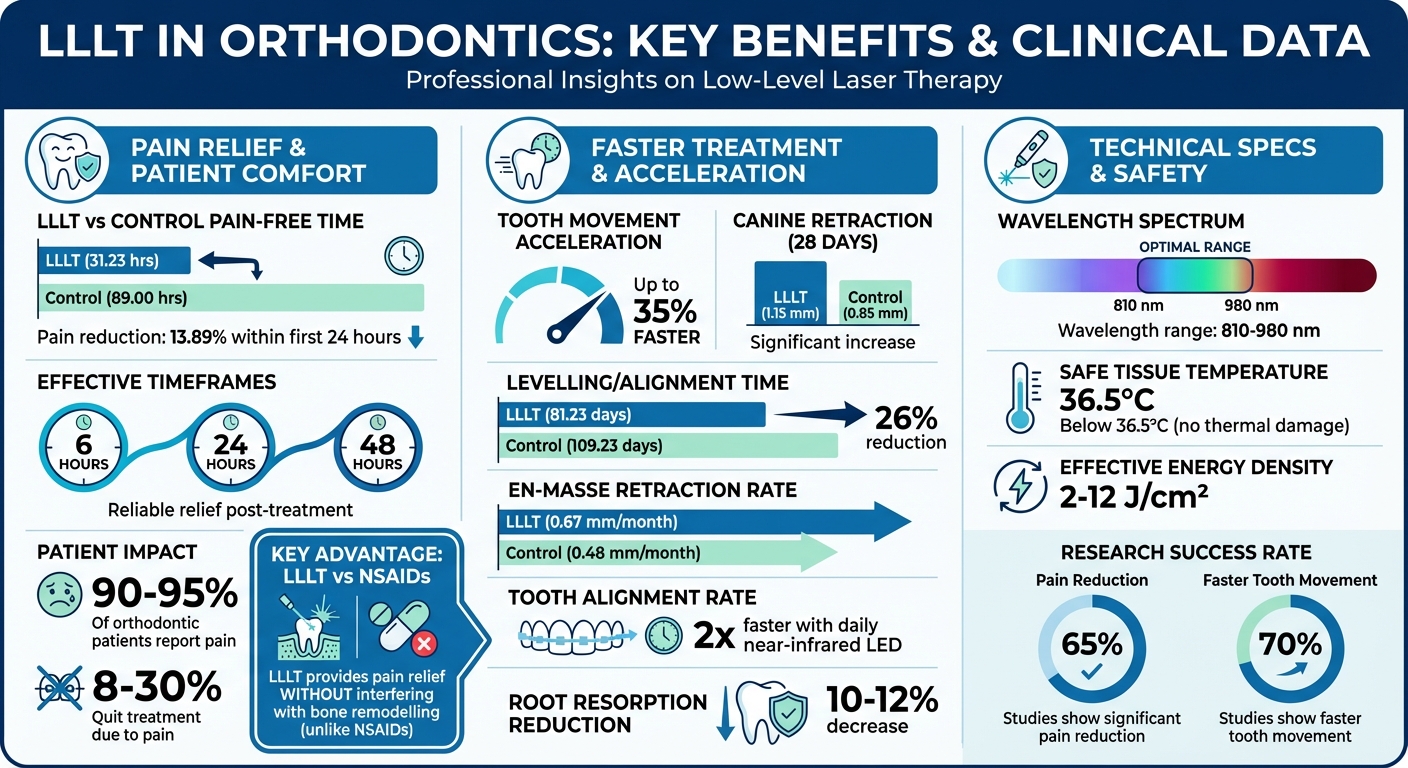
LLLT Benefits in Orthodontics: Key Statistics and Clinical Outcomes
Dental Treatment: Low Level Laser Therapy | Aug 30, 2023
How LLLT Works in Orthodontics
LLLT (Low-Level Laser Therapy) achieves its effects through photobiomodulation, where specific light wavelengths trigger biological changes at the cellular level. This process explains its growing use for reducing orthodontic pain and promoting faster healing during treatment.
Pain Relief Through LLLT
LLLT alleviates orthodontic pain using multiple mechanisms. It inhibits the release of arachidonic acid, which lowers Prostaglandin E2 (PGE2) levels – an inflammatory mediator responsible for the dull, aching pain patients often feel after adjustments [9][8]. Additionally, it stimulates the release of beta-endorphins, providing natural pain relief [8][4].
On a neurological level, LLLT reduces pain by inhibiting C-fibre depolarisation [4]. It also modulates inflammatory cytokines like Interleukin-1β (IL-1β), which peak during the first 24 hours after orthodontic force application. By improving local blood flow, the therapy helps clear inflammatory byproducts and minimise tissue swelling [9][2][6][4].
A 2022 clinical trial conducted at the Inga University Centre demonstrated LLLT’s effectiveness in pain reduction. Researchers, led by Manoel Heitor Brito, used an 808 nm GaAlAs infrared laser on 28 patients immediately after their first alignment archwire installation. The laser was applied to 12 points per tooth for 15 seconds each (totalling 9.36 J per tooth). Results showed significant pain reduction at 6, 24, and 48 hours compared to a control group of 26 patients [6]. Notably, patients receiving LLLT reported being pain-free at a median of 31.23 hours, while the control group took 89.00 hours to reach the same point [6].
Beyond pain relief, LLLT plays a key role in enhancing tissue healing, as discussed below.
Faster Tissue Healing with LLLT
LLLT promotes faster tissue repair by stimulating the growth and activity of osteoblasts and fibroblasts – the cells responsible for bone remodelling and soft tissue repair [2][4]. It also influences bone metabolism by increasing the RANKL/OPG ratio, enhancing osteoclast activity on the pressure side of moving teeth and supporting bone regeneration on the tension side [2][9].
The therapy activates TGF-beta1, a vital factor in oral wound healing [3]. By reducing inflammatory mediators like PGE2 and inhibiting cyclooxygenase-2 (COX-2), LLLT limits tissue damage and accelerates the transition to the healing phase [9][4].
"LLLT seems to reduce orthodontic pain on two levels: by inhibiting the release of arachidonic acid which reduces the levels of prostaglandin E2 and by provoking the release of beta-endorphin which induces an effective analgesic reaction." – Antonino Lo Giudice, PhD, DDS, MSc, Milano-Bicocca University [8]
Clinical Uses of LLLT in Orthodontics
Low-level laser therapy (LLLT) has become a regular tool in orthodontics, helping to address common challenges. Since orthodontic pain can often impact a patient’s commitment to treatment [10], managing discomfort is a key priority for orthodontists. Here’s how LLLT is making a difference in various clinical scenarios.
Managing Pain During Braces Adjustments
For many patients, braces adjustments and aligner changes can be uncomfortable. LLLT offers a non-drug alternative to NSAIDs for easing this discomfort [6][9]. The therapy is typically applied right after orthodontic forces are activated – like when wires are tightened or separators are placed – targeting the period when sensitivity is at its peak [6]. What’s remarkable is that LLLT alleviates pain without interfering with the biological processes necessary for tooth movement [9].
The standard approach involves treating multiple points (cervical, middle, and apical regions) on both the buccal and lingual sides of the tooth roots [6]. For instance, one study using an 810 nm laser showed a 13.89% reduction in pain intensity within the first 24 hours after application [9].
"LLLT has been recently applied as a nonpharmacological method to reduce orthodontic pain because of its analgesic and anti-inflammatory effects attributed to increased blood flow due to alleviating Prostaglandin levels and inhibiting COX-2 enzyme secretion." – AlSayed Hasan MMA, BMC Oral Health [10]
Beyond pain relief, LLLT has another major advantage: it can speed up the process of tooth movement.
Speeding Up Tooth Movement
LLLT doesn’t just ease pain – it also accelerates tooth movement by boosting bone remodelling and cellular activity in the periodontium [3]. A clinical trial conducted in 2021 by Junyi Zheng and Kai Yang at Capital Medical University examined 12 patients undergoing upper first premolar extractions. Using an 810 nm diode laser (100 mW, 6.29 J/cm²) on days 0, 7, 14, and 21, they achieved 1.15 mm of canine retraction on the laser-treated side versus 0.85 mm on the control side over 28 days [2]. Another study by Youssef et al. found that LLLT could speed up orthodontic movement by as much as 98% during the retraction phase [2].
A review of human clinical trials further supports these findings, with 7 out of 10 studies reporting faster tooth movement when LLLT was used compared to control groups [3]. Energy densities in the range of 2 to 12 J/cm² appear to be effective for stimulating the biostimulation needed for quicker tooth movement [2].
But LLLT’s benefits don’t stop there – it also aids in tissue recovery after orthodontic procedures.
Healing Tissue After Orthodontic Procedures
LLLT promotes tissue healing by stimulating fibroblasts, keratinocytes, and osteoblasts, which are essential for collagen production and bone remodelling [11]. It enhances vascularisation and microcirculation through angiogenesis, helping tissues recover faster from irritation or injury [11][12]. Additionally, LLLT improves the stability of miniscrews by increasing bone density and osseointegration [11].
Clinical studies have shown that daily near-infrared LED treatments can double the rate of tooth alignment [12]. Furthermore, LLLT has been found to reduce root resorption during intrusive tooth movements by 10% to 12% [11]. Unlike surgical methods like corticotomy or piezocision, LLLT offers similar benefits in accelerating treatment, but without the associated risks or trauma [11][12].
"LLLT fits in perfectly and, thanks to its intrinsic characteristics, helps the clinician in his or her daily routine… reducing chair time and minimising patient discomfort." – MDPI Applied Sciences [11]
sbb-itb-2be92ed
Research Evidence and Safety of LLLT
Expanding on the clinical benefits previously mentioned, research provides further backing for the effectiveness of Low-Level Laser Therapy (LLLT) while also shedding light on its safety profile.
Pain Reduction Results
The pain-relieving effects of LLLT in orthodontics are well-documented, though results can vary. A meta-analysis of 20 randomised clinical trials revealed that 65% of studies reported a significant reduction in pain. Notably, LLLT was shown to lower pain levels at 6, 24, and 48 hours after orthodontic adjustments [9][6]. A 2025 study even found that LLLT surpassed a paracetamol–caffeine combination in reducing peak pain during the separation phase and the insertion of rectangular archwires [13]. However, it’s worth noting that some trials indicate LLLT may not be as effective during peak pain periods for certain procedures, such as molar distalisation [7][10]. Pain is a common experience for orthodontic patients, with around 90–95% reporting discomfort during treatment [10][4], and between 8% and 30% potentially discontinuing treatment due to pain [9].
Tooth Movement Speed Studies
Clinical research consistently highlights LLLT’s ability to speed up tooth movement by promoting alveolar bone remodelling. A systematic review of 10 clinical trials found that 70% of the studies reported faster tooth movement with LLLT compared to control groups [3]. One randomised controlled trial demonstrated that LLLT reduced the time needed for levelling and alignment by 26%, with the laser group completing treatment in 81.23 days versus 109.23 days for the control group [14].
In another study conducted at Capital Medical University, researchers used a split-mouth design with 12 patients undergoing maxillary canine retraction. One side received 810 nm diode laser treatment (100 mW, 6.29 J/cm²) on days 0, 7, 14, and 21. The laser-treated side showed 1.15 mm of cumulative tooth movement over 28 days, compared to 0.85 mm on the control side – a 35% increase in retraction speed [2]. Similarly, during en-masse retraction, movement rates reached approximately 0.67 mm/month in the maxilla with LLLT, compared to 0.48 mm/month in control groups [15].
"With the parameter settings used in this study, LLLT could, to some extent, lead to changes in bone metabolism, which could accelerate orthodontic tooth movement." – Junyi Zheng, Department of Orthodontics, Capital Medical University [2]
That said, not all studies align with these findings. In one review, 3 out of 10 studies reported no significant advantages, likely due to differences in laser wavelength, power, and irradiation intervals [3]. While LLLT shows promise in speeding up treatment, its safety and limitations must also be carefully evaluated.
Safety and Limitations
Unlike NSAIDs, which can slow orthodontic tooth movement by inhibiting prostaglandin synthesis, LLLT offers pain relief and promotes healing without disrupting bone remodelling. It is considered safe when proper protocols are followed, with minimal contraindications. The low energy output of LLLT ensures tissue temperatures stay below 36.5°C, preventing thermal damage to oral tissues [2]. However, both patients and practitioners must wear protective glasses during laser application to avoid eye injuries [2][13].
A major challenge with LLLT is the absence of standardised treatment protocols. There’s no universal agreement on optimal wavelength, power settings, irradiation time, or treatment intervals, leading to inconsistent clinical outcomes [2][3]. Additionally, some studies suggest that LLLT may only be effective during specific phases of treatment rather than providing consistent benefits throughout [13][7]. Many existing studies also face limitations such as small sample sizes and potential bias, which means the current evidence should be interpreted cautiously [9][4]. To better understand the molecular mechanisms and long-term biological effects of LLLT, further research, particularly histological studies, is needed [3].
Summary and Future Developments
Main Points
Low-Level Laser Therapy (LLLT) offers a non-invasive approach to pain relief while speeding up tooth movement by influencing inflammatory markers and bone remodelling processes [2][6]. Specifically, it impacts markers like IL-1β and the RANKL/OPG ratio [2]. Clinical studies consistently show that LLLT not only alleviates pain but also accelerates orthodontic treatment [2][6]. Unlike NSAIDs, which can interfere with bone remodelling, LLLT provides targeted pain relief without such drawbacks [5][6]. These findings open doors for broader clinical applications in orthodontics and beyond.
Future Applications of LLLT in Orthodontics
The potential of LLLT continues to grow as research delves into new therapeutic areas. Emerging studies are investigating its role in preventing mandibular nerve paraesthesia, optimising clear aligner therapy, and integrating nanotechnology for more precise treatments [16][5]. For example, combining laser therapy with gold nanorods may pave the way for advanced photothermal and photodynamic therapies [5].
However, the lack of standardised treatment protocols remains a challenge. Current research varies widely in terms of wavelength, power output, and irradiation frequency [2][16]. Future efforts are expected to define evidence-based parameters, likely focusing on wavelengths within the optical window of 550–950 nm and energy densities between 2 and 12 J/cm² [2][1]. Additionally, histological studies are gaining traction to better understand how laser energy influences osteoblast activity at the cellular level [3][2]. As these protocols become refined, LLLT could significantly boost patient compliance by reducing both the pain and the overall duration of orthodontic treatments [1].
FAQs
Does LLLT work with braces and clear aligners?
Yes, low-level laser therapy (LLLT) can be combined with braces and clear aligners like Invisalign. It’s known to help speed up tooth movement during orthodontic treatments while also easing discomfort. Recent studies and reviews back these claims, highlighting LLLT as a helpful addition to orthodontic care.
How many LLLT sessions are usually needed during orthodontic treatment?
Low-level laser therapy (LLLT) usually requires around 12 sessions throughout orthodontic treatment. These sessions typically begin right after the first archwire is placed. In some cases, additional sessions are suggested during the initial phases of treatment, depending on the specific needs and the treatment plan tailored for the patient.
Who should avoid LLLT in orthodontics?
Low-Level Laser Therapy (LLLT) in orthodontics comes with certain precautions. It should be avoided in pregnant women when applied directly over the developing foetus. Additionally, it is not recommended for patients with conditions such as epilepsy, cancer, or tumours, or when targeting sensitive areas like the thyroid gland or the gravid uterus. These guidelines exist to address safety concerns and potential risks associated with its use.
Related Blog Posts
- Laser Dentistry for Pain Relief
- Advances in Orthodontic Pain Management Techniques
- 7 Pros And Cons Of Laser Dentistry
- How Aligners Move the Jaw
Important Notice: Any surgical or invasive procedure carries risks. Before proceeding, you should seek a second opinion from an appropriately qualified health practitioner.
Individual results may vary. The information provided in this article is for educational purposes only and does not constitute medical advice.
Checkout Related Blogs




Get in touch with us
For more information, call us now to start feeling better. Or fill the form below to make appointment
The Latest News from Complete Smiles
How to Clean Clear Plastic Retainers
Checklist for Choosing Wearable Dental Devices
Checklist for Choosing Cloud AI Platforms in Dentistry

Complete Smiles Bella VistaAccepts All Major Health Funds, Including





