





Future of Endodontics: Stem Cell Therapies
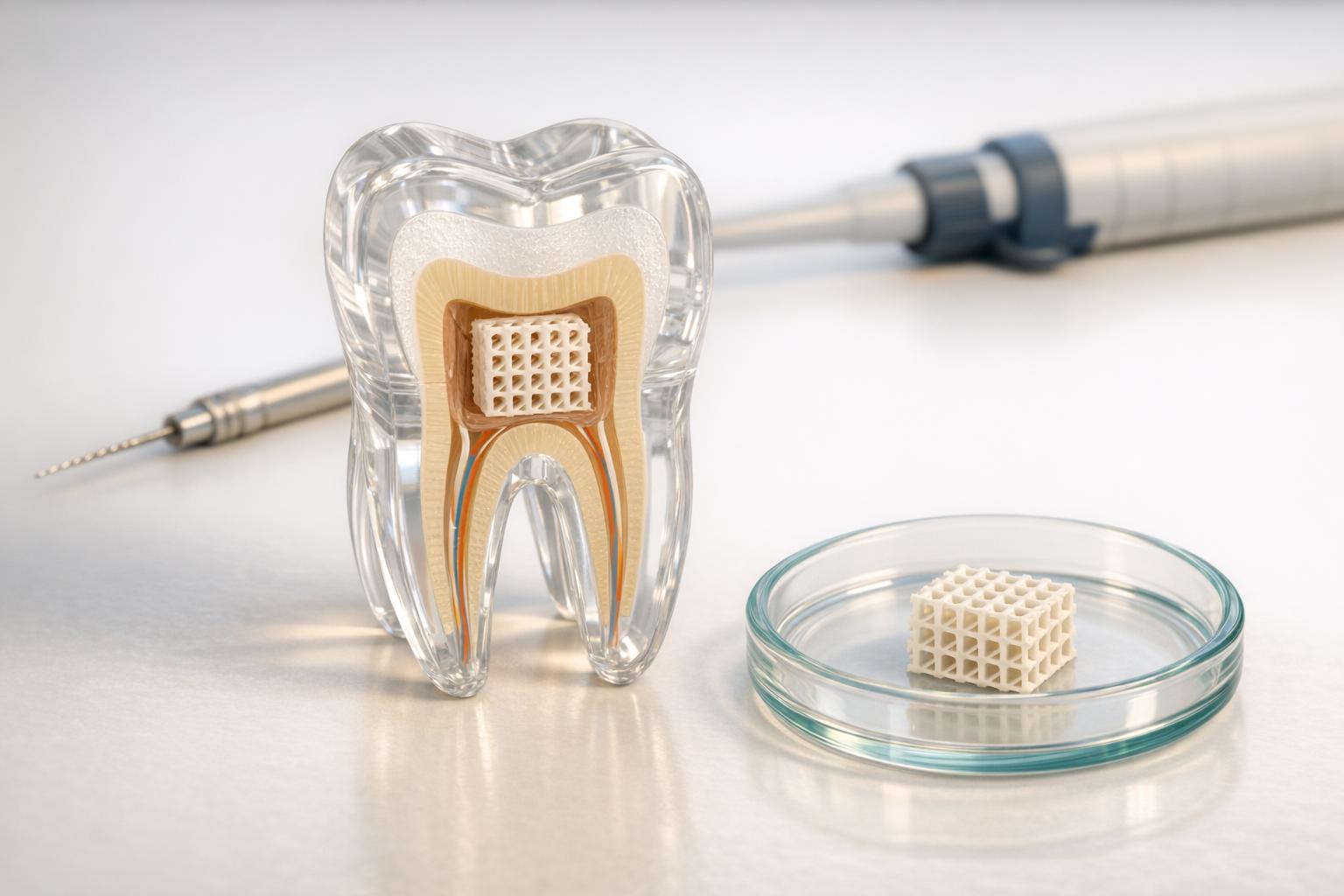
Stem cell-based regenerative endodontics is changing how we treat damaged or infected dental pulp. Unlike root canal therapy (RCT), which removes the pulp and leaves the tooth brittle, regenerative techniques aim to restore the tooth’s vitality. This approach uses stem cells, scaffolds, and growth factors to rebuild the pulp-dentin complex, allowing teeth to heal, grow, and defend themselves naturally.
Key Takeaways:
- Root Canal Therapy (RCT):
- Success rate: ~89%.
- Removes infected pulp but leaves teeth non-vital and prone to fractures.
- Stops root development in immature teeth, increasing fracture risks.
- Regenerative Endodontics (REPs):
- Success rate: ~90%.
- Restores pulp vitality in ~50–56% of cases.
- Promotes continued root growth and strengthens dentinal walls in immature teeth.
- Challenges include stem cell differentiation, immune compatibility, and complex procedures.
Quick Comparison:
| Feature | Root Canal Therapy (RCT) | Regenerative Endodontics (REPs) |
|---|---|---|
| Success Rate | ~89% | ~90% |
| Pulp Vitality | Lost | Potential restoration |
| Root Development | Stops in immature teeth | Continues |
| Structural Strength | Decreased | Increased |
| Complexity | Standardised protocols | Technically demanding |
Stem cell therapies show promise, especially for young patients with immature teeth, but challenges like standardising procedures and ensuring long-term safety remain. As research advances, these techniques could reshape dental care by preserving tooth vitality and improving durability.
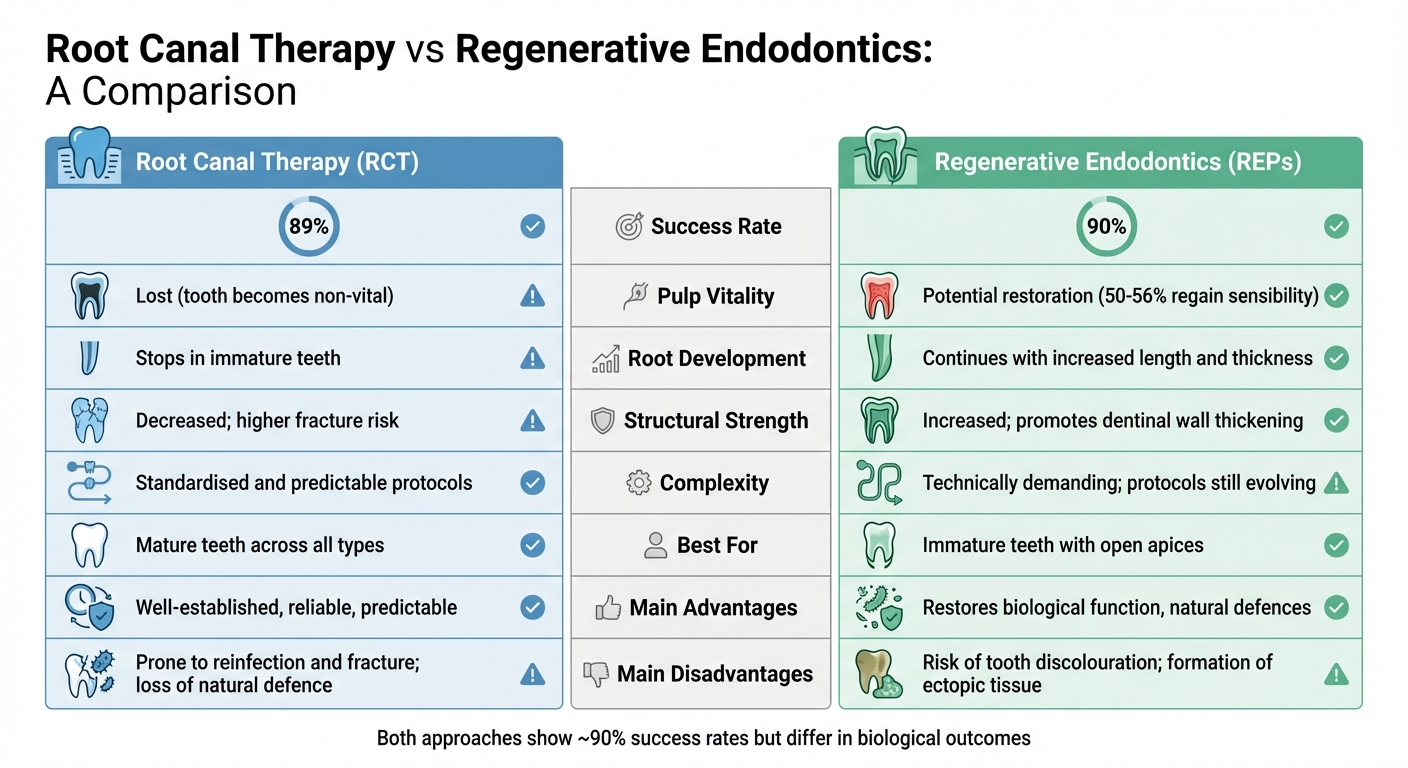
Root Canal Therapy vs Regenerative Endodontics Comparison Chart
1. Traditional Root Canal Therapy (RCT)
Efficacy
For decades, traditional root canal therapy (RCT) has been the go-to treatment for addressing pulpal necrosis and periapical issues. It boasts a pooled success rate of 89% (95% CI: 77–95%) and an impressive one-year survival rate of 95% [4]. When comparing treatment duration, single-session RCTs show better outcomes at 92.65%, compared to 85.48% for two-session procedures. Radiographic healing effectiveness is reported at 86.95% [4].
The procedure involves removing infected tissue through mechanical and chemical means, thoroughly cleaning and shaping the root canal, and sealing it to prevent reinfection [4][1]. While this method is highly effective in eradicating harmful microorganisms and preserving the tooth’s structure, it doesn’t restore the biological functions of the pulp. As highlighted by the British Dental Journal, "RCT has a documented success rate, yet it fails to revitalise the pulp, may compromise the structural integrity of the tooth, and may be prone to reinfection or fracture in the future" [4].
Despite its high success rates, RCT isn’t without risks.
Risks
One of the key drawbacks of RCT is the removal of the pulp, which eliminates its immune defence, sensation, and ability to regenerate dentine [4][1][2]. This can lead to increased brittleness, making the tooth more prone to fractures over time [4][1].
Additionally, procedural errors, such as incomplete sealing or disinfection, can result in treatment failure and reinfection [4]. The challenges are particularly evident in immature teeth with open apices, where RCT halts root development. This leaves thin dentinal walls, significantly increasing the risk of cervical fractures [4][1].
Applicability
Traditional RCT is the standard treatment for mature teeth across all types, including anterior, premolar, and molar teeth. Its predictable outcomes and well-established protocols make it the preferred option for cases of irreversible pulp inflammation or necrosis, where the primary objective is to control infection and preserve the tooth’s structure [5].
However, its use in immature permanent teeth is increasingly scrutinised. Techniques like apexification can close the root apex, but they don’t promote continued root growth or strengthen dentinal walls [2]. This limitation has driven interest in regenerative approaches that aim to restore vitality rather than just maintaining structure.
Future Potential
Although advancements in stem cell therapies are reshaping dental care, traditional RCT remains a cornerstone of modern dentistry. It is particularly vital for treating complex molar anatomy, where regenerative techniques are still being refined [4]. The British Dental Journal notes, "Traditional RCT remains the standard for mature teeth across various tooth types, while REPs offer particular advantages for immature teeth and cases requiring biological regeneration" [4].
Looking ahead, RCT may evolve to incorporate regenerative principles, such as facilitating the migration of stem cells to support tissue repair rather than merely filling the root canal [5]. While regenerative methods hold promise, RCT will continue to be indispensable in cases where these new techniques are not yet practical. These limitations underline the growing need for regenerative strategies, which will be explored in the next section.
sbb-itb-2be92ed
2. Stem Cell-Based Regenerative Endodontics
Efficacy
Stem cell-based regenerative endodontic procedures (REPs) have shown a success rate of 90% (95% CI: 83–94%) in pooled data, setting them apart by focusing on restoring biological function rather than merely filling voids left by diseased tissue [6]. These procedures utilise the "tissue engineering triad" – stem cells, scaffolds, and growth factors – to rebuild the pulp-dentin complex [2].
In a 2020 triple-blind randomised clinical trial led by C. Brizuela, 36 patients with mature incisors, canines, or premolars underwent either cell-based REPs with encapsulated human umbilical cord mesenchymal stem cells or traditional root canal therapy (RCT). After 12 months, the REP group achieved 100% tooth survival and a median reduction of 0.94 mm in periapical lesions, compared to 0.35 mm in the RCT group [7][8].
Cold, hot, and electric pulp testing shows that around 50–56% of REP-treated teeth respond positively [6]. As highlighted in the British Dental Journal:
A unique advantage of REPs is the potential for restoring pulp sensibility, which is not possible with conventional RCT [6].
Research using laser Doppler flowmetry has confirmed improved blood flow in REP-treated teeth, with pulp perfusion units increasing from 6.39 to 17.5 [9].
For immature teeth with open apices, REPs encourage continued root development, leading to longer roots and thicker dentinal walls. This reduces the likelihood of fractures, a common issue with traditional apexification methods [2][6]. While these outcomes are promising, REPs still face technical and biological challenges.
Risks
One major challenge in REPs is controlling stem cell differentiation within the root canal. Ensuring cells develop into the correct tissue types in the appropriate locations is not always predictable [2][3].
Immune compatibility is another concern, especially when using donor-derived (allogenic) cells. Autologous cells, sourced from the patient, avoid rejection risks but require strict aseptic conditions to prevent complications [2]. Additionally, maintaining cell viability and ensuring precise placement within the intricate root canal anatomy remains complex [2].
The scaffold materials used in REPs must degrade at the right pace to synchronise with new tissue formation. As Rosana Farjaminejad of City, University of London explains:
A scaffold that degrades too quickly or too slowly may trigger inflammation or disrupt tissue development [2].
Age also plays a role in treatment predictability, as regenerative abilities tend to decline over time, making outcomes less consistent in older patients [2]. Muhammad Junaid from Najran Health Cluster summarises:
Challenges such as immunological response, stem cell differentiation, and long-term safety still exist, despite favourable preclinical and clinical data [3].
Applicability
Compared to traditional RCT, REPs aim to restore biological function, making them particularly effective for immature teeth. They support ongoing root development and are especially successful in simpler tooth structures like incisors and canines [6][9].
Recent trials have expanded REPs to mature teeth with periapical lesions, but results are less consistent than for immature teeth [7][10]. Complex molar anatomy remains a challenge for REPs, where traditional RCT still holds the advantage [6].
Unlike RCT, which relies on mechanically cleaning and filling the canal with inert materials, REPs focus on creating conditions for the body to regenerate functional tissue. As noted in the Polymers Journal:
REPs represent a paradigm shift in dental care, aligning with the body’s intrinsic healing capacity and offering improved long-term outcomes for patients [2].
Future Potential
Despite the challenges, advancements in technology are paving the way for improved REP outcomes. For instance, 3D bioprinting for tissue repair allows for the creation of patient-specific scaffolds based on cone-beam computed tomography (CBCT) data, replicating the unique shape of each root canal [2]. Injectable hydrogels made from chitosan and collagen are being developed for easy application in complex canal anatomies using syringes [2].
Gene therapy, particularly with CRISPR/Cas9, is being explored to activate natural pathways for dentine and blood vessel formation [2]. Researchers are also investigating cell-free approaches, such as using conditioned mediums containing exosomes or extracellular vesicles secreted by stem cells. These methods could promote regeneration without the risks linked to direct cell transplantation [2].
While mature teeth with intricate anatomy remain a challenge, tools like micro-CT imaging and standardised clinical protocols are improving treatment predictability [2]. As summarised in the British Dental Journal:
Traditional RCT remains the standard for mature teeth across various tooth types, while REPs offer particular advantages for immature teeth and cases requiring biological regeneration [6].
These advancements suggest a shift towards biologically focused treatments that could eventually complement – or even surpass – traditional RCT.
Regenerative Endodontics – Revascularization, Protocol and Technique, Dr William Nudera, Endo: 004
Advantages and Disadvantages
Both traditional root canal therapy (RCT) and regenerative endodontic procedures (REPs) boast high success rates, sitting at approximately 89–90% [4]. However, the two approaches differ greatly in their strengths and limitations.
Traditional RCT is a well-established method, particularly effective for mature teeth. It follows standardised protocols, ensuring reliability. However, by removing the pulp and dentine, it compromises the tooth’s structural integrity, making it more prone to fractures and reinfections. Additionally, the treated tooth becomes non-vital, losing its natural defences [11].
On the other hand, REPs focus on biological regeneration. This is especially beneficial for immature teeth, as the procedure promotes continued root development and thickening of dentinal walls, which can enhance the tooth’s strength [11]. A notable advantage is that 50–56% of REP-treated teeth regain sensory responses to stimuli like cold, heat, and electric testing – something traditional RCT cannot achieve [4]. As highlighted by the International Journal of Oral Science:
"The ultimate objective of REPs is to regenerate the pulp-dentin complex, extend the tooth longevity and restore the normal function." [11]
Despite these benefits, REPs come with their own set of challenges. The procedures are technically demanding, with evolving protocols that can lead to unpredictable outcomes. Tooth discolouration is another concern, particularly when minocycline-based antibiotics are used. However, alternative antibiotic pastes, such as double antibiotic paste, can help reduce this risk [11]. Additionally, histological studies often reveal that instead of true pulp regeneration, REPs may result in reparative tissues like ectopic bone or cementum [11]. Bill Kahler from the University of Queensland School of Dentistry points out:
"Patient-centred outcomes such as tooth discolouration and possibly more appointments with the potential for adverse effects needs to be discussed with patients and parents." [12]
Here’s a quick comparison of the two approaches:
| Feature | Traditional Root Canal Therapy (RCT) | Regenerative Endodontics (REPs) |
|---|---|---|
| Success Rate | ~89% [4] | ~90% [4] |
| Pulp Vitality | Lost; tooth becomes non-vital [11] | Potential restoration (50–56% sensibility) [4] |
| Root Development | Stops in immature teeth [11] | Continues with increased length and thickness [11] |
| Structural Strength | Decreased; higher fracture risk [11] | Increased; promotes dentinal wall thickening [4] |
| Complexity | Standardised and predictable [4] | Technically sensitive; protocols evolving [11] |
| Main Disadvantages | Prone to reinfection and fracture; loss of natural defence [11] | Risk of tooth discolouration; formation of ectopic tissue [11] |
Both methods have their place in modern dentistry, but the choice often depends on the specific needs of the tooth and the patient’s circumstances.
Conclusion
Stem cell-based regenerative endodontics represents a transformative step forward, moving beyond traditional inert root fillings to genuinely restoring biological function. By combining stem cells, bioactive scaffolds, and growth factors, this approach doesn’t just tackle infection – it preserves the tooth’s natural defence mechanisms and sensory abilities, which standard root canal treatments (RCT) often compromise [2][3]. The tissue engineering triad enables true pulp-dentin regeneration, supporting immune defence, sensory perception, and dentin production [2].
For this approach to become routine, collaboration between materials scientists, biologists, and endodontists is crucial. Muhammad Junaid from Najran Health Cluster highlights:
The future of regenerative endodontics will largely depend on sustained interdisciplinary collaboration and innovation in stem cell technologies [3].
Emerging technologies like 3D bioprinting, injectable scaffolds, and gene-editing tools such as CRISPR/Cas9 are paving the way for treatments that work in harmony with the body’s natural healing processes [2].
In Australia, clinics like Complete Smiles Bella Vista are beginning to explore advanced imaging and regenerative techniques. For instance, technologies like CBCT are being used to optimise treatment planning, particularly for young patients with immature permanent teeth – where regenerative therapies have shown consistent success [2][3]. Chair-side stem cell isolation and injectable hydrogels could soon provide biologically driven treatments that promote root lengthening, strengthen dentinal walls, and significantly reduce fracture risks compared to traditional RCT [2][14]. Unlike conventional methods that sacrifice tooth vitality, these regenerative approaches aim to restore natural tissue and improve long-term durability.
However, challenges like standardising protocols and proving long-term efficacy remain. C. Brizuela from Universidad de Los Andes observes:
The clinical translation of these current bioengineering approaches will undoubtedly be beneficial to the future practice of endodontics [13].
As research advances and techniques are refined, regenerative endodontics could become a practical option for preserving natural teeth while enhancing their structural strength and biological vitality.
FAQs
Am I a candidate for regenerative endodontics?
Regenerative endodontics could be an option for you, but it depends on several factors, including the health of your pulp tissue and the extent of the damage. This treatment is particularly suited for teeth with necrotic or damaged pulp, as it focuses on regenerating tissue to bring back essential functions like immune defence and dentin production. A skilled endodontist will evaluate your situation, looking at aspects such as the availability of stem cells and the overall condition of your teeth and gums.
Are stem cell endodontic treatments safe long term?
The safety of stem cell-based treatments in endodontics is an area of ongoing investigation. Initial studies, including clinical trials and experiments on animals, indicate that these procedures are generally safe when executed properly. They show potential for aiding in pulp regeneration and promoting healing. However, challenges such as ensuring proper stem cell differentiation and addressing immune compatibility issues persist. Additionally, there is a lack of extensive long-term data. Ongoing research is crucial to better understand their safety and effectiveness over extended periods.
Why might regenerative endodontics fail to restore tooth sensation?
Regenerative endodontics may not always succeed in bringing back tooth sensation, often due to lingering infection or re-infection within the root canal. These issues can block nerve regeneration and stop the pulp tissue from revitalising – both critical steps needed to restore sensation.
Related Blog Posts
- Stem Cells in Periodontal Regeneration: Current Trials
- Growth Factors vs. Stem Cells in Gum Grafting
- Dental Pulp Stem Cells in Regenerative Dentistry
- Growth Factors in Dental Pulp Repair
Important Notice: Any surgical or invasive procedure carries risks. Before proceeding, you should seek a second opinion from an appropriately qualified health practitioner.
Individual results may vary. The information provided in this article is for educational purposes only and does not constitute medical advice.
Checkout Related Blogs




Get in touch with us
For more information, call us now to start feeling better. Or fill the form below to make appointment
The Latest News from Complete Smiles
How to Clean Clear Plastic Retainers
Checklist for Choosing Wearable Dental Devices
Checklist for Choosing Cloud AI Platforms in Dentistry

Complete Smiles Bella VistaAccepts All Major Health Funds, Including





