





Growth Factors in Dental Pulp Repair
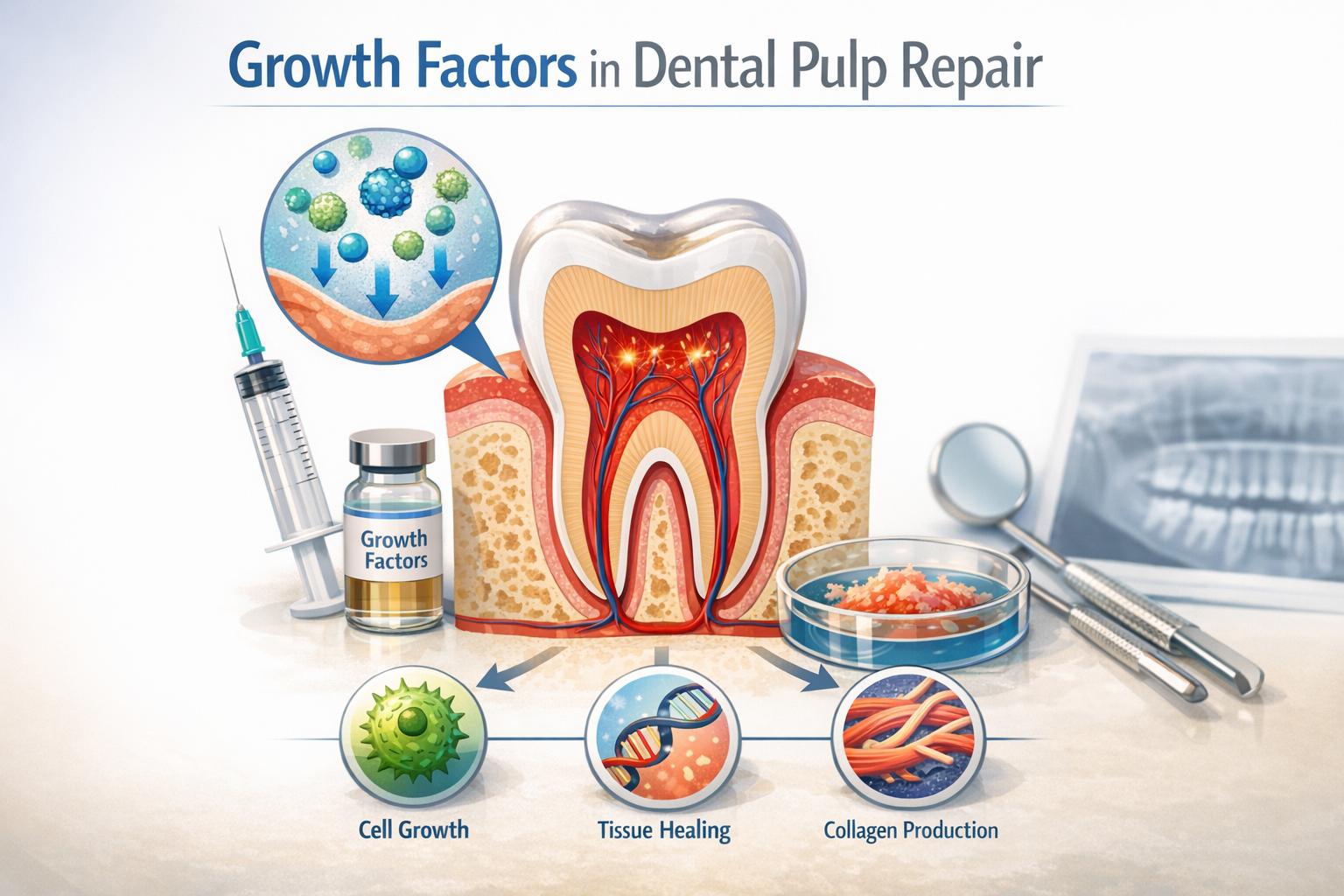
Dental pulp repair is transforming how damaged teeth are treated, moving away from conventional methods like root canals to regeneration-focused approaches. Instead of leaving teeth lifeless, this method uses growth factors to restore blood supply, sensory function, and immune response within the tooth. These biological molecules guide the healing process by attracting stem cells, encouraging their growth, and supporting the formation of new dentin, blood vessels, and nerves.
Key growth factors involved include:
- TGF-β: Promotes stem cell differentiation into dentin-producing cells.
- VEGF: Restores blood supply through new capillary formation.
- PDGF: Aids in wound healing and structural restoration.
- bFGF: Attracts stem cells and supports their regenerative capacity.
Platelet concentrates like PRF and CGF provide a natural delivery system for these factors, showing promising results in clinical trials. Challenges remain, such as standardising preparation methods and overcoming anatomical complexities. However, emerging technologies like gene therapy, bioprinting, and cell-free treatments are paving the way for more predictable outcomes, offering hope for better dental care.
Tissue Regeneration Using Nature’s Way
sbb-itb-2be92ed
Main Growth Factors in Dental Pulp Regeneration
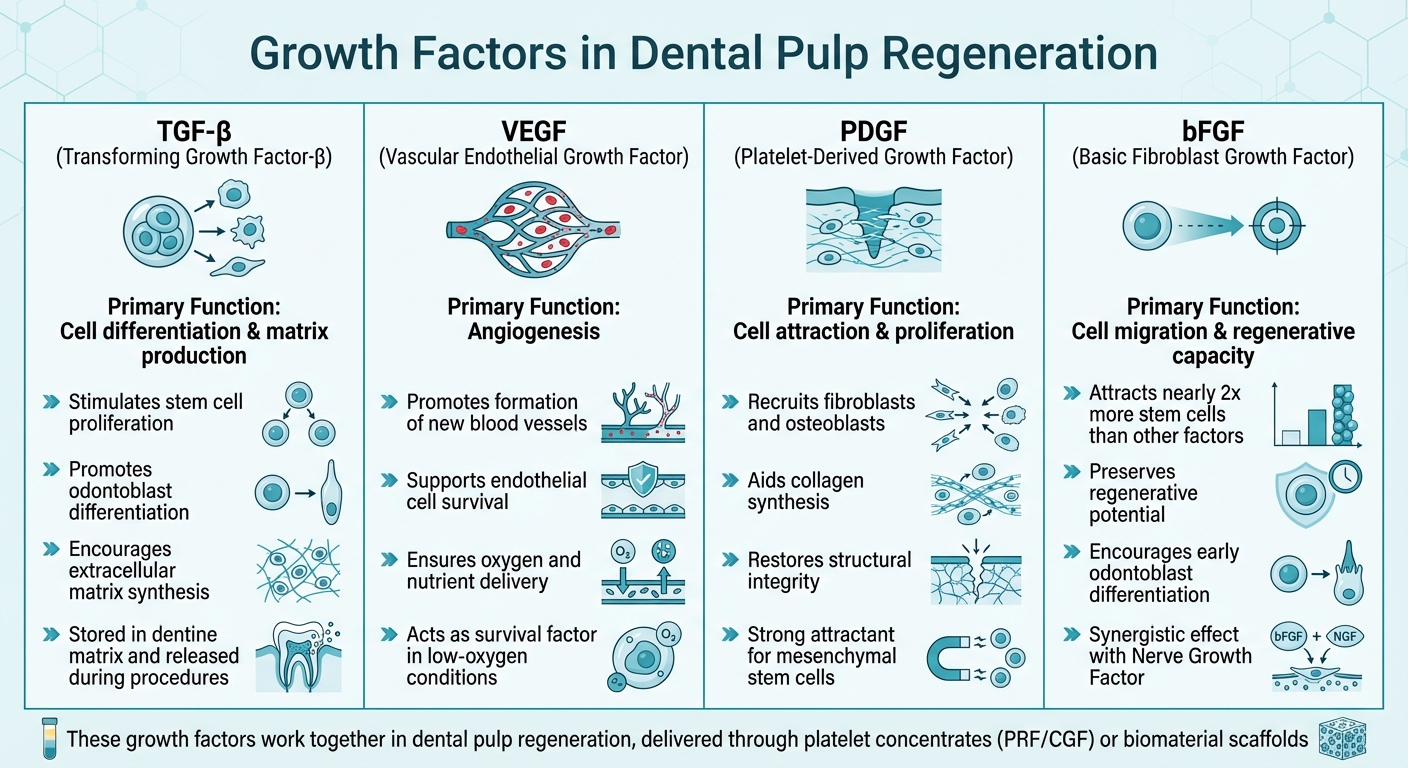
Key Growth Factors in Dental Pulp Regeneration and Their Functions
Growth factors play a central role in steering the cellular processes that drive dental pulp regeneration.
"Both pulp repair and regeneration processes are orchestrated by a highly coordinated interplay of different growth factors and cytokines." – Orti et al. [1]
Transforming Growth Factor-β (TGF-β)
TGF-β is a key player in cell differentiation and matrix production within the pulp. It works as both a chemotactic and mitogenic factor, drawing mesenchymal stem cells to the site of injury and encouraging their proliferation. This growth factor, stored in the dentine matrix during tooth formation, is released during clinical procedures. Once released, it promotes extracellular matrix synthesis and directs stem cells to differentiate into odontoblasts, the cells responsible for dentine production. While TGF-β focuses on cell differentiation, another essential factor, VEGF, addresses vascular restoration.
Vascular Endothelial Growth Factor (VEGF)
VEGF is indispensable for re-establishing the blood supply to damaged pulp tissue. It targets endothelial cells – the cells lining blood vessels – stimulating them to migrate, multiply, and form new capillary networks through angiogenesis. This ensures that the regenerating tissue receives adequate oxygen and nutrients. VEGF also acts as a survival factor for endothelial cells in low-oxygen conditions. Research highlights the potential need for external VEGF supplementation to achieve effective angiogenesis [1][4][3]. Alongside VEGF, other factors like PDGF and FGF contribute to cellular recruitment and tissue repair.
Platelet-Derived Growth Factor (PDGF) and Fibroblast Growth Factor (FGF)
PDGF is a strong attractant and growth stimulator for fibroblasts, osteoblasts, and mesenchymal stem cells. It plays a vital role in collagen production and wound healing, helping to restore the structural integrity of the pulp [4].
The FGF family, particularly basic FGF (bFGF or FGF-2), is another major contributor to pulp regeneration. bFGF excels at recruiting stem cells to injury sites, with studies showing it attracts nearly twice as many stem cells from the apical papilla compared to other factors. Beyond recruitment, bFGF helps maintain the regenerative capacity of these cells, encouraging early odontoblastic differentiation. However, prolonged exposure to bFGF might inhibit the final stages of cell maturation [1][2]. When paired with Nerve Growth Factor, bFGF has demonstrated a synergistic effect, enhancing neural differentiation within the pulp [1].
| Growth Factor | Primary Function | Key Action in Regeneration |
|---|---|---|
| TGF-β | Cell differentiation & matrix production | Stimulates stem cell proliferation and odontoblast differentiation [4] |
| VEGF | Angiogenesis | Promotes formation of blood vessels and supports endothelial cell survival [1][4] |
| PDGF | Cell attraction & proliferation | Recruits fibroblasts and aids collagen synthesis [4] |
| bFGF | Cell migration & regenerative capacity | Attracts stem cells and preserves their regenerative potential [1] |
Clinical Uses of Growth Factors in Endodontics
Growth factors play a key role in pulp repair, and clinicians are now leveraging these molecules in various advanced treatment methods.
Platelet-Derived Concentrates: PRP, PRF, and CGF
Platelet concentrates act as autologous 3D scaffolds and reservoirs of cytokines, making them invaluable in endodontic treatments [6]. After disinfecting the root canal with 1.5% sodium hypochlorite and 17% EDTA, clinicians induce periapical bleeding and place the platelet concentrate up to the cementoenamel junction [6]. These concentrates release growth factors – such as TGF-β1, PDGF, VEGF, and IGF-1 – that encourage stem cell proliferation and differentiation into odontoblast-like cells [6].
Each type of concentrate has unique characteristics. PRP releases growth factors quickly (within 7–14 hours) using bovine thrombin, while PRF and CGF, prepared without additives and via variable-speed centrifugation, provide a sustained release over several days and promote angiogenesis [6]. A 2024 randomised clinical trial with 18 patients suffering from mature necrotic maxillary incisors showed promising results: PRF and CGF reduced lesion sizes by 83.02% and 89.42% respectively over 12 months [6].
In addition to platelet concentrates, biomaterial scaffolds are being used to refine growth factor delivery.
Scaffold-Based Growth Factor Delivery
Biomaterial scaffolds provide a 3D structure that regulates the release of growth factors in both time and space [7]. Injectable hydrogels are particularly effective in endodontics as they can be delivered via syringe and adapt to the intricate, narrow root canal morphology, which typically holds only about 20 µL in volume [7]. These scaffolds mimic the extracellular matrix, enabling cell adhesion, migration, and differentiation. However, their degradation rate must align with tissue growth – too fast, and inflammation may occur; too slow, and tissue development could be impeded [5].
Natural scaffolds like collagen and fibrin are highly biocompatible but lack mechanical strength. On the other hand, synthetic materials such as PLA and PGA can be tailored for specific needs but tend to have lower bioactivity [5].
The integration of stem cell therapy with growth factors provides another promising avenue for regeneration.
Combining Stem Cell Therapy with Growth Factors
Stem cells and growth factors work together to improve regenerative outcomes by facilitating "cell homing." Molecules like bFGF and PDGF-BB attract endogenous stem cells from the periapical region into the root canal [4]. bFGF promotes stem cell proliferation, while BMP-2 and TGF-β1 encourage differentiation into odontoblast-like cells for reparative dentine formation [4][1].
One case study from 2021 highlights the potential of this approach. A 21-year-old male with a non-vital maxillary left central incisor and an open apex was treated with autologous CGF packed into the canal. After 12 months, radiographs showed reduced periapical lesions, increased dentine thickness, and restored pulp vitality and sensory function [4]. The success rate for CGF combined with revascularisation in treating apical hypoplasia has been reported at 71.4% [4].
Research Evidence and Clinical Results
Clinical Trials on Pulp Regeneration
Research highlights the critical role of growth factors in promoting dental pulp regeneration. A randomised clinical trial (NCT06227533), conducted at the Faculty of Dental Medicine, Al-Azhar University, explored this in detail. The 2024 study followed 18 patients with mature necrotic maxillary incisors over 12 months, comparing the use of Platelet-Rich Fibrin (PRF) and Concentrated Growth Factor (CGF) as regenerative scaffolds [6]. Results showed promising outcomes: the PRF group achieved an 83.02% ± 17.13% reduction in periapical lesions, while the CGF group reached 89.42% ± 9.22%. Both groups also reported 100% recovery of pulp sensibility within the 12-month period [6].
The study also measured relative bone density improvements. In the PRF group, bone density increased to approximately 0.45 ± 0.15, while the CGF group saw an increase to 0.52 ± 0.08 [6]. While CGF showed slightly better numerical results, the difference in periapical healing between the two treatments was not statistically significant (p-value = 0.34) [6].
"Revascularization using PRF or CGF successfully preserved mature teeth with necrotic pulps." – Nature/BDJ Open, 2024 [6]
These findings are supported by individual case reports, which provide further evidence of the effectiveness of these therapies.
Case Studies of Regenerative Treatments
Case studies add a practical dimension to the clinical trial data. For instance, a 2025 review described the treatment of a 24-year-old patient with a necrotic pulp and periapical lesion using CGF as a scaffold [5]. Follow-up assessments revealed complete healing of the periapical lesion and increased dentine wall thickness, showcasing the potential of regenerative therapies to outperform traditional root canal treatments [5]. This case challenges the belief that regenerative procedures are only effective in immature teeth, proving their efficacy even in fully mature dentition.
The success of these treatments hinges on meticulous clinical protocols. For example, using lower concentrations of sodium hypochlorite (1.5%) during disinfection – rather than the 5.25% concentration typical in conventional root canal therapy – helps preserve stem cell viability and supports dentine formation [6].
Challenges and Future Research
Limitations of Current Therapies
While growth factor therapies have shown encouraging clinical outcomes, they still face a range of practical challenges. For instance, excessively high levels of growth factors can actually hinder cell proliferation due to the presence of TGF-β and proteolytic enzymes [4]. The complex anatomy of root canals, particularly in the apical regions, also makes effective revascularisation difficult [5].
Another issue lies in the preparation of platelet concentrates, which currently lacks standardisation. This inconsistency leads to varying growth factor levels, making outcomes less predictable [4]. Additionally, the biphasic nature of bFGF poses a challenge: it supports early stem cell differentiation but may inhibit final mineralisation when exposure is prolonged [1][2]. Factors like patient age and the severity of infection further impact regenerative success, as adults generally have a reduced capacity for regeneration [5]. Moreover, traditional materials like calcium hydroxide and MTA have limited regenerative potential and can sometimes result in necrotic tissue formation beneath the treated area [1][2].
Addressing these limitations is essential to improving the effectiveness of pulp regeneration therapies. Fortunately, emerging technologies are offering new possibilities for overcoming these barriers.
New Directions in Growth Factor Research
Gene therapy, particularly using CRISPR/Cas9, is showing potential for precisely activating genes involved in dentine and vascular formation. Researchers are exploring both in vivo methods – directly introducing genes into damaged pulp – and ex vivo approaches, where stem cells are modified to overexpress growth factors before being reintroduced [5].
Cell-free strategies are another promising avenue. These involve conditioned media enriched with exosomes derived from dental stem cells, which can encourage healing without the risk of immune rejection [5]. Injectable hydrogels, such as those made from chitosan or collagen, and nanocomposites and nanoparticles like silver or bioactive glass, offer controlled and sustained delivery of therapeutic molecules while also providing antimicrobial benefits [5][1].
Three-dimensional bioprinting is also making waves in the field. By using CBCT data, this technology can create patient-specific scaffolds tailored to the unique structure of root canals, enhancing the precision and effectiveness of treatments [5].
Conclusion
Growth factors have reshaped how dental pulp repair is approached, moving the focus away from traditional root canal treatments with inert fillers to regenerative therapies driven by biological processes. By leveraging clinical protocols, these molecules can be released from the dentin matrix, creating an environment conducive to tissue healing [3].
Platelet concentrates, such as PRF and CGF, have shown promising results in pulp regeneration. They provide a sustained release of growth factors over 7–14 days [8]. Unlike traditional methods, these therapies not only restore tissue volume but also revive vital functions like immune defence, sensory perception, and the ability for continued root development [5].
However, challenges remain. The preparation of platelet concentrates lacks standardisation, certain growth factors like bFGF exhibit biphasic effects, and the intricate anatomy of root canals complicates consistent outcomes. As discussed earlier, variability in growth factor release and the complexities of root canal anatomy have been significant hurdles. Fortunately, recent advancements are beginning to address these issues.
Emerging technologies, including gene therapy with CRISPR/Cas9, injectable hydrogels, 3D bioprinting, and cell-free approaches like exosomes, show potential to further improve the predictability of these treatments [5].
The future of endodontics lies in harnessing the body’s natural healing mechanisms through evidence-backed strategies. With ongoing research refining delivery systems, optimising signalling pathways, and creating standardised protocols, growth factor therapies are poised to become more reliable and widely accessible, leading to better long-term outcomes for patients in need of pulp repair.
FAQs
Am I a candidate for pulp regeneration instead of a root canal?
Recent research suggests that pulp regeneration could be an option for teeth suffering from pulp necrosis, especially those with immature roots. This approach focuses on regenerating the pulp-dentin complex, promoting root development, and bringing back vitality to the tooth.
The success of this treatment hinges on a few key factors, such as thorough disinfection and ensuring the apical foramen is appropriately sized to facilitate the process.
How safe are PRF and CGF platelet treatments for pulp repair?
Recent research suggests that PRF (Platelet-Rich Fibrin) and CGF (Concentrated Growth Factor) platelet treatments are generally considered safe for pulp repair. Studies point to their potential in aiding tissue regeneration without causing significant side effects. While the findings are encouraging, there is still limited long-term histological data available on their outcomes. Even so, these treatments hold potential for enhancing dental pulp healing and regeneration, all while maintaining a strong safety record.
How long do regenerative pulp treatments take to heal and show results?
Regenerative pulp treatments typically require several months before healing becomes apparent. Root development and tissue regeneration are generally observed within a 6 to 12-month timeframe. However, this timeline can differ based on factors such as the patient’s overall condition and the specific treatment method used.
Related Blog Posts
- Stem Cells in Periodontal Regeneration: Current Trials
- Antimicrobial Nanocomposites for Tooth Regeneration
- Growth Factors vs. Stem Cells in Gum Grafting
- Dental Pulp Stem Cells in Regenerative Dentistry
Important Notice: Any surgical or invasive procedure carries risks. Before proceeding, you should seek a second opinion from an appropriately qualified health practitioner.
Individual results may vary. The information provided in this article is for educational purposes only and does not constitute medical advice.
Checkout Related Blogs




Get in touch with us
For more information, call us now to start feeling better. Or fill the form below to make appointment
The Latest News from Complete Smiles
How to Clean Clear Plastic Retainers
Checklist for Choosing Wearable Dental Devices
Checklist for Choosing Cloud AI Platforms in Dentistry

Complete Smiles Bella VistaAccepts All Major Health Funds, Including





