





Plasma Coatings and Osseointegration: What Studies Show

Plasma-sprayed coatings are transforming dental implants by improving how they bond with bone tissue. They use hydroxyapatite – a mineral similar to bone – applied to titanium surfaces through a high-temperature plasma jet. This process creates a textured, bioactive surface that encourages faster bone growth, stronger integration, and reduced healing times.
Key findings from research include:
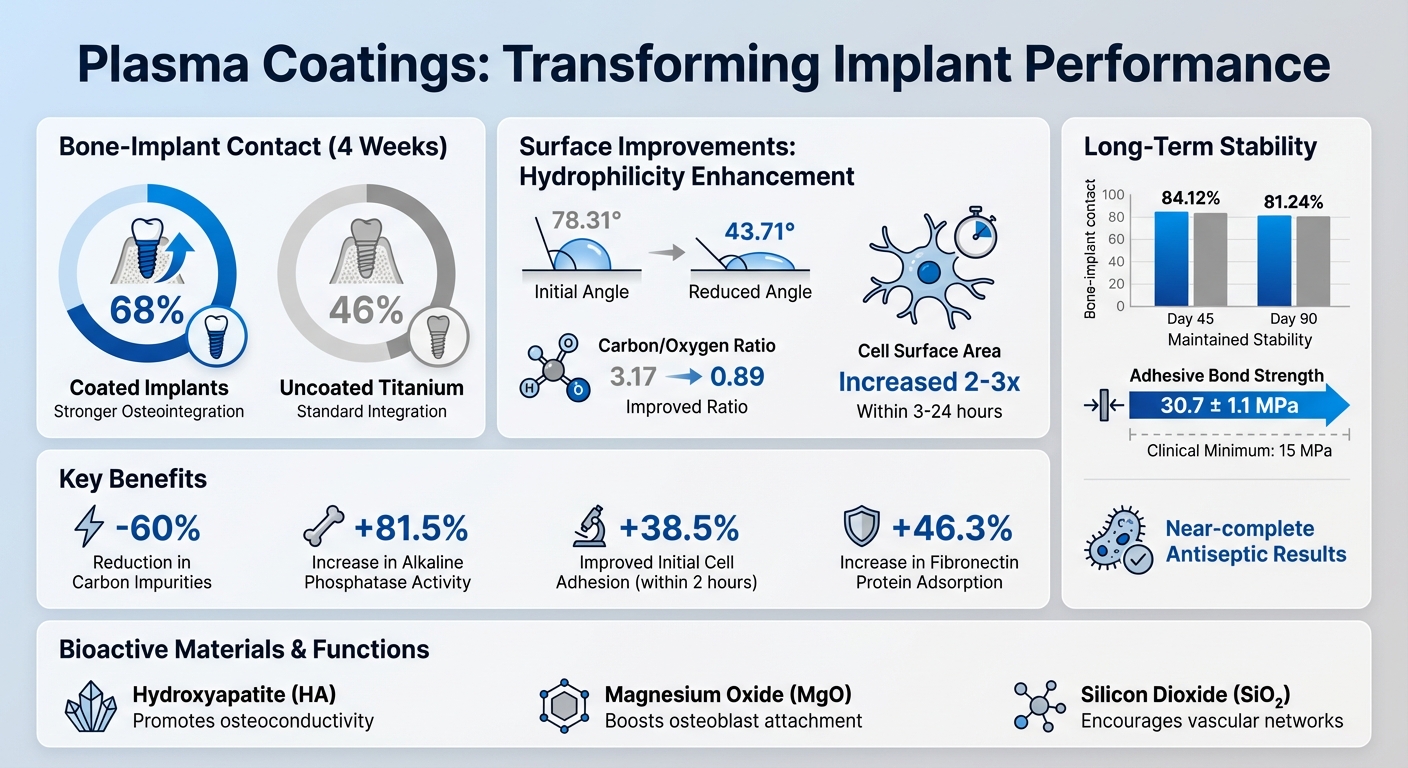
- 68% bone-implant contact in 4 weeks for coated implants, compared to 46% for uncoated titanium.
- Improved surface roughness and hydrophilicity enhance cell adhesion and bone bonding.
- Bioactive materials like magnesium oxide (MgO) and silicon dioxide (SiO₂) boost bone cell growth and stability.
- Plasma treatments also reduce bacterial adhesion, lowering infection risks.
Challenges like coating delamination and material stability remain, but advancements like thinner coatings and hybrid materials are addressing these issues. Plasma coatings are shaping the future of dental and medical implants by improving performance and long-term outcomes.
Plasma-Sprayed Coatings vs Uncoated Implants: Key Performance Metrics
Plasma Surface Treatment for Dental Applications
sbb-itb-2be92ed
How Plasma-Sprayed Coatings Improve Osseointegration
Plasma-sprayed coatings transform implant surfaces, making them more conducive to rapid cell adhesion and stronger bone integration.
Surface Roughness and Hydrophilicity
Plasma spraying alters smooth titanium into a micro-textured surface, creating features that help bone tissue attach more securely. These roughened surfaces provide mechanical interlocking points, giving bone a firm grip on the implant [4].
Another key benefit is the significant improvement in hydrophilicity – the surface’s ability to attract and retain water. For instance, research on zirconia surfaces found that plasma treatment reduced the water contact angle from 78.31° to 43.71°. This change makes the surface more welcoming to biological fluids, enabling cells to spread and adhere more effectively [6]. Plasma treatment also introduces hydroxyl (OH) groups, which further enhance osteoblast adhesion [6].
The biological effects are striking: human gingival fibroblast cells increased their surface area two to three times within the first 3 to 24 hours of culture. Additionally, plasma treatment reduced the Carbon/Oxygen ratio on the surface from 3.17 to 0.89, helping to eliminate contaminants that could otherwise hinder cell attachment [6]. These changes activate genes involved in cell adhesion, setting the stage for direct bone contact.
Improved Bone-to-Implant Contact
Plasma-sprayed coatings also speed up the establishment of direct bone-to-implant contact. Studies using dog models showed that implants coated with calcium phosphate (CaP) achieved successful osseointegration [5].
Min-Soo Kim from Yonsei University College of Dentistry explains: "CaP is known to have characteristics such as enhancing rapid fixation and direct bonding of the implant to bone" [5].
This improvement is driven by contact osteogenesis, a process where new bone forms directly on the implant surface, rather than growing from existing bone towards the implant. This method shortens the time needed for implant fixation and creates a stronger biological bond, reinforcing overall osseointegration [5].
Bioactive Materials in Plasma Coatings
While surface texture and hydrophilicity enhance mechanical attachment, bioactive materials take it a step further by chemically improving bone bonding. Hydroxyapatite (HA) implant coatings, commonly used in plasma coatings, facilitates osteoconductivity, encouraging early-stage bone growth and direct bonding between the implant and surrounding tissue [4].
Susmita Bose from the W. M. Keck Biomedical Materials Research Laboratory notes: "Because of its compositional similarity to bone mineral, HA coatings can promote bonding between host tissues and implant surface, therefore increasing osseointegration and reducing implant fixation time" [4].
Modern plasma coatings are often enhanced with additives like magnesium oxide (MgO) and silicon dioxide (SiO2). MgO boosts osteoblast attachment and proliferation, while SiO2 encourages the formation of vascular networks and reduces bone resorption [4]. Thermal oxidation at 800°C can further improve coating crystallinity, increasing it from 64% to 75%. This enhancement reduces dissolution rates in bodily fluids, ensuring long-term stability [4]. These optimised coatings exhibit adhesive bond strengths of 30.7 ± 1.1 MPa, far exceeding the clinical minimum requirement of 15 MPa [4].
Research Findings on Plasma-Sprayed Coatings
Vacuum Plasma on SLA Surfaces
Vacuum Plasma Spraying (VPS) operates in a controlled low-pressure argon environment – typically ranging between 50 and 200 mbar. This setup minimises oxidation and allows for the creation of denser coatings by using high-velocity molten droplets [8]. For instance, VPS-applied hafnium carbide (HfC) coatings achieved an impressive Vickers hardness of 1,650.7 HV with a porosity of 16.8%. This performance significantly surpassed that of titanium carbide coatings, which demonstrated a hardness of 753.6 HV and a porosity of 22.5% [8].
Interestingly, other surface treatments on sandblasted, large-grit, acid-etched (SLA) surfaces showed minimal performance differences. Canine studies revealed that acid-etched grit-blasted implants achieved 47.4% bone-to-implant contact, while grit-blasted controls reached 48.8% after four weeks [7]. When measuring ultimate shear strength, acid-etched surfaces registered 9.41 MPa compared to 10.15 MPa for grit-blasted surfaces alone [7]. These findings suggest that grit-blasted surfaces already perform exceptionally well, leaving little room for improvement through additional modifications in short-term models [7]. These results pave the way for clinical exploration of hydroxyapatite (HA) coatings.
Hydroxyapatite Coatings in Clinical Use
Hydroxyapatite (HA) coatings have shown clear benefits over bio-inert titanium surfaces by significantly accelerating osseointegration [9][3]. A study conducted at Huzhou Central Hospital in August 2021 used male New Zealand white rabbits to evaluate HA-coated titanium implants. Led by Xiaojun Wang and Fengfeng Wu, the research demonstrated that HA-coated implants achieved higher bone-to-implant interface values and faster osseointegration over an eight-week period compared to standard micro-arc oxidised titanium [9].
According to Rüdiger Junker from Radboud University Nijmegen Medical Centre: "Thin calcium phosphate (CaP) coating technology can solve the problems associated with thick CaP coatings, while they still improve implant bone integration compared with non-coated titanium implants" [3].
Thin CaP coatings not only match or exceed the osseointegration performance of thicker coatings but also reduce the risk of delamination, where the coating separates from the implant surface [3]. These findings highlight the importance of refining surface treatments to optimise implant performance.
Comparing Different Surface Treatments
Further comparisons of surface treatments reveal how material composition and treatment conditions affect osseointegration. Pure HA coatings consistently outperform composite variations. For example, while adding zirconia (ZrO₂) to HA improves mechanical bonding strength, it significantly hinders osseointegration. Pure HA coatings achieved direct bone-to-coating contact, whereas HA/ZrO₂ composites failed to achieve osseointegration even after 12 weeks [11].
The conditions under which plasma treatments are applied also play a critical role. Implants treated at 5 Torr showed better reduction of carbon impurities and enhanced osteoblast differentiation compared to those treated at 16 Torr. This suggests that lower pressure improves plasma stability and protein adsorption [12]. Additionally, substrate preparation methods impact coating performance. Porous titanium precoats provide superior primary and secondary stability compared to chemical etching or sandblasting. Among these, sandblasting ranks as the least effective method for ensuring HA coating adhesion [10].
Clinical Outcomes and Patient Benefits
Research shows that plasma-sprayed coatings not only speed up early osseointegration but also improve overall implant performance.
Faster Early Bone Healing
Plasma-sprayed coatings significantly enhance early osseointegration by removing up to 60% of carbon impurities from implant surfaces, optimising their biological response [15]. This creates a hydrophilic surface that encourages rapid protein adsorption and early bone cell attachment. For instance, in August 2022, the ACTILINK plasma treatment applied to Straumann SLA implants boosted alkaline phosphatase activity by 81.5% and improved initial cell adhesion by 38.5% within just two hours [15].
According to Racquel Z. LeGeros, Professor at New York University College of Dentistry: "HA-coated implants provided greater amount of bone attachment, higher bone-implant interfacial strength and accelerated skeletal attachment" [2].
In rat models, osteoid formation – a precursor to mature bone tissue – was observed on HA-coated implant surfaces as early as two weeks after implantation [16]. By day 45, plasma-coated titanium implants achieved an impressive bone-implant contact rate of 84.12% [14]. This faster integration shortens the waiting period before the implant can handle functional loads.
Reduced Bacterial Adhesion
Plasma treatments also offer antimicrobial benefits through preventing implant infections with surface engineering by producing reactive oxygen species, ions, and ultraviolet radiation that work together to destroy bacteria on implant surfaces. These agents disrupt bacterial membranes, making it harder for bacteria to colonise [18]. The same process that removes carbon impurities also creates a surface less conducive to bacterial attachment.
As Sogand Schafer and colleagues from the University of Miami Miller School of Medicine explain: "The eradication of bacteria is facilitated by the effect of hydroxyl radicals on unsaturated fatty acids produced by plasma, resulting in the impairment of membrane lipids" [18].
In anti-biofilm tests, magnetron-sputtered silver coatings – a vacuum plasma technique – achieved near-complete antiseptic results against Staphylococcus aureus [17]. Notably, vacuum plasma devices can treat implants while they remain sealed in sterile packaging, preserving sterility while enhancing surface properties [13][15]. This dual effect – better bioactivity and reduced infection risk – leads to healthier implant sites with fewer complications post-surgery.
Together, faster bone healing and reduced bacterial adhesion pave the way for improved long-term implant outcomes.
Better Implant Stability and Longevity
The combination of accelerated bone integration and lower bacterial colonisation enhances the long-term stability of implants. A study from September 2023 revealed that plasma-coated titanium implants maintained an 81.24% bone-implant contact rate over 90 days, demonstrating stable integration in healthy bone [14].
Stronger interfacial strength between the bone and implant enables the restoration to better withstand normal chewing forces. Plasma-treated surfaces also showed a 46.3% increase in fibronectin protein adsorption, a key protein that acts as a scaffold for bone cells [13]. This stronger bond reduces the risk of implant loosening, though maintaining the coating’s crystallinity is essential for long-term success.
Challenges and Future Research Directions
Plasma-sprayed coatings offer notable clinical advantages, but addressing their challenges is crucial for long-term success. Since osseointegration plays a key role in implant efficacy, tackling these technical hurdles is essential.
Coating Delamination Issues
One persistent issue with plasma-sprayed coatings is their tendency to separate from the implant surface under clinical conditions. Everyday activities like chewing generate repetitive stresses, which can lead to crack formation and, eventually, coating detachment [19][20]. For example, a study published in Biomaterials (June 2001) by I.G. Turner from the University of Bath found that vacuum plasma-sprayed (VPS) coatings fully delaminated after just 1 million cycles in Ringer’s solution. In contrast, detonation gun (DGUN) coatings only exhibited interface failure after 10 million cycles [20].
The high temperatures involved in plasma spraying can also cause hydroxyapatite to break down into more soluble phases, such as tricalcium phosphate and calcium oxide. These phases dissolve quickly, weakening the bond before the bone can properly integrate. Post-treatment heating, often used to improve crystallinity, can introduce internal stresses that further contribute to cracking [16].
Research on Gas Types and Material Combinations
Ongoing research is examining how different plasma gas types and material combinations affect coating performance. For instance, lowering gas pressure to 5 Torr has been shown to increase reactive nitrogen density and stabilise the plasma, which enhances carbon removal and improves surface bioactivity compared to higher pressures like 16 Torr [12]. Supersonic plasma nozzles are another area of exploration. These nozzles reduce the exposure time of particles to excessive heat, helping to preserve the crystalline structure of hydroxyapatite and achieving bond strengths ranging from 4.8 to 24 MPa [16].
Adding materials like silver can introduce antibacterial properties, but its potential toxicity poses a challenge. Co-doping with strontium is being studied as a way to counteract this toxicity while simultaneously promoting bone growth [16].
According to Robert B. Heimann, there is "a paradigmatic shift towards the development of transition metal-substituted calcium hexa-orthophosphates with the NaSiCON structure to be used for implant coatings with superior degradation resistance" [1].
Hybrid coatings that combine inorganic plasma-sprayed layers with organic materials, such as collagen or bone proteins, are also showing potential for improving tissue integration [16].
Long-Term Clinical Outcomes
Data on the long-term performance of plasma coatings remain inconsistent. Some studies report conflicting results, underscoring the need for controlled trials that extend beyond the typical 90-day period [16]. Additionally, the biological mechanisms driving bone formation on these coatings are not fully understood, making it difficult to refine their design. Researchers are calling for advanced modelling techniques, such as finite element analysis and fracture mechanics, to predict when and how coatings might fail under real-world conditions [19].
Further studies are needed to identify the factors that most influence long-term success. These could include implant design, surgical techniques, or coating properties like thickness and porosity. Carefully controlled clinical trials will be essential to bridge these gaps and ensure that the early clinical benefits of plasma-sprayed coatings are sustained over time [16].
Conclusion
Summary of Benefits
Plasma-sprayed coatings bring clear advantages to implant technology by improving osseointegration and ensuring implant stability. These coatings encourage bone growth and vascularisation, which accelerates osseointegration and reduces the risk of fibrous tissue encapsulation – a common cause of implant failure. As a result, they contribute to high mechanical stability and durability [21].
Plasma treatments also significantly reduce hydrocarbon impurities, cutting them by approximately 60% [15]. Clinically, this translates to reduced post-operative discomfort, quicker early-stage bone healing, and improved long-term implant longevity.
"HA-coated cementless implants are still considered the current ‘gold standard’ in hip arthroplasty and dental restoration." – Journal of Thermal Spray Technology [21]
These achievements provide a strong foundation for ongoing advancements in the field.
Future Perspectives
The horizon for plasma-sprayed coatings is filled with promising developments. Researchers are exploring hybrid bioactive coatings that merge inorganic calcium phosphates with organic elements like collagen and bone morphogenetic proteins to accelerate tissue integration [16]. Technological innovations, such as supersonic plasma nozzles, are refining coating crystallinity by minimising heat exposure, while ultra-thin techniques like Suspension Plasma Spraying allow for precise applications with coating layers thinner than 20 µm [16]. These advancements address critical clinical challenges and improve the precision of treatments.
Looking further ahead, fourth-generation "smart" implants are poised to revolutionise the field. These implants incorporate electronic systems designed to monitor cellular responses and use bioelectric signals to aid tissue regeneration [21]. Plasma coating technologies will undoubtedly play a central role in achieving better outcomes for patients in both dental and medical applications.
FAQs
Are plasma-coated implants safe long term?
Studies suggest that plasma-coated implants may improve osseointegration, making them a promising option for dental procedures. However, information on their long-term safety remains limited. More research is needed to assess how well these implants perform over extended periods. Current studies are focused on providing a better understanding of their durability and safety.
Can plasma coatings reduce implant infections?
Plasma coatings and surface treatments play a key role in reducing implant infections by making it harder for bacteria to stick to dental implant surfaces and form biofilms. These treatments actively work to kill or suppress harmful pathogens, which helps to prevent infections and minimise tissue inflammation.
On top of that, plasma coatings enhance the surface’s hydrophilicity, encouraging better tissue integration while also lowering the chances of bacterial growth. Combined, these benefits contribute to improved clinical results and a reduced risk of implant-related infections.
Do plasma coatings let implants heal faster?
Plasma coatings are known to aid implants in healing more efficiently by improving osseointegration – the process where bone bonds to the implant. These coatings enhance the surface’s hydrophilicity, minimise hydrocarbons, and encourage stronger bone bonding. Together, these factors contribute to quicker and more effective recovery.
Related Blog Posts
- How Hybrid Coatings Improve Osseointegration
- Surface Modifications for Better Osseointegration
- Plasma Spraying for Dental Implants: Key Advances
- Plasma Sprayed Coatings vs. Other Implant Coatings
Important Notice: Any surgical or invasive procedure carries risks. Before proceeding, you should seek a second opinion from an appropriately qualified health practitioner.
Individual results may vary. The information provided in this article is for educational purposes only and does not constitute medical advice.
Checkout Related Blogs




Get in touch with us
For more information, call us now to start feeling better. Or fill the form below to make appointment
The Latest News from Complete Smiles
How to Clean Clear Plastic Retainers
Checklist for Choosing Wearable Dental Devices
Checklist for Choosing Cloud AI Platforms in Dentistry
Complete Smiles Bella VistaAccepts All Major Health Funds, Including





