





Plasma Sprayed Coatings vs. Other Implant Coatings
When it comes to dental implants, surface coatings significantly impact how well implants integrate with bone and resist complications. Plasma-sprayed coatings, anodisation, sandblasting with acid etching (SLA), and nanostructured coatings are widely used, each offering distinct benefits and challenges. Here’s what you need to know:
- Plasma-Sprayed Coatings: Known for their porous surfaces, these coatings improve early bone integration but may face risks like delamination if not manufactured with precision. They are ideal for cases requiring rapid initial stability.
- SLA and Anodisation: These methods deliver 97–99% survival rates by modifying the implant’s surface itself, avoiding delamination risks. They are reliable for long-term outcomes.
- Nanostructured and Antibacterial Coatings: Emerging options that enhance bone cell adhesion and reduce infection risks, though they require further clinical validation.
Key factors like bone quality, healing ability, and infection risk play a role in choosing the right coating. While plasma-sprayed coatings excel in early integration, SLA and anodisation are more predictable for long-term success. Hybrid and antibacterial coatings show promise but are still under study.
Quick Comparison:
| Coating Method | Bone Integration | Long-Term Survival | Key Limitation |
|---|---|---|---|
| Plasma Spraying (HA) | High (early phase) | Variable | Risk of delamination |
| SLA/Anodisation | Rapid primary stability | 97–99% | Requires precise control |
| Nanostructured Coatings | Promising | Limited data | Manufacturing complexity |
| Antibacterial Coatings | Infection resistance | Emerging data | Potential cytotoxicity |
Choosing the right coating depends on patient-specific needs, clinical conditions, and cost considerations. Plasma-sprayed coatings are useful for fast integration, while SLA and anodisation provide reliable, long-term results.
3 Types of Dental Implants and Surface treatments explained!
Understanding Plasma-Sprayed Coatings
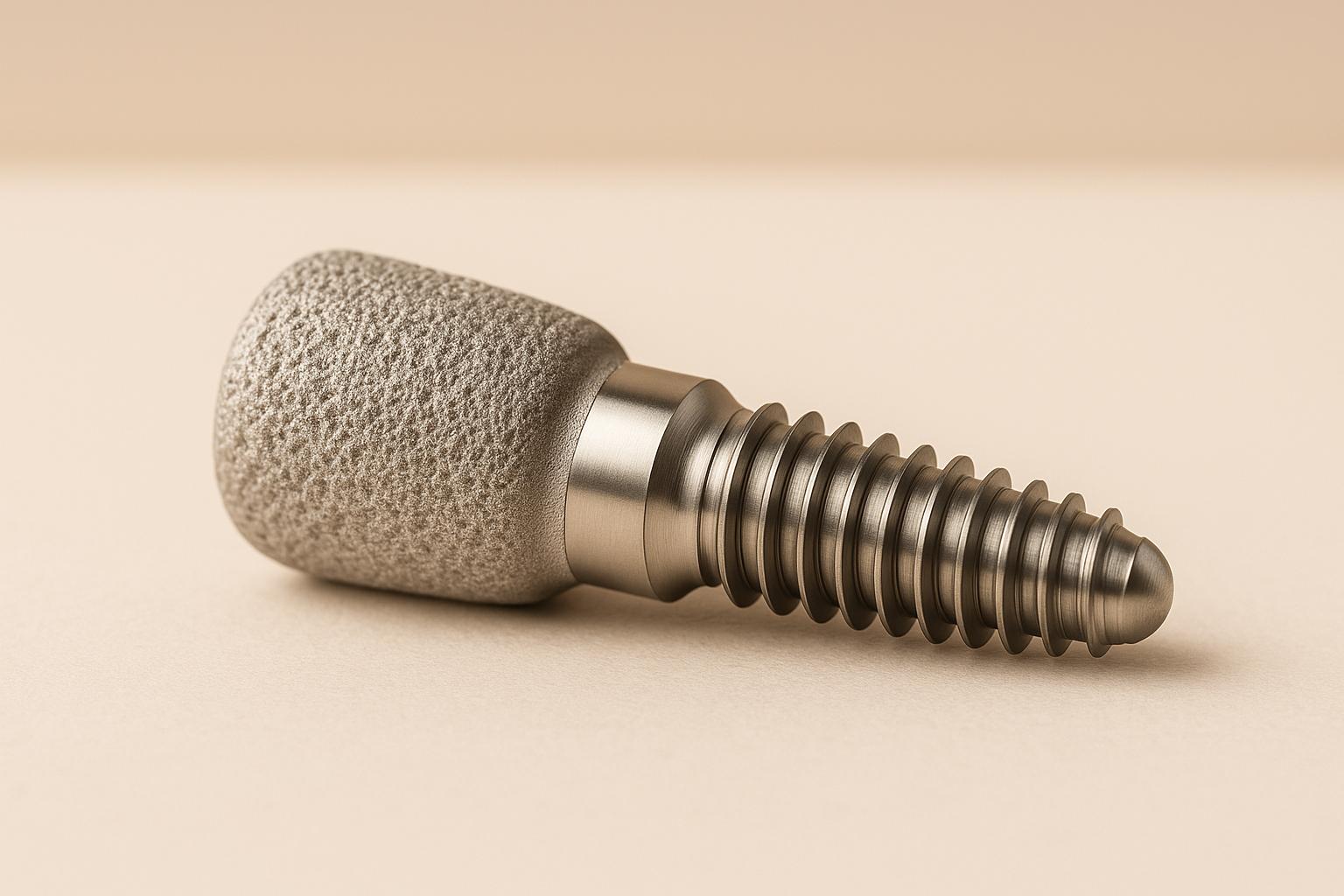
Plasma-sprayed coatings enhance the surface of dental implants by applying particles – usually hydroxyapatite or titanium – through a high-temperature plasma jet. These particles are deposited onto the titanium implant, forming a distinct layer with controlled roughness and thickness. This layer is markedly different from the smooth surface of untreated titanium[1].
The process creates a porous, irregular surface at the microscopic level. The plasma-sprayed titanium layer integrates seamlessly with the implant, maintaining structural integrity at the interface[3]. This intricate surface modification is key to understanding the application process and its benefits.
How Plasma-Sprayed Coatings Are Applied
The plasma-spraying process involves exposing materials to extreme temperatures, transforming them into a sprayable form. Material particles are introduced into a plasma torch, where temperatures can soar to several thousand degrees Celsius. This intense heat melts or partially melts the particles, which are then propelled at high velocity toward the implant surface. Upon impact, these particles flatten, solidify, and accumulate in layers.
The coating’s thickness can be tailored to clinical needs, typically ranging from tens to hundreds of micrometres. Achieving high-quality coatings demands precise control over factors such as plasma temperature, feed rate, spray distance, and application angle. Modern plasma-spraying equipment includes monitoring systems to ensure consistency, although skilled technicians remain essential for optimal results. These controlled steps form the foundation for the advantages and challenges of plasma-sprayed coatings.
Advantages of Plasma-Sprayed Coatings
The unique properties of plasma-sprayed coatings translate into several clinical benefits. Their irregular, porous surface promotes better osteoblast adhesion compared to smooth surfaces[3]. When hydroxyapatite is used, implants show improved bone-to-implant contact during the early healing phase[1]. Additionally, the ability to apply thicker coatings enhances mechanical fixation by creating a strong interlock with surrounding bone. Manufacturers can also adjust spraying parameters and material composition to customise surface properties for specific clinical scenarios.
Limitations of Plasma-Sprayed Coatings
While plasma-sprayed coatings offer notable advantages, they also present challenges that may impact long-term outcomes. One major concern is the potential for layer delamination, where the coating detaches from the implant surface. This can lead to inflammation and other complications[1]. Uneven coating thickness, often caused by the complex shapes of dental implants, can create weak spots that are more prone to delamination. In comparison, alternative methods like sandblasting with acid treatment and anodisation have shown survival rates of around 97–99%[1].
Maintaining quality control during manufacturing is critical. The plasma-spraying process requires precise environmental conditions and equipment calibration. Even small variations in humidity, temperature, or material quality can affect the final coating. Each batch undergoes thorough testing to ensure consistency. Additionally, clinical studies suggest that factors such as patient age, smoking habits, and opposing dentition play a more significant role in implant failure than the coating type itself[2].
Alternative Implant Coating Methods
Dental implant surface modifications are designed to create surfaces that support bone cell adhesion and integration. Beyond plasma spraying, techniques like anodisation, sandblasting combined with acid etching (SLA), nanostructuring, and antibacterial treatments are employed to improve implant performance. These methods refine surface properties to enhance osseointegration and minimise complications.
Anodisation and Sandblasted Surface Treatments
Anodisation is an electrochemical process that forms a nanoporous oxide layer on titanium implants by applying an electrical current in an electrolytic solution. This process produces micro- and nano-scale roughness, which promotes cell adhesion and bone integration. One of its key advantages is the ability to create a uniform and controlled surface modification without adding external materials.
SLA surfaces are created through a two-step process. First, sandblasting is used to mechanically roughen the implant surface. This is followed by acid etching, which removes debris and further refines the micro-topography. Some SLA treatments also include a plasma step, which creates superhydrophilic surfaces that retain moisture until implantation. This feature optimises protein adsorption and cell attachment during the early stages of healing. These approaches maintain reliable survival rates while reducing the risk of delamination.
However, these methods demand strict control over process parameters. For example, variations in electrical settings, sandblasting pressure, or acid etching time can significantly impact the final surface characteristics. Additionally, any damage to the passivation layer during anodisation can increase the risk of corrosion. Despite these challenges, these treatments lay the groundwork for further advancements in nanoscale surface design and antibacterial strategies. [1]
Nanostructured and Antibacterial Coatings
Nanostructured treatments complement plasma-sprayed coatings by engineering micro- and nano-scale features that improve osteoblast adhesion and soft tissue integration. Techniques like anodisation, SLA, or direct acid etching are used to produce these features, although achieving consistent nanoscale patterns requires precise control over the process.
Antibacterial coatings are designed to lower the risk of peri-implant infections by incorporating antimicrobial metals such as copper, silver, or titanium-copper alloys (e.g., Ti-5Cu). These metals help prevent bacterial colonisation, but the challenge lies in balancing their antibacterial properties with the potential cytotoxic effects of high metal concentrations.
Hybrid coating systems are an emerging approach that combines materials to encourage bone growth while reducing bacterial colonisation. For instance, calcium phosphate can be paired with silver or copper, or polymers can be combined with bone morphogenetic proteins (BMPs) to achieve synergistic effects. These systems aim to merge the strengths of different materials, enhancing both bone integration and infection prevention. However, as with plasma-sprayed technologies, these complex systems require further clinical validation before they can be adopted widely. [1]
sbb-itb-2be92ed
Comparing Plasma-Sprayed Coatings with Alternatives
Building on earlier discussions about surface treatments, this section compares different coating methods in terms of their clinical performance, durability, and biocompatibility. Plasma-sprayed coatings and alternative techniques each bring their own set of strengths and challenges, making the choice of technology highly dependent on the desired outcomes. Let’s break down how these methods stack up across key factors.
Clinical Performance Metrics
Survival rates and bone integration are critical when evaluating coating technologies. For example, SLA (sandblasted, large-grit, acid-etched) and anodisation methods consistently deliver 97–99% long-term survival rates. Plasma-sprayed coatings achieve similar results, but only when manufacturing quality is tightly controlled [1].
When it comes to bone integration, plasma-sprayed hydroxyapatite coatings stand out by enhancing early bone cell attachment compared to traditional surfaces. Meanwhile, superhydrophilic coatings have shown even higher early bone-to-implant contact (BIC) rates [1]. The table below summarises the performance of different methods:
| Coating Method | Coating Thickness | Bone Integration | Long-term Survival | Key Limitation |
|---|---|---|---|---|
| Plasma Spraying (TPS/HA) | Thick, customisable layer | Excellent initial fixation | High, but coating-dependent | Risk of delamination; quality-dependent |
| SLA/Anodisation | Micro/nano roughness | Rapid primary stability | 97–99% | Requires precise process control |
| Ion Implantation | Minimal, very shallow | Moderate | High | Limited modification depth |
| Grit Blasting | Surface roughening only | Limited (relies on texture) | Very low | Low bioactivity; minimal customisation |
| Hybrid Coatings | Variable | Potentially superior | Emerging data | Manufacturing complexity |
Durability and Manufacturing Consistency
Durability and consistent manufacturing are just as important as clinical performance. Adhesion strength is a key factor – coatings need to stay intact for the implant’s lifespan. Plasma-sprayed coatings, while effective, can be prone to delamination if quality control falters. In comparison, SLA and anodisation modify the titanium surface itself, eliminating the need for a separate coating layer. This integration often results in more consistent outcomes, provided the process parameters are carefully managed.
Each method has its own manufacturing challenges. Plasma spraying allows for customisable coating thickness and composition but requires advanced equipment and stringent quality checks. On the other hand, ion implantation offers shallow surface modifications with limited customisation, while grit blasting often produces inconsistent results and lacks bioactivity enhancements. SLA and anodisation, by integrating with the titanium substrate, tend to deliver more stable, long-term results. However, plasma-sprayed coatings can still provide excellent performance if rigorous quality assurance is maintained [1].
Biocompatibility and Infection Resistance
Biocompatibility and infection resistance are essential factors when selecting a coating. Plasma-sprayed hydroxyapatite coatings, with their textured surfaces, promote osteoblast adhesion and encourage strong early bone integration. SLA and anodisation, meanwhile, rely on optimised surface topography rather than chemical composition to achieve biocompatibility.
Emerging antibacterial coatings are also gaining attention. These coatings incorporate antimicrobial metals like copper, silver, or titanium-copper alloys (e.g., Ti-5Cu) to prevent bacterial colonisation and reduce the risk of peri-implantitis. However, balancing antibacterial effectiveness with cytotoxicity remains a challenge. Hybrid coatings that combine osteoinductive and antibacterial properties show promise, but they still require more clinical validation before becoming widely adopted.
Ultimately, the choice of coating technology depends on prioritising quality and consistency over the type of coating alone. Plasma-sprayed coatings offer excellent initial fixation but require precise manufacturing to avoid issues like delamination. For more predictable long-term results, established methods like SLA and anodisation – with their proven survival rates of 97–99% – remain reliable options. Hybrid coatings may hold potential for complex cases, but further research is needed to confirm their effectiveness in routine clinical use.
Practical Considerations for Coating Selection
Choosing the right implant coating involves balancing patient-specific factors with practical clinical realities. The decision must account for how coatings perform in everyday scenarios, ensuring that both immediate needs and long-term outcomes are addressed. Ultimately, the choice should be tailored to the unique requirements of each patient. Let’s dive into how patient characteristics and financial considerations shape these decisions.
Factors Influencing Coating Selection
Patient characteristics significantly impact which coating technology will yield the best results. For instance, bone quality is a key factor. Patients with low bone density often benefit from coatings that enhance early bone-to-implant contact. Plasma-sprayed coatings, known for their porous, uneven surfaces at the micron level, are particularly effective at promoting osteoblast adhesion and bone growth[3].
Age and healing ability also play a role. Younger patients with strong healing responses typically adapt well to a range of modern coatings. In contrast, older patients or those with systemic conditions affecting bone metabolism may require coatings designed to accelerate early integration. Options like plasma-sprayed titanium surfaces or superhydrophilic modifications have demonstrated higher bone-to-implant contact rates in the critical early weeks following placement, compared to traditional hydrophobic implants[1]. This can be especially beneficial for patients needing quicker functional restoration.
The implant’s location and functional demands further influence coating choices. For example, anterior implants, which prioritise aesthetics and long-term stability, often benefit from SLA or anodised surfaces with reported survival rates of 97–99%[1]. On the other hand, posterior implants, which face higher mechanical stress, require coatings that resist wear and delamination.
Time constraints also matter. Patients who need rapid functional loading may prefer plasma-sprayed coatings, which excel in early integration and can shorten treatment timelines[3]. Those with more flexible timelines might opt for SLA surfaces, which maintain consistently high bone-to-implant contact over the healing period[1].
Risk factors for complications, such as diabetes, immunosuppression, or poor oral hygiene, also guide coating selection. Patients with higher infection risks may benefit from newer antibacterial coatings that incorporate antimicrobial metals. However, as these technologies are still under study, established methods with proven success rates are often the safer choice for high-risk individuals.
These patient-specific factors, combined with performance outcomes, provide a framework for selecting the most appropriate coating.
Balancing Cost, Performance, and Longevity
Economic considerations are another critical aspect of coating selection, extending beyond the upfront cost of the implant.
While plasma-sprayed coatings offer advantages in early integration, their long-term success hinges on coating durability and manufacturing quality[1]. A coating failure years after placement could lead to revision surgery and additional complications, increasing overall treatment costs.
SLA and anodised surfaces, with their 97–99% long-term survival rates, represent a more predictable and cost-effective investment[1]. These methods modify the titanium surface itself rather than applying a separate layer, eliminating concerns about delamination and reducing the likelihood of expensive complications. Their well-established manufacturing processes also ensure consistent quality across implant systems.
Manufacturing complexity directly affects both cost and reliability. Plasma-sprayed coatings require careful evaluation of deposition uniformity and adhesion, as inconsistencies can lead to clinical failures[1]. In contrast, surface-integrated methods like SLA and anodisation involve simpler manufacturing processes, resulting in more reliable outcomes.
Survival data show that plasma-sprayed coatings generally have lower long-term stability compared to SLA and anodised surfaces[1]. Failures not only incur the financial burden of revision but also inconvenience patients and potentially undermine their trust in the treatment.
For patients with good bone quality and no complicating factors, SLA or anodised surfaces offer a practical, long-term solution with minimal maintenance requirements[1]. Plasma-sprayed coatings, however, remain valuable in cases where rapid early integration is critical or when specific patient needs demand faster healing.
Quality assurance is key to managing costs effectively. Plasma-sprayed coatings, in particular, require rigorous checks for deposition uniformity and adhesion to minimise the risk of delamination[1]. Clinical studies have linked coating failures to inflammation and other complications, which can lead to additional expenses.
Conclusion
The success of dental implants heavily relies on pairing the right coating technology with the specific clinical needs of each patient. For instance, plasma-sprayed coatings, with their porous surfaces, are effective at speeding up bone-to-implant contact. However, they come with a potential drawback: the risk of delamination, which can lead to inflammation and even implant failure.
On the other hand, SLA and anodised surfaces integrate directly with titanium, offering long-term survival rates of 97–99% without the delamination risks associated with plasma-sprayed options [1]. These coatings provide a reliable and durable solution for many cases.
That said, the outcome of an implant often depends more on factors such as bone quality, surgical technique, and oral hygiene than on the coating itself. Advances like improved hydrophilicity have also shown to accelerate early bone integration, further enhancing implant success [1][2].
For clinicians, choosing the right coating involves considering patient-specific factors like bone density, healing ability, and infection risk. Plasma-sprayed coatings may be ideal for cases requiring rapid integration, provided stringent quality controls are in place. Meanwhile, SLA or anodised surfaces are often a more predictable and cost-effective choice for standard procedures.
Looking to the future, hybrid coatings that blend multiple technologies and antibacterial coatings using elements like silver or copper offer exciting potential. However, these innovations still require further research to address concerns such as the possible cytotoxic effects of higher ion concentrations [1].
FAQs
How do plasma-sprayed coatings compare to SLA or anodised coatings for dental implants?
Dental implants can be treated with different surface techniques to improve their performance, including plasma-sprayed coatings, SLA (sandblasted, large-grit, acid-etched), and anodised coatings. Each method has unique characteristics that cater to specific needs, particularly in terms of durability and how well they work with the body.
Plasma-sprayed coatings are designed to create a rough surface that bonds strongly with bone tissue. This makes them an excellent choice for long-term durability and reliability. On the other hand, SLA and anodised coatings focus more on refining the surface texture and chemical composition, which can speed up healing and enhance osseointegration – the process where the implant integrates with the surrounding bone.
The choice between these methods often depends on the patient’s unique requirements and the clinical circumstances. For instance, plasma-sprayed coatings are ideal for situations where strength and longevity are priorities. Meanwhile, SLA and anodised coatings are often selected for their ability to promote quicker recovery and better compatibility with the body. It’s always best to discuss these options with your dental specialist to choose the most appropriate solution for your needs.
What factors determine the best implant coating method for a patient?
The type of implant coating suitable for a patient depends on various individual factors like oral health, bone density, and any medical conditions they may have. For example, plasma-sprayed coatings are frequently chosen because they are known for their strength and compatibility with the body, helping implants bond more effectively with the bone. That said, other coating methods might be a better fit depending on the patient’s specific requirements and the nature of the dental procedure.
Consulting a qualified dental professional is crucial. They can help determine the best coating option tailored to your unique situation and treatment objectives.
What are the risks of plasma-sprayed dental implant coatings, and how can they be addressed?
Plasma-sprayed coatings are a popular choice for dental implants, known for their strength and their ability to encourage bone integration. However, if the coating process isn’t meticulously managed, issues like coating delamination, uneven surface textures, or reduced long-term stability can arise. These problems can compromise the implant’s performance and lifespan.
To minimise these risks, maintaining strict manufacturing standards is crucial. Additionally, implants should only be placed by a qualified dental professional to ensure proper application. Regular dental check-ups are equally important – they allow for monitoring the implant’s condition and addressing potential concerns early. Be sure to consult your dentist to determine the implant option that best suits your specific needs.
Related Blog Posts
- Electrochemical Deposition for Implant Coatings
- How Hybrid Coatings Improve Osseointegration
- Plasma Spraying for Dental Implants: Key Advances
- Wear-Resistant Coatings for Dental Implants: Overview
Important Notice: Any surgical or invasive procedure carries risks. Before proceeding, you should seek a second opinion from an appropriately qualified health practitioner.
Individual results may vary. The information provided in this article is for educational purposes only and does not constitute medical advice.
Checkout Related Blogs




Get in touch with us
For more information, call us now to start feeling better. Or fill the form below to make appointment
The Latest News from Complete Smiles
How to Clean Clear Plastic Retainers
Checklist for Choosing Wearable Dental Devices
Checklist for Choosing Cloud AI Platforms in Dentistry

Complete Smiles Bella VistaAccepts All Major Health Funds, Including





