





Ceramic vs. Zirconia Crown Bonding Techniques

Bonding ceramic and zirconia crowns requires different approaches due to their unique material properties. Ceramic crowns, like lithium disilicate, bond through acid etching and silane application, creating strong chemical and mechanical adhesion. Zirconia crowns, on the other hand, depend on mechanical roughening (sandblasting) and chemical primers containing 10-MDP for effective bonding.
Here’s what you need to know:
- Ceramic crowns: Use hydrofluoric acid etching (e.g., 5% for lithium disilicate), followed by silane coupling agents for strong adhesion.
- Zirconia crowns: Require sandblasting with aluminium oxide particles (50 µm at 0.2 MPa) and phosphate monomer primers (10-MDP) for chemical bonding.
- Both rely on resin cements, but the choice varies by material and clinical needs.
Quick Comparison
| Material | Bonding Method | Key Surface Treatment | Long-Term Bond Strength Retention |
|---|---|---|---|
| Ceramic | Acid etching + Silane | HF acid (5–9.5%) + Silane | ~88% after 10,000 thermocycles |
| Zirconia | Sandblasting + 10-MDP Primer | Airborne-particle abrasion | ~64% after 10,000 thermocycles |
Key takeaway: Ceramic crowns offer better long-term bond stability, while zirconia crowns demand precise surface preparation to achieve strong initial adhesion. Proper protocols are essential for reliable and lasting restorations.
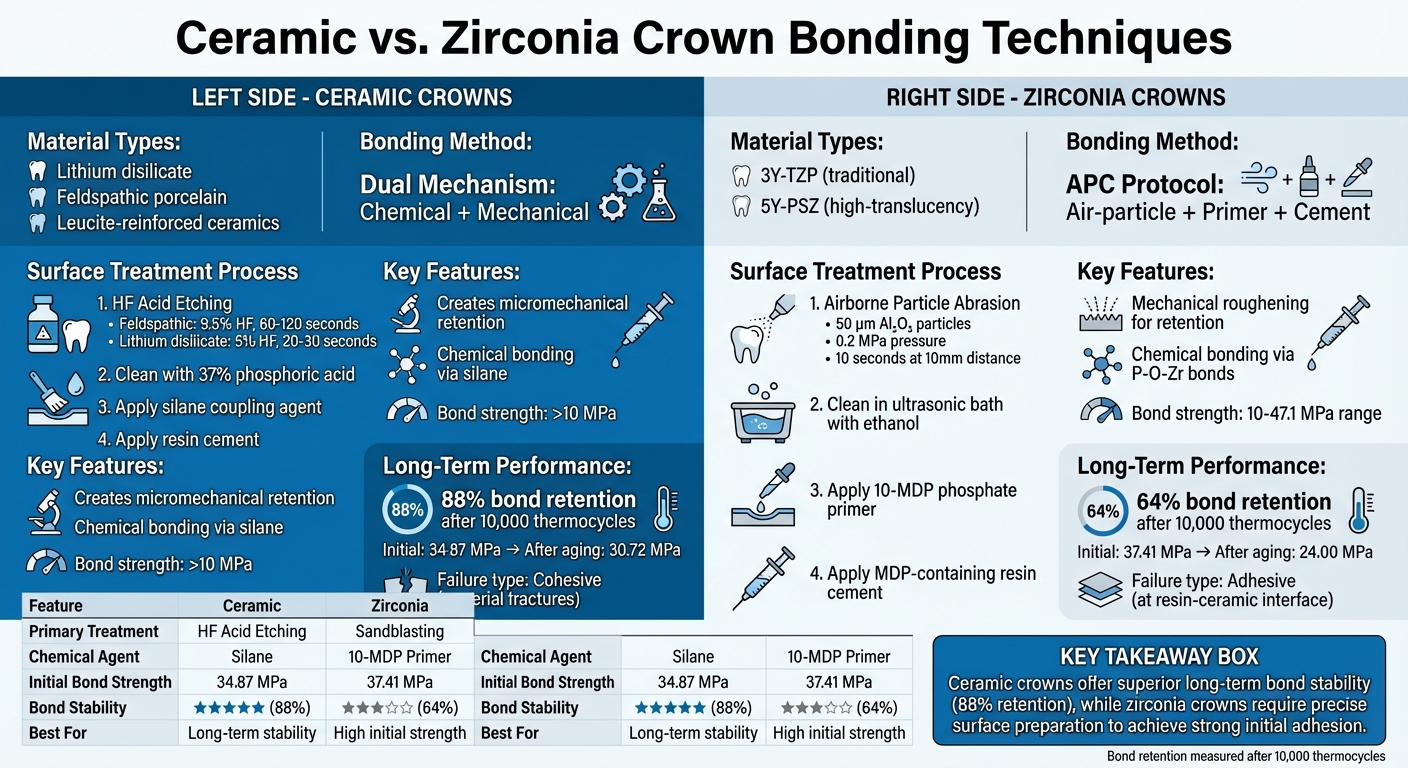
Ceramic vs Zirconia Crown Bonding Methods Comparison Chart
Applying Bonding Agent BEFORE Zirconia Crown Cementation
sbb-itb-2be92ed
Ceramic Crown Bonding Techniques
Glass-based ceramic crowns – such as feldspathic porcelain, leucite-reinforced ceramics, and lithium disilicate – require bonding techniques tailored to their silica-rich structure. These materials use a dual bonding mechanism that combines mechanical interlocking with chemical adhesion, achieving bond strengths exceeding 10 MPa [7].
Hydrofluoric Acid Etching
Hydrofluoric (HF) acid is used to etch the ceramic surface by dissolving its glass matrix, creating a textured surface that enables resin cement to mechanically interlock with the material [8]. The etching time is more critical than the acid concentration [8]. For feldspathic porcelain, a 60–120 second etch with 9.5% HF acid is recommended, while lithium disilicate requires just 20–30 seconds with 5% HF acid [8]. Over-etching can weaken the ceramic, so adhering to material-specific guidelines is crucial.
After etching, the crown should be cleaned with 37% phosphoric acid to remove contaminants like saliva, blood, and residual salts [8]. Avoid sandblasting etched glass-containing ceramics, as it can damage the etch pattern and introduce micro-cracks, reducing the ceramic’s strength [8].
Once cleaned, the application of silane agents facilitates chemical bonding between the ceramic surface and the resin cement.
Silane Coupling Agents
Silane coupling agents act as a chemical bridge between the etched ceramic and the resin cement. These agents bond to the silica in the ceramic while also polymerising with the organic matrix of the cement [8]. A dedicated silane primer is preferable to silane within universal adhesives, as research indicates the latter may be less effective for glass-based ceramics [8].
Silane is available in two formats: one-bottle (pre-hydrolysed) systems with a shorter shelf life, and two-bottle systems that are mixed just before use for maximum efficacy [8]. Although one-bottle systems are less technique-sensitive, they can degrade over time due to self-reaction, reducing their performance [8].
When combined with HF etching, silane application creates a strong dual bonding system.
Chemical and Mechanical Bonding
The combination of HF etching and silane application enhances bond strength by providing both mechanical retention and chemical adhesion [6]. This dual mechanism reduces marginal leakage and improves the fracture resistance of the overall restoration, addressing potential bond failures [6].
A dry environment is essential during bonding, as both bonding agents and resin cements are hydrophobic. Using a rubber dam for isolation is highly recommended [9][10]. For restorations thinner than 1.5 mm, apply a bonding agent to both the silanised ceramic and the tooth. A curing light can effectively polymerise resin cement through up to 2.5 mm of lithium disilicate [8].
| Ceramic Type | Recommended Etching Time | HF Acid Concentration |
|---|---|---|
| Feldspathic Porcelain | 60–120 seconds | 9.5% |
| Leucite-reinforced | 60 seconds | 9.5% |
| Lithium Disilicate | 20–30 seconds | 5% |
Zirconia Crown Bonding Techniques
Bonding zirconia crowns is a unique challenge because zirconia doesn’t behave like silica-based ceramics. Unlike materials such as feldspathic porcelain or lithium disilicate, zirconia lacks a glass phase and silica content. This makes traditional hydrofluoric acid etching ineffective [13]. Instead, zirconia requires a mix of mechanical and chemical techniques, combining surface roughening with specialised chemical primers.
One widely accepted method for achieving durable bonding is the APC protocol, which stands for: (A) air-particle abrasion, (P) application of a zirconia primer with phosphate monomers, and (C) use of an adhesive composite resin [12]. Let’s break down the key steps.
Airborne Particle Abrasion
Creating a rough surface is critical for ensuring micromechanical retention, and this is where sandblasting with aluminium oxide particles comes in [13]. This process not only increases surface energy and wettability but also introduces hydroxyl groups on the zirconia surface, which are essential for bonding with phosphate primers [5].
For 3Y-TZP zirconia, the recommended parameters are:
- Aluminium oxide particles: 50 µm
- Pressure: 0.2 MPa
- Duration: 10 seconds
- Distance: 10 mm [5]
However, for high-translucency zirconia (5Y-PSZ), gentler treatment is needed. Smaller particles (25 µm) are preferred, as this type of zirconia is less resistant to transformation hardening under aggressive sandblasting [5].
It’s important to avoid excessive pressure – anything above 0.4 MPa can cause residual stresses ranging from 451 to 905 MPa, which might lead to microcracks [5]. Another option is tribochemical silica coating, which uses silica-coated alumina particles. This method deposits a silica layer on the zirconia surface, enabling silane coupling and potentially enhancing long-term bond stability [13].
Phosphate Monomer Primers
Primers containing 10-MDP (10-methacryloyloxydecyl dihydrogen phosphate) are considered the gold standard for zirconia bonding [13]. These molecules work in two ways: the phosphoric acid group chemically bonds with zirconia’s metal oxides to form stable P-O-Zr bonds, while the methacrylate group polymerises with the resin cement [13].
"The 10-MDP presents a terminal functional group with phosphoric acid, which reacts with zirconia and forms P-O-Zr bonds." – Rubén Comino-Garayoa, Department of Conservative Dentistry and Bucofacial Prosthesis, Complutense University of Madrid [13]
Research shows that 10-MDP primers outperform other options like 4-META or MAC-10 [14]. However, contamination from saliva or blood can interfere with bonding, as these fluids contain phosphates that compete for bonding sites. In such cases, re-sandblasting or using specialised cleaning agents is recommended – rinsing with water or alcohol alone won’t suffice [2].
Mechanical Retention Strategies
While chemical adhesion with 10-MDP primers is crucial, mechanical retention through sandblasting remains the backbone of zirconia bonding [11]. Studies confirm that combining mechanical and chemical methods (as in the APC protocol) achieves the highest bond strengths [13]. Reported bond strength values range from 0 to 47.1 MPa, though artificial ageing – like 5,000 thermocycles or 30 days in water – can reduce these values [13].
Sandblasting provides immediate mechanical retention, while 10-MDP primers ensure long-term chemical stability. For best results, use self-adhesive resin cements or those formulated with 10-MDP to maximise compatibility with zirconia [13].
| Technique | Mechanism | Key Parameters |
|---|---|---|
| Airborne Particle Abrasion | Micromechanical | Al₂O₃ particles (50 µm) at 0.2 MPa |
| Phosphate Monomer Primer | Chemical | 10-MDP forming P-O-Zr bonds |
| Tribochemical Coating | Mechanicochemical | Silica-coated alumina with silane |
Material-Specific Challenges
Ceramic and zirconia crowns come with their own set of bonding difficulties, which must be carefully managed to ensure durable restorations. While earlier sections covered etching and primer techniques, these challenges emphasise the importance of tailoring strategies to the specific material.
Zirconia Crown Challenges
Zirconia’s chemical inertness is one of its most significant hurdles. As a polycrystalline material lacking a glass phase, it does not react to hydrofluoric acid etching [5]. Its naturally hydrophobic surface and low surface energy make it difficult for resin cements to adequately wet and penetrate [5].
"The lack of a glass phase in the structure and the chemical inertness of the material causes zirconium oxide to not be susceptible to traditional etching procedures." – Department of Prosthodontics, Jagiellonian University Medical College [5]
Another issue is phase transformation. Sandblasting can cause a tetragonal-to-monoclinic phase shift, leading to microcracks and residual stresses. This is particularly problematic for high-translucency zirconia, which is more prone to damage under excessive pressure [5]. Traditional 3Y-TZP zirconia is more robust in this regard compared to newer high-translucency options like 5Y-PSZ, which have lower strength (550–800 MPa versus 800–1,200 MPa) and require gentler handling [5].
On the other hand, glass-based ceramics face an entirely different set of challenges.
Ceramic Crown Challenges
Glass-based ceramics are highly reactive due to their silica content, which exceeds 15% by weight. This makes them well-suited for hydrofluoric acid etching, but it also introduces fragility risks [3]. Over-etching, while necessary for creating micromechanical retention, can weaken the material, increasing the likelihood of fractures during handling or cementation [6].
The challenges don’t stop with the crown materials themselves – core materials also play a critical role in bonding success.
Core Material Interactions
Bonding at the cement-tooth interface is influenced by the type of core material – whether dentine, composite, or metal – each demanding distinct adhesive techniques [6]. For example, bonding to dentine requires primers that manage the hybrid layer and reduce microleakage. Composite cores, however, need a completely different surface preparation compared to crown materials.
Additionally, differences in the thermal expansion coefficients of the cement, crown, and core materials can lead to stress concentrations during temperature fluctuations [4]. Achieving a consistent bond strength of 10–13 MPa is crucial for reliable results [4].
Bond Strength and Longevity Comparison
When following the bonding protocols outlined earlier, ceramic and zirconia crowns demonstrate similar initial adhesion. However, their long-term performance diverges due to differences in surface chemistry and bonding mechanisms.
Bond Strength Results
Both glass-based ceramics and zirconia achieve comparable immediate bond strength when treated correctly, though their bonding processes differ. For instance, lithium disilicate ceramics treated with hydrofluoric (HF) acid etching and silane coupling agents achieve shear bond strength (SBS) values of 34.87 ± 11.02 MPa [18]. On the other hand, zirconia treated with airborne particle abrasion (APA) at 0.1 MPa combined with 10-MDP resin cement achieves slightly higher immediate values of 37.41 ± 13.51 MPa [18].
| Material Type | Surface Treatment | Immediate SBS (MPa) | Post-Ageing SBS (10,000 cycles) | Stability (Retention %) |
|---|---|---|---|---|
| Ceramic (LDGC) | HF Etching + Silane | 34.87 ± 11.02 | 30.72 ± 7.97 | 88.1% |
| Zirconia (3Y-TZP) | APA (0.1 MPa) + MDP | 37.41 ± 13.51 | 24.00 ± 6.86 | 64.1% |
| Zirconia (3Y-TZP) | GCSD + HF + Silane | 27.03 ± 9.76 | 21.84 ± 7.03 | 80.8% |
Both materials exceed the clinically accepted SBS threshold of 10–13 MPa, ensuring safe dental restorations [4]. However, the choice of cement plays a key role in retention strength. A May 2022 study in BMC Oral Health highlighted that Multilink Speed with Monobond N achieved 2.71 MPa retention strength on zirconia, outperforming Duo-Link Universal with Z-Prime Plus, which achieved only 1.42 MPa [16]. While these values reflect initial bond strength, they set the stage for understanding how surface treatments and ageing impact long-term performance.
Surface Treatment Results
The type of failure during testing provides insight into bond durability. Glass-based ceramics tend to show cohesive failure, meaning the cement or ceramic itself fractures, indicating a bond stronger than the material’s internal structure [16]. Zirconia, however, often exhibits adhesive failure at the resin-ceramic interface, suggesting the bond is the weak link [15][11].
"Micromechanical adhesion was a more effective mechanism than chemical adhesion and airborne particle abrasion significantly increased mean shear bond strengths compared with another surface treatments." – Materials Science and Engineering: C [11]
Innovative coatings like ZirLiner have improved outcomes. For example, ZirLiner achieves mean SBS values of 17.98 ± 2.51 MPa, with 69.2% mixed failure modes. This contrasts with standard sandblasting, which yields SBS values of 6.1–14.65 MPa and predominantly adhesive failures [17].
Long-Term Bonding Stability
While initial bond strength is important, long-term performance reveals clear differences. Ceramic crowns retain approximately 88% of their bond strength after 10,000 thermocycles, dropping from 34.87 MPa to 30.72 MPa [18]. Zirconia bonds, however, degrade more significantly, maintaining only 64% of their initial strength (reducing from 37.41 MPa to 24.00 MPa) when using APA with MDP-containing cement [18].
"The APA combined with MDP-containing resin cement could achieve the high immediate zirconia SBSs of those of the LDGC, but it decreased significantly after thermocycling." – Journal of Functional Biomaterials [18]
This degradation in zirconia is attributed to the hydrolytic breakdown of P-O-Zr bonds. In contrast, the deep micromechanical interlocking created by HF etching in glass-based ceramics resists moisture-induced weakening [18]. While zirconia bonds may start strong, ceramic restorations demonstrate greater resilience under the demanding conditions of the oral environment.
Best Practices for Crown Bonding
Achieving durable and reliable bonds with ceramic and zirconia crowns depends on selecting the right materials and following well-established protocols. While both materials can form strong initial bonds, their unique surface properties call for tailored approaches to ensure long-term success.
Adhesive Resin Cements
For zirconia bonding, self-adhesive resin cements containing 10-MDP are the go-to option. The MDP molecule plays a key role here, with its phosphate group bonding to metal oxides and its vinyl group integrating with the resin matrix. Research shows that zirconia crowns cemented with zinc-phosphate are twice as likely to loosen compared to those bonded with self-adhesive resin cements [19][5].
"Self-adhesive cement and those containing 10-MDP obtained the best results in adhesion to zirconia." – Rubén Comino-Garayoa, Department of Conservative Dentistry [13]
In cases where mechanical retention is limited, such as with onlays or veneers, a multi-step adhesive system like PANAVIA V5 is often recommended to improve bond strength. PANAVIA SA Cement Plus has been shown to deliver 35% higher bond strength to dentine and 15% higher to enamel compared to its predecessor [19]. For aesthetic restorations, using amine-free dual-cure cements can prevent discolouration over time while ensuring complete polymerisation, even in areas with limited light access. These cements work hand-in-hand with the surface treatments outlined below.
Combined Surface Treatments
The APC bonding concept offers a structured approach to zirconia bonding: air-particle abrasion with alumina, primer application containing 10-MDP, and composite resin cementation [12][19]. This method combines surface roughening for micromechanical retention with chemical adhesion from functional monomers.
"The APC zirconia-bonding concept is based on decades of research on how to achieve high and long-term durable bond strengths to high-strength ceramics." – Professor Matthias Kern, University of Kiel [12]
For 3Y-TZP zirconia, follow standard air-particle abrasion parameters. For high-translucency zirconia (5Y-PSZ), use smaller alumina grains (25 µm) to protect its lower flexural strength [5]. After sandblasting, clean the surface in an ultrasonic bath with ethanol for 1 to 10 minutes to remove debris and contaminants [13][20]. Perform sandblasting chairside just before bonding, as any delay can lead to contamination and reduce bond strength [21].
For silicate-based ceramics, hydrofluoric acid etching followed by a silane coupling agent ensures both micromechanical interlocking and chemical bonding [19][5]. These surface treatments are directly tied to proper tooth preparation, which is covered next.
Tooth Preparation Guidelines
Proper tooth preparation is essential for achieving strong bonds, especially when addressing the specific challenges of zirconia crowns. For anterior teeth, zirconia crowns require 1.0–1.5 mm of incisal reduction, while posterior teeth need 1.0–2.0 mm. To maintain structural integrity, a minimum wall thickness of 0.5 mm is required, though 1.0–1.5 mm is ideal [21][22]. Margins should feature a continuous chamfer with a gingival reduction of 0.5–0.7 mm [21][22].
The ideal convergence angle ranges between 6° and 12°, with a maximum of 15°. However, clinical practice often narrows this to 5°–10° for anterior crowns and 4°–8° for posterior crowns. Abutment height should be at least 4 mm, and rounding occlusal and incisal edges – using a football diamond bur – helps minimise stress concentrations that could lead to fractures [21][22].
During cementation, maintaining optimal isolation is critical. Contamination from saliva or blood can significantly weaken the chemical bond formed with MDP primers. This is especially crucial for minimal-preparation designs that rely more on adhesive retention than mechanical retention.
| Preparation Feature | Anterior Zirconia | Posterior Zirconia |
|---|---|---|
| Incisal/Occlusal Reduction | 1.0–2.0 mm | 1.0–2.0 mm |
| Ideal Wall Thickness | 1.0–1.5 mm | 1.0–1.5 mm |
| Gingival Reduction | 0.5–0.7 mm | 0.5–0.7 mm |
| Taper/Angle | 5°–10° | 4°–8° |
| Margin Style | Chamfer | Chamfer |
Conclusion
The bonding processes for ceramic and zirconia crowns are quite distinct due to their unique chemical properties. For glass-based ceramics, hydrofluoric acid (HF) etching creates micromechanical porosities, which are then chemically bonded using silane agents [1][5]. Zirconia, on the other hand, is polycrystalline and chemically inert, requiring airborne-particle abrasion for mechanical retention and 10-MDP phosphate monomers for chemical adhesion [1][5].
"Due to the widespread use of zirconia ceramics and the introduction of new zirconia-based materials, the use of a predictable and standardised cementation protocol is one of the most important factors contributing to the long-term clinical success of prosthetic restorations." – Department of Prosthodontics, Jagiellonian University Medical College [5]
The importance of these bonding techniques becomes evident when considering their clinical outcomes. Research highlights a significant difference in resin cement protocols for zirconia compared to ceramic crowns [1]. Errors such as relying solely on silane for zirconia or skipping sandblasting can result in weaker bonds and higher rates of debonding [1][5].
For glass-based ceramics, HF etching combined with silane ensures strong bonding under occlusal forces. Zirconia, however, benefits from airborne-particle abrasion and 10-MDP primers, especially in situations like non-retentive preparations or when using high-translucency zirconia, which has lower flexural strength [1][5]. Achieving durable bonding hinges on matching the surface treatment, primer, and cement to the specific crown material, ensuring both immediate adhesion and long-term performance.
FAQs
Can zirconia be etched like porcelain?
Zirconia doesn’t respond to phosphoric acid etching the way porcelain does. To enhance its bonding capabilities, it needs specialised pretreatment methods. Options like sandblasting or applying a tribochemical silica coating are commonly used. These approaches effectively prepare the zirconia surface, making it more receptive to strong adhesion.
What cement is best for zirconia crowns?
The best cement for zirconia crowns pairs chemical surface treatments, like using MDP silane to boost bond strength, with mechanical methods such as sandblasting with Al₂O₃. Together, these approaches strengthen the adhesion between zirconia and resin cement, creating a long-lasting bond.
What should be done if a crown becomes contaminated with saliva during bonding?
When a crown becomes contaminated with saliva during the bonding process, it’s crucial to clean it properly to ensure strong adhesion. Techniques like sandblasting with Al₂O₃ are highly effective in removing saliva residues from zirconia surfaces. This step enhances the resin bond strength, promoting better and more reliable adhesion.
Related Blog Posts
- Ceramic Materials in Crowns and Bridges
- Ceramic Bracket Bonding: Adhesive Types Compared
- Bond Strength of CAD/CAM Materials with Adhesives
- Porcelain vs. Ceramic: Strength and Fracture Resistance
Important Notice: Any surgical or invasive procedure carries risks. Before proceeding, you should seek a second opinion from an appropriately qualified health practitioner.
Individual results may vary. The information provided in this article is for educational purposes only and does not constitute medical advice.
Checkout Related Blogs




Get in touch with us
For more information, call us now to start feeling better. Or fill the form below to make appointment
The Latest News from Complete Smiles
How to Clean Clear Plastic Retainers
Checklist for Choosing Wearable Dental Devices
Checklist for Choosing Cloud AI Platforms in Dentistry

Complete Smiles Bella VistaAccepts All Major Health Funds, Including





