





Reducing Microleakage with Nano-Filled Bonding Agents

Nano-filled bonding agents are transforming how dental restorations tackle microleakage. These agents, formulated with nanoparticles as small as 12 nanometres, create stronger bonds between restorative materials and tooth surfaces. By reducing polymerisation shrinkage and improving resin penetration, they help seal tiny gaps that can lead to secondary decay, sensitivity, or restoration failure.
Key Benefits of Nano-Filled Bonding Agents:
- Improved Sealing: Reduces microleakage to levels comparable to intact enamel.
- Enhanced Bond Strength: Stronger adhesion to enamel and dentine.
- Durability: Greater resistance to wear and degradation over time.
- Versatility: Effective even in challenging conditions like saliva contamination or bleaching treatments.
Challenges:
- Higher cost compared to standard bonding agents.
- Technique sensitivity during application.
- Limited long-term clinical data.
Nano-filled bonding agents are particularly useful for complex cases requiring superior sealing and durability. For routine treatments, standard bonding agents may still suffice. Proper application techniques and material selection are critical to achieving the best outcomes.
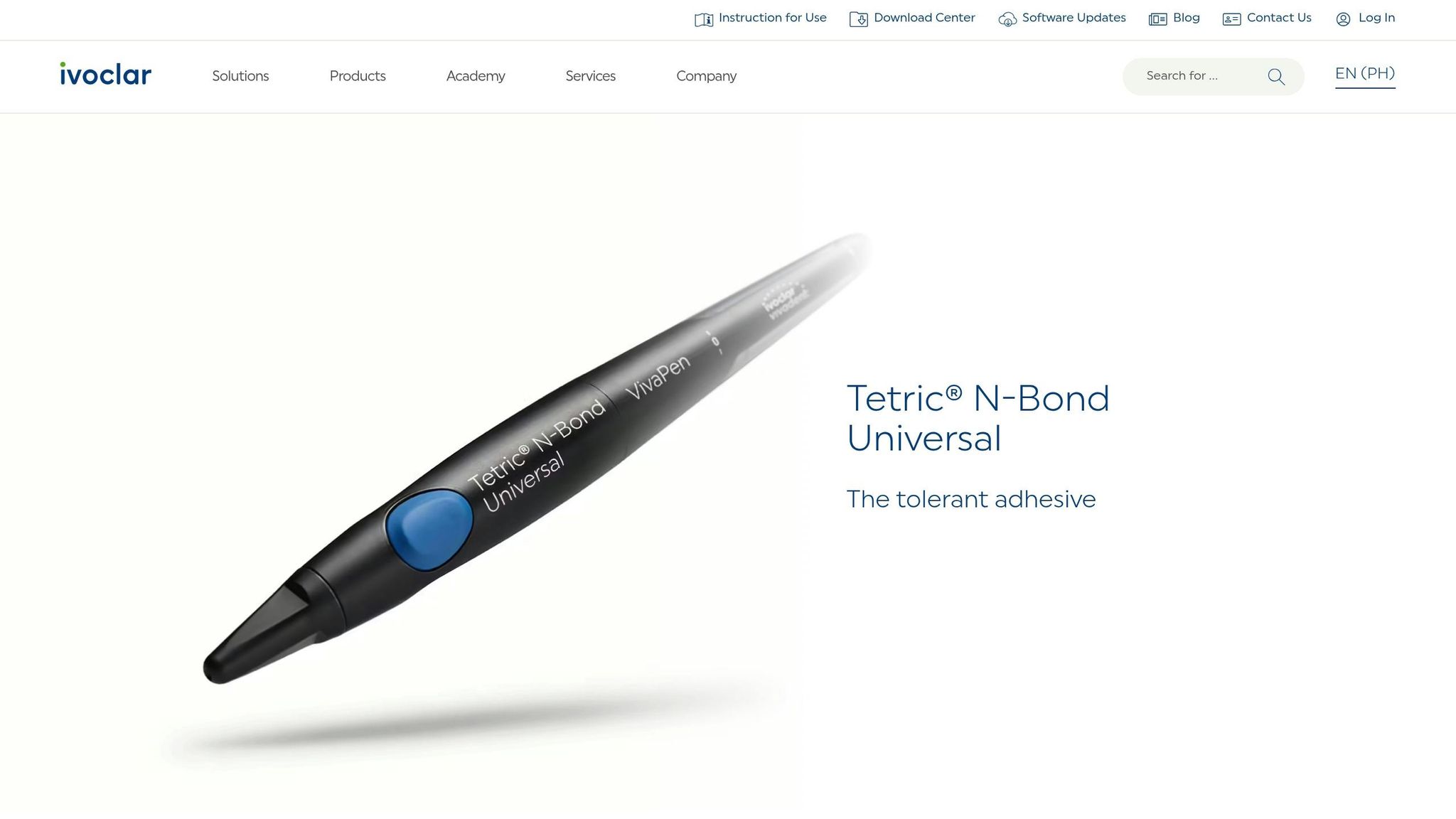
Tetric N Bond
How Nano-Filled Bonding Agents Reduce Microleakage
Nano-filled bonding agents tackle microleakage by addressing the key factors that lead to restoration failure. These materials employ advanced mechanisms to ensure durable and reliable restorations. Let’s explore their structure, properties, and the research that supports their effectiveness.
Structure and Properties of Nano-Filled Bonding Agents
Nano-filled bonding agents are formulated with nanoparticles designed to enhance adhesion to tooth surfaces. For example, nano-fillers averaging 12 nm – like the 5 nm colloidal fillers found in Adper Single Bond 2 [2] – are carefully calibrated to improve elasticity while minimising defects related to viscosity.
When properly balanced, these nanoparticles strengthen the bonding material and reduce polymerisation shrinkage. Additionally, hydrophilic monomers, which diffuse efficiently in alcohol-based solvents, help eliminate residual moisture, creating a more robust bond.
Nano-fillers also play a critical role in forming resin tags and reinforcing the hybrid layer. By filling spaces around collagen fibrils within the hybrid layer, they contribute to a stronger and more stable adhesive interface [3].
Research Evidence
Studies consistently show that nano-filled bonding agents significantly reduce microleakage, even under challenging conditions. A notable 2013 study from Tehran University of Medical Sciences, led by Mehrsa Paryab, tested these agents on saliva-contaminated enamel using 75 extracted human premolars. The results demonstrated that nano-filled bonding agents restored microleakage performance to levels comparable to uncontaminated enamel [2].
Nano-filled coatings applied prior to bleaching treatments have also been shown to significantly lower microleakage values [5].
Beyond their sealing capabilities, these agents help achieve the minimum bond strength of 17–20 MPa required to counteract the contraction forces of resin composites in both enamel and dentine [4]. The inclusion of filler particles reduces polymerisation shrinkage and enhances the adhesive layer’s integrity, further contributing to the reduction of microleakage [3].
Together, these findings highlight how nano-filled bonding agents improve mechanical strength, optimise penetration into tooth structures, minimise shrinkage stress, and maintain effective sealing – even in less-than-ideal clinical situations. For Australian dental professionals, these advancements offer a practical way to extend the life of restorations and deliver better outcomes for patients.
Comparison: Nano-Filled vs Standard Bonding Agents
When it comes to choosing between nano-filled and standard bonding agents, understanding their differences is crucial for dental professionals aiming to select the best material for their clinical needs. Both types serve the purpose of bonding restorations to tooth structure, but their composition and performance can differ in significant ways. Let’s break down the key distinctions that influence clinical decision-making.
The standout difference lies in their composition. Nano-filled bonding agents incorporate nanosized fillers (≈12 nm) [6], while standard bonding agents may include inorganic fillers or sometimes no fillers at all. This seemingly small difference in particle size leads to noticeable improvements in clinical performance.
Nano-filled bonding agents are known for their deeper resin penetration and thicker hybrid layer [6]. These traits result in better mechanical properties and sealing ability. Studies consistently show that these agents outperform standard options in enamel and dentine bond strength, stress absorption, and even shelf life [6].
However, it’s worth noting that if nano-fillers exceed 15–20 nm or 1.0% by weight, their adhesive viscosity increases. This can lead to filler build-up on moist surfaces, which may create flaws, cause cracks, and ultimately weaken bond strength [6].
Benefits and Drawbacks
Here’s a closer look at how these differences translate into clinical performance:
| Feature | Nano-Filled Bonding Agents | Standard Bonding Agents |
|---|---|---|
| Sealing Ability | Excellent microleakage reduction, even in challenging conditions like bleaching or saliva contamination [7][2] | Moderate microleakage reduction, less effective in difficult scenarios [7] |
| Bond Strength | Superior enamel and dentine bond strength with better stress absorption [6] | Adequate bond strength but generally lower than nano-filled agents |
| Technique Sensitivity | Less technique-sensitive due to improved penetration and sealing [2] | Requires strict protocol adherence, making it more technique-sensitive |
| Mechanical Properties | Greater durability and resistance to degradation [6] | Standard durability with potential for earlier wear |
| Viscosity | Optimal when properly formulated; can become problematic if filler content exceeds 1.0% [6] | Consistent viscosity across most formulations |
| Cost | Higher upfront cost | More budget-friendly option |
| Shelf Life | Longer shelf life due to increased stability [6] | Typical shelf life for bonding agents |
These differences play a big role in a restoration’s ability to minimise microleakage, which is critical for long-term success.
Clinical research backs up these distinctions. For example, studies comparing nano-filled adhesives like Grandio and Transbond Supreme LV with the conventional Transbond XT for bonding molar tubes found that both nano-filled adhesives achieved shear bond strengths well above clinically acceptable ranges [8]. Notably, failure patterns varied: adhesive failure occurred with Transbond XT and Transbond Supreme LV, while cohesive failure was observed with Grandio [8].
For Australian dental practices, the choice between nano-filled and standard bonding agents often comes down to weighing performance against cost. Nano-filled agents are particularly useful in complex cases – like post-bleaching restorations or contaminated fields – where their superior sealing ability justifies the higher price. On the other hand, standard bonding agents are a practical choice for routine procedures where cost-efficiency is more important than top-tier performance.
Regardless of the system chosen, success hinges on proper application. With nano-filled agents, paying close attention to filler content and particle size is essential to avoid viscosity issues that could hinder penetration [6]. Following the manufacturer’s instructions ensures the best possible results, no matter which type of bonding agent is used.
sbb-itb-2be92ed
Clinical Use and Best Practices
Using nano-filled bonding agents effectively in clinical settings requires a solid grasp of their technical application and the steps needed to reduce microleakage. Success hinges on attention to detail, from ensuring proper isolation to selecting the right materials.
Step-by-Step Methods for Nano-Filled Bonding Agents
Preventing microleakage starts with adequate isolation. A well-sealed matrix system is essential to protect the margins[1].
Surface preparation depends on the adhesive system in use:
- Etch-and-Rinse Systems: The wet bonding technique is crucial here. It prevents collagen collapse in dentine, maintaining the interfibrillar spaces for better monomer diffusion[9]. Begin by etching with phosphoric acid: 15–30 seconds for enamel and 15 seconds for dentine[9]. Rinse thoroughly for 15 seconds, then air-dry gently to avoid desiccating the dentine.
- Three-Step Systems: Apply the primer using a microbrush with a light scrubbing motion for 15 seconds. Follow this by gentle air drying for 15–30 seconds until the surface appears uniformly glossy[9].
- Self-Etch Systems: These combine the primer and etchant into one step. Apply actively with agitation, then thin the layer by gently air drying to remove solvents. For improved enamel bonding, selectively etch the enamel margins with phosphoric acid for 15 seconds before applying the self-etch primer[9].
- Universal Adhesives: These offer flexibility, working with etch-and-rinse, self-etch, or selective etch techniques. Each has specific protocols and timing requirements[9].
Proper curing is another critical step. Use a light source with a consistent beam profile, ensuring exposure times are followed precisely. Air-dry the adhesive thoroughly to evaporate solvents before polymerisation[1][6].
Material selection is equally important. Opt for filling materials that combine low polymerisation stress with high flowability to complement the bonding agent[1]. Also, consider the configuration factor (C-factor), as restorations with a lower C-factor typically handle polymerisation contraction stresses better[6].
The adhesive’s solvent type can influence the bonding protocol. For example:
- Acetone-based adhesives perform best on moist dentine surfaces.
- Ethanol-based adhesives are less affected by moisture levels[9].
Australian Requirements
In Australia, clinical protocols align with strict regulatory standards. Dental practitioners must follow evidence-based practices and ensure all materials meet the requirements set by the Dental Board of Australia. This regulatory body oversees the use of dental materials, ensuring that only products with proven clinical performance and approved certifications are used.
When selecting nano-filled bonding agents, practitioners should focus on the compatibility of products available locally. Reputable manufacturers offer systems that meet international standards and are widely distributed in Australia.
Brands like Dentsply Sirona provide additional support through online dental academies. These platforms include webinars and instructional videos, helping practitioners master the correct use of their products[1].
Limitations and Future Developments
Nano-filled bonding agents, while offering exciting potential, are not without their challenges. For dental practitioners and researchers, understanding these limitations is critical to improving the clinical use of these materials. These hurdles highlight the need for continuous advancements in the field.
Current Challenges
One of the main issues is the technique sensitivity of nano-filled bonding agents. The adhesive process is highly intricate, and even small errors during application can weaken the bond and increase the likelihood of microleakage [11].
Another challenge is achieving uniform nanoparticle dispersion. Poor dispersion may result in filler accumulation on moist surfaces, which can compromise bonding performance.
Cost is also a consideration. Nano-filled bonding agents tend to be more expensive than traditional adhesives, potentially influencing their use in routine restorative treatments where standard options may suffice.
In addition, there is a lack of long-term clinical data. While laboratory studies are promising, more extensive clinical trials are needed to confirm how these materials perform over time in the complex oral environment.
Bleaching treatments pose another concern. They can disrupt the adhesive interface, leading to increased microleakage if surface protection is not applied before the procedure [5].
Finally, the variability in dentine morphology adds another layer of complexity. Differences in tooth structure can make it difficult to achieve consistent adhesion [11].
Addressing these challenges is essential to unlocking the full potential of nano-filled bonding agents in clinical practice.
New Research and Trends
In response to these limitations, researchers are actively working to refine nano-filled adhesives. By experimenting with different nanoparticles, they aim to improve both the mechanical and biological properties of these materials, paving the way for more effective and versatile bonding systems.
One promising area of innovation involves antibacterial nanoparticles. For example, studies show that incorporating 1% titanium dioxide (TiO₂) nanoparticles can inhibit biofilm formation and reduce Streptococcus mutans colony counts.
Titanium dioxide also shows potential in orthodontics. Research by Behnaz et al. demonstrated that adding 2% TiO₂ nanoparticles by weight to Transbond X orthodontic adhesive helped prevent white spot lesions after one month of use [13]. Beyond this, photocatalytic TiO₂ nanoparticles have been found to improve mechanical properties, enhance remineralisation, inhibit biofilm formation, and boost the biocompatibility of dental materials used in orthodontic and endodontic treatments [13].
Universal adhesive systems are another exciting development. Manufacturers are creating multi-mode adhesives that work in both etch-and-rinse and self-etch techniques. These products aim to reduce technique sensitivity while leveraging the benefits of nano-filled technology [10].
Research into zirconia nanoparticles is also gaining traction. These particles, which offer greater hardness and fracture toughness compared to traditional silica fillers, may lead to stronger adhesive matrices [14]. Similarly, nano-hydroxyapatite is being explored for its potential to enhance bond strength, minimise bond failure, and encourage remineralisation of the surrounding tooth structure [12].
In Australia, the regulatory landscape is evolving alongside these advancements. The Australian Therapeutic Goods Administration (TGA) enforces strict safety and performance standards for dental materials. While this can slow development timelines, it ensures that new nano-filled bonding agents meet the high expectations of Australian dental professionals.
There is also ongoing research aimed at simplifying application techniques. Reducing technique sensitivity and shortening manipulation time could make these materials more accessible and practical for everyday clinical use [6].
Conclusion and Key Points
Nano-filled bonding agents are proving to be a game-changer in addressing microleakage – a long-standing issue in adhesive dentistry. Thanks to their unique structural properties and advanced performance, these materials are raising the bar for dental restorations.
With 12-nanometre fillers, these agents allow for deeper resin penetration and the creation of thicker hybrid layers. The nanoparticles also enhance the adhesive system by cross-linking it, which helps minimise dimensional changes that often lead to gap formation and microleakage.
Research backs up their effectiveness. Studies reveal that nano-filled bonding agents can reduce sealant microleakage caused by saliva contamination to levels comparable to uncontaminated enamel [2]. This immediate improvement in sealing performance is a step towards better clinical outcomes over time.
The advantages don’t stop there. Long-term studies highlight that silica-doped nanohydroxyapatite bonding agents maintain 90% of their bond strength even after six months. The formation of star-shaped crystals in the adhesive layer contributes to a hybrid layer that is more resistant to hydrolytic degradation [15].
For dental practitioners in Australia, these bonding agents offer practical benefits in everyday practice. They enhance protection during bleaching treatments, reduce postoperative sensitivity, and help prevent secondary caries. Even a small addition – just 0.2% hydroxyapatite by weight – can significantly improve the degree of conversion and polymerisation rate of dental adhesives [15].
As research continues to uncover their full potential, nano-filled bonding agents are showing promise not only in reducing microleakage but also in improving the durability of restorations. For Australian dentists, these materials provide a scientifically sound way to enhance patient outcomes across various restorative procedures.
FAQs
How do nano-filled bonding agents help minimise microleakage in dental treatments?
Nano-filled bonding agents are crafted to form a stronger and more precise connection between the tooth and the restoration. Thanks to their ultra-fine particles, these agents penetrate deeply into the tiny irregularities on the tooth’s surface. This enhances adhesion and reduces the chances of gaps forming. The result? A tighter seal that helps prevent microleakage, which can lead to issues like tooth sensitivity, staining, or even decay over time.
With their superior bonding strength and durability compared to standard options, nano-filled bonding agents provide more dependable and longer-lasting dental restorations, offering improved results for patients.
What are some challenges associated with using nano-filled bonding agents in dental treatments?
While nano-filled bonding agents bring clear benefits to dental restorations, they also present a few challenges. One issue lies in their chemical stability – some adhesives may experience hydrolytic degradation over time, which could shorten the lifespan of the bond. Another concern is that the presence of nanoparticles might interfere with the polymerisation process, potentially compromising the mechanical strength of the restoration and increasing the likelihood of bond failure.
There’s also the question of safety and environmental impact. Although current studies show promise, more research is required to fully understand the long-term effects of nanoparticles on both patients and the environment. Dentists weigh these factors carefully to ensure they are used safely and effectively in clinical settings.
How effective are nano-filled bonding agents in improving the durability of dental restorations?
Nano-filled bonding agents play a key role in boosting the durability of dental restorations. Thanks to their advanced formulation with nanofillers, these agents offer improved resistance to water absorption and material degradation – two factors that often weaken dental work over time. This results in stronger, more enduring bonds between the tooth structure and restorative materials.
Studies have demonstrated that nano-filled bonding agents maintain high bond strength over long periods, ensuring dependable performance that can last months or even years. For patients looking for reliable and long-lasting dental solutions, these agents are a standout option.
Related Blog Posts
- Wear Resistance of Polymer-Based Restoratives
- Advances in Dental Adhesives: What to Know
- Nanomaterials in Dentistry: Wear Resistance Explained
- Chemical Adhesion in Dental Bonding: How It Works
Important Notice: Any surgical or invasive procedure carries risks. Before proceeding, you should seek a second opinion from an appropriately qualified health practitioner.
Individual results may vary. The information provided in this article is for educational purposes only and does not constitute medical advice.
Checkout Related Blogs




Get in touch with us
For more information, call us now to start feeling better. Or fill the form below to make appointment
The Latest News from Complete Smiles
How to Clean Clear Plastic Retainers
Checklist for Choosing Wearable Dental Devices
Checklist for Choosing Cloud AI Platforms in Dentistry

Complete Smiles Bella VistaAccepts All Major Health Funds, Including





