





5 Features of Next-Generation Composite Resins
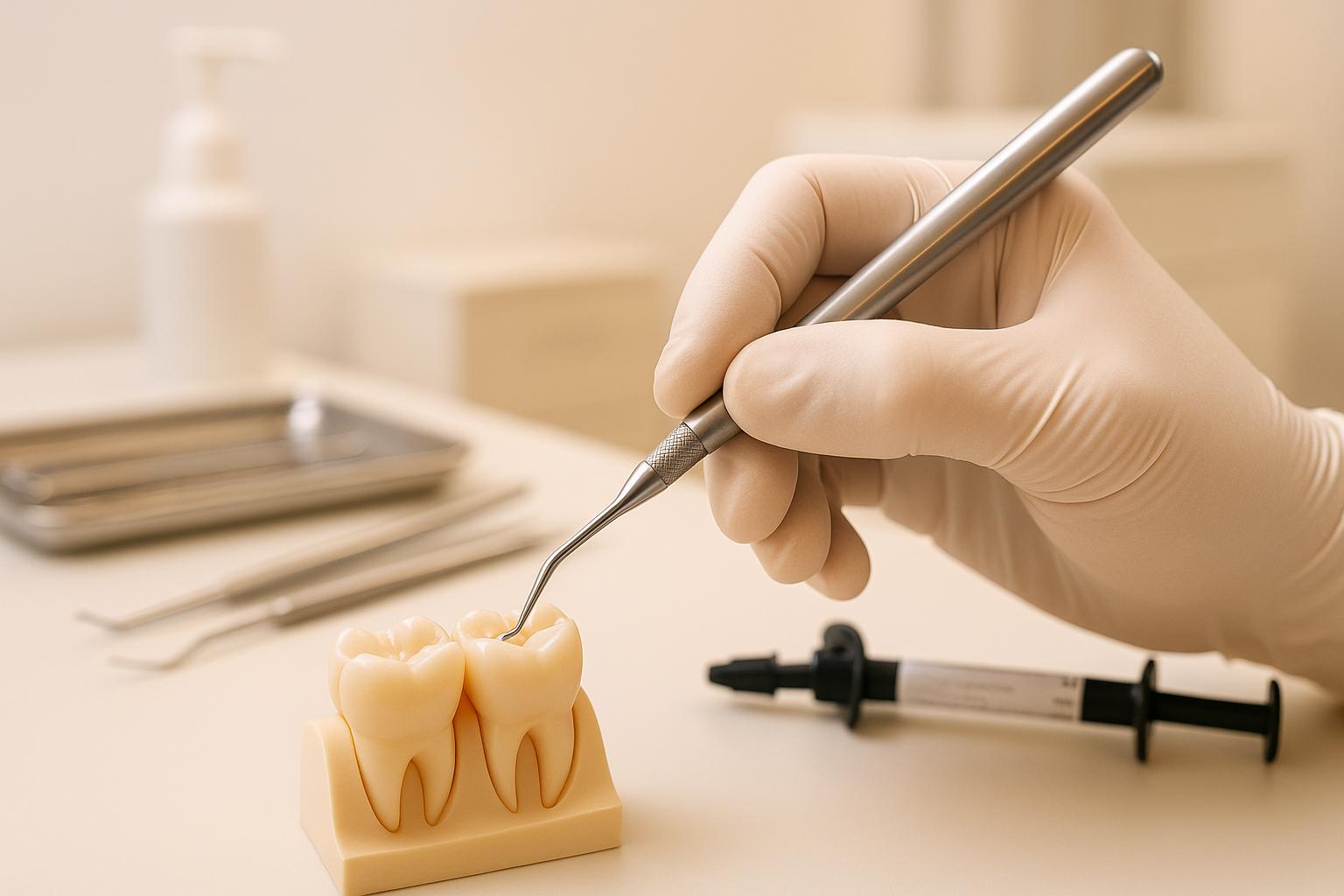
Composite resins have come a long way, solving issues like weak durability, poor colour matching, and complicated application. The latest materials offer better strength, lifelike aesthetics, simpler use, bioactive benefits, and improved safety. Here’s a quick breakdown:
- Stronger and long-lasting: Enhanced resistance to wear and stress.
- Natural look: Improved colour matching and polishability for seamless restorations.
- Simpler application: Easier handling, faster curing, and reduced errors.
- Bioactive properties: Promote tooth health and fight bacteria.
- Safer for patients: Reduced sensitivity and improved biocompatibility.
These advancements make dental procedures faster, safer, and more effective for both dentists and patients. Let’s dive deeper into each feature.
1. Improved Mechanical Strength
Enhanced durability and resistance to wear
Modern composite resins have tackled the issue of rapid wear that plagued older materials, especially under the strain of heavy chewing forces. Thanks to advancements in fillers and polymer matrices, these next-generation materials hold up against the daily rigours of chewing, grinding, and clenching while maintaining their structural integrity.
What makes the difference? A uniform distribution of filler particles creates smoother, abrasion-resistant surfaces. When paired with optimised filler-to-matrix ratios, these composites also exhibit greater fracture toughness. This means they can resist crack propagation and absorb stress more effectively. The result is a material that doesn’t just last longer but also performs better under pressure.
These mechanical improvements don’t just boost reliability – they set the stage for seamless aesthetic applications, which we’ll explore next.
2. Better Aesthetic Integration
Aesthetic Appeal and Colour Matching
Recent advancements in resin formulations have made it easier than ever to create restorations that seamlessly blend with natural teeth. Today’s composites are designed to maintain excellent colour stability and translucency, closely mimicking the look of tooth enamel and dentine. Refined shade systems now capture the natural variations in teeth, from the translucent edges of incisors to the more opaque cervical areas, making restoration margins far less noticeable.
Additionally, improved polishability ensures a smooth, enamel-like surface that enhances the overall appearance. These developments not only provide long-lasting aesthetics but also make these materials suitable for both front and back teeth. When paired with their improved mechanical strength, these aesthetic advancements offer even more reliable and visually pleasing restorative solutions.
3. Easier and More Efficient Application
Ease of Clinical Application
Modern composite resins have transformed the restoration process, making it simpler and more efficient while maintaining high-quality results. The latest formulations are designed with better handling properties, reducing the challenges of placement and manipulation during treatment.
These advanced composites boast optimised viscosity, which allows for precise placement without the annoyance of stickiness. This improvement not only shortens chair time but also minimises the risk of voids or air bubbles that could compromise the restoration. Additionally, the materials hold their shape during application, avoiding slumping on vertical surfaces while staying pliable enough to adapt seamlessly to cavity walls.
Curing has also become faster and more effective thanks to advancements in light-curing technology. Next-generation resins feature improved photoinitiator systems that work more efficiently with LED curing lights. This means shorter exposure times are needed to achieve complete polymerisation, speeding up the procedure and reducing the potential for patient discomfort caused by prolonged light exposure.
Sculpting these materials is straightforward with standard dental instruments, allowing practitioners to recreate natural tooth anatomy with ease.
Moreover, reduced technique sensitivity ensures consistent results, even when moisture control or placement precision isn’t perfect. The introduction of pre-polymerised fillers has further simplified the process by eliminating the need for complex layering techniques. Additionally, single-shade composites now adapt seamlessly to surrounding tooth structures, streamlining the aesthetic aspect of restorations.
4. Bioactive and Multifunctional Properties
Bioactivity for Better Oral Health
Modern composite resins are no longer just about filling cavities or looking good – they’re stepping into the realm of therapy. The latest advancements include resins infused with bioactive agents that actively interact with the oral environment. These agents do more than just sit passively; they encourage remineralisation of teeth and help fight off harmful bacteria, promoting healing and reducing the risk of disease[1]. This shift from passive to active restoration is a game-changer, offering not only functional benefits but also improved compatibility with the natural oral environment. The topic of biocompatibility will be explored further in the next section.
sbb-itb-2be92ed
5. Biocompatibility and Patient Safety
Patient Safety and Long-Term Compatibility
Modern composite resins go through extensive testing to ensure they are safe for patients, non-toxic, and unlikely to trigger adverse reactions. These advanced materials are carefully crafted to minimise irritation and reduce the chance of substances leaching into the mouth. This solid safety foundation allows for ongoing improvements in their formulations.
Earlier versions of composite resins often contained problematic monomers and uncured resin components, which heightened the risk of sensitivity. However, these issues have largely been addressed, with many of these components either significantly reduced or completely removed. As a result, today’s composites are suitable for a wider range of patients, including those with sensitivities or allergies to traditional dental materials.
The compatibility with oral tissues has also been improved by using filler particles and resin matrices that closely resemble the natural structure of teeth. This reduces the chances of inflammation and promotes long-term stability.
Thanks to these advancements, modern composite resins are highly resistant to saliva, temperature changes, and chewing forces. This durability not only minimises post-treatment sensitivity but also lowers the likelihood of allergic reactions. Importantly, these formulations meet strict safety standards for children, offering effective protection for developing tissues both immediately and over time. Their proven safety makes them a reliable choice for patients of all ages, including paediatric applications.
Composite Resins: Composition and Classifications
Comparison Table
The shift from traditional composite resins to next-generation materials marks a significant leap in dental restoration technology. By examining the key differences, it becomes clear why modern composites are now the preferred choice for many dental applications. Below is a table summarising these advancements, followed by a discussion of their practical benefits.
| Feature | Traditional Composite Resins | Next‐Generation Composite Resins |
|---|---|---|
| Compressive Strength | 200–300 MPa | 350–450 MPa |
| Colour Matching | Limited shade options; prone to colour changes over time | Wide shade range; excellent colour stability |
| Polymerisation Shrinkage | 2.5–4.0% volume reduction | 1.5–2.5% volume reduction |
| Working Time | 60–90 seconds under operatory lighting | 3–5 minutes with improved light stability |
| Bioactive Properties | Inert material | Releases beneficial ions |
| Antibacterial Activity | None | Effective against common oral bacteria |
| Sensitivity Reactions | Higher rate of post-operative sensitivity | Greatly reduced sensitivity incidence |
Next-generation resins outshine their predecessors in several critical areas. They offer greater compressive strength, ensuring more durable restorations, and a wider range of shades that maintain their colour over time. These materials also exhibit lower polymerisation shrinkage, which helps preserve the integrity of the bond between the tooth and the restoration, reducing the risk of marginal gaps and post-operative sensitivity.
Additionally, these advanced composites provide longer working times under operatory lighting, allowing dentists more flexibility during procedures. Their bioactive properties, such as the release of beneficial ions, not only support oral health but also actively combat common oral bacteria, offering a dual benefit of restoration and protection. The significantly reduced sensitivity rates further enhance patient comfort, making these materials a standout choice for modern dental care.
With these advancements, next-generation composite resins have redefined standards in strength, aesthetics, efficiency, and bioactivity, paving the way for superior dental restorations.
Conclusion
Next-generation composite resins are reshaping the landscape of dentistry, offering a leap forward compared to traditional materials. These advanced resins not only provide superior strength and durability but also maintain natural-looking aesthetics with consistent colour stability over time.
For dental professionals, these materials bring practical advantages like extended working times and reduced polymerisation shrinkage, which help minimise complications after procedures. Some of these composites even include bioactive components with antibacterial properties, adding another layer of benefit.
Patients also stand to gain significantly. These materials improve comfort during and after treatment, reduce sensitivity, and ensure restorations last longer. Their biocompatibility supports healthy tissue responses, contributing to better long-term oral health.
These advancements aren’t just about better materials – they’re about delivering better results. At Complete Smiles Bella Vista, the use of cutting-edge composite materials enhances a wide range of cosmetic and restorative treatments, from straightforward fillings to intricate procedures like porcelain veneers.
The shift from traditional to next-generation composite resins is more than an upgrade – it’s a step forward for modern dentistry, blending improved performance, patient satisfaction, and streamlined processes to meet the demands of contemporary care.
FAQs
What makes next-generation composite resins beneficial for oral health?
Next-generation composite resins bring a fresh wave of benefits by offering bioactive properties that actively contribute to better oral health. They support the remineralisation of weakened tooth structures, helping to strengthen teeth while also providing antimicrobial effects to combat harmful bacteria and reduce the chances of secondary decay.
These cutting-edge materials also enhance adhesion to dentin, forming a stronger and more durable bond. This not only minimises the risk of wear and tear over time but also increases the longevity of dental restorations, delivering improved long-term results for patients.
What makes next-generation composite resins safer for patients with sensitivities or allergies?
Next-generation composite resins are crafted to be gentler on the body, aiming to minimise the chances of sensitivities or allergic reactions. Many of today’s formulations steer clear of materials linked to allergies, such as specific metal components. Instead, they incorporate zirconia-based composites, known for their compatibility with the human body.
These innovations tackle common dental concerns like postoperative sensitivity and microleakage, providing patients with a safer and more comfortable experience. By focusing on both safety and long-lasting performance, these advanced materials play a key role in promoting better oral health.
How do modern composite resins improve the appearance of dental restorations?
Modern composite resins boast impressive aesthetic qualities, including improved translucency and accurate colour matching. These features enable them to closely resemble the natural appearance of teeth, ensuring restorations blend effortlessly with surrounding teeth for a seamless, natural look.
Thanks to their ability to replicate the optical properties of enamel and dentin, these resins make dental restorations nearly indistinguishable from natural teeth. The result? A confident, radiant smile that looks completely natural.
Related Blog Posts
- Wear Resistance of Polymer-Based Restoratives
- Advances in Dental Adhesives: What to Know
- Nanomaterials in Dentistry: Wear Resistance Explained
- Nanocomposites for Pulp Regeneration: Key Features
Important Notice: Any surgical or invasive procedure carries risks. Before proceeding, you should seek a second opinion from an appropriately qualified health practitioner.
Individual results may vary. The information provided in this article is for educational purposes only and does not constitute medical advice.
Checkout Related Blogs




Get in touch with us
For more information, call us now to start feeling better. Or fill the form below to make appointment
The Latest News from Complete Smiles
How to Clean Clear Plastic Retainers
Checklist for Choosing Wearable Dental Devices
Checklist for Choosing Cloud AI Platforms in Dentistry

Complete Smiles Bella VistaAccepts All Major Health Funds, Including





