





Studies on Patient Expectations in Dentistry

Patients expect more than just functional dental treatments – they want fast, pain-free, and aesthetically pleasing results. However, these expectations often clash with clinical realities, leading to dissatisfaction even when procedures are successful. Here’s what you need to know:
- Aesthetic demands: Social media and celebrity influences drive unrealistic goals for "perfect" smiles, with many patients unaware of the limits of dental treatments. For example, patients often compare professional and at-home whitening without understanding the clinical differences in results.
- Speed vs. biology: While digital workflows promise faster results, biological processes like healing can’t always keep up.
- Pain and comfort: Fear of discomfort remains a barrier, though patients prioritise gentle care and time efficiency.
- Cost and access: High expenses and limited insurance coverage deter many, with 66.3% citing cost as a major obstacle.
- Communication gaps: Misunderstandings about risks, maintenance, and realistic outcomes fuel dissatisfaction.
Clear communication, patient education, and personalised care help manage expectations and improve satisfaction. Dentists can use tools like visual aids and the "teach-back" method to ensure patients understand treatment plans. Advances in digital dentistry, like AI-powered dental imaging and 3D printing, are reshaping care but require careful integration to align with patient needs.
Key Findings from Recent Studies
Pain-Free and Fast Results
Research highlights how much dental patients value both comfort and efficiency. A 2024 study revealed that 82% of patients consider "cares about my time" a top priority when selecting a dental practice, while 79% emphasise the importance of a "gentle" approach during procedures [7]. Pain remains a major obstacle for many, with fear of discomfort discouraging people from seeking essential care [6][7]. Interestingly, there’s often a mismatch between how patients perceive their pain tolerance and their actual experience. Even those who see themselves as resilient may become dissatisfied if a procedure feels more uncomfortable than expected, sometimes leading to complaints despite clinically successful outcomes [1].
With advancements in digital technology, the demand for speedy results has skyrocketed. Digital workflows – like scanning, 3D printing, and milling – have created expectations for near-instant outcomes, including immediate implant placements. However, these desires often clash with biological realities, sometimes resulting in delays [1]. Notably, 96% of patients who prioritise quick results are also the most likely to stick to their appointments [7]. This highlights how a focus on time efficiency influences patient behaviour.
In addition to speed and comfort, many patients now place a greater emphasis on achieving visually pleasing results.
Aesthetic Goals and Customised Care
Cosmetic perfection has become a primary motivator for many patients, but there’s often a gap between what they want and what’s realistically achievable. Studies show that non-dental professionals are 3.02 times more likely to seek aesthetic dental treatments compared to professionals, who are more aware of potential long-term complications [8]. Among those who’ve had cosmetic procedures before, 84.3% express interest in further enhancements, reflecting growing demand for aesthetic treatments [8].
Social media and the "Zoom Boom" have amplified scrutiny of one’s smile, driving a surge in cosmetic dentistry [9]. However, this pursuit of perfection can sometimes overlook the irreversible nature of certain procedures and the ongoing maintenance they require [1]. While aesthetic improvements may initially boost satisfaction, the "hedonic treadmill" effect suggests that patients often return to their baseline level of happiness, prompting a cycle of chasing further enhancements [1].
Psychological factors also play a critical role. For example, 83.7% of patients seeking aesthetic care report high self-esteem, while 16.3% have low self-esteem [8]. Those with a "high smile line" tend to have lower dental self-confidence compared to individuals with normal or low smile lines [3]. Additionally, a combination of psychological factors and oral health explains about 20.61% of the variation in a patient’s interest in orthodontic treatment [9].
While aesthetics are a driving force in treatment decisions, financial and accessibility concerns significantly influence patient choices.
Cost and Accessibility Concerns
The high cost of dental care remains a major barrier. For instance, 66.3% of patients cite expense as the main obstacle to orthodontic treatment, with 59.5% believing that current costs are too steep and should be reduced [10]. Unsurprisingly, when patients invest heavily in treatment, they expect flawless results and may become critical of even minor imperfections.
Payment options also play a crucial role in decision-making. Around 50% of patients prefer monthly payment plans over lump-sum payments, and 52.6% believe orthodontic costs should be covered by dental insurance [10]. However, 92.2% of patients in one study had to pay out-of-pocket, as insurance coverage for specialised treatments is still limited [10]. This financial strain often forces low-income individuals to prioritise essentials like rent and food over dental care [11]. Additionally, modern dental technologies, while advancing care, can drive up costs, further complicating affordability.
Accessibility extends beyond financial barriers. Long wait times in public clinics, limited specialised facilities for patients with special needs, and transportation challenges all hinder access to care [11]. As one dental professional noted:
Finances is a big, big issue… being able to afford toothpaste, and toothbrush and mouth rinses and all the fancy things… unless the patient has it, they’re not going to have access to these things [11].
These challenges underline the growing expectation for fairness in dental care, where patients believe everyone should have equal and affordable access, regardless of their financial situation [10].
sbb-itb-2be92ed
Managing Patient Expectations – Non-CE Replay
Realistic vs Unrealistic Expectations
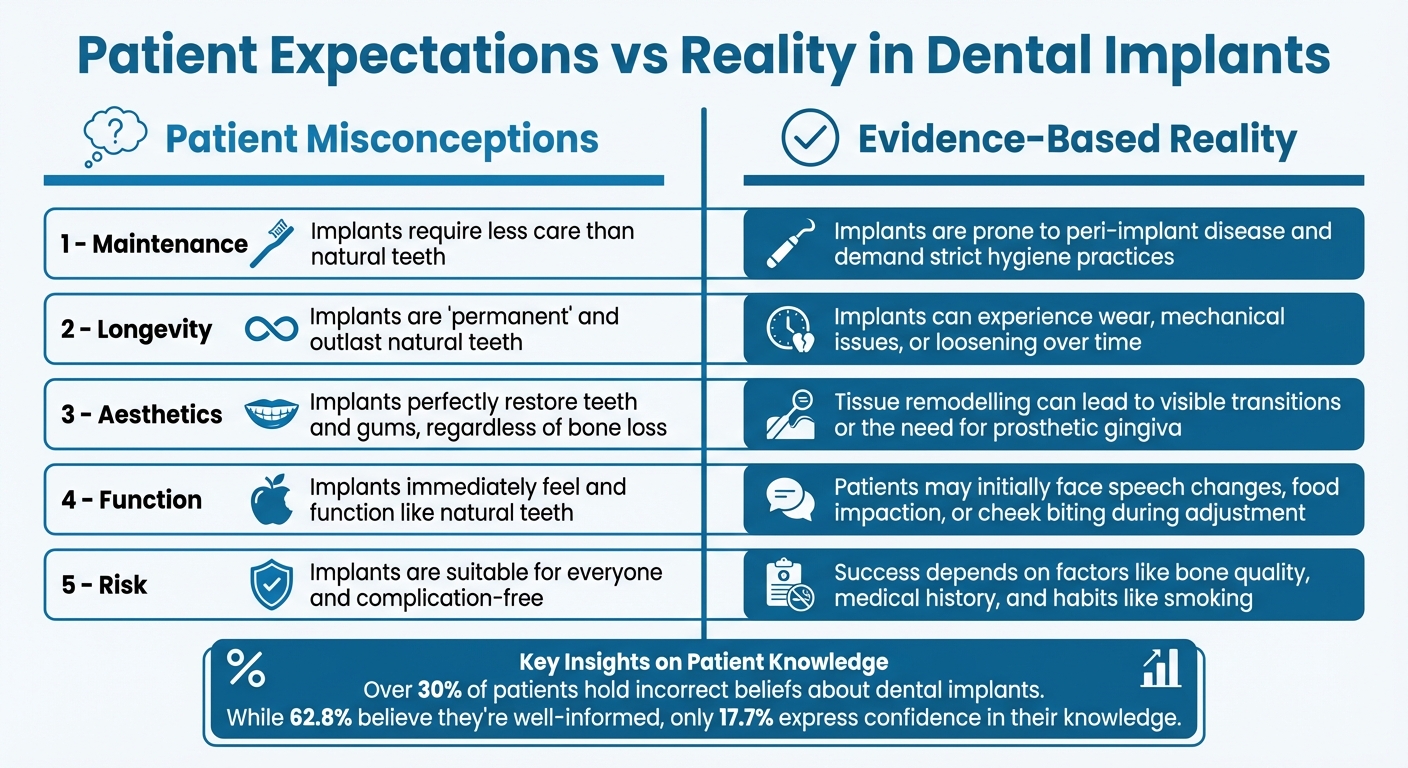
Patient Expectations vs Reality in Dental Implants
Expectations vs Reality
When it comes to dental care, there’s often a noticeable gap between what patients expect and what is actually achievable. This disconnect can lead to dissatisfaction, even when treatments meet professional standards. For instance, research shows that over 30% of patients hold incorrect beliefs about dental procedures, particularly implants[14]. A common misconception is that implants are maintenance-free and completely risk-free.
Here’s a breakdown of some common patient beliefs versus the actual realities:
| Category | Patient Misconception | Evidence-Based Reality |
|---|---|---|
| Maintenance | Implants require less care than natural teeth[14] | Implants are prone to peri-implant disease and demand strict hygiene practices[1][14] |
| Longevity | Implants are "permanent" and outlast natural teeth[14][15] | Implants can experience wear, mechanical issues, or loosening over time[1][14] |
| Aesthetics | Implants perfectly restore teeth and gums, regardless of bone loss[1] | Tissue remodelling can lead to visible transitions or the need for prosthetic gingiva[1] |
| Function | Implants immediately feel and function like natural teeth[14] | Patients may initially face speech changes, food impaction, or cheek biting during adjustment[1] |
| Risk | Implants are suitable for everyone and complication-free[14] | Success depends on factors like bone quality, medical history, and habits like smoking[1][14] |
Interestingly, while 62.8% of patients believe they’re well-informed about implants, only 17.7% express confidence in the information they have[14]. This lack of clarity often fuels unrealistic expectations, especially regarding aesthetics. Digital imagery and media can further distort perceptions, making it even more crucial to have honest conversations about potential outcomes.
How Communication Addresses Unrealistic Goals
Given the gap between patient expectations and clinical realities, effective communication is key to managing these misunderstandings. Clear and upfront discussions can prevent many issues. As highlighted in Nature (British Dental Journal):
Many complaints are a result of unmet expectations or simple misunderstandings, which, if addressed in advance of treatment, can be easily clarified, but if presented after treatment, are perceived by the patient to be elaborate excuses. – Nature (British Dental Journal)[1]
One effective strategy is the "teach-back" method. By asking patients to explain the treatment plan and associated risks in their own words, dentists can ensure the information is truly understood[5]. Research supports this approach, showing that patients who feel well-informed are more comfortable during treatment (p = 0.015)[16]. In fact, 98.9% of patients who felt "very well informed" reported greater satisfaction and more realistic expectations[16].
It’s also important to involve patients in understanding their dental history. For example, explaining how prior periodontal issues or smoking habits can impact the longevity of implants helps set realistic expectations for future care[1]. This discourages the misconception that implants are a flawless, permanent fix[14][15].
Visual aids, like models and Digital Smile Design for patient communication, can help illustrate realistic outcomes. However, these tools should be used carefully to avoid creating new misconceptions[1]. Additionally, documenting discussions about risks – especially for quick procedures – helps ensure patients are aware of the complexities involved in dental treatments[1].
Strategies for Managing Patient Expectations
Communication Techniques That Work
Managing patient expectations starts with effective communication. Studies reveal that many malpractice complaints stem not from technical errors but from miscommunication or inadequate explanations [17][18]. This highlights the importance of clear and effective dialogue.
The "5 Cs" of Communication offer a useful guideline: messages should be Clear (easy to understand), Correct (accurate), Concise (to the point), Complete (covering essential details), and Cohesive (well-organised) [17]. Using simpler language – like saying "germ" instead of "bacteria" – can make explanations more accessible [17].
Another helpful approach is motivational interviewing, which involves open-ended questions, affirmations, reflective listening, and summaries [18]. For instance, using questions that start with "How", "What", or "Describe" encourages patients to share detailed responses, revealing expectations they might not express otherwise. Reflective listening – rephrasing or summarising what the patient says – helps confirm understanding and shows empathy. Even physical positioning can make a difference; sitting at or below the patient’s eye level creates a sense of partnership and reduces perceived power imbalances [17].
Since patients often retain less than half of the oral health advice they receive, breaking information into smaller, manageable parts is crucial [18][19]. Limiting discussions to three main points improves recall and understanding. Reinforcing these techniques through multiple educational tools further strengthens patient comprehension.
Patient Education and Awareness
Patient education plays a critical role in bridging the gap between clinical realities and patient assumptions. Alison Large, Dento-legal Adviser at the Dental Defence Union, emphasises this point:
Clear and consistent information from all members of the practice team, on your website, on answering machines and posters in waiting rooms can help patients know what to expect. [5]
Providing consistent information through various channels – like websites, waiting room posters, and leaflets – helps set realistic expectations [5]. This is especially important as unrealistic expectations often arise from either too much misleading information (like advice from friends or online sources) or too little information about potential complications or waiting times [4].
For patients with limited health literacy, it’s essential to use plain language and visual aids [18]. Many patients may not admit they don’t understand, so offering jargon-free explanations and easy-to-read materials can make a big difference. Providing "take-home" resources – whether printed or digital – allows patients to review information in a relaxed setting, away from the stress of the clinic [5]. Visual aids, in particular, can simplify complex ideas and help patients better understand treatment outcomes [17][18].
Preventive and Personalised Care
Once communication and education are in place, personalised care takes patient management to the next level. This approach moves away from a "one-size-fits-all" model, focusing instead on individual needs shaped by genetic, biological, behavioural, and social factors [21]. Personalised care not only manages expectations effectively but also empowers patients by making them active participants in their treatment.
Research shows that 55% of patients expect specific product recommendations, and 84% feel more satisfied when care is tailored to their needs [12]. Actively involving patients by asking if the treatment plan aligns with their goals – or if they have any concerns – ensures they feel heard and in control [22].
Using data-driven planning, such as a patient’s health history, lifestyle, and risk factors, allows for more targeted care plans [20]. This approach addresses both clinical and emotional aspects, ensuring patients feel genuinely cared for [13]. Establishing feedback mechanisms, like online comment forms or direct conversations during visits, gives patients a chance to voice concerns before they escalate into complaints [13][22].
These methods align with recent findings that underscore the importance of balancing aesthetic goals with practical outcomes in dental care. By combining clear communication, thorough education, and personalised care, dentists can better manage patient expectations while improving overall satisfaction.
Future Trends and Research Directions
Impact of Digital Dentistry
Advancements in digital dentistry are reshaping patient expectations and clinical practices. Same-day restorations, once a luxury, have now become the norm. As SprintRay highlights:
In 2026, patient expectations have shifted. Same-day crowns and restorations are now expected as standard [23].
AI has revolutionised diagnostics, cutting cavity detection time from 10 minutes to just two. With sensitivity rates ranging between 71% and 99% – and an average of 85% sensitivity and 90% specificity – AI-powered imaging is setting new benchmarks for accuracy [23][25]. These advancements are driving demand for faster, more precise, and transparent care. A notable example is Aspen Dental‘s nationwide implementation of VideaAI across over 1,100 practices in February 2026, marking one of the largest AI deployments in dentistry to date [26].
3D printing is another game-changer, drastically reducing costs. Dentures that once cost $400–$1,000 can now be produced for under $100 [24]. This shift has spurred rapid adoption, with 17% of U.S. dentists already using 3D printers by 2023 [24].
Patient engagement is also evolving with tools like exocad‘s Smile Creator, which allows individuals to preview treatment outcomes in 4K video. Studies show patients greatly prefer video simulations (9.2/10) over static images (7.8/10), with 100% of participants expressing satisfaction with their proposed results before treatment began [27]. Such tools effectively align patient expectations with clinical possibilities.
AI-driven remote monitoring for clear aligners is addressing the growing demand for efficient, high-quality care by reducing the need for in-person visits [23]. Collectively, these innovations are steering dentistry toward a more proactive and patient-centred approach.
Growing Focus on Preventive Care
As diagnostic tools improve, there’s a noticeable shift toward prevention-focused dental care. Research reveals that 78% of patients consider "improving my oral health" a top priority when choosing a dental practice [7]. This reflects a deeper understanding of how oral health impacts systemic conditions like diabetes and cardiovascular disease [28][29].
Personalised care is becoming a key expectation. Over half of dental patients (55%) now want providers to recommend specific products tailored to their oral health needs [7]. Liran Levin from the University of Saskatchewan emphasises this shift:
Including personalised self-care recommendations as part of every dental treatment plan will address these needs and motivate patients to engage in their oral health care [7].
The global burden of oral disease underscores the urgency of this preventive focus. In 2019, oral diseases accounted for $387.09 billion in direct costs worldwide, with severe periodontal disease ranking as the 11th most common condition globally [28][29]. On average, patients are willing to spend $53.40 (2024 PPP US$) on preventive dental interventions, highlighting a growing appreciation for prevention’s role in long-term health [28].
Minimally invasive techniques are gaining traction within this preventive framework. For instance, prosthetically guided orthodontics – using clear aligners to optimise tooth positioning before restorative work – helps preserve natural tooth structure. This method reduces the "biological cost" of treatments like veneers or crowns while still achieving aesthetic goals [27]. Patients increasingly favour such approaches, which minimise future intervention needs.
The World Health Organisation has recognised oral health as a critical indicator of overall wellbeing. Their push to integrate oral health into essential national health service packages by 2030 further solidifies prevention as a cornerstone of modern dental care [29]. This global policy shift reflects the growing emphasis on proactive measures to enhance both individual and public health outcomes.
Conclusion
Effectively managing patient expectations in dentistry hinges on clear communication and an understanding of psychological factors. Research shows that only 2.0%–4.5% of patients expect perfect results from every treatment [2], yet modern media continues to promote high aesthetic standards [1].
It’s essential to differentiate between clinical success and patient satisfaction. A procedure may be clinically flawless but still fall short if the patient’s expectations were not aligned with the outcome. Psychological aspects also play a significant role in dental care. For instance, women pursuing aesthetic treatments often report lower self-esteem compared to men, and there’s a notable link between dental self-confidence and overall self-esteem (r = 0.500) [3]. By acknowledging these nuances, dental professionals can better meet both the functional and emotional needs of their patients.
FAQs
How can I tell if my smile goals are realistic?
To figure out if your smile goals are realistic, it’s best to consult a dental professional. They can evaluate your oral health, consider your facial features, and discuss your expectations. With their clinical expertise and evidence-based guidance, they’ll help you set achievable goals that work for your dental health in the long run. A personalised plan ensures you’re on the right track.
Why can’t some treatments be done immediately?
Some treatments demand careful planning, clear communication with the patient, and setting realistic expectations. Elements such as the complexity of the procedure, required healing time, or the need for preparatory steps can sometimes postpone immediate treatment. These measures are essential to achieve optimal results and ensure lasting success.
What should I do to maintain dental implants long-term?
Maintaining the longevity of dental implants hinges on consistent oral care and routine dental visits. Make daily brushing and flossing a priority to keep plaque and gum disease at bay – both of which can threaten the stability of your implants. Regular check-ups with your dentist are equally important, as they provide opportunities for professional cleaning and close monitoring of the implant area. Beyond this, steer clear of smoking, manage any existing medical conditions, and focus on overall oral health to give your implants the best chance to last.
Related Blog Posts
- Studies on Pain Management in Dental Extractions
- Common Communication Mistakes in Dentistry
- Digital Smile Design for Patient Communication
- Patient-Reported Outcomes in Digital Dentistry
Important Notice: Any surgical or invasive procedure carries risks. Before proceeding, you should seek a second opinion from an appropriately qualified health practitioner.
Individual results may vary. The information provided in this article is for educational purposes only and does not constitute medical advice.
Checkout Related Blogs




Get in touch with us
For more information, call us now to start feeling better. Or fill the form below to make appointment
The Latest News from Complete Smiles
How to Clean Clear Plastic Retainers
Checklist for Choosing Wearable Dental Devices
Checklist for Choosing Cloud AI Platforms in Dentistry
Complete Smiles Bella VistaAccepts All Major Health Funds, Including





