





How PPE Reduces Chemical Exposure in Dental Clinics
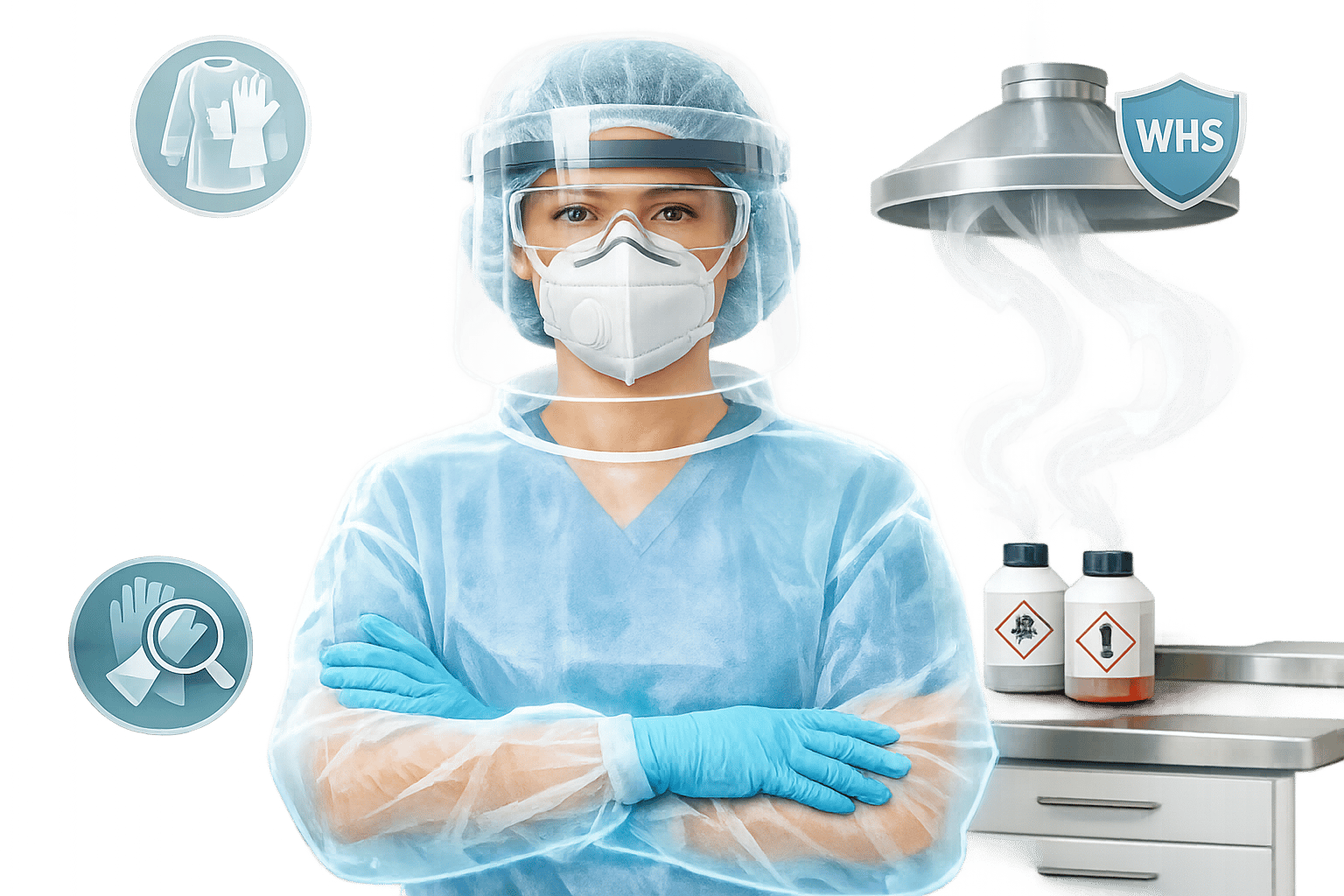
Personal protective equipment (PPE) is essential in dental clinics to minimise risks from harmful chemicals like methyl methacrylate, glutaraldehyde, mercury, and silica dust. These substances can cause skin irritation, respiratory issues, and long-term conditions such as asthma or cancer. Proper PPE, including gloves, gowns, goggles, and respirators, acts as a barrier against chemical splashes, vapours, and aerosols.
Key points:
- Common hazards: Mercury levels in clinics often exceed safe exposure limits. Silica dust and caustic agents also pose risks.
- PPE essentials: Heavy-duty gloves, fluid-resistant gowns, protective eyewear, and respirators are critical for safety.
- Proper use: PPE must be donned and doffed correctly to avoid contamination. Damaged or soiled items should be replaced immediately.
- Australian standards: Clinics must comply with WHS regulations, including the use of PPE and limits on airborne contaminants by December 2026.
While PPE provides essential protection, combining it with ventilation systems and safe handling practices ensures better safety for dental professionals.
How to Put On & Take off Dental PPE (Personal Protective Equipment)
sbb-itb-2be92ed
Types of PPE for Chemical Protection
Choosing the right PPE is essential for protecting dental professionals from hazardous chemicals. The equipment must align with the specific risks encountered in the clinic, whether it’s dealing with disinfectants or managing aerosols during procedures. Each type of PPE is chosen to address particular hazards, following international guidelines from the CDC and WHO, as well as Australian standards. Below, we’ll explore the key equipment and maintenance practices necessary for effective protection.
Protective Clothing and Gloves
Long-sleeved gowns or lab coats serve as the first line of defence against chemical splashes and sprays. For procedures involving hazardous chemicals, fluid-repellent gowns are a better choice since standard cotton lab coats can absorb liquids, allowing chemicals to seep through to the skin [5]. These garments should be replaced immediately if they become saturated or visibly soiled [1][3].
When it comes to gloves, careful selection is critical. Regular patient examination gloves are not suitable for handling chemicals. Instead, heavy-duty utility gloves made from nitrile or rubber are specifically designed for chemical resistance. The CDC highlights their importance:
Chemical- and puncture-resistant utility gloves offer more protection than patient examination gloves when using hazardous chemicals. [2]
These gloves are indispensable when working with liquid disinfectants like glutaraldehyde or while processing contaminated instruments [2][3]. It’s important to note that gloves should never be washed, as this can cause wicking, which allows liquids to penetrate through tiny, undetectable holes [3]. To ensure proper protection, dental professionals should consult the manufacturer’s Safety Data Sheets (SDS) to confirm the compatibility of glove materials with specific chemicals [2].
Protecting the eyes and respiratory system is equally crucial, as discussed below.
Eye and Respiratory Protection
The eyes are highly vulnerable to chemical splashes and airborne particles. Goggles with side shields provide effective protection against splashes, while face shields offer additional coverage when used alongside masks [1][3].
Respiratory protection depends on the type of hazard present. Surgical masks are designed to filter larger particles, whereas N95, N99, and N100 respirators progressively filter finer aerosols, capturing 95%, 99%, and 99.7% of particles as small as 0.3 µm, respectively [3][4]. For these respirators to work effectively, professional fit-testing is required. Factors like improper sizing or facial hair can compromise the seal and reduce their efficiency [4].
Research on PPE Effectiveness
PPE Impact on VOC Levels
Studies suggest that relying solely on PPE may not provide dental professionals with sufficient protection from chemical exposure. However, its effectiveness improves significantly when paired with proper ventilation systems. For instance, a 2021 pilot study involving 21 dentists found that using a surgical microscope with a bag barrier drape – combined with high-volume evacuation (HVE) – reduced aerosolised particles by up to 98.5% compared to using loupes or face shields alone [8].
Interestingly, face shields did not significantly lower aerosol exposure compared to loupes. On the other hand, 75% of participants achieved aerosol levels within preoperative ambient ranges when using the combination of a surgical microscope and a bag barrier drape [8]. During crown preparation procedures, respirable aerosol concentrations returned to background levels 43.7% of the time [6]. The most effective setup – a surgical microscope with a bag barrier drape, HVE, and external suction units – brought particle levels down to 15.1 μg/m³, a stark contrast to the 999 μg/m³ recorded when using loupes or face shields without additional filtration measures [8].
These results emphasise the importance of combining PPE with integrated control measures to maximise protection, a point further validated by survey data on PPE practices.
Dental Professional Survey Results
Survey data offers additional context on PPE practices in dental settings. In June 2020, 99.6% of dentists reported wearing PPE during patient treatments, with 72.8% adhering to the full CDC interim guidance [8]. A separate cross-sectional survey conducted by Chulalongkorn University from January to June 2022 examined 207 Thai dentists and 125 dental assistants. This study revealed a 300% increase in the use of protective grinding devices following the COVID-19 pandemic [9]. However, it also highlighted gaps in practice: one-third of dentists rarely used protective grinding boxes when adjusting dental prostheses, citing delays and design challenges as barriers. Additionally, dentists were found to be more diligent with PPE and disinfectants when working on worn prostheses compared to new ones straight from the lab [9].
These findings illustrate that while PPE adoption is widespread, its protective capacity depends heavily on the type of equipment used and how it is integrated with ventilation strategies. For example, source control methods like placing HVE near the patient’s mouth can intercept aerosols before they reach the breathing zone, proving more effective than relying solely on facial PPE [6][7]. Proper PPE usage and maintenance remain critical, as explored in the following section.
How to Use and Maintain PPE
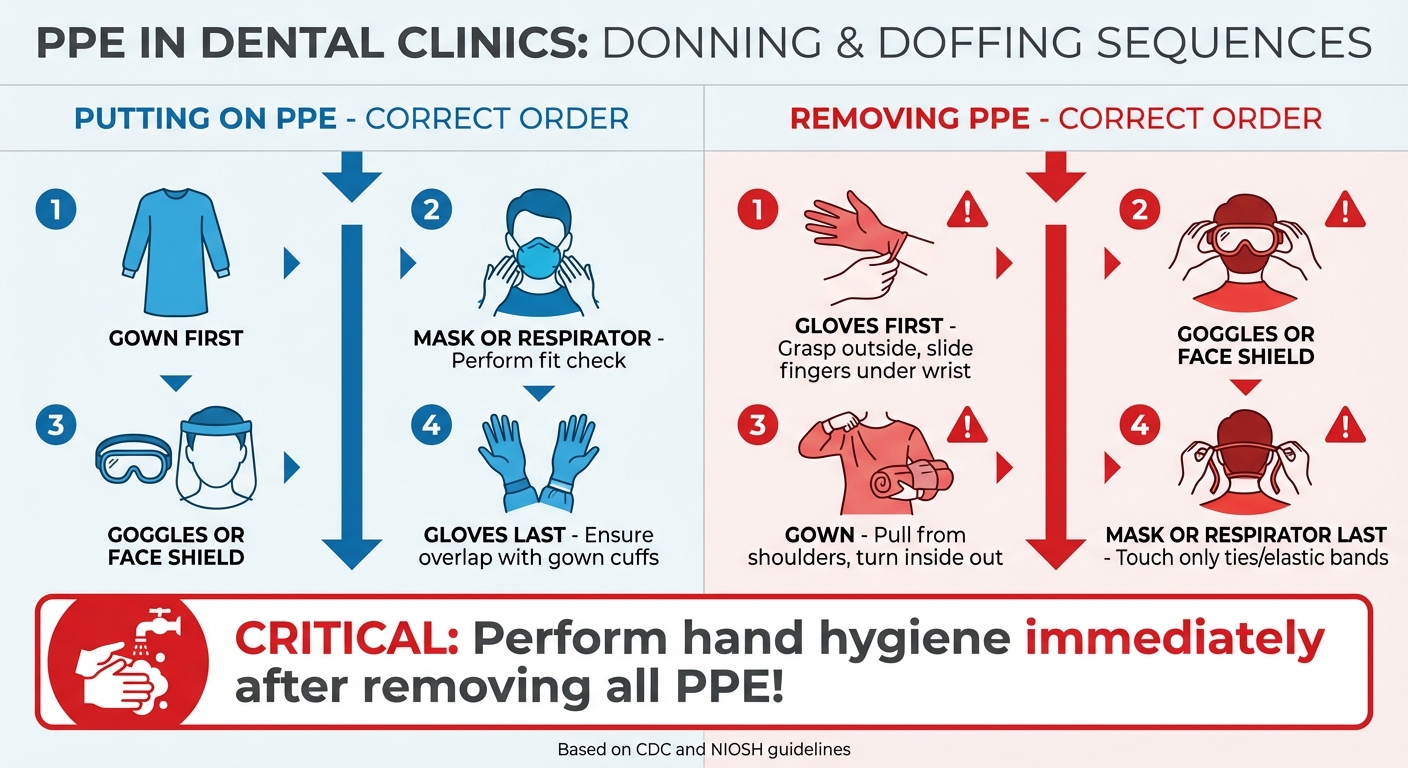
Proper PPE Donning and Doffing Sequence for Dental Clinics
Putting On and Removing PPE
The way you put on (don) and take off (doff) personal protective equipment (PPE) is just as important as the gear itself. To put on PPE correctly, follow this sequence: gown first, then mask or respirator (making sure to perform a fit check), followed by goggles or face shield, and finally gloves [11]. This order ensures each piece fits properly and overlaps to avoid gaps in protection. For respirators like P2/N95 masks, a fit check is non-negotiable to confirm a proper seal [11].
Taking PPE off requires even more caution to prevent contamination. The recommended order is gloves, then goggles or face shield, followed by the gown, and lastly the mask or respirator [11]. The National Institute for Occupational Safety and Health (NIOSH) explains:
"Donning means to put on and use PPE properly to achieve the intended protection and minimise the risk of exposure. Doffing means removing PPE in a way that avoids self-contamination." [10]
For gloves, peel them off by carefully grasping the outside of one glove with the opposite hand, then sliding ungloved fingers under the wrist of the remaining glove [11]. When removing gowns, unfasten the ties and pull the gown away from your shoulders, ensuring it turns inside out as you roll it into a bundle for disposal [11]. Masks should be removed by handling only the ties or elastic bands to minimise contact with contaminated surfaces [11]. And always remember this key step from the CDC:
"Perform hand hygiene immediately after removing all PPE!" [11]
Proper procedures, combined with regular inspection and timely replacement of PPE, are essential for maintaining its effectiveness.
PPE Inspection and Replacement
Once PPE is donned and doffed correctly, its condition must be checked regularly to ensure it remains effective. Replace PPE between patients or immediately if it becomes torn, soiled, or otherwise compromised. Disposable PPE is strictly for single use and should never be washed, as washing damages its protective properties [1]. The FDA explains:
"Disposable PPE is designed to be used only one time and by one person; it cannot be washed. Washing PPE changes its protective or barrier capabilities, and it may no longer be effective." [1]
For tasks involving chemicals, such as cleaning or preparing disinfectants, opt for puncture-resistant and chemical-resistant utility gloves instead of standard examination gloves [2]. Surgical masks should be replaced between patients or sooner if they become damp from breathing or exposure to fluids [1]. Additionally, all PPE must be removed before entering non-clinical areas like breakrooms or offices to prevent contaminant spread [10] [1].
Under Australian WHS laws, PCBUs (persons conducting a business or undertaking) are responsible for providing PPE and ensuring these maintenance protocols are followed. Workers, in turn, must comply with the instructions provided [12].
Australian PPE Standards for Dental Clinics
WHS Regulations for Chemical Hazards
Under the Model Work Health and Safety (WHS) laws, dental clinic operators (also known as PCBUs) are required to provide personal protective equipment (PPE) to their workers. Safe Work Australia defines PPE as:
"Personal protective equipment (PPE) is anything a worker uses or wears to keep them healthy and safe." [12]
However, relying on PPE alone isn’t enough. It’s meant to complement other safety measures like proper ventilation and safe handling of chemicals. PCBUs must ensure that the PPE provided is not only fit for the task but also comfortable for workers. For instance, chemical-resistant gloves are essential when handling disinfectants, goggles are needed for splash protection, and respirators help protect against airborne hazards.
Australia is currently in the process of updating its regulations on airborne contaminants. Until 1 December 2026, workplaces must comply with the existing Workplace Exposure Standards (WES) list [13][14]. After this date, Safe Work Australia mandates:
"From 1 December 2026, persons conducting a business or undertaking (PCBUs) must ensure that no person at the workplace is exposed to an airborne contaminant at a level above the exposure limit in the workplace exposure limits for airborne contaminants." [13]
This means dental clinics will need to ensure their workers are not exposed to airborne contaminants beyond the allowable limits. Dental procedures can generate various airborne particles – dusts, gases, fumes, vapours, or mists – that are often invisible but can pose serious health risks [15]. To comply, PCBUs must train their staff on proper PPE usage, cleaning, and maintenance. They must also display clear signage where PPE is required and regularly evaluate the effectiveness of the equipment. Workers, in turn, are expected to use the PPE correctly and responsibly. Failure to comply, such as refusing to wear PPE or damaging it intentionally, may result in disciplinary action [17].
These WHS requirements form the foundation for additional professional standards enforced by the Dental Board of Australia.
Dental Board of Australia Requirements

In addition to WHS regulations, the Dental Board of Australia (DBA) enforces specific standards aimed at protecting both the public and dental practitioners. These include strict Australian standards for dental tool disinfection and infection control protocols, which mandate the use of appropriate PPE when dealing with chemical hazards [16]. The DBA emphasises:
"The Dental Board of Australia expects dental practitioners to practise in a way that maintains and enhances public health and safety." [16]
Dental practitioners are expected to stay updated on DBA guidelines to ensure their PPE practices align with current standards. Compliance is monitored through a notification system managed by Ahpra, and recent legal changes have introduced stricter penalties for non-compliance. To assist with this, the DBA provides resources like the Professional Practice Resources hub, which offers training materials on infection prevention for clinic staff. Practitioners can also access the 24/7 Dental Practitioner Support service for additional guidance on maintaining safety standards.
Conclusion
The evidence is clear: using PPE correctly and consistently plays a key role in reducing chemical exposure risks in dental clinics. As NIOSH highlights, "PPE can be effective, but only when workers use it correctly and consistently" [18]. This underscores the importance of following proper protocols for putting on and removing equipment, routinely inspecting PPE, and replacing items that show any signs of damage or wear.
Different dental tasks demand specific protective gear. For instance, heavy-duty utility gloves, FFP3 respirators, protective eyewear with side shields, and gowns each provide targeted protection against chemical hazards. It’s crucial to remember that disposable PPE is for single use only and should never be reused.
Australian standards and regulations set the benchmarks for safe practices in dental clinics. Meeting these standards involves comprehensive training, fit-testing respirators, and maintaining clear separations between clinical and non-clinical areas to prevent cross-contamination. Together, these measures create a robust safety framework for dental professionals.
PPE functions as the fifth layer in the hierarchy of controls, complementing engineering solutions like proper ventilation and administrative measures such as safe handling protocols. When PPE is combined with these strategies and used according to established guidelines, it significantly lowers the risk of chemical exposure. Simple practices, like changing masks between patients, practising hand hygiene immediately after glove removal, and following correct doffing procedures, further enhance safety for dental professionals.
FAQs
Which glove material is safest for specific dental chemicals?
Nitrile gloves are highly regarded as the safest choice for handling certain dental chemicals. Their strong resistance to chemical permeation provides effective protection for dental professionals against exposure to various substances commonly used during procedures.
Do I need a P2/N95 respirator or is a surgical mask enough?
In dental settings, a surgical mask typically provides adequate protection against droplet transmission. However, for procedures that generate aerosols or in cases where the risk of airborne transmission is elevated, a P2/N95 respirator is advised. These respirators offer a higher level of protection against fine particles and airborne contaminants, making them a safer choice in such scenarios.
What else reduces chemical exposure besides PPE?
Proper ventilation and local exhaust systems play a key role in reducing chemical exposure in dental clinics. These systems work to limit airborne contaminants, helping create a safer workspace for dental professionals. Alongside PPE, they are essential tools for maintaining a healthier environment.
Related Blog Posts
- Australian Standards for Dental Tool Disinfection
- Australian Rules for Dental Waste Disposal
- Guide to Laser Safety in Periodontal Care
- Workplace Safety Standards in Dentistry
Important Notice: Any surgical or invasive procedure carries risks. Before proceeding, you should seek a second opinion from an appropriately qualified health practitioner.
Individual results may vary. The information provided in this article is for educational purposes only and does not constitute medical advice.
Checkout Related Blogs




Get in touch with us
For more information, call us now to start feeling better. Or fill the form below to make appointment
The Latest News from Complete Smiles
How to Clean Clear Plastic Retainers
Checklist for Choosing Wearable Dental Devices
Checklist for Choosing Cloud AI Platforms in Dentistry

Complete Smiles Bella VistaAccepts All Major Health Funds, Including





