





Powered vs Manual Interdental Tools: Key Differences

When it comes to cleaning between your teeth, choosing the right tool can make a big difference. Powered tools like water flossers use technology to simplify the process, while manual options such as floss or interdental brushes rely on your effort. Here’s a quick breakdown:
- Powered Tools: Easier to use, great for braces or implants, and often preferred for sensitive gums. They’re more expensive upfront but offer advanced features like adjustable pressure settings.
- Manual Tools: Affordable, portable, and effective when used correctly. Options include floss, floss picks, and interdental brushes, which are ideal for various gap sizes.
Quick Takeaway: Powered tools are convenient and often better for complex dental needs, while manual tools are cost-effective and versatile. Your choice depends on your dental anatomy, budget, and preferences.
Powered Interdental Tools Explained
Types of Powered Tools
Powered interdental tools rely on motors, pumps, or batteries to produce pressurised, pulsating water streams. These streams – delivered through devices like water flossers or oral irrigators – help flush out plaque and debris effectively [8]. Most models feature a water reservoir, a motor, and a specialised tip designed to glide along your gumline.
Some advanced models take this functionality further. For example, the Philips Sonicare Power Flosser uses "Quad Stream" technology, which splits the water into four streams to cover more interdental areas [7]. Other devices combine water flossers with electric toothbrushes for a more comprehensive oral care routine [8]. There are even prototype power toothbrushes with "Interdental" modes, where the brush head rotates vertically to clean hard-to-reach spots [6]. You’ll typically find these tools in two main styles: countertop models, which have larger water reservoirs and multiple pressure settings, and cordless models, which are battery-operated and great for travel or smaller bathrooms [8].
Benefits of Powered Tools
One of the biggest advantages of powered interdental tools is how easy they are to use. Unlike traditional string floss, which requires dexterity and precise finger coordination, powered flossers only need you to guide a nozzle along your teeth [8]. This makes them especially useful for people with arthritis or limited mobility.
These tools are also a game-changer for anyone with braces, bridges, crowns, or dental implants. The pressurised water can reach areas around brackets, wires, and other dental work where string floss often falls short [8]. Many users find water flossers more comfortable and enjoyable to use, which can encourage better consistency in oral care routines. Plus, advanced models often feature adjustable pressure settings – some with up to 10 levels – allowing users to customise the intensity for sensitive gums [7].
Beyond just cleaning, the pulsating water stream can also stimulate gum tissue, promoting better gum health [8]. As Waterpik puts it:
"The targeted stream of water removes plaque, food particles, and bacteria in a way that’s more effective, more comfortable, and easier than traditional string floss" [8].
Clinical studies back these claims, showing that powered flossers can eliminate up to 99.9% of plaque in treated areas and are up to 180% more effective than string floss at improving gum health [7].
Manual Interdental Tools Explained
Types of Manual Tools
Manual interdental tools rely entirely on your hand movements, making them simple yet effective options for oral care. Dental floss is the most traditional choice – a thin string made from nylon filaments or plastic monofilaments, which you wind around your fingers. To use it, you guide the floss in a C-shape along each tooth to clean effectively [3] [10]. If regular floss feels awkward or uncomfortable, dental tape offers a thicker, flatter alternative that some find easier to handle [10].
Flossettes, commonly known as floss picks, are another handy option. These feature a small strip of floss stretched between two plastic prongs on a curved handle. They’re especially practical for one-handed use, making them a favourite for parents cleaning their kids’ teeth or for those with limited dexterity [3] [5]. Then there are interdental brushes, which look like tiny bottle brushes. They consist of a flexible wire core surrounded by bristles, available in different sizes to fit various gaps between teeth. These are used with a gentle push-and-pull motion to clean thoroughly [3] [9] [10] [5].
Other manual options include wooden picks and rubber cleaning sticks [11]. However, many dental associations advise against wooden toothpicks due to the risk of splintering or gum damage [3] [5]. Since regular toothbrushing can’t reach all tooth surfaces [9], interdental tools play a vital role in maintaining oral hygiene. Each type of tool brings its own benefits, catering to different needs and preferences.
Benefits of Manual Tools
Manual interdental tools offer a budget-friendly and practical solution for maintaining oral health. Products like interdental brushes and flossettes are affordable and compact, making them perfect for travel or quick touch-ups. Unlike powered devices, manual tools don’t require batteries or charging, which means no extra costs beyond the initial purchase.
Another advantage is the level of control they provide. With manual tools, you can adjust pressure and movement instantly, ensuring a gentler cleaning experience. As the Australian Dental Association reminds us, "Healthy gums do not bleed" [3].
Studies highlight the effectiveness of these tools. Properly sized interdental brushes, for instance, can reduce bleeding between teeth by 46% in just one week and by 72% after three months [12]. Additionally, while single-use floss must be discarded after each session, interdental brushes can be rinsed and reused until the bristles wear out or the wire becomes bent [2] [3] [5]. These practical and efficient features make manual interdental tools an essential part of a thorough oral care routine.
Water Flossing vs. String Flossing – Which is Better?
sbb-itb-2be92ed
Powered vs Manual: Direct Comparison
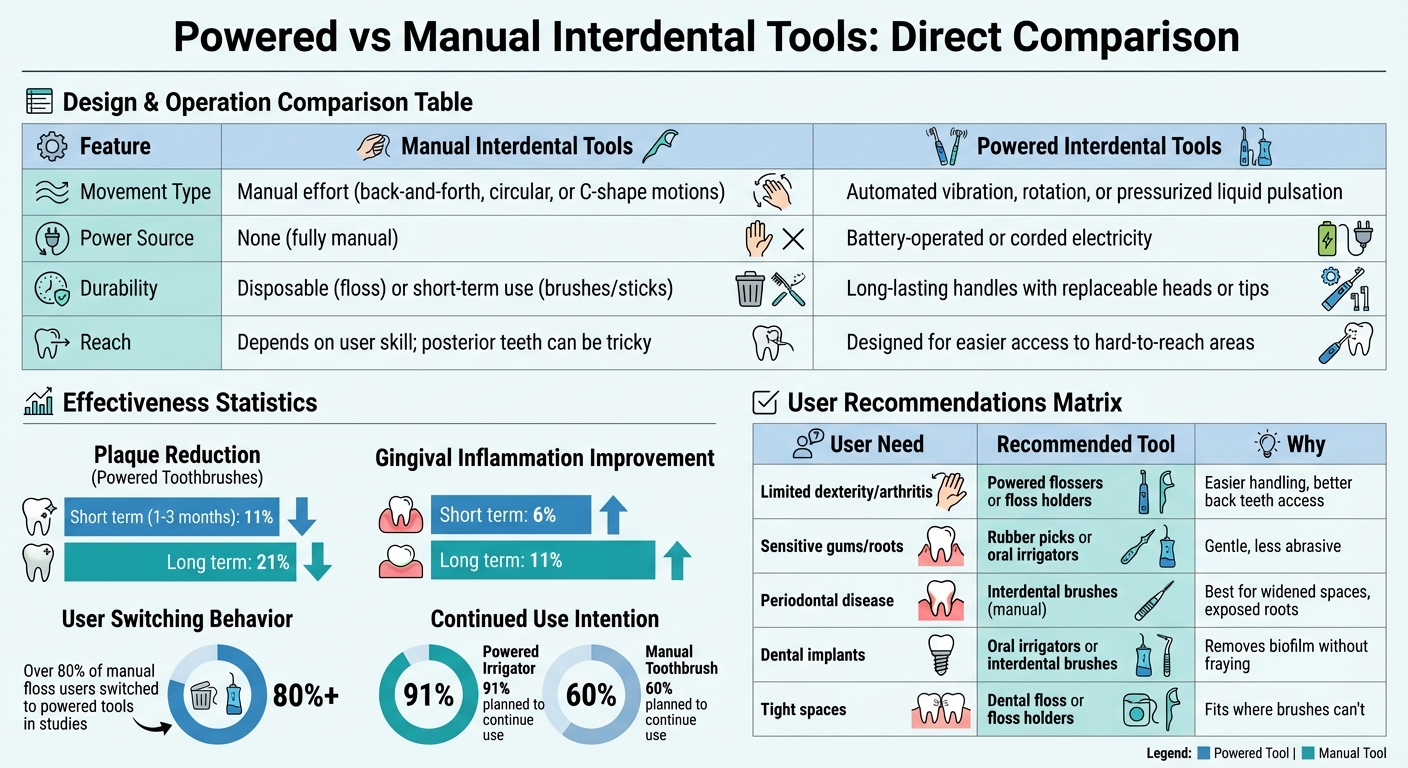
Powered vs Manual Interdental Tools Comparison Chart
Design and How They Work
The primary difference between powered and manual interdental tools lies in how they operate. Manual tools – like dental floss, interdental brushes, and rubber picks – rely entirely on your control. You determine the pressure, angle, and speed as you clean between your teeth [4]. Powered tools, on the other hand, automate much of this process. For instance, liquid-based devices such as oral irrigators use high-pressure water jets or air-liquid microdroplets to remove plaque. Meanwhile, mechanical tools, like powered interdental brushes or flossers, employ vibration or rotation to get the job done [13].
| Feature | Manual Interdental Tools | Powered Interdental Tools |
|---|---|---|
| Movement Type | Requires manual effort (e.g., back-and-forth, circular, or "C" shape motions) | Uses automated vibration, rotation, or pressurised liquid pulsation [13] |
| Power Source | None (fully manual) | Battery-operated or corded electricity [13] |
| Durability | Disposable (e.g., floss) or short-term use (brushes/sticks) [13] | Long-lasting handles with replaceable heads or tips [13] |
| Reach | Depends on user skill; posterior teeth can be tricky to clean [4] | Designed for easier access to hard-to-reach areas [13] |
Using manual floss effectively requires a certain level of skill and precision, which many people find challenging [4] [13]. It’s no surprise, then, that only about one-third of people floss daily [13]. Powered tools simplify the process, making them particularly helpful for cleaning those tough-to-reach spaces, especially at the back of the mouth.
Effectiveness for Plaque and Gum Health
The difference in design translates into varying levels of effectiveness when it comes to plaque removal and gum health. Studies reveal that powered toothbrushes can reduce plaque by 11% in the short term (1–3 months) and by 21% over longer periods compared to manual brushing. They also improve gingival inflammation by 6% in the short term and 11% over time [14].
Specifically for interdental cleaning, power-driven interdental cleaning tools (PDICTs) – like oral irrigators and powered flossers – perform just as well as manual floss in reducing plaque and bleeding between teeth. Interestingly, manual interdental brushes have been shown to be more effective than floss in certain scenarios, particularly when there’s enough space for the brush to fit [1]. Research consistently supports the idea that interdental brushes often outperform floss in plaque reduction [1].
User preference also plays a major role. In studies, over 80% of individuals who initially used manual floss chose to switch to powered interdental tools [13]. This highlights the importance of comfort and ease of use when selecting the right tool for maintaining oral health.
Which Tool Suits Different Users
Choosing the right interdental tool often depends on individual needs. While manual tools offer precision and affordability, they require good hand coordination. Powered tools, on the other hand, minimise physical effort, making them a better choice in specific situations.
| User Need | Recommended Tool Type | Why It Works Better |
|---|---|---|
| Limited dexterity or arthritis | Powered flossers or floss holders | Easier to handle and provides better access to back teeth [4] [13] |
| Sensitive gums or roots | Rubber interdental picks or oral irrigators | Gentle on gums and less abrasive compared to metal-wire brushes [4] [13] |
| Periodontal disease | Interdental brushes (manual) | Best for cleaning widened spaces and exposed root surfaces [4] |
| Dental implants | Oral irrigators or interdental brushes | Effectively removes biofilm without causing floss fraying [4] |
| Tight spaces | Dental floss or floss holders | Ideal for areas where brushes can’t fit [4] |
In one study, 91% of participants using a powered oral irrigator planned to continue its use, compared to just 60% of those using a manual toothbrush [13]. This highlights how powered tools not only enhance cleaning but also encourage consistent oral hygiene habits.
Choosing the Right Tool for You
Main Differences at a Glance
When deciding between powered and manual interdental tools, it often comes down to cleaning effectiveness, cost, and how well the tool suits your dental anatomy. These factors are closely tied to the earlier discussions on design and functionality, highlighting the importance of tailoring your choice to your specific needs.
Powered interdental tools typically come with a higher upfront cost (ranging from $50 to $200) and require periodic replacement of parts like brush heads. On the other hand, manual tools are more budget-friendly and easy to replace. One advantage of powered tools is that they can encourage better consistency in your oral care routine.
Your oral anatomy also plays a big part in the decision. If you have tight spaces between your teeth, string floss is usually the most effective option. For larger gaps or widened spaces caused by gum issues, interdental brushes are often more effective. If you have braces, crowns, or dental implants, water flossers or interdental brushes are generally safer and more effective than traditional floss, which can fray or snag on rough surfaces [15][4][3].
Ask Your Dentist for Advice
Because of these differences, seeking professional advice is crucial. A dentist or dental hygienist can help you choose the tool that best fits your dental needs and abilities.
"The choice of toothbrush should be made on an individual patient basis, taking into account the patient’s abilities, needs, preferences, and manual dexterity." – Scottish Dental Clinical Effectiveness Programme (SDCEP) [15]
A professional can evaluate your specific situation, recommend the right interdental cleaning tool, and even demonstrate how to use it correctly. This is especially important for interdental brushes, as using the wrong size can either be ineffective or potentially cause harm [3][15]. Proper technique often makes a bigger difference than the tool itself. If you’re dealing with persistent bleeding or feeling uncertain about which tool works best with your dental work, a consultation with your dentist will guide you toward the right choice for maintaining your oral health.
FAQs
What are the benefits of powered interdental tools for people with braces or dental implants?
Powered interdental tools, like water flossers and motorised interdental brushes, are especially helpful for individuals with braces or dental implants. Their specialised design makes it easier to clean tricky spots, such as behind brackets, around wires, or near implant abutments – areas that traditional floss often struggles to reach.
Studies have shown that using these tools daily, in addition to brushing, can noticeably reduce plaque buildup and gum inflammation. Plus, they’re often simpler to use, which encourages better consistency in oral care routines. For people managing orthodontic appliances or implants, powered tools provide a practical and efficient way to maintain healthy teeth and gums.
How do the costs of powered and manual interdental tools compare?
While the article doesn’t dive into exact price comparisons, there’s a general trend worth noting. Manual tools like dental floss or interdental brushes are usually cheaper to purchase upfront. On the other hand, powered tools like water flossers come with a higher initial price tag, but they often bring extra convenience and advanced features to the table.
If you’re unsure about which option suits your needs and budget best, it’s always a good idea to check with your dentist for tailored recommendations.
What is the best interdental tool for people with sensitive gums?
For those with sensitive gums, using a soft-bristled interdental brush that easily fits between your teeth can be a gentle yet effective way to clean. These brushes are specially designed to clean those tight spaces without causing irritation, making them a great option if flossing feels uncomfortable.
Not sure which size or type is right for you? It’s always a good idea to ask your dentist or oral health professional. They can provide personalised recommendations to help you care for your gums comfortably and effectively.
Related Blog Posts
- Research on Interdental Sticks: What Studies Show
- How to Use Interdental Brushes with Braces
- Research on Interdental Brushes and Oral Health
- How to Floss Properly: Step-by-Step Guide
Important Notice: Any surgical or invasive procedure carries risks. Before proceeding, you should seek a second opinion from an appropriately qualified health practitioner.
Individual results may vary. The information provided in this article is for educational purposes only and does not constitute medical advice.
Checkout Related Blogs




Get in touch with us
For more information, call us now to start feeling better. Or fill the form below to make appointment
The Latest News from Complete Smiles
How to Clean Clear Plastic Retainers
Checklist for Choosing Wearable Dental Devices
Checklist for Choosing Cloud AI Platforms in Dentistry

Complete Smiles Bella VistaAccepts All Major Health Funds, Including





