





Natural Language Processing in Periodontal Records

NLP is transforming periodontal care by turning unstructured clinical notes into organised, searchable data. This allows dentists to save time, reduce errors, and improve research by analysing thousands of patient records efficiently. Key findings:
- What it does: Extracts details like pocket depths, bone loss, and treatments from free-text notes.
- How it works: Techniques like Named Entity Recognition (NER) and transformer models (e.g., BERT, RoBERTa) classify periodontal stages and grades with high accuracy.
- Real-world results: Studies show NLP can achieve diagnostic extraction accuracy of up to 99%, outperforming manual methods.
- Challenges: Inconsistent documentation styles and hidden data in unstructured notes.
- Future: Voice-activated charting and multimodal data fusion (combining text with radiographs) are on the horizon.
NLP isn’t just about efficiency – it’s enabling large-scale research and helping dentists make better decisions, faster.
Using NLP to curate unstructured electronic health records into research ready datasets
Challenges in Managing Periodontal Records
Using effective NLP techniques is critical for tackling the issues that arise in managing periodontal records.
The Problem with Unstructured Data
A major issue with periodontal records is that much of the data is found in narrative clinical notes rather than in structured, easily accessible fields. This format often buries critical details, making it hard to analyse data on a large scale.
To put this into perspective, researchers studying 28,908 dental records discovered that essential information about gum health was hidden in unstructured notes. This made it difficult to track disease progression or evaluate the quality of care being provided [3]. Adding to the challenge, traditional speech recognition tools struggle to process the natural, conversational language dentists use during examinations [1].
"This current approach limits clinical efficiency and occupies auxiliary personnel who could have been helping the dentist manage patient or instrument delivery." – IEEE [1]
The workflow implications are significant. Manual documentation often requires an assistant or hygienist to record findings during an examination, pulling them away from direct patient care. Additionally, basic computational methods for extracting diagnoses from these notes perform poorly, achieving F1 scores of just 0.3 to 0.4. This means a large portion of the information remains undetected [4].
These challenges highlight the need for advanced NLP tools to overcome the inefficiencies posed by unstructured notes.
Data Inconsistencies in Periodontal Records
Another hurdle in periodontal record management is the inconsistency in how data is recorded. Practices vary widely in how thoroughly they document periodontal information. For example, a 2018 study across four Australian dental institutions found that documentation completeness ranged from a mere 0.97% at one institution to 99.49% at another [7]. Similarly, in the study of 28,908 records, periodontal diagnoses were documented in only 42.71% of cases at one institution.
The introduction of the 2018 AAP/EFP classification system aimed to standardise periodontal diagnoses by incorporating stages and grades. However, its complexity has led to incomplete records. While the system requires objective measures like Bleeding on Probing (BOP%) percentages, many clinicians still rely on subjective assessments, such as visual evaluations of gum colour and swelling. Research has shown a striking mismatch: only 34% of diagnoses using the 2018 criteria aligned with those recorded by clinicians using traditional methods. In fact, 66% of patients labelled as having gingivitis were reclassified as healthy under the objective criteria [3].
"The largest gaps in documentation were related to periodontal diagnoses and capturing oral homecare compliance." – BMC Oral Health [7]
Key details – like oral homecare compliance, smoking history, and previous surgeries – are often left out. In one study sample, oral homecare compliance was documented for just 45.29% of patients, compared to 67.37% for diabetes and 68.92% for tobacco use [7]. These omissions not only hinder research but can also delay accurate diagnoses, potentially leading to more invasive and expensive treatments down the line.
How NLP Transforms Periodontal Data Management
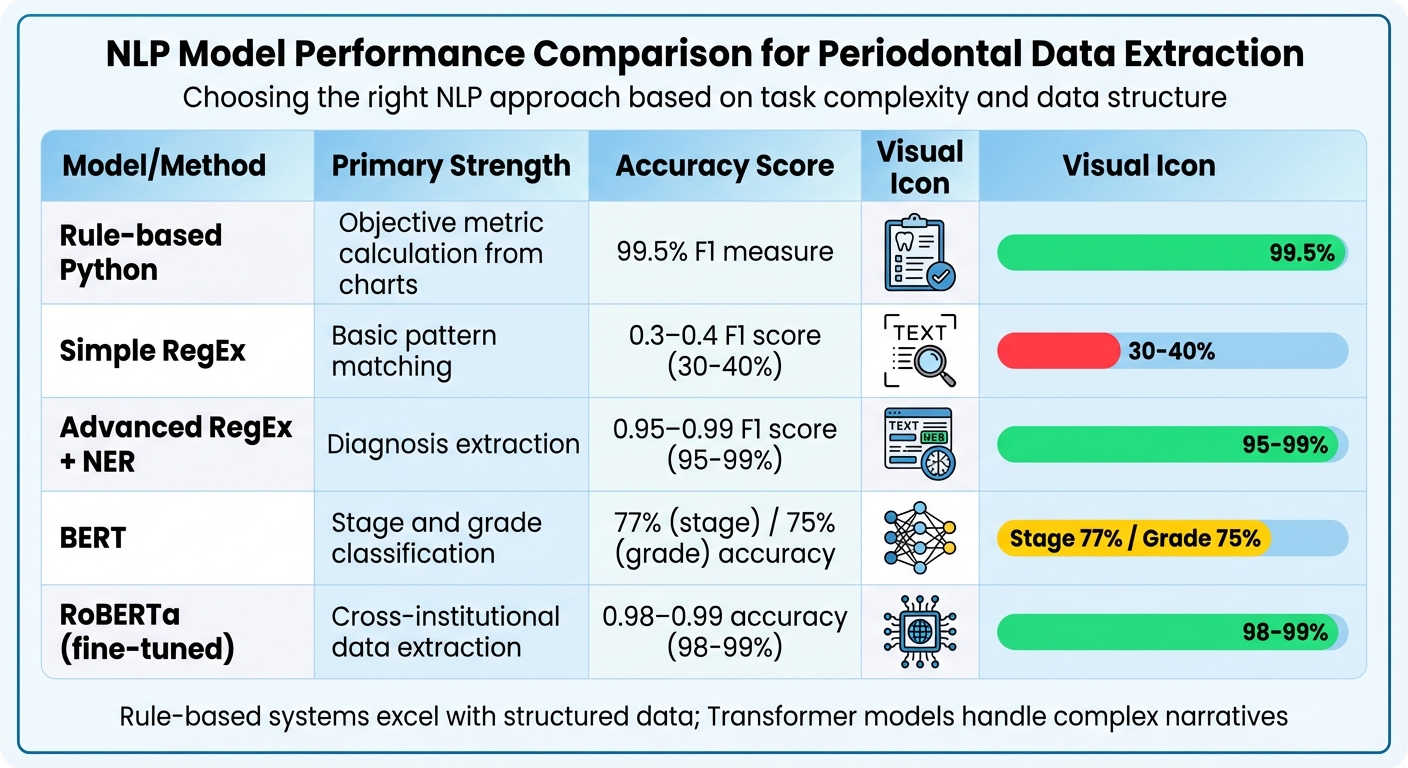
NLP Model Performance Comparison for Periodontal Data Extraction
Advanced NLP techniques are stepping up to address the challenges of organising and analysing periodontal records, offering new ways to manage this complex data.
Natural language processing (NLP) tackles the problem of unstructured clinical notes by transforming them into organised, searchable data. This process not only resolves inconsistencies but also makes clinical workflows more efficient. By extracting key information from the free-text notes dentists write during patient exams, NLP systems bring order to the chaos.
This transformation relies on several distinct NLP methods, each tailored to specific aspects of data extraction.
Key NLP Techniques for Periodontal Records
One of the core techniques is Named Entity Recognition (NER), which identifies and categorises specific dental terms, such as disease names, anatomical locations, and severity markers, within clinical notes. For instance, a study involving 28,908 dental records showed that combining advanced Regular Expressions (RE) with NER achieved an impressive 98% F1 measure in extracting periodontal details [3].
Transformer-based models, like BERT and RoBERTa, take data analysis further by examining words in context – both before and after the target word. Researchers at the University of Alberta, in December 2024, used a BERT-base-uncased model to classify periodontitis stages and grades from 309 anonymised patient charts. The results? The BERT model achieved 77% accuracy for stages and 75% for grades, far outperforming baseline Multi-Layer Perceptron models, which only managed 59.4% and 62.5% accuracy respectively [6].
Synthetic data generation using Large Language Models, such as GPT-4, addresses a common roadblock: the lack of training data due to privacy concerns. A cross-institutional study in June 2025 utilised GPT-4 to create synthetic dental notes for training a RoBERTa model. When tested on 120 clinical notes from two different sites, the model achieved diagnostic extraction accuracy of 0.99 for Site 1 and 0.98 for Site 2 [5]. This approach allows systems to learn from a variety of clinical scenarios without compromising patient privacy.
"Integrating AI and NLP technologies enhances documentation and simplifies administrative tasks by precisely extracting complex clinical information." – Yao-Shun Chuang et al., University of Texas Health Science Centre [5]
Another important tool is error-tolerant matching, which ensures that NLP systems can handle the real-world quirks of clinical notes, such as spelling errors, abbreviations, and inconsistent grammar. Techniques like robust string matching and Levenshtein distance calculations help recognise periodontal terms even when they’re misspelled or formatted inconsistently [3].
Comparing NLP Models for Periodontal Data Extraction
Different NLP approaches excel at different tasks, depending on the nature of the data and the complexity of the task. For example:
- Rule-based systems shine when working with structured data. They achieve a near-perfect 99.5% F1 measure when calculating metrics like bleeding on probing percentage (BOP%) from dental charts [3]. However, they struggle with unstructured, narrative-style notes.
- Simple Regular Expressions are a basic starting point for pattern matching but often fall short, with F1 scores ranging between 0.3 and 0.4. That said, more advanced RE algorithms can push performance up to 0.9 [8]. When combined with NER, these scores can climb even higher, reaching 0.95 to 0.99 for extracting periodontitis diagnoses [8].
- Transformer models, like BERT and RoBERTa, excel in handling complex classification tasks. RoBERTa models, when fine-tuned with synthetic data, consistently deliver top-tier accuracy, maintaining diagnostic extraction scores above 0.98 across different clinical environments [5].
| Model/Method | Strength | Accuracy |
|---|---|---|
| Rule-based Python | Objective metric calculation from charts | 99.5% F1 measure [3] |
| Simple RegEx | Basic pattern matching | 0.3–0.4 F1 score [8] |
| Advanced RegEx + NER | Diagnosis extraction | 0.95–0.99 F1 score [8] |
| BERT | Stage and grade classification | 77%/75% accuracy [6] |
| RoBERTa (fine-tuned) | Cross-institutional data extraction | 0.98–0.99 accuracy [5] |
The choice of model depends on the specific task. Rule-based systems are ideal for structured data, while transformer models like RoBERTa are better suited for understanding complex clinical narratives and adapting to varied dental practices. These advancements in NLP are directly improving clinical accuracy, leading to better patient care outcomes.
sbb-itb-2be92ed
Benefits of NLP in Periodontal Care
The integration of NLP methods into dental care is reshaping how periodontal diagnosis, treatment, and research are approached, offering practical benefits that enhance both efficiency and accuracy.
Improving Diagnostic Accuracy and Efficiency
NLP systems streamline workflows by reducing the need for manual data entry while improving diagnostic precision. For instance, studies show NLP achieves an impressive 98% F-1 measure accuracy when extracting diagnoses from clinical notes. It also identifies diagnostic inconsistencies, with one study revealing that 66% of patients diagnosed with gingivitis under older criteria would now be classified as "healthy" based on updated 2018 standards[3].
Automated dental charting systems powered by NLP algorithms are equally impressive, achieving a 99.0% recall rate and 97.8% precision in extracting clinical details from oral exam transcripts. When compared to human performance, these systems demonstrated 98.4% recall, nearly indistinguishable from the 100% accuracy of human professionals[2]. This level of precision allows dental practitioners to spend less time on administrative tasks and more time focusing on patient care.
Enabling Better Research and Data Reuse
NLP is revolutionising dental research by converting unstructured historical records into structured, analysable datasets. This transformation makes large-scale retrospective studies possible, even when dealing with the complexities of free-text documentation.
"Utilizing longitudinal EDR data to track disease changes over 15 years was a feasible method that could be applied for studying clinical courses using AI and ML methods." – Patel et al., Researchers[6]
The ability to standardise data extraction across different documentation styles is another critical advantage. For example, studies using GPT-4 to generate synthetic dental notes for fine-tuning RoBERTa models achieved accuracy scores of 0.99 at one site and 0.98 at another for assessing periodontal status, stage, and grade[5]. This level of consistency supports high-quality, collaborative research across multiple institutions.
Supporting Clinical Decision-Making
NLP-powered Clinical Decision Support Systems (CDSS) are proving invaluable in identifying at-risk patients earlier by detecting patterns in clinical data that might otherwise go unnoticed. These systems can extract subtle details – such as mentions of smoking or diabetes in patient notes – and use this information to flag individuals who require closer monitoring.
"The utilization of BERT in this context represents a groundbreaking application in dentistry, particularly in CDSS. Our BERT model outperformed baseline models, even with reduced information, promising efficient review of patient notes." – Ameli et al., PLOS Digital Health[6]
Implementing NLP in Dental Practices
After understanding how NLP can enhance periodontal care, the next step is figuring out how to integrate it effectively into dental practices. This process involves careful planning around data quality, model validation, and resource allocation. To support transformer models like BERT or RoBERTa, practices need to establish robust data pipelines that can handle unstructured clinical text from Electronic Dental Records (EDRs) [6]. Beyond these technical requirements, successful implementation hinges on validating the models across different clinical settings.
Cross-Institutional Validation and Scalability
One of the biggest hurdles in NLP adoption is ensuring that models work consistently across various clinical sites, despite differences in documentation styles. For instance, in June 2025, a research team led by Yao-Shun Chuang validated a RoBERTa model using two distinct datasets with 120 clinical notes. The results were impressive: diagnostic accuracy of 0.99 at Site 1 and 0.98 at Site 2 [5].
This validation process highlights an important challenge – dental practices document periodontal findings differently. Some clinicians rely on shorthand, while others favour detailed narratives. Models trained exclusively on data from one source often falter when applied elsewhere. That’s why testing them across diverse environments is so important before full-scale implementation.
Role of Synthetic Data in NLP Development
Another key to successful NLP integration is addressing the challenges of data annotation. Manual annotation can be time-consuming and expensive. This is where generative AI tools like GPT-4 come in handy. By creating synthetic clinical notes, these tools not only speed up the training process but also help mitigate privacy concerns related to sharing sensitive patient records [5].
"Using synthetic training data from LLMs optimises the training process, improving accuracy and efficiency in identifying periodontal diagnoses from clinical notes." – Yao-Shun Chuang et al. [5]
Additionally, practices must consider data imbalances. For example, if Stage III periodontal cases significantly outnumber Stage I cases, models may become biased toward the more frequent diagnosis. Techniques like class weighting can help balance the data, ensuring the system maintains accuracy across all types of periodontal conditions [6].
The Future of NLP in Periodontal Records
The next generation of NLP systems in periodontal care aims to integrate augmented intelligence into Clinical Decision Support Systems (CDSS). This would allow for real-time staging and grading of periodontal conditions, enabling timely interventions and potentially reducing long-term treatment costs [6].
One promising development is voice-activated charting. By converting oral examination transcripts into structured databases, this technology could eliminate the need for manual data entry. Early trials have already shown high levels of accuracy in this area [2].
Another significant advancement lies in multimodal data fusion. This approach combines text extracted through NLP with radiographic images and periodontal charts to create detailed diagnostic profiles. These profiles are expected to enhance clinical assessments by providing a more comprehensive view of a patient’s condition [6][9]. Additionally, generative AI tools are being used to produce synthetic training data, addressing challenges like data scarcity and privacy concerns, especially for rare periodontal conditions [6][9].
In the midst of these technological strides, the Dental Board of Australia underscores an important reminder:
"Regardless of what technology is used to advance healthcare, the practitioner remains responsible for delivering safe and quality care and for ensuring their own practice meets the professional obligations set out in their Code of Conduct"
[9]. Human oversight remains critical to ensure that professional standards are upheld, even as algorithms achieve impressive accuracy rates – 77% for stage prediction and 75% for grade prediction [6].
Looking ahead, there will be a strong focus on explainable AI and strategies to reduce bias. Tools like Local Interpretable Model-Agnostic Explanations (LIME) can help clinicians understand how models arrive at their decisions. This transparency is essential for building trust and ensuring fair outcomes for all patient groups [6][9]. Ultimately, these advancements are designed to support, not replace, clinical judgement, aiming to improve diagnostic consistency while maintaining professional accountability [10]. With these innovations, NLP is set to play a transformative role in managing periodontal data.
FAQs
How is patient privacy protected when NLP is used on dental notes?
Patient privacy in Australia is protected by strict laws, including the Privacy Act 1988 and the Health Records Act 2001. These regulations ensure that sensitive health information is handled with care – securely stored, accessed only by authorised individuals, and used exclusively for legitimate purposes.
On the technical side, measures like encryption, access controls, and audit trails play a key role in safeguarding data. Beyond the technical safeguards, ethical practices are essential. Transparency and obtaining informed consent are crucial when patient data is used, especially with NLP tools, ensuring trust and accountability in every step of the process.
What data quality is required for NLP to work effectively in periodontal records?
For natural language processing (NLP) to work effectively with periodontal records, the data needs to meet a few key criteria: it must be accurate, consistent, and well-organised. This means adopting standardised terminology and maintaining thorough documentation. These steps are crucial for ensuring reliable extraction and analysis of clinical details. When the data quality is high, it becomes possible to gain meaningful insights that can help enhance dental care outcomes.
Can NLP tools integrate with Australian dental practice software and workflows?
Yes, NLP tools can work seamlessly with Australian dental practice software and workflows. They transform unstructured patient records, such as treatment notes, into structured data, making tasks like charting and reviewing patient histories much easier. Tools like voice-to-text software are designed to align with Australian privacy laws and standards, ensuring secure and efficient documentation that meets local requirements.
Related Blog Posts
- AI in Dentistry: Predicting Periodontal Disease
- NLP in Dental Records: Common Applications
- NLP vs. Manual Record Analysis in Orthodontics
- How NLP Improves Dentist-Patient Communication
Important Notice: Any surgical or invasive procedure carries risks. Before proceeding, you should seek a second opinion from an appropriately qualified health practitioner.
Individual results may vary. The information provided in this article is for educational purposes only and does not constitute medical advice.
Checkout Related Blogs




Get in touch with us
For more information, call us now to start feeling better. Or fill the form below to make appointment
The Latest News from Complete Smiles
How to Clean Clear Plastic Retainers
Checklist for Choosing Wearable Dental Devices
Checklist for Choosing Cloud AI Platforms in Dentistry

Complete Smiles Bella VistaAccepts All Major Health Funds, Including





