





NLP vs. Manual Record Analysis in Orthodontics

Orthodontists today face a choice: rely on manual record analysis or leverage Natural Language Processing (NLP) for interpreting patient data. Manual methods are precise and allow for hands-on clinical judgement but are time-consuming and prone to human error. On the other hand, NLP systems process data faster and more consistently, offering tools like automated dental charting and extraction predictions. However, NLP struggles with nuanced clinical information and requires expert oversight.
Key takeaways:
- Manual Analysis: Accurate but slow and labour-intensive. Provides tactile feedback and nuanced insights but risks fatigue-related errors and variability.
- NLP: Processes data in seconds, reduces variability, and scales easily. Yet, it depends on high-quality data and lacks transparency in decision-making.
Quick Comparison
| Feature | Manual Analysis | NLP Analysis |
|---|---|---|
| Processing Time | Hours per case | Seconds to minutes |
| Accuracy | High with expert oversight | High in structured tasks |
| Scalability | Limited by clinician availability | High (batch processing possible) |
| Consistency | Variable (depends on clinician) | Uniform algorithmic output |
| Challenges | Time-intensive, fatigue errors | Requires standardised data |
The best approach? A hybrid workflow. Let NLP handle repetitive tasks like data extraction while clinicians focus on complex decision-making. This balance improves efficiency without compromising clinical quality.
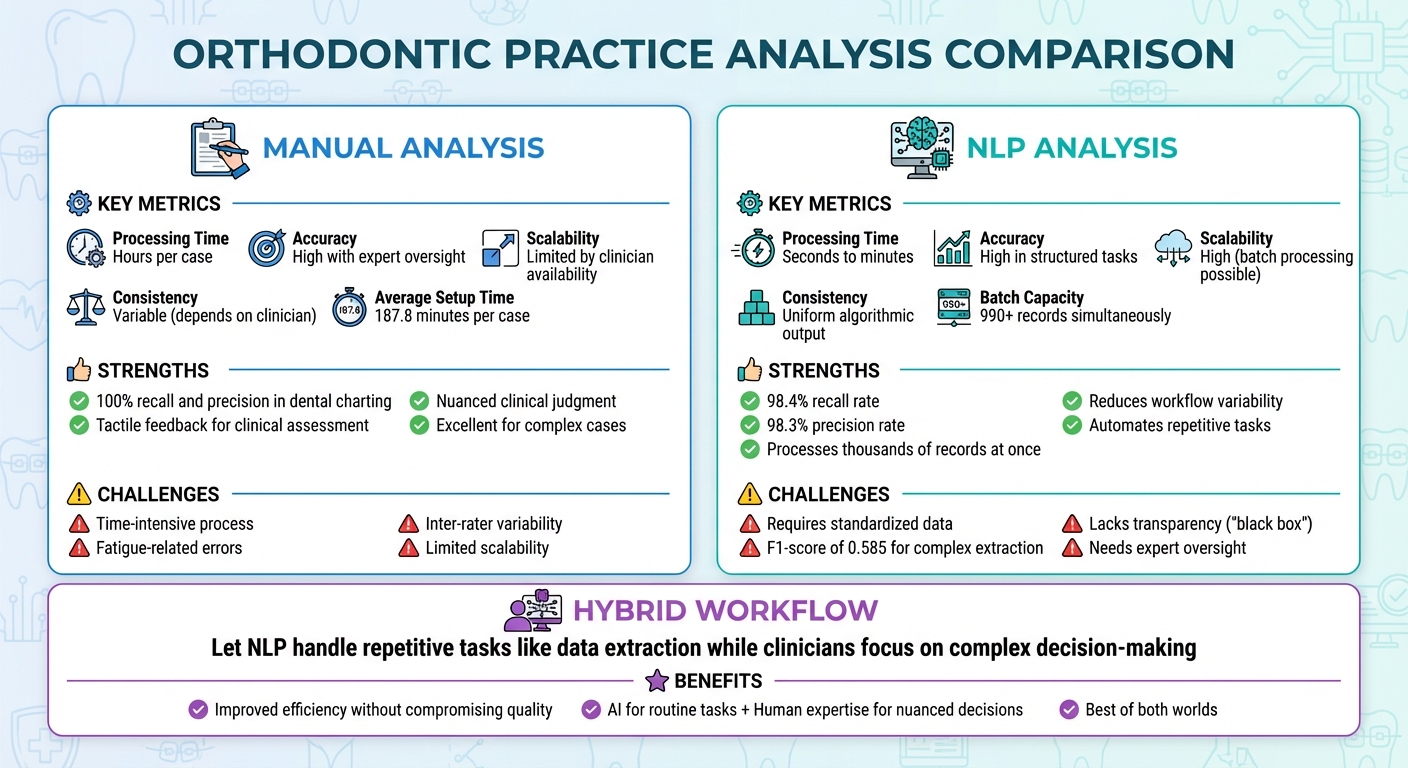
NLP vs Manual Record Analysis in Orthodontics: Efficiency and Accuracy Comparison
Using NLP to curate unstructured electronic health records into research ready datasets
What is Natural Language Processing in Orthodontics
Natural Language Processing (NLP), a field within artificial intelligence, allows computers to understand and interpret human language. In orthodontics, it transforms unstructured text – like treatment notes, medical certificates, and oral exam transcripts – into structured data that clinicians can use for diagnosis and treatment planning [1][5][3].
Instead of manually combing through pages of handwritten or typed notes, NLP systems can automatically pinpoint and extract key details. These systems process clinical documentation much like a human would, but with greater speed and consistency.
"Natural language processing provides promising chances for dentistry, in particular for patient communication." – Martha Büttner and Falk Schwendicke, Charité – Universitätsmedizin Berlin [3]
How NLP Works
NLP analyses clinical notes to identify orthodontic issues, prioritise treatments, and understand patient characteristics that influence care decisions [1].
For example, in May 2019, Kajiwara and colleagues developed an automated orthodontic diagnostic system using 990 medical certificates. The system achieved an F1-score of 0.585 and a 0.584 correlation with human rankings, demonstrating its reliability [1].
Another application is voice-activated dental charting. In May 2021, researchers led by Yifan Zhang at the University of Alabama at Birmingham created an NLP algorithm in JAVA to automate charting from oral exam transcripts. Using 20 simulated oral exams and 4 validation transcripts, the system achieved a recall rate of 98.4% ± 3.2% and precision of 98.3% ± 1.9%, matching the accuracy of human performance [5].
"The natural language processing algorithm potentially serves as a starting point to implement speech recognition for a voice-activated automatic dental charting system." – Yifan Zhang, School of Dental Medicine, Southern Illinois University [5]
These advancements not only streamline data processing but also improve clinical decision-making, opening doors to practical applications in orthodontic care.
Uses in Orthodontic Practice
With its ability to extract and organise data efficiently, NLP supports orthodontists in various ways. For instance, it helps identify malocclusions by analysing patient histories and clinical notes to highlight specific orthodontic concerns [2]. It can also prioritise cases based on urgency or complexity, as identified in medical certificates [1].
When it comes to predicting treatment outcomes, NLP acts as a decision-making aid. It can assist in determining whether a patient may need tooth extractions or orthognathic surgery [6][2]. Tools like Bola AI use NLP to transcribe patient notes into standardised formats for records and insurance claims, reducing manual data entry and allowing clinicians to dedicate more time to patient care [9].
In dental charting, a specialised NLP algorithm has demonstrated a recall rate of 99.0% ± 3.3% and precision of 97.8% ± 4.1% [5]. This level of accuracy makes it an invaluable tool for managing patient records in busy orthodontic practices, where streamlining documentation can significantly enhance efficiency and patient interaction.
Manual Record Analysis in Orthodontics
Manual record analysis represents a traditional, hands-on approach where orthodontists rely heavily on their clinical expertise to assess patient documentation. This process starts with collecting detailed diagnostic records, which include patient history, clinical examinations, plaster study models, and radiographs [11][14]. Orthodontists then manually measure mesiodistal tooth widths, arch length, and arch width, performing specific analyses like the Bolton analysis to evaluate tooth size proportions and the Angle classification to assess sagittal dental relationships [13].
This method demands a significant time commitment. On average, manual diagnostic setups take about 187.8 minutes per case. Orthodontists typically duplicate pretreatment study models using alginate, cast them in plaster, and then physically cut and rearrange plaster teeth in wax dental arches to simulate treatment objectives [10]. To ensure precision, practitioners use standardised tools throughout the process [10]. While this approach is thorough, it stands in stark contrast to the speed and consistency offered by modern digital methods like NLP.
"Manual diagnostic setup is time consuming with a technique-sensitive laboratory procedure." – Sherwet Shakr, Orthodontic Department, Ain Shams University [10]
Benefits of Manual Analysis
Despite its labour-intensive nature, manual analysis remains a cornerstone of orthodontic practice, offering orthodontists the ability to apply nuanced clinical judgement to complex cases [15]. One unique advantage is the tactile feedback it provides. For example, orthodontists can physically assess occlusal contacts, such as cusp-fossa relationships and structural configurations, in ways that digital tools cannot replicate [10]. This hands-on approach also allows practitioners to evaluate muscle activity – like the roles of the tongue, lips, and cheeks – and its influence on structural configurations, a critical factor in understanding and addressing malocclusions [12].
Manual charting has been shown to achieve exceptional accuracy, with validation studies reporting 100% recall and precision in data extraction [5]. Additionally, the ability to provide clinical "explainability" for diagnostic decisions makes manual analysis particularly valuable in borderline cases where precise measurements and clinical experience are crucial for effective treatment planning [15].
Drawbacks of Manual Analysis
While manual analysis excels in precision and clinical insight, it comes with notable challenges. The process is time-consuming, routinely exceeding 187 minutes per case, which can limit the number of patients a practitioner can manage efficiently [10][15]. Handling large volumes of patient records also increases the risk of fatigue-related errors, further highlighting the inefficiencies of manual methods [13].
Inter-rater variability, though relatively low, remains a concern. For instance, even with a high agreement rate (Cohen’s kappa = 0.87) for crowding classification, discrepancies can still arise [15]. Additionally, manual notetaking and record-keeping often lack standardisation, making it harder to consolidate data for long-term analysis or broader practice reviews. Another drawback is the potential for errors during the setup process, such as tooth breakage, which has been recorded at a rate of 0.71% across 1,680 teeth during manual diagnostic setup construction [10].
Furthermore, manual methods may not achieve the same level of precision as digital alternatives. For example, the total ABO Cast Radiograph Evaluation (CRE) score for manual setups averages 13.08, which suggests they are less precise in achieving optimal alignment and occlusal goals compared to digital methods [10].
Efficiency Comparison: NLP vs Manual Analysis
When it comes to processing speed, the gap between NLP and manual methods is hard to ignore. Manual analysis demands significant time, often ranging from minutes to hours per patient. Orthodontists must carefully review clinical histories, study models, and radiographs in detail. On the other hand, NLP systems can deliver results in seconds or minutes. This streamlined process allows clinicians to dedicate more time to refining treatment plans instead of getting bogged down by data extraction and initial analysis.
Scalability is another area where NLP stands out. Manual record analysis depends heavily on staff hours, which means that handling a larger patient load requires more resources and clinician time. NLP systems, however, can process thousands of records simultaneously. For instance, a 2019 study demonstrated an NLP system processing 990 certificates in a single batch – a scale that’s simply unachievable through manual methods [1].
"These systems can simplify the tasks and provide results in quick time which can save the dentist time and help the dentist to perform his duties more efficiently." – Sanjeev B. Khanagar et al., Journal of Dental Sciences [2]
This boost in efficiency also transforms the day-to-day workflow. NLP can automate repetitive tasks like note-taking and remote monitoring [4][16]. In CAD/CAM workflows, orthodontists can dictate appliance instructions instead of manually designing them, freeing up time to focus on perfecting the final designs [16]. This shift not only speeds up processes but also helps reduce treatment delays and tackle long patient waiting lists often associated with traditional manual workflows.
Efficiency Measurements
| Efficiency Measurement | Manual Record Analysis | NLP/AI Analysis |
|---|---|---|
| Processing Time | Minutes to hours per patient | Seconds to minutes |
| Scalability | Limited by clinician availability | High (processes thousands at once) [1][2] |
| Processing Capacity | Constrained by human work hours | Nearly unlimited (batch processing) |
| Workflow Speed | Slower due to manual tasks | Faster through automation [16] |
| Variability | High (depends on clinician judgment) | Low (consistent algorithmic output) [7] |
While NLP significantly speeds up analysis and reduces variability, it still requires expert oversight. Its accuracy and reliability, while improving, have not yet consistently surpassed expert clinicians in all diagnostic areas [7]. For now, NLP systems are best used as tools to enhance workflows rather than replace human decision-making entirely.
sbb-itb-2be92ed
Accuracy Comparison: NLP vs Manual Analysis
When it comes to balancing diagnostic precision with workflow efficiency, comparing the accuracy of NLP (Natural Language Processing) and manual analysis is essential. Both methods excel in diagnostic accuracy but with distinct strengths. Research from Southern Illinois University’s School of Dental Medicine reveals that NLP algorithms can match human expertise in extracting data from dental transcripts. Validation tests showed NLP achieving a recall of 98.4% ± 3.2% and a precision of 98.3% ± 1.9%, closely aligning with manual analysis standards [5].
"Natural language processing algorithm performs comparably with humans." – Yifan Zhang, School of Dental Medicine, Southern Illinois University [5]
Beyond the numbers, one of NLP’s standout advantages is its consistency. Unlike manual analysis, which can be influenced by subjectivity and fatigue, NLP applies algorithmic logic uniformly. For instance, clinicians may interpret cephalometric landmarks differently or miss subtle details after long hours of work. In contrast, NLP systems deliver standardised results regardless of time or workload [7][8].
That said, NLP isn’t without its limitations. It struggles with extracting nuanced clinical information, as demonstrated by an F1-score of 0.585 when analysing 990 certificates for orthodontic problem extraction [1]. This highlights the importance of using NLP as a tool to support, rather than replace, expert judgement. For broader diagnostic tasks, AI tools have shown impressive accuracy, with rates of 97.1% for detecting dental caries and 97.6% for identifying dental restorations on X-rays [9].
Accuracy Measurements
To provide a clearer comparison, here’s a breakdown of key performance metrics:
| Metric | NLP Algorithm | Manual Analysis | Task Description |
|---|---|---|---|
| Recall (Sensitivity) | 98.4% ± 3.2% [5] | 100% [5] | Dental charting validation |
| Precision | 98.3% ± 1.9% [5] | 100% [5] | Dental charting validation |
| F1-Score | 0.585 [1] | N/A | Orthodontic problem extraction |
| Caries Detection | 97.1% [9] | Variable | Diagnostic accuracy |
| Restoration Detection | 97.6% [9] | Variable | X-ray analysis |
While NLP achieves near-human accuracy in structured tasks and minimises variability in results, its true value lies in complementing clinical workflows rather than replacing human expertise [7][8].
Challenges and Opportunities for NLP in Orthodontics
NLP Limitations
While NLP has shown promise in structured tasks, its application in orthodontics comes with several hurdles. One major issue is the lack of standardised, high-quality data. Orthodontic clinical notes are often inconsistent, making it tough for machine learning models to perform reliably. Without access to robust, pooled datasets, NLP models struggle to adapt to various clinical environments and diverse patient groups [4].
Another significant limitation lies in handling unstructured data. Extracting relevant information from free-form medical certificates or specialised orthodontic terminology remains a challenge. For example, one study reported an F1-score of just 0.585 when processing such data [1], highlighting the difficulty in achieving accurate results.
Then there’s the issue of transparency. NLP algorithms often operate as "black boxes", making it hard to understand or explain their predictions. This raises accountability concerns, as Paul Hellyer, a retired GDP and clinical teacher, points out:
"The algorithms themselves are unable to explain their modelling and predictions, leading to potential difficulties of accountability if the modelling is not reviewed by a clinician" [4].
Bias is another critical concern. Models trained on specific demographics can produce skewed results. For instance, AI systems predominantly trained on European populations might misinterpret skeletal relationships in Asian patients, such as incorrectly classifying Steiner’s ANB angle [17].
These limitations highlight the need for a collaborative approach to overcome these barriers.
Combined Approaches
To tackle these challenges, a "human-in-the-loop" approach could be the way forward. By combining NLP with clinical expertise, orthodontists can let AI handle routine data extraction while they focus on complex decision-making and patient interactions [4].
For example, NLP outputs can streamline data processing, enabling faster workflows without compromising clinical accountability. Orthodontists can then review and validate these outputs, ensuring accuracy and reliability.
This collaboration also addresses the issue of standardisation. As clinicians refine how they input and organise data, they create more consistent records. Over time, this improves the performance of machine learning models [4]. Essentially, this partnership blends the efficiency of automation with the nuanced judgment of experienced professionals, striking a balance between speed and precision.
Choosing the Right Approach for Orthodontics
When deciding between NLP-powered tools and manual methods in orthodontics, it’s not about picking one over the other – it’s about recognising their strengths. AI tools stand out for their speed and consistency, while manual analysis remains the benchmark for handling complex treatment plans. Research makes it clear: AI can simplify repetitive tasks, but skilled clinicians are irreplaceable when it comes to making nuanced decisions [7].
A hybrid workflow strikes the right balance. Let AI handle the initial groundwork – extracting data, pinpointing cephalometric landmarks, and managing routine documentation. Then, clinicians can step in for the critical tasks: interpreting diagnostics and crafting treatment plans. This approach not only preserves clinical quality but also significantly reduces the time spent on administrative tasks [7][18].
It’s all about using the right tool for the right job. AI shines in high-volume tasks like airway segmentation, assessing skeletal maturity, or creating initial charts. Meanwhile, manual oversight is indispensable for patient-specific, intricate cases. As Specialist Periodontist Reena Wadia aptly puts it:
"At all moments, human supervision remains essential" [7]
To make hybrid workflows even more effective, practices should focus on standardising documentation. Consistent clinical notes and structured templates allow NLP algorithms to process information more effectively [4]. Over time, this creates a feedback loop: better data leads to better AI performance, which, in turn, benefits clinicians even more.
The future of orthodontic record analysis lies in collaboration. By blending AI’s efficiency with human expertise, practices can speed up processes without sacrificing the clinical precision and care that patients expect.
FAQs
What are the benefits of using natural language processing (NLP) instead of manual methods to analyse orthodontic records?
Using natural language processing (NLP) to examine orthodontic records brings a host of benefits compared to traditional manual methods. For one, NLP can process vast amounts of patient data in just minutes, significantly cutting down the time clinicians spend combing through records. What might take hours manually can now be done in a fraction of the time.
Another key advantage is its ability to produce consistent and precise results, often rivaling or even surpassing human accuracy. By standardising how unstructured notes are interpreted, NLP minimises the chance of human error. This not only ensures reliable treatment prioritisation but also allows clinicians to handle more records efficiently. The time saved can be redirected towards direct patient care, while the data analysed provides evidence-based insights – all without sacrificing accuracy or safety.
How does natural language processing (NLP) compare to manual methods for analysing orthodontic records?
Natural language processing (NLP) provides an efficient, automated way to analyse orthodontic records by interpreting free-form text and pulling out key clinical details, like malocclusion types or patient-specific factors. Research indicates that NLP can deliver accuracy levels comparable to human performance when working with structured data, making it a valuable tool for handling large volumes of records quickly.
That said, NLP can face challenges when dealing with inconsistent or poorly formatted notes. In these cases, manual review still outshines automation, as it’s better at picking up on subtle nuances. While manual methods are slower and more susceptible to errors caused by fatigue, they remain the go-to approach for interpreting highly variable or unstructured information.
NLP shines as a tool for improving efficiency and precision in orthodontic record analysis, especially when documentation is consistent and well-organised.
Can combining NLP and manual analysis enhance orthodontic record review?
A blended method that integrates natural language processing (NLP) with hands-on analysis can greatly enhance how orthodontic records are reviewed. NLP tools are capable of swiftly pulling out critical information from patient files, such as types of malocclusion, missing teeth, or specific treatment limitations. This allows orthodontists to dedicate more time to specialised clinical judgement and decision-making.
Although NLP systems can make processes quicker and more efficient, their outputs still need to be checked by a qualified clinician. This ensures accuracy and helps resolve any uncertainties. Studies indicate that AI-supported workflows can rival – or even outperform – traditional methods in diagnostic accuracy and speed. However, expert involvement is crucial to address concerns like data bias and privacy. Clinics like Complete Smiles Bella Vista can leverage NLP to handle routine tasks more efficiently while upholding the professional care standards essential for patient-focused treatment.
Related Blog Posts
- AI vs. Traditional Methods: Impacted Teeth Detection
- How Machine Learning Analyses Orthodontic Cases
- NLP in Dental Records: Common Applications
- AI-Powered Orthodontics: Cost vs. Efficiency
Important Notice: Any surgical or invasive procedure carries risks. Before proceeding, you should seek a second opinion from an appropriately qualified health practitioner.
Individual results may vary. The information provided in this article is for educational purposes only and does not constitute medical advice.
Checkout Related Blogs




Get in touch with us
For more information, call us now to start feeling better. Or fill the form below to make appointment
The Latest News from Complete Smiles
How to Clean Clear Plastic Retainers
Checklist for Choosing Wearable Dental Devices
Checklist for Choosing Cloud AI Platforms in Dentistry

Complete Smiles Bella VistaAccepts All Major Health Funds, Including





