





How to Calibrate Dental Equipment

Calibrating dental equipment ensures accuracy, safety, and compliance with Australian standards. It helps maintain optimal performance for devices like autoclaves, X-ray machines, and handpieces. Here’s what you need to know:
- Autoclaves: Must be calibrated annually (or more frequently for heavy use). Key steps include inspecting components, verifying sensors, and conducting physical and microbiological tests.
- X-ray Machines: Require annual compliance testing under ARPANSA codes to ensure correct radiation doses and patient safety.
- Handpieces: Regular checks for speed, torque, and lubrication are essential. Professional servicing is recommended for precise calibration.
Compliance with standards like AS/NZS 3551 and AS 5369:2023 is mandatory for accreditation and avoiding legal issues. Detailed records of calibration and servicing are critical for audits. Regular calibration not only ensures safety but also prolongs equipment lifespan.
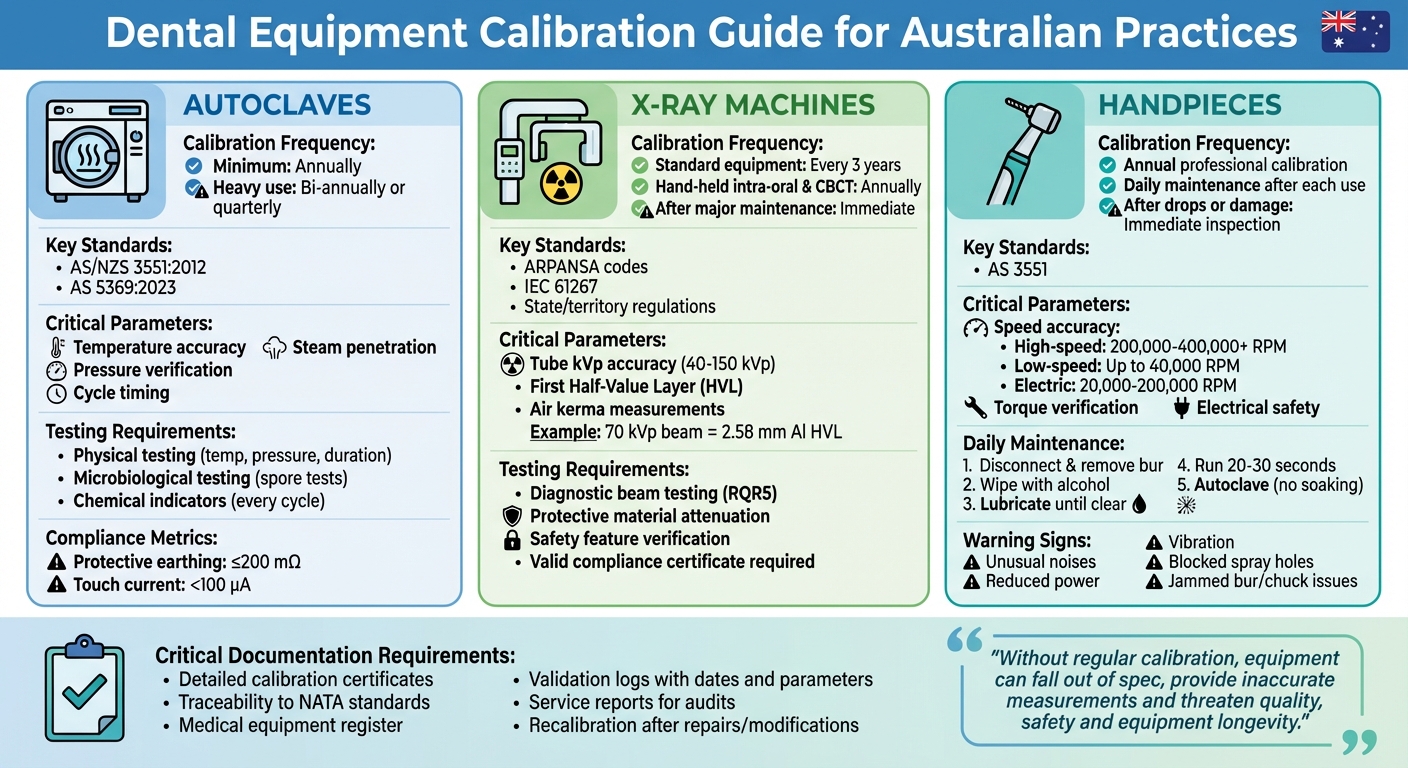
Australian Dental Equipment Calibration Requirements and Frequencies
Legal Requirements and Calibration Standards in Australia
Key Australian Standards for Dental Equipment
In Australia, AS/NZS 3551:2012 is the go-to standard for managing medical equipment in dental practices. It focuses on performance verification, including physical, functional, and electrical testing, ensuring that devices are safe for clinical use. Unlike the more general AS/NZS 3760 standard, which applies to "test and tag" procedures for standard electrical appliances, AS/NZS 3551 imposes stricter requirements. For instance, protective earthing resistance must not exceed 200 mΩ, and touch current must stay below 100 µA [7]. These precise benchmarks form the foundation for the routine calibration checks discussed later.
The recently updated AS 5369:2023 standard now oversees the reprocessing of reusable medical devices, such as sterilisation equipment. It replaces older guidelines like AS/NZS 4815 and AS/NZS 4187, offering updated protocols for tools like autoclaves and ultrasonic cleaners [8][9]. Additionally, dental X-ray equipment must meet ARPANSA codes and specific state or territory regulations. The Australian Radiation Protection and Nuclear Safety Agency (ARPANSA) provides diagnostic and protection-level calibrations through its Primary Standards Dosimetry Laboratory [1].
How Often to Calibrate and Test Equipment
According to these standards, autoclaves must undergo calibration at least once a year. However, for machines with heavy usage, more frequent servicing – such as biannual or even quarterly calibration – may be necessary.
"Australian requirements are to calibrate autoclaves at least once annually. Some autoclaves are used heavily and may require bi-annually, or even quarterly calibration and validation services." – MES Australia [2]
X-ray machines also require annual compliance testing to meet ARPANSA codes and state-specific regulations [1][6]. Similarly, general medical devices must be tested yearly to adhere to AS/NZS 3551 and accreditation standards [6][7]. Keeping a detailed medical equipment register with scheduled reminders can help ensure these intervals are consistently met and all documentation is audit-ready. It’s also essential to recalibrate any equipment immediately after modifications or repairs [2][7].
How to Calibrate Autoclaves
Pre-Calibration Checks
Before starting any calibration, inspect the autoclave’s key components – chamber, seals, filters, sensors, and pumps – to ensure they align with the manufacturer’s specifications. As MES Australia explains:
"During an autoclave service, our engineers will inspect autoclave parts like the filter, seal, sensors, pumps and chambers, ensuring that these are compliant with the manufacturer’s requirements" [2].
Verify that temperature gauges, pressure gauges, and timers are functioning properly. If the autoclave has been repaired or moved to a new location, a comprehensive calibration and validation must be conducted before it is used again in clinical settings [2]. Additionally, confirm that Installation Qualification (IQ) and Operational Qualification (OQ) processes have been completed, as calibration is part of the Performance Qualification (PQ) stage [10].
Once these checks are complete, you can move on to adjusting and verifying the accuracy of the sensors.
Calibration Procedure
Calibration involves comparing the autoclave’s sensors against a NATA-certified standard. Technicians typically use NATA-certified data loggers or the autoclave’s built-in sensors to monitor temperature, pressure, and cycle times during test runs [3][11]. This step ensures the sensors are correctly adjusted to measure the specific ranges needed for proper sterilisation [2].
After confirming the physical parameters, proceed with microbiological validation. This involves two key steps:
- Physical testing: Ensure temperature, pressure, and cycle duration meet the required specifications.
- Microbiological testing: Use biological indicators (spore tests) to confirm the autoclave can effectively eliminate resistant bacterial spores [3].
To further verify the process, chemical indicators should be included in every sterilisation cycle. These indicators confirm steam penetration into packs or trays during the cycle [3].
Documentation and Reporting
Proper documentation is critical. Create a calibration certificate that includes details about what was calibrated, who performed the calibration, when and where it occurred, and the methodology used [11]. Calibration and Testing Services highlights the importance of this process:
"Traceability is the unbroken chain of comparisons from the measurement being made by an instrument, to a recognised national, legal standard" [11].
Your records must demonstrate this traceability and should include the calculated uncertainty of measurement to confirm accuracy [11]. Maintain a detailed validation log that captures the date, calibration status, and key cycle parameters such as temperature, pressure, duration, and steam penetration [2]. These records should be stored alongside your medical equipment register to ensure compliance with regulatory audits and accreditation standards. If any repairs or adjustments were needed to bring the autoclave into specification, document these in the annual servicing report [5].
How to Calibrate X-ray Machines
Compliance Testing Parameters
X-ray machines in Australia must adhere to ARPANSA codes and Australian Standards. Key metrics include Tube kVp (kilovoltage peak) accuracy, First Half-Value Layer (HVL), and air kerma measurements across different radiation qualities [4][12]. These parameters ensure the machine delivers the correct radiation dose while reducing unnecessary exposure for patients.
Testing typically involves diagnostic X-ray beams ranging from 40 kVp to 150 kVp. For instance, a standard 70 kVp diagnostic beam (RQR5) should yield a First HVL of 2.58 mm Al if the machine is correctly calibrated [4]. The process also evaluates safety features such as the attenuation properties of protective materials, including lead-loaded glass and protective aprons [1]. All measurements are benchmarked against the IEC 61267 international standard to maintain precision [4].
Additionally, all X-ray equipment must hold a valid compliance certificate [12].
Using Traceable Standards for Calibration
Calibration depends on equipment traceable to national standards maintained by ARPANSA’s Primary Standards Dosimetry Laboratory (PSDL) [1][4]. This traceability ensures a seamless chain of comparisons from your X-ray machine to Australia’s primary radiation measurement standard.
To ensure proper calibration, service providers must use instruments with up-to-date NATA or ARPANSA calibration certificates [1][4]. The calibration should align with the specific radiation qualities used in dental diagnostics, such as the RQR series for general radiography [4]. This method not only meets ARPANSA codes but also complies with state-specific safety requirements [1]. Following this standard ensures that recalibration occurs promptly after any significant maintenance.
When to Recalibrate After Maintenance
Recalibration is essential following any major maintenance to confirm the equipment remains within safe operational parameters. According to guidelines [13]:
"Ensure that routine tests are carried out as part of your practice’s quality assurance programme and following any major maintenance" [13].
Service engineers are required to provide a detailed report outlining any changes that might impact radiation dose or image quality [13]. If the report indicates alterations to radiation output, it’s important to consult a Radiation Protection Adviser to determine whether immediate recalibration is necessary [13].
Routine performance testing is required at least every three years for standard X-ray equipment. However, hand-held intra-oral X-ray devices and CBCT equipment must undergo annual testing [13]. Immediate recalibration is also necessary if quality assurance checks reveal significant performance issues or if patient doses exceed diagnostic reference levels [13].
sbb-itb-2be92ed
How to Calibrate Handpieces and Other Dental Devices
After tackling autoclave and X-ray calibration, it’s equally important to focus on handpieces and other dental devices. Proper maintenance ensures they operate safely and effectively.
Basic Checks for Handpieces
Calibrating handpieces involves checking critical performance metrics like speed, torque, and electrical safety, all in line with Australian Standard AS 3551 [2]. Here’s a quick breakdown of operating speeds:
- High-speed air-driven handpieces: 200,000 to over 400,000 RPM
- Low-speed models: Up to 40,000 RPM
- Electric models: Between 20,000 and 200,000 RPM [15]
Daily upkeep is just as important as formal calibrations. After each use, follow these steps:
- Disconnect the handpiece and remove the bur while wearing gloves.
- Wipe the exterior with alcohol for surface cleanliness.
- Use an inverted lubricant can to spray until clear, then run the handpiece for 20–30 seconds to distribute the lubricant evenly.
- Autoclave the device, but avoid soaking it to protect seals and prevent rust [14].
"If you want your handpieces to last longer, then the better maintained they are, the longer they will last and cost you less to service and repair." – PHR Handpiece Headquarters [14]
Pay attention to signs of wear or malfunction, such as unusual noises, reduced power, vibration, or blocked spray holes. A jammed bur or a chuck that fails to hold securely may signal the need for turbine or chuck replacement. Even if a handpiece seems fine after being dropped, it’s wise to send it for professional servicing to avoid hidden damage [14].
When these checks reveal performance issues, it’s time to seek professional calibration.
When to Use Professional Servicing
Specialised devices like apex locators, curing lamps, and diagnostic monitors require professional calibration. Accredited laboratories, such as those certified by NATA, use advanced reference equipment in controlled conditions to ensure unmatched precision. This level of accuracy isn’t achievable through basic in-house checks. For compliance, all calibrations must maintain an unbroken chain of comparison back to recognised national standards [11].
Most dental clinics follow an annual calibration routine, with services typically taking 7–14 days. Always recalibrate and validate equipment after major repairs to confirm it meets the manufacturer’s specifications [2]. If you use automated cleaning and lubricating machines, ensure they’re serviced according to the manufacturer’s guidelines to prevent handpiece failures [14].
Conclusion
Regular calibration plays a crucial role in ensuring patient safety while also prolonging the lifespan of medical equipment. It guarantees that devices meet industry benchmarks and provide precise diagnostic results [16].
In essence, calibration serves as the link between routine maintenance and technical accuracy. It goes beyond basic upkeep by verifying that equipment performs as intended. For instance, calibrating an autoclave ensures proper sterilisation, while X-ray calibration helps manage radiation levels safely [3][2][1].
"Without regular calibration, equipment can fall out of spec, provide inaccurate measurements and threaten quality, safety and equipment longevity." – Royal New Zealand College of General Practitioners [5]
FAQs
Why is it essential to maintain accurate records of dental equipment calibration?
Maintaining precise calibration records is essential for keeping dental equipment in line with Australian safety and performance standards. These records serve as proof of compliance with regulations, enhance patient safety, and are invaluable during audits.
By keeping a detailed history of calibrations, dental practices can spot potential problems early, reduce equipment downtime, and ensure the consistent performance of crucial tools like autoclaves, X-ray machines, and handpieces. This approach not only protects patients but also reinforces the high professional standards required in Australian healthcare.
What steps should be taken if an autoclave or X-ray machine fails calibration?
If an autoclave or X-ray machine doesn’t pass its calibration, it’s crucial to take it out of service right away to protect both patients and staff. The next step is to have the equipment inspected and repaired by a qualified technician. Once the repairs are done, the machine must go through re-calibration and validation to ensure it meets the necessary standards before it’s safe to use again in a clinical environment.
Sticking to regular maintenance routines and calibration schedules can go a long way in avoiding these problems and keeping your dental equipment operating smoothly.
How often should dental handpieces be calibrated by a professional?
Dental handpieces need professional calibration at least once a year to keep them running smoothly and safely. This routine maintenance not only ensures they perform at their best but also helps extend their lifespan and safeguards patient well-being during procedures.
If your practice relies heavily on these tools, you might need to service them more often. Always refer to the manufacturer’s instructions and seek advice from a qualified technician for tailored recommendations.
Related Blog Posts
- Dental Equipment Inspection: Key Requirements
- Australian Standards for Dental Tool Disinfection
- Sterilisation Monitoring: Australian Standards Explained
- Checklist for Sterilisation Competency in Dental Clinics
Important Notice: Any surgical or invasive procedure carries risks. Before proceeding, you should seek a second opinion from an appropriately qualified health practitioner.
Individual results may vary. The information provided in this article is for educational purposes only and does not constitute medical advice.
Checkout Related Blogs




Get in touch with us
For more information, call us now to start feeling better. Or fill the form below to make appointment
The Latest News from Complete Smiles
How to Clean Clear Plastic Retainers
Checklist for Choosing Wearable Dental Devices
Checklist for Choosing Cloud AI Platforms in Dentistry

Complete Smiles Bella VistaAccepts All Major Health Funds, Including





