





Guide to Periapical X-rays for Root Canal Therapy
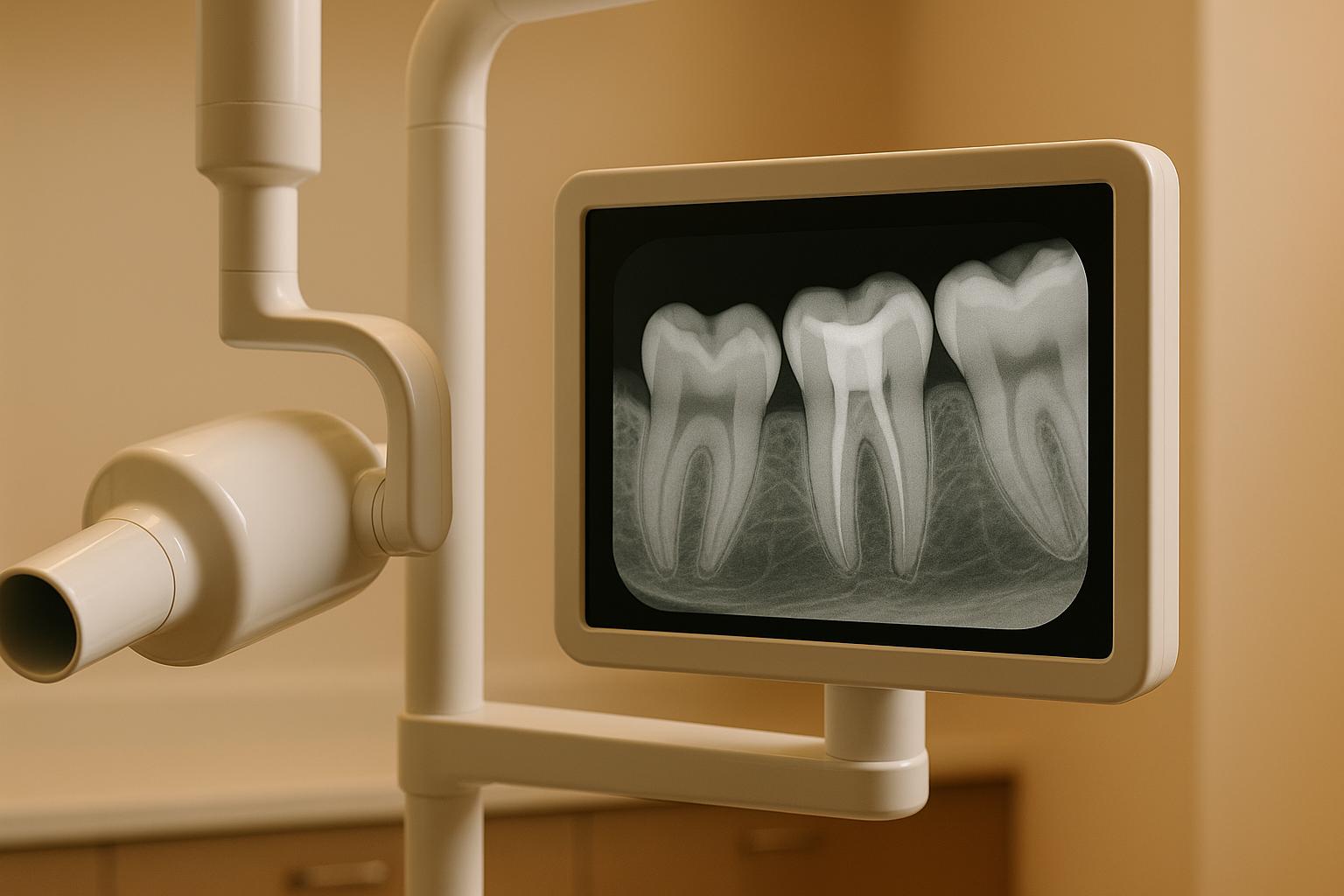
Periapical X-rays are a key diagnostic tool in root canal therapy, providing detailed images of teeth, their roots, and surrounding bone. These X-rays help dentists detect infections, assess root anatomy, and plan treatments effectively. Used before, during, and after treatment, they ensure precision and monitor healing.
Key points about periapical X-rays:
- Purpose: Diagnose and manage root canal issues, including hidden infections and bone loss.
- Procedure: Requires precise alignment for clear images; minimal discomfort for patients.
- Safety: Modern equipment ensures low radiation exposure, following strict Australian guidelines.
- Limitations: Cannot show soft tissue details; advanced imaging like CBCT may be needed for complex cases.
- Best Practices: Digital X-rays reduce radiation and improve efficiency, aligning with safety standards.
These X-rays remain the primary choice for root canal therapy due to their detailed imaging and low radiation risks.
How to Take Dental X-Rays and not Miss The Apex. {Course Lecture}
How Periapical X-rays Help Diagnose Dental Problems
Periapical X-rays provide a deeper look into dental issues that might not be visible during a regular clinical exam. They help identify infections, bone loss, and the internal structure of teeth, making them indispensable for planning root canal treatments.
Detecting Common Dental Problems
When a tooth becomes infected or the infection spreads to nearby tissues, periapical X-rays can reveal key warning signs. For instance, abscesses often appear as darker areas (radiolucent zones) around the tooth root, signalling bone damage caused by the infection. Similarly, bone loss shows up as reduced bone density in the area surrounding the tooth’s tip.
Interestingly, root canal issues don’t always come with clear symptoms. While some patients may feel intense pain, others might not experience any discomfort at all. This makes X-rays a crucial tool in diagnosing these hidden problems. Dentists frequently use periapical X-rays during routine check-ups to monitor tooth health and catch early signs of decay or damage that could lead to more serious issues like root canal infections[7].
Mapping Root Shape and Canal Structure
Understanding a tooth’s internal structure is critical for successful root canal procedures. Periapical X-rays provide detailed insights into the tooth’s anatomy, including the number, length, and shape of its root canals. This helps dentists visualise the complexity of the canal system and tailor their treatment approach accordingly.
The process begins with initial X-rays to confirm the diagnosis and measure root lengths. Additional images are taken during treatment to guide instrument placement and ensure precision. These X-rays allow dentists to see the root canal space, the surrounding bone, and even the periodontal ligament, enabling them to create a thorough treatment plan that covers all aspects of the tooth’s internal structure[9].
What Periapical X-rays Cannot Show
Despite their usefulness, periapical X-rays have limitations. They aren’t always accurate for every condition and can’t effectively capture soft tissue details or differentiate between certain complex pathologies. Subtle differences in imaging can sometimes lead to misdiagnoses, such as mistaking reversible pulp inflammation for more serious issues or misinterpreting the nature of periapical lesions[2].
When lesions fail to heal properly after treatment or display unusual features on X-rays, further investigation may be needed. This could involve a biopsy or complete excision to clarify the diagnosis[3]. Dentists are encouraged not to rely solely on X-ray results for treatment decisions. Instead, they should consider clinical symptoms and other diagnostic tools. For particularly complex cases, advanced imaging techniques like cone beam computed tomography (CBCT) can provide more detailed insights[1].
Even with these limitations, periapical X-rays remain the go-to imaging option for routine diagnosis and treatment planning. They offer crucial details while keeping radiation exposure to a minimum.
How to Capture and Read Periapical X-rays
Capturing and interpreting periapical X-rays with precision is essential for successful root canal therapy. The clarity and accuracy of these images directly influence the quality of diagnosis and, ultimately, the treatment’s success. Without properly taken X-rays, delivering effective root canal treatment becomes nearly impossible[8].
Taking Periapical X-rays
Proper patient positioning is key to avoiding image distortion. The patient should sit upright in the dental chair, keeping their head steady. The X-ray sensor or film needs to be placed parallel to the tooth’s long axis, while the radiation beam should be directed perpendicular to the sensor. This setup ensures a clear and accurate image[8]. To maintain this positioning during the procedure, patients often bite gently on a special film holder.
Radiation safety is a top priority during imaging. Dentists use lead aprons and thyroid collars to shield sensitive areas, particularly for children whose tissues are still developing. Modern digital X-ray systems further enhance safety by using significantly lower radiation doses than traditional film-based methods. Once the image is taken, immediate checks are performed to confirm it meets diagnostic standards.
Reading Periapical X-rays
Interpreting periapical X-rays requires a deep understanding of dental anatomy. Dentists carefully examine the crown, root structure, and the number of canals. Darker areas on the X-ray may indicate abscesses or lesions, while changes in bone density can signal infections or periodontal problems. The periodontal ligament is also reviewed for signs of inflammation.
Adjusting the X-ray beam’s angle can help differentiate between normal anatomical features and potential pathology. Taking multiple images from various angles provides a clearer and more complete view of the tooth’s structure[10]. These X-rays also serve as a helpful visual tool for explaining diagnoses and treatment plans to patients.
Using X-rays at Different Treatment Stages
Periapical X-rays play an important role throughout the different stages of root canal therapy, aligning with established diagnostic protocols:
- Before treatment: These X-rays reveal the internal structure of the tooth and map the root canal system, offering critical insight for treatment planning[9].
- During treatment: Working radiographs confirm the root and canal lengths, ensuring cleaning and shaping are performed to the correct depth. Gutta-percha fit X-rays verify proper filling lengths before the canals are sealed[9].
- After treatment: Post-operative X-rays assess the quality of the canal sealing and confirm that all canals have been thoroughly cleaned, disinfected, and sealed. These images should clearly show complete obturation. Follow-up X-rays, typically taken three to six months later, track healing and ensure long-term success.
Compared to panoramic images, periapical X-rays provide a more detailed view, particularly in cases of dental trauma or when evaluating bone loss near the root’s apex or sides. This level of detail is especially valuable for diagnosing periodontal conditions or complex endodontic-periodontal lesions[8].
sbb-itb-2be92ed
Periapical X-rays Compared to Other Dental X-rays
Selecting the right dental X-ray is key to accurate diagnosis and effective root canal treatment. Each type of imaging serves a distinct purpose, and knowing their differences ensures proper treatment planning.
Periapical vs Bitewing and Panoramic X-rays
Periapical X-rays are often regarded as the go-to imaging method for root canal therapy. They capture the entire tooth – from the crown to the root tip – along with the surrounding bone. This level of detail is essential for precise diagnosis and treatment planning [7] [8].
On the other hand, bitewing X-rays focus on the crowns and upper portions of the roots. They are primarily used to detect cavities between teeth rather than for detailed endodontic evaluation. As such, they serve as a supplementary tool rather than a primary one [7] [9].
Panoramic X-rays, meanwhile, provide a broad view of the entire mouth and jaw. While they are great for initial screenings and assessing overall dental health, their lower resolution makes them unsuitable for the fine detail required in root canal work [7] [8].
| Imaging Type | Coverage Area | Detail Level | Use in Root Canal Therapy | Radiation Exposure |
|---|---|---|---|---|
| Periapical X-rays | One to two teeth (crown to root apex) | Very high – full tooth anatomy and tissues | Essential for diagnosis, planning, monitoring | Lower than panoramic/CBCT |
| Bitewing X-rays | Crowns and upper root portions | Moderate – focuses on interproximal areas | Supplementary; not ideal for endodontic work | Lower than periapical |
| Panoramic X-rays | Entire mouth and jaw structures | Low – broad overview without fine detail | Not suitable for detailed root canal work | Higher than periapical |
Periapical X-rays excel in capturing the detail needed to assess dental trauma. They can reveal bone loss around the root tip or sides, making them invaluable for diagnosing combined endodontic-periodontal lesions. Dentists also rely on them to evaluate periapical lesions and cystic formations.
For root canal treatment, dentists often use a mix of bitewing and multiple periapical X-rays taken from various angles. This approach helps assess bone quality and map out root canal pathways. During and after treatment, periapical X-rays are used to monitor progress, check the quality of the root canal filling, and identify any anatomical variations or complications [9] [10].
In more challenging cases, traditional imaging may need to be supplemented with advanced methods.
When to Use Advanced Imaging Methods
While periapical X-rays are typically the first choice for root canal cases, advanced imaging like Cone Beam Computed Tomography (CBCT) may be needed in certain situations. These include cases of suspected pulpal involvement, significant dental trauma, or when a three-dimensional view is required for treatment planning. CBCT is also helpful when persistent periapical pathology doesn’t respond to non-surgical treatment. Since periapical X-rays are two-dimensional, unusual or unresolved lesions might require further investigation, such as a biopsy [3].
Radiation exposure and cost are critical factors in choosing an imaging method. Periapical X-rays usually have a lower radiation dose compared to panoramic X-rays and CBCT, making them a safer and more conservative option for routine endodontic evaluations. Digital systems further reduce radiation exposure, adhering to the ALARA (As Low As Reasonably Achievable) principle.
For most root canal cases, periapical X-rays provide the necessary diagnostic detail at a lower cost and radiation dose. Advanced imaging like CBCT is reserved for cases where the added diagnostic benefit outweighs the increased exposure and expense. Current guidelines recommend periapical X-rays as the primary imaging tool for root canal therapy, with other methods used only for specific clinical needs [3] [4].
Recent Developments and Best Practices in Periapical Radiography
Advancements in technology and updated protocols are shaping the way periapical radiography is performed, helping dental practitioners improve patient care while adhering to Australian standards.
Digital X-rays and Reduced Radiation Exposure
Digital periapical X-rays offer a significant advantage over traditional film-based methods by delivering lower radiation doses and providing enhanced image contrast. These systems allow for immediate image review and easier electronic storage, making them both efficient and effective [5] [1]. This aligns with the ALARA principle (as low as reasonably achievable), a key component of Australian radiation safety standards, which aims to minimise radiation exposure without compromising diagnostic quality [1] [5].
In fact, the Australian Radiation Protection and Nuclear Safety Agency (ARPANSA) underscores the importance of reducing radiation exposure while ensuring diagnostic effectiveness. Digital X-ray systems strike this balance perfectly, often eliminating the need for additional protective measures in most cases. Reflecting these advancements, the American Dental Association has updated its guidelines, no longer recommending routine use of lead aprons and thyroid collars during dental X-rays [5]. However, Australian practitioners should always follow ARPANSA and state-based dental board regulations, which may have specific requirements for radiation protection in clinical settings.
Emerging Diagnostic Imaging Technologies
The landscape of dental radiography is evolving with new diagnostic tools. AI-assisted technologies are beginning to play a role in refining root canal diagnostics by improving the accuracy of measurements like canal lengths and bone density. These tools hold the potential to enhance treatment precision, particularly in root canal therapy. For Australian dental practices, it’s crucial to ensure that any AI-based diagnostic software complies with local regulatory standards and undergoes clinical validation before being incorporated into routine workflows.
Additionally, adjusting the X-ray beam’s angulation remains a fundamental technique for uncovering anatomical details such as root curvatures or overlapping structures, ensuring accurate diagnoses [10].
Adhering to Australian Best Practices
While technology continues to advance, maintaining compliance with Australian best practice standards is non-negotiable. Dental practitioners must ensure that every radiographic examination is justified by its diagnostic value, as outlined by ARPANSA and other local guidelines. Evidence-based protocols dictate that periapical X-rays should be taken pre-operatively, during treatment, and post-operatively, with follow-up intervals customised to the patient’s clinical needs [1] [6]. Proper documentation of these radiographs is not only a clinical necessity but also a legal requirement.
Interestingly, research on endodontic guidelines reveals some variability in recommended follow-up intervals. While two guidelines suggest taking the first review radiograph at six months, one recommends three months, and others provide no specific timeframe [4]. This lack of consensus highlights the need for Australian practitioners to rely on evidence-based recommendations from organisations like the Australian Dental Association or international endodontic societies. Individual patient factors and clinical findings should also guide follow-up protocols.
Clear communication with patients is equally important. Practitioners should explain the necessity of radiographs at various stages of treatment, addressing any concerns about radiation exposure. This transparency not only reassures patients but also reinforces the practice’s commitment to evidence-based care and patient wellbeing.
Conclusion
Periapical X-rays play a crucial role in root canal therapy [8]. They help uncover hidden issues such as decay, infections, or pulp damage that might not be visible otherwise [7]. By using multiple periapical X-rays, dental professionals can accurately diagnose problems, plan treatments, and monitor recovery after the procedure. These images offer essential insights into root canal anatomy and help identify complications like abscesses or bone loss [1][9].
Additionally, advancements in digital X-ray technology have enhanced diagnostic precision while minimising radiation exposure. This aligns with the ALARA principle and meets Australian safety standards [1].
FAQs
What makes periapical X-rays important for root canal treatments, and how do they differ from other dental X-rays?
Periapical X-rays play a key role in root canal therapy by offering detailed images of the entire tooth, including the root tips and the surrounding bone. These images help dentists spot issues like infections, abscesses, or fractures that might not show up on other types of X-rays.
Unlike bitewing X-rays, which are designed to capture the crowns of the upper and lower teeth for detecting cavities, periapical X-rays go deeper. They provide a full view of the root canal system and the tissues around the tooth, delivering the clarity needed for precise diagnosis and effective treatment planning.
How is radiation exposure minimised during periapical X-rays?
Modern dental practices prioritise patient safety by leveraging advanced technology and following strict protocols to reduce radiation exposure during periapical X-rays. One key advancement is the use of digital X-rays, which produce much lower radiation levels compared to traditional film-based methods. To further protect patients, dentists provide shielding gear such as lead aprons and thyroid collars to safeguard sensitive body areas.
Another crucial safety measure is the adherence to the ALARA principle – "As Low As Reasonably Achievable." This approach ensures that only the smallest radiation dose required for obtaining clear diagnostic images is used. These precautions make periapical X-rays a safe and reliable tool for planning treatments, including root canal procedures.
When might a dentist choose advanced imaging like CBCT instead of periapical X-rays for root canal treatment?
While periapical X-rays are a staple in root canal therapy, providing detailed images of the tooth and nearby bone, there are situations where a dentist may turn to cone beam computed tomography (CBCT) for a more in-depth view. CBCT is especially helpful in handling complex cases, such as locating hidden canals, evaluating fractures, or diagnosing problems that standard X-rays can’t fully reveal.
What sets CBCT apart is its ability to deliver a 3D view of the tooth and surrounding structures, making it a powerful tool for planning precise treatments. That said, it’s generally used only when this extra level of detail is absolutely necessary, as it comes with higher costs and increased radiation exposure compared to traditional X-rays.
Related Blog Posts
- How X-Rays Help in Dental Treatment Planning
- How Full-Mouth X-Rays Aid Diagnosis
- CBCT in Endodontics: Accuracy and Limitations
- How Occlusal X-rays Help Detect Oral Issues
Important Notice: Any surgical or invasive procedure carries risks. Before proceeding, you should seek a second opinion from an appropriately qualified health practitioner.
Individual results may vary. The information provided in this article is for educational purposes only and does not constitute medical advice.
Checkout Related Blogs




Get in touch with us
For more information, call us now to start feeling better. Or fill the form below to make appointment
The Latest News from Complete Smiles
How to Clean Clear Plastic Retainers
Checklist for Choosing Wearable Dental Devices
Checklist for Choosing Cloud AI Platforms in Dentistry

Complete Smiles Bella VistaAccepts All Major Health Funds, Including





