





FAQs on Dental Claim Deadlines

Dental claim deadlines are critical for making the most of your health insurance benefits. Missing these deadlines can mean losing unclaimed allowances or having claims denied. Here’s what you need to know:
- Annual Benefit Resets: Most health funds reset dental limits on 1 January, while others use 1 July or your policy anniversary date. Unused benefits don’t roll over.
- Claim Submission Windows: Filing deadlines range from 90 days to 2 years depending on your insurer. Medicare bulk-billed dental claims now have a 1-year limit.
- Timing Matters: Claims are tied to the treatment date, not the submission date. For example, treatments in December 2025 fall under 2025 benefits, even if claimed in January 2026.
- Preventive Care: Regular check-ups not only use your benefits but also help avoid costly treatments later.
To avoid losing benefits:
- Track treatment dates and check your policy’s reset and claim windows.
- Use instant claiming systems like HICAPS to process claims on the spot.
- Plan treatments strategically, especially near reset dates.
Act promptly if you suspect a missed deadline – some insurers may assist with late claims under certain conditions.
Timely Filing Explained: How to Avoid Denied Dental Claims and Lost Revenue
Standard Timeframes for Dental Insurance Claims
In Australia, health funds follow different reset cycles and submission windows, which dictate the deadlines for dental claims. Understanding these timeframes can help you avoid losing benefits or facing claim rejections.
Calendar Year vs Financial Year Deadlines
Most major Australian health funds – such as Medibank, Bupa, HCF, NIB, Australian Unity, GMHBA, CBHS, and HBF – reset their annual dental benefit limits on 1 January each year [2]. Any unused allowances expire at midnight on 31 December.
However, some funds operate on a financial year cycle, resetting on 1 July. These include AHM, Defence Health, Navy Health, Peoplecare, and Onemedifund [2]. Others, like GU Health, Hunter Health, and Queensland Country Health Fund, align their reset dates with the policy anniversary date [2].
It’s important to note that the reset date determines when your new annual limit becomes available, but it does not affect claim submission deadlines. Benefits are tied to the date of treatment. For example, as Beyond Dental Care explains: "Treatments received in December 2025 will be covered by 2025 benefits, even if you claim in January 2026" [2]. This distinction is especially useful when planning for costly procedures.
Individual Policy Claim Windows
Beyond the annual reset, health funds set specific submission deadlines – the time you have to lodge a claim after receiving treatment. The two most common filing windows are:
- Two years from the date of service (used by HCF and nib) [4][7].
- One year, which applies to bulk-billed Medicare dental services.
On 5 September 2025, Medicare tightened its rules for bulk-billed dental claims, reducing the submission window from two years to one year [5]. The Australian Dental Association commented on this change:
Commencing this month [September 2025], bulk-billed Medicare dental claims must be submitted within one year, down from two years, to improve Medicare integrity [5].
For private health insurance policyholders, it’s essential to check your individual terms. While many funds allow up to two years for claim submissions, some have shorter windows ranging from 90 days to 12 months [1]. Claims lodged after these deadlines will be automatically denied, even if you still have unused benefits.
In the next section, we’ll explore how these submission windows align with the reset dates of Australian health funds.
What Happens When You Submit Claims Late
Consequences of Missing Deadlines
Submitting dental claims after the deadline can result in an automatic denial, meaning you lose any chance of reimbursement. In Australia, major health funds like HCF and nib enforce a strict two-year limit from the date of treatment – not the date you submit your claim [4][7]. As nib clearly states:
"Confirm your service is within the past two years. We can’t pay claims after this period." [7]
For instance, if you had a dental crown fitted on 15 March 2023 but waited until April 2025 to lodge your claim, it would be rejected. Health funds generally don’t make exceptions for delays caused by misplaced paperwork or administrative issues.
Timing can also lead to rejections in other scenarios. For example, if you received treatment during a waiting period but submitted the claim after the waiting period ended, the claim will be denied. HCF clarifies:
"This also means that you cannot lodge a claim after the waiting period has ended for a service that was provided within the waiting period." [4]
Additionally, claims may be denied if receipts are incomplete or unclear [7].
Steps to Take for Late Submissions
If you suspect you’ve missed a deadline, act quickly. Contact your health fund immediately. Some insurers, like nib, allow members with suspended or terminated policies to request a special claim form for past services, as long as the treatment occurred while the policy was active and within the standard timeframe [7].
Carefully review the rejection letter – sometimes, claims are denied due to missing information rather than a missed deadline [7].
If your claim was rejected because of a medical assessment, such as a pre-existing condition review, you can request a second review. HCF advises:
"If you do not agree with our medical practitioner’s assessment, you can request a second review to take place. There must be a valid reason and we’ll require additional relevant clinical documentation that was not previously supplied." [4]
To prevent future issues, ensure all receipts are itemised and include your dentist’s provider number. Keep your bank details updated and double-check invoices for accuracy [4][6][9]. If internal reviews don’t resolve the matter, you can escalate your complaint to the fund’s Feedback and Resolutions team or reach out to the relevant ombudsman.
sbb-itb-2be92ed
Australian Health Fund Reset Dates
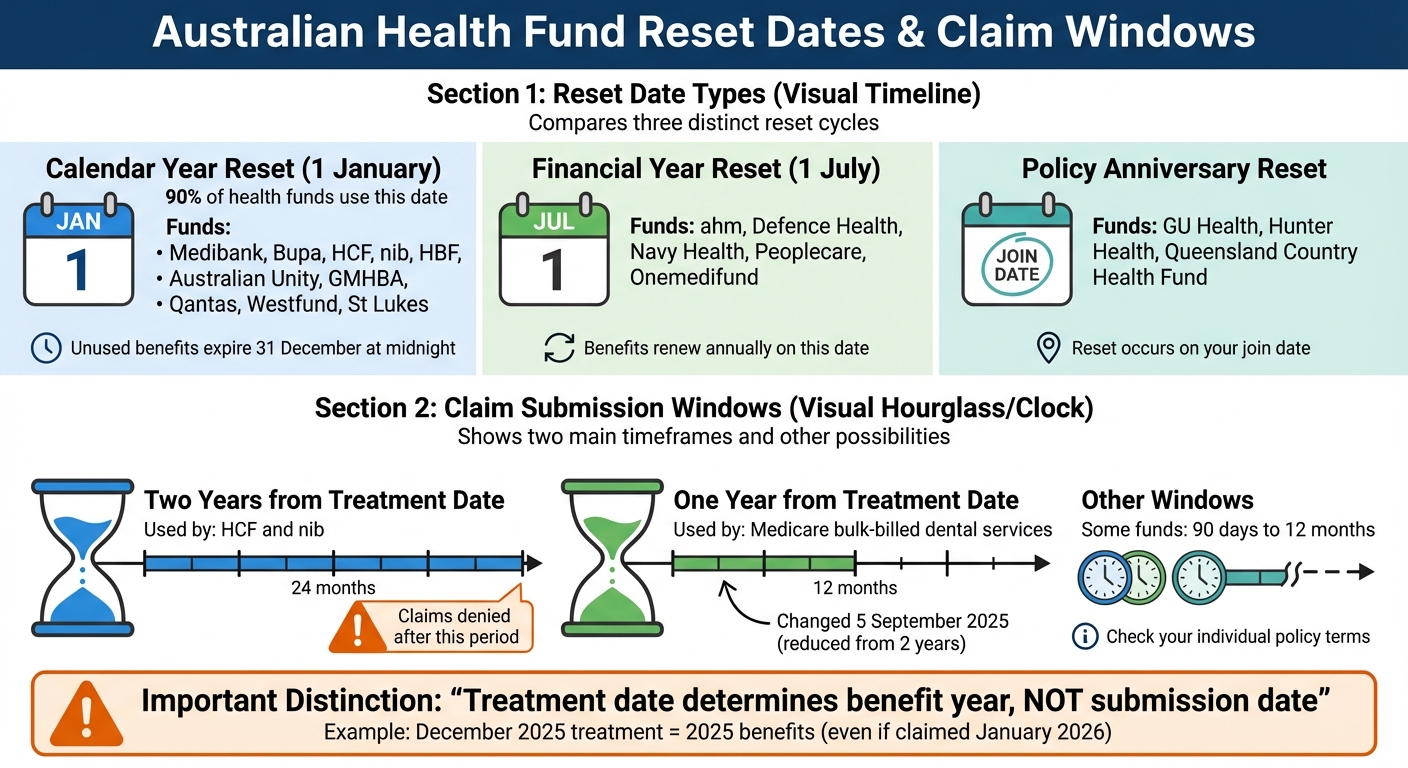
Australian Health Fund Dental Benefit Reset Dates and Claim Submission Windows
Understanding your health fund’s reset dates is crucial for making the most of your dental benefits. These dates dictate when unused benefits expire and when new limits come into effect, so staying informed can help you plan better.
For most Australians, reset dates are straightforward. Approximately 90% of health funds reset on 1 January [2][10]. This includes major providers like Medibank, Bupa, HCF, nib, HBF, Australian Unity, GMHBA, Qantas, Westfund, and St Lukes.
Some funds, however, align their resets with the financial year, starting on 1 July [2][10]. Examples include ahm, Defence Health, Navy Health, Peoplecare, and Onemedifund.
A smaller group of funds uses your policy anniversary – the date you first joined – as the reset point [2]. GU Health, Hunter Health, and Queensland Country Health Fund follow this approach. Keeping track of your policy anniversary is just as important as monitoring standard reset cycles to avoid missing out on benefits.
| Reset Type | Reset Date | Example Health Funds |
|---|---|---|
| Calendar Year | 1 January | Medibank, Bupa, HCF, nib, HBF, Australian Unity, GMHBA, Qantas, Westfund, St Lukes |
| Financial Year | 1 July | ahm, Defence Health, Navy Health, Peoplecare, Onemedifund |
| Policy Anniversary | Your Join Date | GU Health, Hunter Health, Queensland Country Health Fund |
It’s important to note that your reset date doesn’t affect the timeframe for filing claims – it only determines when your benefits renew.
To confirm your reset date, you can check your policy documents, log into your health fund’s mobile app or member portal, or reach out to their customer service team [2][11][12]. Keep in mind that unused benefits typically expire at midnight right before the reset date [2].
How to Use Your Dental Benefits Before Deadlines
Keeping Track of Treatment Dates and Claim Windows
Stay on top of your treatment dates, as most health funds allow claims for services provided within two years [4]. However, delays in submitting claims can mean losing out on benefits when limits reset. To avoid this, use your fund’s app – like My Medibank or HCF My Membership – to monitor your remaining limits and track expiry dates [2][11][12].
Always request an itemised receipt that includes the treatment date, provider number, and service codes [7]. This ensures your claims are processed correctly and helps you keep track of your benefit year. For major treatments, ask for item numbers in advance so you can estimate costs [3][8]. These simple tracking habits can make a big difference in avoiding missed deadlines, as explained further below.
Practical Ways to Avoid Missing Deadlines
Once you’ve got accurate tracking in place, follow these tips to ensure you submit claims on time. Many dental clinics offer instant claiming through systems like HICAPS, which process claims directly at your appointment [3]. By using your physical or digital membership card, your claim is handled immediately, and you only pay the gap amount. To stay organised, set a calendar reminder before your reset date to submit any outstanding claims.
Some health funds even offer 100% back on two check-ups and cleans per calendar year if you visit Members’ Choice or Advantage dentists [8][13]. These preventive services often don’t count toward your general dental annual limit. To make the most of these benefits, book one appointment early in the year and another before December.
"It’s very important to get a claim on file with insurance as quickly as possible. It just avoids a lot of headaches on the back end."
- Jeff Smith, Head of Special Projects, Dental Claim Support [1]
How Dental Clinics Help with Timely Claims
Dental clinics play a key role in ensuring claims are submitted on time. They provide essential details like provider numbers and itemised receipts required by insurers [7]. Many clinics now use electronic claiming systems to send claims directly to your health fund, cutting down on paperwork and processing delays. These systems help you stay within claim windows and avoid last-minute stress.
If you’re planning costly treatments, ask your dentist in November to review your remaining annual benefits and discuss your needs before the 1 January reset [2]. Some clinics can even schedule treatments strategically – for example, starting a crown in December and finishing it in January – to take advantage of two benefit years [2].
At Complete Smiles Bella Vista, the team can assist you in understanding your policy and submitting claims on time. They provide all necessary documentation and offer electronic claim processing where possible, making it easier to maximise your benefits before deadlines. Keep in mind that many dental clinics close for extended periods during the December/January holiday season, so plan your year-end treatments early to avoid missing out [14].
Summary: Understanding Dental Claim Deadlines
Keeping track of dental claim deadlines is crucial to make the most of your benefits. Many health funds, such as HCF, have a two-year window for submitting claims after treatment[4]. If you miss this deadline, you lose access to those benefits permanently. That’s why it’s essential to understand both submission timelines and how annual limits work.
Annual benefit limits operate on a strict "use it or lose it" basis. For most funds, these limits reset on 1 January each year[6][13]. If you don’t use your general dental allowance or claim your annual check-ups before this reset, those benefits won’t carry over into the next year. Orthodontic benefits, like top-ups, follow the same principle, with resets occurring after a 12-month waiting period[6].
Waiting periods are another critical factor. For general dental services, the waiting period is typically two months, while major and orthodontic treatments require a 12-month wait[4]. Claims for services received during these waiting periods won’t be accepted, so it’s important to plan ahead for treatments like crowns, bridges, or braces.
To get the most out of your dental cover, check the reset date for your policy – it could be 1 January, 1 July, or your policy anniversary. Also, review your remaining limits before scheduling major treatments. Ask your dentist for item numbers and use instant claiming systems like HICAPS to avoid manual errors[3][4]. Following these steps ensures you maximise your benefits without falling foul of missed deadlines.
FAQs
What can I do if I’ve missed the deadline to claim for a dental service?
If you’ve missed the deadline to lodge a dental claim, don’t panic – reach out to your health insurer as soon as you can. Let them know what happened and ask if they’re willing to accept a late claim. Make sure you have all the necessary documents ready, like receipts or proof of the treatment date, to support your case.
Some insurers might consider accepting late claims depending on the circumstances, but time is of the essence. Review your policy terms to see what options are available. To avoid this situation in the future, it’s a good idea to stay on top of claim deadlines and keep a record of important dates.
How can I make sure I use my dental benefits before they expire?
To get the most out of your dental benefits, take a moment to review your policy. Check your remaining balance and note the annual reset date, which is often 31 December or 1 January. If you need treatments like check-ups, cleanings, or planned procedures, it’s smart to book them early. Clinics such as Complete Smiles Bella Vista often offer reminders to help you stay organised and secure an appointment in time. Acting now ensures you use your benefits before they reset.
What happens if I submit my dental claim after the deadline?
Submitting a dental claim past the deadline could lead to your claim being denied, as most health funds enforce strict timeframes for submissions. These time limits differ depending on your insurance provider and policy, so it’s crucial to review your specific terms and conditions.
If you happen to miss the deadline, reach out to your health fund promptly. While some providers might make exceptions for late claims under special circumstances, this is not something you can count on. To keep things simple and avoid any issues, it’s always wise to submit your claims soon after receiving dental treatment.
Related Blog Posts
- How to Claim Dental Expenses on Your Tax Return
- Dental Insurance Waiting Periods Explained
- Transparent Dental Pricing Explained
- Ultimate Guide To After-Hours Dental Services
Important Notice: Any surgical or invasive procedure carries risks. Before proceeding, you should seek a second opinion from an appropriately qualified health practitioner.
Individual results may vary. The information provided in this article is for educational purposes only and does not constitute medical advice.
Checkout Related Blogs




Get in touch with us
For more information, call us now to start feeling better. Or fill the form below to make appointment
The Latest News from Complete Smiles
How to Clean Clear Plastic Retainers
Checklist for Choosing Wearable Dental Devices
Checklist for Choosing Cloud AI Platforms in Dentistry

Complete Smiles Bella VistaAccepts All Major Health Funds, Including





