





Digital Dentistry: Compliance with Australian Laws
Digital dentistry is transforming patient care in Australia, but compliance with strict regulations is non-negotiable. Here’s what you need to know:
- Regulatory Bodies: The Therapeutic Goods Administration (TGA) oversees device safety, while the Dental Board of Australia (DBA) and AHPRA regulate practitioner conduct and advertising.
- Device Compliance: Most digital tools (e.g., 3D printers, scanners) must be listed in the Australian Register of Therapeutic Goods (ARTG). Practitioners importing materials directly from overseas are considered "sponsors" and must meet additional obligations.
- Data Privacy: Practices must comply with the Privacy Act 1988, ensuring patient data is securely stored, protected, and accurately maintained.
- Penalties: Breaching advertising rules or importing unregistered devices can result in fines of up to $5,000 for individuals or $10,000 for corporations.
To stay compliant, focus on sourcing ARTG-listed materials, maintaining accurate records, and securing patient data with encryption and regular backups. Non-compliance risks fines, disciplinary actions, and reputational damage.
Key takeaway: Compliance safeguards both patients and your practice’s future. Understand your responsibilities, train your team, and ensure all systems and materials meet Australian standards.
Australian Regulatory Framework for Digital Dentistry
Digital dentistry in Australia is governed by two main regulatory bodies: the Dental Board of Australia (DBA), in collaboration with the Australian Health Practitioner Regulation Agency (AHPRA), and the Therapeutic Goods Administration (TGA). Each plays a distinct role in maintaining patient safety and ensuring professional accountability.
Dental Board of Australia (DBA) and AHPRA Requirements

The DBA establishes the professional standards, codes, and guidelines that registered dental practitioners must follow when incorporating digital technologies into their practices. Together with AHPRA, the DBA ensures that practitioners using these technologies are appropriately trained, qualified, and adhere to clinical and ethical standards.
"As a registered dental practitioner, you have responsibilities to act in accordance with the Board’s standards, codes, and guidelines." – Therapeutic Goods Administration (TGA) [2]
Practitioners are also required to comply with AHPRA’s advertising regulations, which strictly prohibit the use of testimonials, misleading claims, and any content that promotes unnecessary treatments. Breaching these regulations is treated as a professional conduct issue, with penalties reaching up to $5,000 for individuals and $10,000 for corporations [1].
Obtaining informed consent is a critical step when using digital technologies. Patients must fully understand the treatment process and the potential outcomes before agreeing to proceed. Additionally, all staff members operating digital systems must complete training that aligns with DBA and AHPRA standards.
While these guidelines focus on practitioner conduct, the TGA enforces standards for the devices themselves.
Therapeutic Goods Administration (TGA) Device Regulation
The TGA oversees the regulation of digital dental devices, including scanners, 3D printers, software, and materials, classifying them as medical devices. Most of these devices must be listed in the Australian Register of Therapeutic Goods (ARTG) before they can be legally imported or distributed within the country. Even devices exempt from ARTG listing must still meet the TGA’s Essential Principles, which outline mandatory safety and performance requirements.
Practitioners who import digital materials directly from overseas are classified as "sponsors" and must register these products in the ARTG. Those manufacturing devices outside of chair-side operations may fall under the "manufacturer" category, which comes with additional responsibilities. The table below highlights these roles:
| Activity | TGA Regulatory Status | ARTG Inclusion Required? |
|---|---|---|
| Importing materials from overseas | Practitioner is the "Sponsor" | Yes, before import |
| Buying materials from an Australian sponsor | Practitioner is the "User" | No (Sponsor handles it) |
| Manufacturing non-implantable devices (crowns/splints) from ARTG materials | Practitioner is the "Manufacturer" | Exempt (but must meet Essential Principles) |
| Manufacturing implantable devices (e.g., custom abutments) | Practitioner is the "Manufacturer" | Yes, even if using ARTG materials |
The TGA also regulates patient-matched medical devices (PMMDs), such as 3D-printed surgical guides and occlusal splints, under its Personalised Medical Devices Framework. All PMMDs must either be listed in the ARTG or have a valid application submitted by 1 July 2029. Practitioners purchasing digital materials locally should confirm that their Australian suppliers have registered these products in the ARTG to avoid inadvertently taking on sponsor responsibilities. Furthermore, any adverse events involving digital dental devices must be reported to the TGA as part of its ongoing post-market monitoring efforts.
Data Privacy and Cybersecurity Requirements
In the world of digital dentistry, safeguarding patient information is not just a priority – it’s a legal obligation. Under the Privacy Act 1988, dental practices in Australia must adhere to the Australian Privacy Principles (APP). These principles outline how patient data should be collected, stored, used, and ultimately disposed of, whether stored on local servers or in cloud-based systems.
Protecting Patient Data: What APP Requires
APP 11 specifically demands that dental practitioners take all reasonable steps to shield personal information from misuse, interference, loss, and unauthorised access, modification, or disclosure. The level of protection should align with the sensitivity of the data and the potential consequences of a breach. The Office of the Australian Information Commissioner (OAIC) recommends a combination of technical and organisational measures to meet these requirements.
Technical measures include tools like encryption, multi-factor authentication (MFA), and anti-virus software. On the organisational side, practices should focus on staff training, comprehensive privacy policies, and audit trails to ensure data security throughout its lifecycle – even when working with third-party cloud providers.
"An APP entity must take such steps as are reasonable in the circumstances to protect the personal information it holds from misuse, interference and loss, as well as unauthorised access, modification or disclosure." – OAIC
When sharing data overseas, practitioners must ensure that the recipients meet Australian privacy standards. Using locally hosted cloud services can simplify compliance with these requirements.
Other APP principles also shape daily operations. For example:
- APP 6: Limits data use to its original purpose (such as dental treatment) unless patients provide consent or specific exceptions apply.
- APP 10: Requires digital records to be accurate, up-to-date, complete, and relevant.
- APP 1: Mandates practices maintain a transparent and current privacy policy.
- APP 13: Grants patients the right to correct inaccuracies in their records.
Cybersecurity Risks and Responsibilities
Health information is a lucrative target for cyber criminals, with common threats including ransomware, phishing attacks, and insider threats. To counter these risks, practices should conduct regular risk assessments to identify vulnerabilities and evaluate the potential impact of breaches.
Among the most effective defences is multi-factor authentication (MFA), which adds an extra layer of security beyond standard passwords. Regular staff training is equally critical, equipping team members to recognise phishing attempts and understand their role in maintaining cybersecurity. For practices offering teledentistry, additional safeguards like securing virtual waiting rooms, enforcing strong passwords, and using end-to-end encryption for video consultations are essential.
A data breach response plan is another vital tool. This plan should outline clear steps for assessing and responding to suspected breaches, including when and how to notify the OAIC. When disposing of digital equipment, practices must either sanitise the hardware to completely erase patient information or destroy it irretrievably. If destruction isn’t feasible, electronic data must be rendered "beyond use" – isolated from access, use, or disclosure.
sbb-itb-2be92ed
Integrating Digital Systems in Dental Workflows
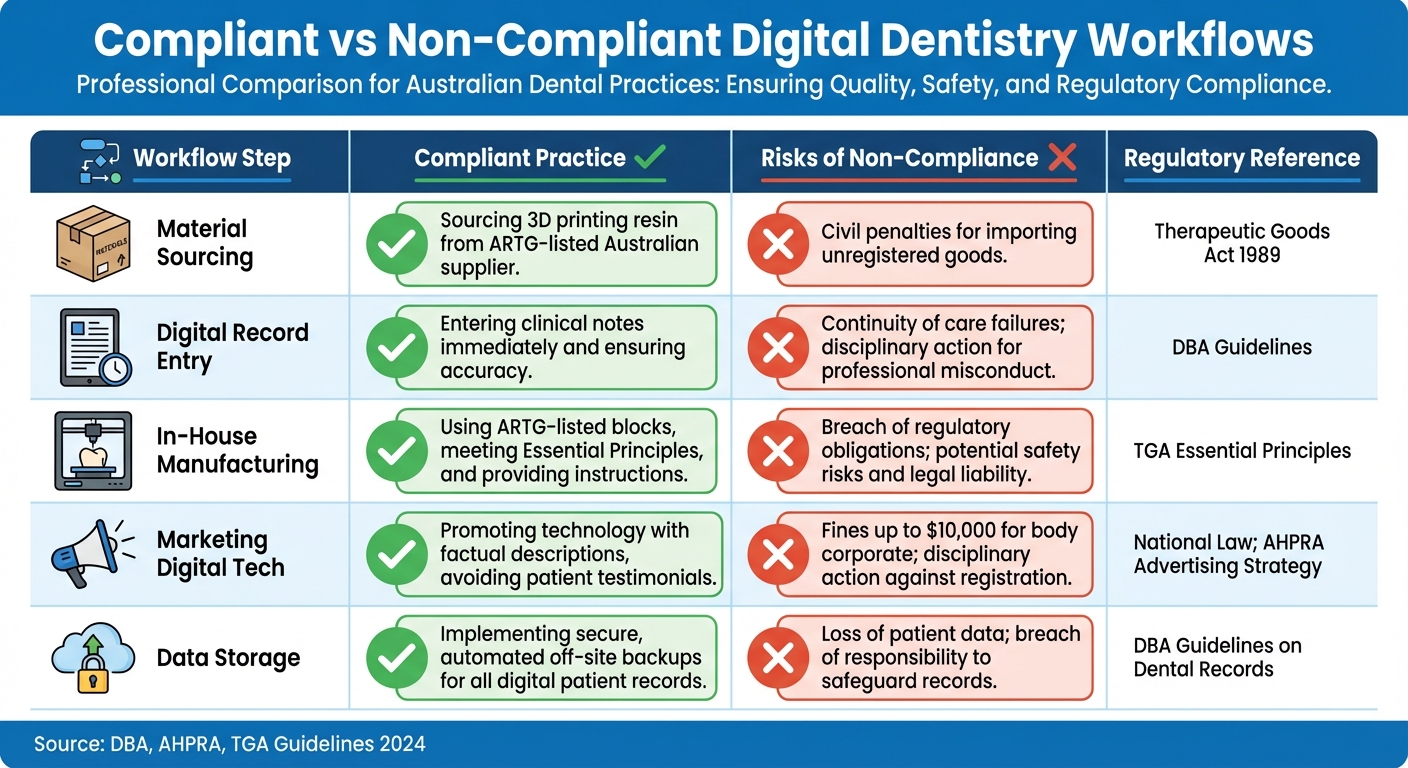
Digital Dentistry Compliance Workflow: Compliant vs Non-Compliant Practices in Australia
Risk Assessments and Staff Training
Before adopting any digital technology in your practice, it’s crucial to understand your regulatory responsibilities. For example, if you’re importing materials like millable blocks or printing resins directly from overseas, you automatically take on the role of a "sponsor" under TGA regulations. This means you must ensure those materials are listed in the Australian Register of Therapeutic Goods (ARTG) [2]. To simplify compliance, consider sourcing all digital materials from Australian suppliers who have already secured ARTG inclusion for their products.
Ongoing CPD is essential for building staff expertise in safely operating digital systems [4][5]. Conducting regular risk assessments helps identify potential weaknesses in your workflow, from sourcing materials to maintaining equipment. Addressing these vulnerabilities proactively not only reduces risks but also sets the stage for robust documentation practices.
Documentation and Audit Preparation
Maintaining clear, accurate, and timely digital records is non-negotiable [3]. Clinical notes should be entered immediately after treatment to ensure they are contemporaneous. According to DBA standards, all digital records – such as CAD-CAM restoration files and high-definition radiographs – must be integrated into the patient’s clinical file and easily transferable to other practitioners if needed [7].
It’s also important to document proof that your materials are ARTG-listed, retain instructions for their use, and log any adverse events reported to the TGA [6]. Digital records should be securely stored with automated off-site backups and retained for 7 to 10 years, as required by state or territory privacy laws [7]. Each entry must include the practitioner’s ID and follow a chronological audit trail to ensure clarity and accountability during regulatory reviews.
The table below illustrates the differences between compliant and non-compliant practices in key workflow steps.
Compliant vs Non-Compliant Workflow Comparison
| Workflow Step | Compliant Practice | Risks of Non-Compliance | DBA/TGA Reference |
|---|---|---|---|
| Material Sourcing | Sourcing 3D printing resin from an ARTG-listed Australian supplier [2]. | Civil penalties for importing unregistered goods [2]. | Therapeutic Goods Act 1989 |
| Digital Record Entry | Entering clinical notes immediately and ensuring accuracy [3]. | Continuity of care failures; disciplinary action for professional misconduct [3]. | DBA Guidelines |
| In-House Manufacturing | Using ARTG-listed blocks, meeting Essential Principles, and providing instructions [2]. | Breach of regulatory obligations; potential safety risks and legal liability [2]. | TGA Essential Principles |
| Marketing Digital Tech | Promoting technology with factual descriptions, avoiding patient testimonials [1]. | Fines up to $10,000 for a body corporate; disciplinary action against registration [1]. | National Law; AHPRA Advertising Strategy |
| Data Storage | Implementing secure, automated off-site backups for all digital patient records [7]. | Loss of patient data; breach of the responsibility to safeguard records [7]. | DBA Guidelines on Dental Records |
Conclusion
Digital dentistry offers a range of advantages, but these can only be realised when dental practices align with Australia’s strict regulatory requirements. Bodies like the Dental Board of Australia, AHPRA, and the TGA have set clear standards designed to safeguard patient safety and uphold public confidence in the profession. Whether you’re using 3D printing resins, creating crowns chair-side, or advertising digital services, it’s vital to understand your obligations – not just as a practitioner but potentially as a sponsor or manufacturer as well.
Failing to comply with these regulations can lead to serious consequences, including financial penalties, disciplinary actions, or even the suspension of your registration. Beyond the legal risks, neglecting device standards or privacy laws could jeopardise patient safety and harm your professional reputation.
To ensure a smooth and secure transition into digital dentistry, proactive compliance is a must. As we’ve outlined, checking ARTG listings, keeping precise digital records with reliable backups, and adhering to truthful marketing practices are all critical steps. Regular staff training and detailed documentation processes will help your practice remain prepared for audits and regulatory checks. By embedding these habits into your daily operations, you not only meet compliance requirements but also strengthen patient trust and ensure long-term success.
FAQs
What are a dental practitioner’s responsibilities when using digital tools in Australia?
In Australia, dental practitioners utilising digital tools like intra-oral scanners, CAD/CAM systems, 3D printers, or electronic health records must adhere to strict professional, safety, and consumer protection standards. This includes operating within the guidelines set by the Dental Board of Australia, maintaining precise digital records, safeguarding patient data, and obtaining informed consent for any digital procedures. Furthermore, any devices that are imported or manufactured must be registered with the Australian Register of Therapeutic Goods (ARTG) to ensure proper traceability and to allow for the reporting of any safety concerns.
Practitioners also carry the responsibility of ensuring patient safety by addressing issues such as device malfunctions or data breaches through mandatory notifications. Regular validation of digital equipment is essential, along with ensuring that all advertising and patient communications are accurate, evidence-based, and comply with AHPRA’s guidelines as well as Australian Consumer Law. For instance, practices like Complete Smiles Bella Vista demonstrate a commitment to these standards by ensuring their digital systems prioritise patient safety and uphold ethical care.
What steps should dental practices take to comply with Australian data privacy laws?
Dental practices in Australia have a critical responsibility to safeguard patient information, aligning with the Privacy Act 1988 and the Australian Privacy Principles (APPs). This means obtaining clear consent before collecting or using personal data, ensuring only authorised staff can access it, and securing electronic records with encrypted systems. Additionally, practices must provide a clear privacy policy and allow patients to access and update their personal information as needed.
To stay compliant, dental clinics should establish a risk management plan to address vulnerabilities in their digital systems. This includes practical steps such as implementing strong passwords, activating multi-factor authentication, keeping software up to date, encrypting backups, and securely disposing of outdated devices. Regular staff training on privacy responsibilities and breach-response procedures is essential, along with routine audits to ensure records meet the standards set by the Dental Board of Australia and relevant state laws. By adopting these measures, dental practices can safeguard patient data and uphold their reputation for trust and professionalism.
What should I do if a digital dental device is not listed in the ARTG?
If a digital dental device isn’t listed on the Australian Register of Therapeutic Goods (ARTG), you must stop using or supplying it right away. Start by checking if the device qualifies for an exemption. If it doesn’t, you’ll need to submit a full inclusion application to the Therapeutic Goods Administration (TGA) via their eBusiness Services platform. Be sure to include all the necessary documentation when completing your application.
Using approved devices not only ensures you comply with Australian regulations but also safeguards patient safety and reinforces trust in your dental practice.
Related Blog Posts
- Teledentistry Guidelines in Australia
- Real-Time AI in Dental Imaging: What to Know
- Deep Learning in Orthodontic Image Analysis
- Teledentistry in Australia: Legal and Ethical Issues
Important Notice: Any surgical or invasive procedure carries risks. Before proceeding, you should seek a second opinion from an appropriately qualified health practitioner.
Individual results may vary. The information provided in this article is for educational purposes only and does not constitute medical advice.
Checkout Related Blogs




Get in touch with us
For more information, call us now to start feeling better. Or fill the form below to make appointment
The Latest News from Complete Smiles
How to Clean Clear Plastic Retainers
Checklist for Choosing Wearable Dental Devices
Checklist for Choosing Cloud AI Platforms in Dentistry

Complete Smiles Bella VistaAccepts All Major Health Funds, Including





