





Clinical Benefits of Ultrasonic Root Canal Devices

Ultrasonic devices have transformed root canal therapy by improving cleaning and disinfection through acoustic streaming and cavitation. These methods help irrigants penetrate deeper into dentinal tubules, reaching areas that traditional tools often miss. Clinical studies show ultrasonic-assisted irrigation (UAI) reduces bacteria by up to 82% in main canals, while also lowering postoperative pain, especially within the first 48 hours. Despite these advantages, long-term healing outcomes remain inconclusive, and more research is needed to determine their full impact.
Key Points:
- Mechanism: Uses sound waves (20,000–40,000 Hz) to improve cleaning and biofilm removal.
- Effectiveness: UAI reduces bacteria and debris significantly better than syringe irrigation.
- Patient Comfort: Reduces pain within the first 24–48 hours post-treatment.
- Challenges: Limited effectiveness in deep tubules and narrow canals; long-term healing data is insufficient.
- Techniques: Includes Passive Ultrasonic Irrigation (PUI) and Continuous Ultrasonic Irrigation (CUI).
Ultrasonic devices are a promising tool for Australian dental practices, offering improved cleaning and patient comfort during root canal treatments. However, their long-term benefits and optimal use require further investigation.
The Role of Ultrasonics in Endodonitcs
Clinical Evidence on Treatment Success
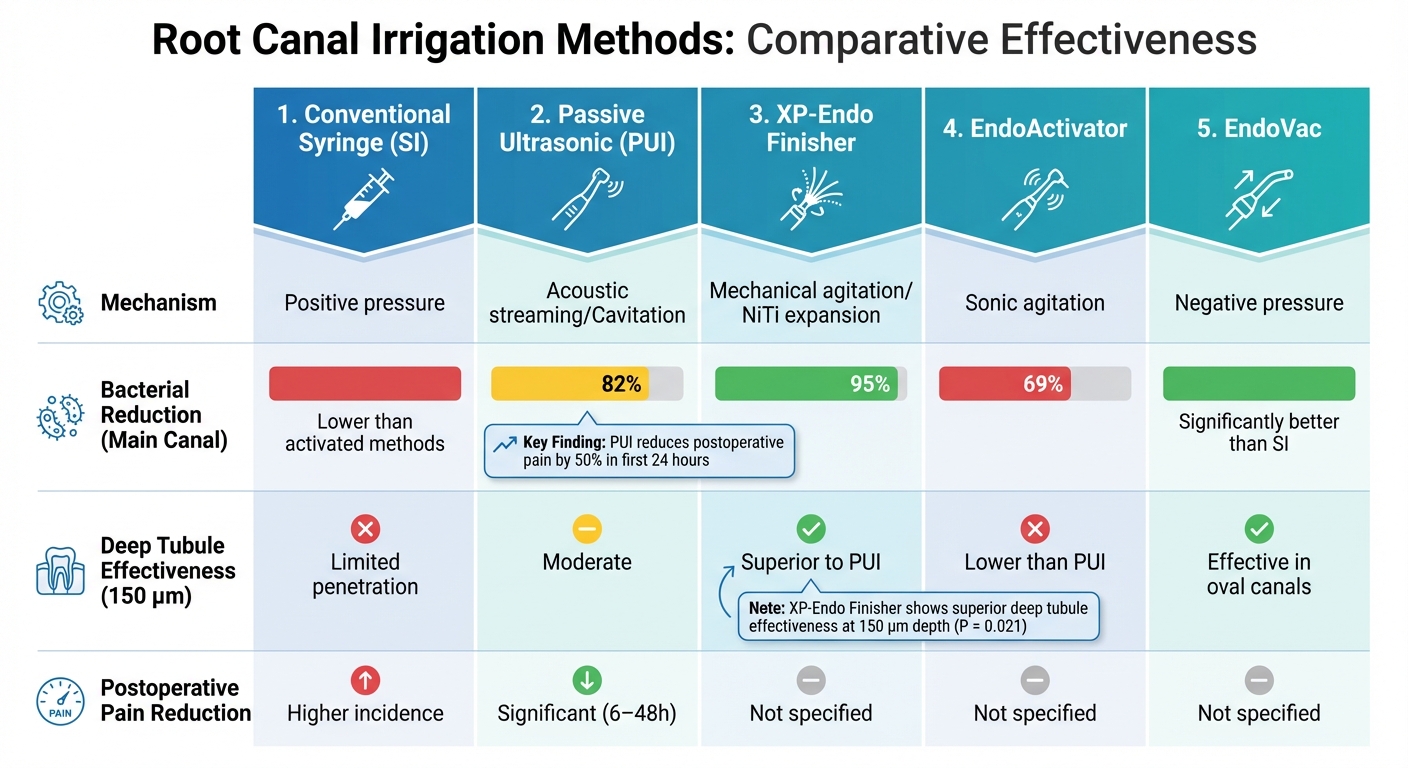
Comparison of Root Canal Irrigation Methods: Effectiveness and Outcomes
Microbial Reduction and Debris Removal
Research highlights that ultrasonic-assisted irrigation (UAI) is more effective at lowering bacterial counts compared to conventional syringe irrigation. A systematic review published in Evidence-Based Dentistry (September 2022) analysed data from 126 teeth across four studies. The findings showed UAI achieved significantly lower microbial levels, with a standardised mean difference of –0.40 [4]. Additionally, UAI demonstrated a reduction in lipopolysaccharides (LPS) – toxic bacterial cell wall components – with a mean difference of –0.06 across 61 canals [4]. These results provide a compelling basis for laboratory studies to further evaluate UAI’s performance.
Laboratory experiments have also supported these findings. For example, a February 2024 study in Scientific Reports examined 84 mesial roots of mandibular molars infected with E. faecalis. Passive ultrasonic irrigation (PUI) reduced bacterial counts in main canals by 82% [6]. However, the study noted a limitation: at a depth of 150 µm in dentinal tubules, mechanical activation methods like the XP-Endo Finisher outperformed PUI (P = 0.021) [6].
While lab data underscores UAI’s ability to reduce bacteria, its influence on long-term clinical outcomes remains less conclusive.
Long-Term Healing and Success Rates
Despite its effectiveness in microbial reduction, UAI has not been definitively linked to better long-term healing outcomes. Systematic reviews reveal no significant differences in radiographic healing or treatment failure rates between UAI and syringe irrigation [5][4]. A meta-analysis examining periapical lesion volume post-treatment also found no measurable differences between the two methods [4]. The certainty of these findings is considered "low" to "very low" due to the limited availability of high-quality clinical trials [4].
However, UAI does provide a noteworthy advantage in managing postoperative symptoms. For cases involving non-vital pulps, UAI reduced the risk of pain within the first 24 hours by 50% compared to syringe irrigation (relative risk = 0.50) [4]. Studies also show that ultrasonic agitation significantly decreases postoperative pain at 6, 24, and 48 hours, though this benefit fades after 72 hours [3]. This early pain relief is likely tied to UAI’s immediate antimicrobial effects.
"UAI may reduce the risk of post‐operative pain during the first 24 hours and reduce microbial counts, particularly cultivable germs in cases of apical periodontitis." – Arash Shahravan, Professor, Kerman University of Medical Sciences [4]
Comparing Different Irrigation Methods
| Irrigation Method | Mechanism | Bacterial Reduction (Main Canal) | Deep Tubule Effectiveness (150 µm) | Postoperative Pain Reduction |
|---|---|---|---|---|
| Conventional Syringe (SI) | Positive pressure | Lower than activated methods [2] | Limited penetration [6] | Higher incidence [3] |
| Passive Ultrasonic (PUI) | Acoustic streaming/Cavitation | Approximately 82% [6] | Moderate [6] | Significant (6–48h) [3] |
| XP-Endo Finisher | Mechanical agitation/NiTi expansion | Approximately 95% [6] | Superior to PUI [6] | Not specified |
| EndoActivator | Sonic agitation | Approximately 69% [6] | Lower than PUI [6] | Not specified |
| EndoVac | Negative pressure | Significantly better than SI [7] | Effective in oval canals [7] | Not specified |
For clinicians managing cases of apical periodontitis, UAI offers a reliable option for reducing cultivable bacteria and alleviating early postoperative pain.
Patient Outcomes: Pain, Comfort, and Satisfaction
Postoperative Pain and Symptom Management
Ultrasonic irrigation doesn’t just improve canal cleanliness – it also brings notable benefits for patients. Studies show that ultrasonic activation significantly reduces pain within the first 48 hours after treatment. For instance, in cases involving non-vital teeth, this method can cut postoperative pain in half compared to conventional techniques. However, by the 72-hour mark, these differences tend to disappear, as reported in trials like those by Liapis et al. (2021) [3][4][8]. These early improvements in symptoms highlight meaningful advantages for patients and provide a glimpse into the factors that drive overall satisfaction.
What Affects Patient Satisfaction
While early pain relief is crucial, patient satisfaction is influenced by more than just immediate comfort. Ultrasonic devices, with their minimally invasive approach, help preserve healthy tooth structure and lower retreatment rates, leading to smoother recoveries and greater confidence in the treatment’s success [4][10][11][9]. Success rates for modern endodontic techniques using ultrasonic irrigation are impressive, ranging from 85% to 97% [9]. For example, a 2020 randomised controlled trial by Verma et al., which included 69 patients, found that passive ultrasonic irrigation achieved a healing rate of 36.8% for chronic apical periodontitis – far outpacing the 10.5% success rate observed with conventional syringe irrigation [8].
Gaps in Patient Outcome Research
Although the short-term benefits, like reduced pain, are well-documented, there’s limited research linking ultrasonic irrigation to long-term patient satisfaction. Metrics assessing quality of life remain especially scarce [3][4].
"Ultrasonic irrigation may lead to less post‐operative pain compared to conventional irrigation techniques; however, the evidence base is limited and further research is needed to support these findings." – Mohammed Adam and James Wootton [3]
Patient satisfaction is shaped by a mix of factors, including the clinician’s skill, the duration of the procedure, costs, and communication. This complexity makes it challenging to pinpoint the exact role ultrasonic irrigation plays in the overall treatment experience.
sbb-itb-2be92ed
Implications for Australian Dental Practices
Evidence-Based Practice Standards
In Australia, the Dental Board of Australia and AHPRA require dental practitioners to back their clinical practices with solid evidence. When it comes to root canal therapy, the use of ultrasonic devices is supported by research showing improved cleaning and disinfection outcomes [1]. Passive Ultrasonic Irrigation (PUI), in particular, is valued for its non-cutting nature, which helps maintain the canal’s original shape – a key principle in modern, minimally invasive dentistry favoured by Australian practitioners [1].
Although earlier Cochrane reviews from 2008–2009 highlighted a lack of high-level evidence for ultrasonic instrumentation as a standalone method, newer systematic reviews and meta-analyses have shown its value as an adjunct. These studies report significant reductions in postoperative pain at 6, 24, and 48 hours (p < 0.05) when ultrasonic agitation is used [3].
"The combination of conventional irrigation together with ultrasonic irrigation facilitates the procedure and improves the elimination of bacteria and the smear layer throughout the canal system thereby contributing to higher success rates for endodontic treatment." – Sandra Mozo, Postgraduate Endodontics Programme, University of Valencia [1]
To maximise its effectiveness, clinicians are encouraged to use ultrasonic activation during the final irrigation phase, after shaping the canal. This ensures the instrument can oscillate freely without touching the canal walls, enhancing its cleaning ability. These practices align with the commitment of Australian dental clinics to provide minimally invasive and effective treatment options.
Example of Contemporary Dental Care
Australian dental clinics are increasingly incorporating these evidence-backed techniques into their services. A great example is Complete Smiles Bella Vista (https://completesmilesbv.com.au), led by Dr James Hanna. Their approach integrates ultrasonic technology into root canal therapy, showcasing how advanced tools can be seamlessly introduced into routine practice. This not only adheres to Australian clinical standards but also prioritises better outcomes for patients.
Conclusion and Future Directions
Key Takeaways for Clinicians and Patients
Ultrasonic devices have shown promise in improving root canal disinfection and easing postoperative pain within the first 48 hours. This is achieved through mechanisms like acoustic streaming and cavitation, which contribute to a bacterial reduction of about 82% [3][6][7]. However, completely eliminating bacteria remains a challenge [1][5][6]. Additionally, these devices come with technical risks, such as the potential for instrument breakage and reduced effectiveness in narrow or curved canals if not used properly [1][7][13]. It’s important to note that long-term treatment success relies on more than just the irrigation method. Factors like proper canal shaping, effective filling techniques, and the patient’s overall health play a critical role.
While these devices offer notable benefits for current clinical use, there are still unanswered questions that need further exploration.
Future Research Needs
To address existing gaps, future research must take a deeper dive into the limitations identified. A key priority is conducting large-scale, multi-year randomised controlled trials, as the current body of evidence lacks the robustness needed for definitive conclusions [12]. These studies should focus on determining whether ultrasonic devices genuinely improve long-term periapical healing compared to traditional methods [5][12].
Another critical area is the development of standardised protocols and the inclusion of patient-reported outcomes. This will provide clearer insights into how ultrasonic devices contribute to long-term healing and help guide clinical decisions in Australian dental practices [1][3][12].
FAQs
How effective is ultrasonic irrigation compared to traditional methods for reducing bacteria during root canal treatment?
Research has shown that ultrasonic irrigation tends to outperform traditional syringe irrigation in lab tests when it comes to eliminating bacteria. That said, clinical studies paint a more complex picture, with some suggesting that the advantages may not be as significant in everyday practice.
Ultrasonic devices operate by generating high-frequency vibrations and acoustic streaming. This process helps clear out debris and bacteria from those tricky, hard-to-reach spots within the root canal system. While this technology shows potential, the success of root canal therapy isn’t just about the tools. It also hinges on factors like the dentist’s skill and carefully selecting the right cases.
What are the challenges of using ultrasonic devices in root canal treatments?
Ultrasonic devices are often used in cleaning and disinfecting root canals, offering some promising benefits, but they’re not without their challenges. The evidence supporting their effectiveness is somewhat mixed. While certain studies indicate that ultrasonic irrigation might help reduce post-operative pain, there’s no consistent proof that it significantly outperforms traditional methods in terms of healing or bacterial removal. To reach more definitive conclusions, larger and better-structured research is needed.
On the practical side, these devices come with a few drawbacks. Ultrasonic tips are delicate and can be expensive to replace, adding to the overall cost of treatment. Additionally, using the technique requires a high level of skill and precision to avoid damaging the canal walls, especially in cases involving complex or curved canals. Despite these hurdles, many dental practices across Australia, including Complete Smiles Bella Vista, incorporate ultrasonic devices as part of a comprehensive approach to deliver high-quality care for their patients.
Why is more research needed to understand the long-term benefits of ultrasonic root canal devices?
The current body of evidence on ultrasonic root canal devices largely stems from laboratory-based studies rather than practical, real-world clinical trials. This gap in research makes it challenging to draw definitive conclusions about their effectiveness in everyday dental settings.
Another issue is the lack of standardised treatment protocols for these devices. Without uniform guidelines, comparing outcomes across different studies becomes problematic. To address these challenges, high-quality randomised clinical trials are crucial. These trials would provide the data needed to determine whether ultrasonic instrumentation truly leads to long-term treatment success, improved patient satisfaction, and better overall oral health. Establishing this connection would ensure that these devices deliver reliable, research-backed results in routine dental practice.
Related Blog Posts
- Benefits of Ultrasonic Activation in Dentistry
- Passive Ultrasonic Irrigation: Faster Root Canal Cleaning
- Sonic vs. Ultrasonic: Root Canal Cleaning Comparison
- Ultrasonic Activation for Biofilm Removal: Research Insights
Important Notice: Any surgical or invasive procedure carries risks. Before proceeding, you should seek a second opinion from an appropriately qualified health practitioner.
Individual results may vary. The information provided in this article is for educational purposes only and does not constitute medical advice.
Checkout Related Blogs




Get in touch with us
For more information, call us now to start feeling better. Or fill the form below to make appointment
The Latest News from Complete Smiles
How to Clean Clear Plastic Retainers
Checklist for Choosing Wearable Dental Devices
Checklist for Choosing Cloud AI Platforms in Dentistry

Complete Smiles Bella VistaAccepts All Major Health Funds, Including





