



Adult Braces Costs Explained

Thinking about getting braces as an adult? Here’s what you need to know:
- Costs in Australia range from $3,000 to $15,000, depending on the type of braces and complexity of treatment.
- Metal braces are the most affordable ($6,000–$9,000), while lingual braces are the most expensive ($9,500–$15,000+).
- Clear aligners like Invisalign can cost between $2,500 (minor cases) and $10,000 (complex cases).
- Treatment duration is typically 18–36 months for adults, longer than for children due to less flexible jawbones.
- Private health insurance may cover $1,000–$3,000, but waiting periods and lifetime limits apply.
- Payment plans are widely available, with monthly instalments around $200–$300.
If you’re unsure which option suits your needs, consider factors like visibility, treatment duration, and budget. Many orthodontists offer interest-free payment plans to make treatment more accessible.
How Much Do Braces Cost in Australia?
sbb-itb-2be92ed
Average Costs of Adult Braces in Australia
The cost of adult braces in Australia can vary significantly, ranging from $3,000 to $15,000, depending on the complexity of the treatment and the type of appliance used [3][7]. A standard 18-month treatment typically costs between $3,500 and $9,000, while minor corrections requiring just three to six months may fall in the range of $2,500 to $4,000. On the higher end, comprehensive treatments involving extensive alignment or bite corrections can cost $9,500 to $10,950 or more [2][1][5]. These differences reflect how treatment complexity and duration impact pricing.
For adults, the process can take longer because adult jawbones are less flexible compared to children’s. Treatments often last between 18 and 36 months, whereas children’s treatments are typically completed within 12 to 24 months. Additional procedures may also be required for adults, further influencing costs [3]. Interestingly, more than 60% of orthodontic patients in Australia are now adults, highlighting an increasing interest in orthodontic care at any age [6].
Geographical location also plays a role in the cost of braces. For instance, a treatment priced between $6,000 and $10,000 in Sydney’s CBD might cost around $4,500 to $7,500 in regional areas like Dubbo or Wagga Wagga in NSW [3]. To make these expenses more manageable, private health insurance can often cover $2,500 to $3,000 of the total cost, depending on your policy [6]. Additionally, many orthodontic clinics offer interest-free payment plans, typically requiring a deposit followed by monthly instalments of around $150 to $300 [3][1].
Factors That Affect the Cost of Adult Braces
When it comes to adult braces, the final price tag depends on a variety of factors, ranging from the complexity of your dental needs to the type of braces you choose and even where your orthodontist is located.
Treatment Complexity and Duration
The severity of your orthodontic issues is a major determinant of cost. For example, straightforward cases like rotating a single tooth or fixing minor crowding can be completed in as little as three to six months, with costs typically ranging between $2,500 and $4,000 [1][5]. On the other hand, more complex treatments – such as correcting root positions – may take anywhere from 18 to 36 months, pushing costs up to $7,000–$11,000 or more [1][3][5].
Bite corrections, including overbites, underbites, crossbites, and open bites, often require additional mechanics and more frequent visits, further increasing expenses [2]. For some adults, treatment may also involve collaboration with other dental professionals to address gum health, restorative work, or even jaw surgery, adding another layer of cost and complexity [3][4].
"The duration of your treatment is determined by the specific problem which needs fixing and the type of tooth movement required."
– Orthodontics Australia [2]
Type of Braces Selected
The type of braces you choose significantly affects the overall cost. Metal braces are the most budget-friendly option, costing between $3,000 and $9,000, as they use pre-formed brackets and wires [3][7]. Ceramic braces, which are less noticeable due to their tooth-coloured brackets, range from $4,500 to $9,500, reflecting the added expense of aesthetic materials [3][7].
Lingual braces, which are placed behind the teeth, are the priciest option, costing anywhere between $8,000 and $15,000. Their high price is due to the customisation required to fit the internal contours of each tooth [3][7][1]. Clear aligners, like Invisalign, vary widely in cost – ranging from $2,500 for minor corrections to over $9,000 for complex cases – depending on the number of trays needed [1][5]. Ultimately, both the technical demands of your treatment and the type of appliance you select will shape your final bill.
Orthodontist Experience and Location
An orthodontist’s expertise can also influence costs. Specialist orthodontists, who undergo an additional three years of full-time training (over 4,000 hours beyond a standard dental degree), often charge higher fees due to their advanced skills and ability to handle complex cases with reduced clinical risk [2].
Where your orthodontist is based also plays a role. Urban clinics often have higher operating costs, such as rent, staff salaries, and utilities, which can lead to steeper prices compared to regional practices. So, location matters when it comes to what you’ll pay for your treatment.
Cost Breakdown by Braces Type
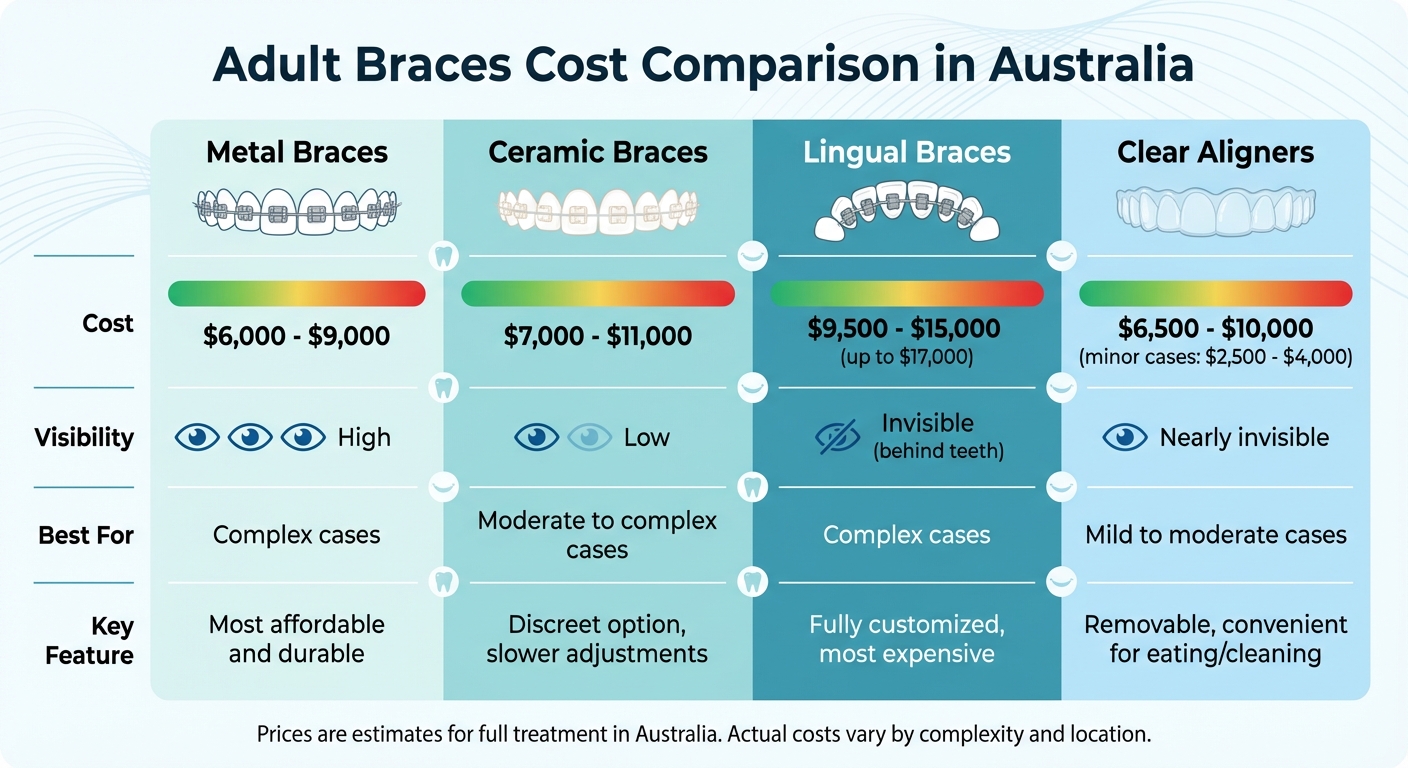
Adult Braces Cost Comparison Australia 2024
To help you navigate the costs associated with different types of braces in Australia, here’s a detailed look at the price ranges and what they offer. Each type comes with distinct features and treatment requirements that influence its overall cost. These estimates can help you plan your budget before factoring in insurance or payment plans.
Metal Braces Costs
Metal braces are the most budget-friendly option, typically priced between $6,000 and $9,000 for full treatment [6]. Their affordability comes from the use of pre-made brackets and archwires, which your orthodontist customises for your treatment. Known for their durability, they are particularly effective for addressing complex alignment issues and often lead to predictable treatment timelines.
Ceramic Braces Costs
Ceramic braces generally fall in the range of $7,000 to $11,000 [6]. The higher price point is due to the more delicate and expensive materials used. Ceramic brackets are less visible than metal ones, making them a popular choice for those seeking a more discreet option.
"Ceramic/clear braces cannot handle as much pressure for long periods of time – meaning your braces will have to be tightened at a slower rate" – Dr. Jessica Yeo from Glow Orthodontics [1]
This slower adjustment process may extend the treatment duration. Additionally, maintaining oral hygiene is crucial, as the clear ligatures can stain if exposed to certain foods or drinks.
Lingual Braces Costs
Lingual braces are the most expensive option, with costs ranging from $9,500 to $15,000, and in some complex cases, they can go up to $17,000 [6]. These braces are fitted behind the teeth, making them virtually invisible. The high cost reflects the level of customisation required – each bracket is tailored to fit the unique contours of your teeth – and the specialised skills needed for installation and adjustments.
Clear Aligners Costs
Clear aligners, such as Invisalign, offer a nearly invisible solution, with comprehensive treatments typically costing between $6,500 and $10,000 [6]. For minor cases, express treatments can cost as little as $2,500 to $4,000 [5]. The final price depends on the complexity of the case and the number of aligner trays required. Since they are removable, clear aligners make eating and cleaning more convenient but are most effective for mild to moderate alignment issues.
| Braces Type | Estimated Cost | Visibility | Best Suited For |
|---|---|---|---|
| Metal | $6,000 – $9,000 | High | Complex cases |
| Ceramic | $7,000 – $11,000 | Low | Moderate to complex |
| Lingual | $9,500 – $15,000 | Invisible | Complex cases |
| Clear Aligners | $6,500 – $10,000 | Nearly invisible | Mild to moderate cases |
Insurance and Financing Options for Adult Braces
Considering the costs involved, finding ways to manage payments for adult braces can make treatment more accessible. Here are some options to reduce upfront expenses or spread out payments.
Health Fund Coverage
Since Medicare doesn’t cover orthodontic treatment for adults, most people turn to private health insurance extras cover [8][9]. Orthodontics is typically classified as a premium extras benefit, meaning you’ll need a mid-to-high tier policy rather than basic dental cover [8][11].
Be aware of the 12-month waiting period before you can claim benefits [8][11][12]. Once you’re eligible, rebates usually cover between 50% and 80% of treatment costs [9][11]. However, these rebates are capped by both annual and lifetime limits. Lifetime limits typically range from $1,000 to $3,000, after which no further benefits apply [9][11][10][13].
"Orthodontic rebates from private health insurance range from a few hundred dollars to over $2,500 – so it pays to do your research." – Orthodontics Australia [8]
To get the most out of your coverage, request a detailed Orthodontic Treatment Plan with item numbers from your orthodontist. This will allow your insurer to provide a written benefit estimate [8][10][13]. Additionally, if your policy’s annual limits reset on 1 January or 1 July, you could plan your treatment across two benefit years to claim multiple annual limits while staying within your lifetime cap [9][12][13].
Payment Plans
For costs not fully covered by insurance, many orthodontists in Australia offer flexible payment plans. These interest-free plans allow you to spread out payments over 12 to 36 months [14][3]. Typically, you’ll need to pay an initial deposit (often around $1,000) and then make monthly instalments of $200 to $300 [3]. For example, a $6,000 treatment might involve a $1,000 deposit and $250 payments over 20 months [3].
"Opting for a payment plan means that you can get started with your braces or clear aligner treatment now and address the bill a bit later on. It’s a great way to manage your cashflow while still getting the specialist support you or your family needs." – Orthodontics Australia [14]
Most payment plans require signing a financial agreement, but they usually don’t involve credit checks [14]. The quoted price generally includes everything: the initial fitting, adjustments, removal, retainers, and follow-up visits for up to two years [2]. Some practices even offer discounts of 5% or more for paying the full fee upfront [14]. However, paying upfront might complicate insurance claims if your fund requires treatment to be ongoing [12][3].
These options can help make orthodontic treatment more affordable and manageable.
Key Takeaways
Getting braces as an adult can cost anywhere from $3,000 to $17,000, with most people spending between $5,000 and $9,000 on their treatment [3]. Metal braces tend to be the least expensive option, while lingual braces are pricier due to the customisation involved.
Treatment length can range from 18 to 36 months, depending on how complex the case is and the rigidity of the adult jawbone [3]. Where you live also plays a role in pricing – metropolitan clinics often charge up to $2,000 more than those in regional areas.
If the cost feels daunting, there are ways to make it more manageable. Many orthodontists offer interest-free payment plans, usually with monthly instalments between $200 and $300 [3]. Private health insurance extras cover can also help, offering rebates of $1,000 to $3,000 over your lifetime, though keep in mind there’s typically a 12-month waiting period [5][15].
"More than 60 percent of orthodontic patients in Australia today are adults, showing that it is never too late to improve your smile." – Orthodontics Australia [6]
To avoid unexpected costs, compare all-inclusive quotes. These should cover everything – fitting, adjustments, removal, retainers, and one to two years of follow-up care [2]. These insights provide a solid foundation for planning and budgeting your orthodontic journey effectively.
FAQs
What’s usually included in a braces quote?
A braces quote typically includes several components: the cost of the braces themselves, the initial assessment, routine adjustments, and follow-up appointments. In many cases, it may also cover retainers and care after the treatment is complete. Since specifics can differ, it’s a good idea to check with your orthodontist for a detailed breakdown.
How can I estimate my out-of-pocket costs after insurance?
To figure out your out-of-pocket costs, ask your orthodontist for a detailed treatment quote that breaks down the total cost. Then, subtract the benefits your private health insurance will cover, considering your policy’s specific coverage and limits. This will help you understand how much you’ll need to pay yourself.
Which braces option is best if I want something less visible?
If you’re looking for a more discreet option, Invisalign or clear aligners might be the perfect solution. These aligners are nearly invisible, making them a subtle choice for those who prefer not to draw attention to their orthodontic treatment. Plus, they can be removed when necessary, offering flexibility and convenience. This makes them especially popular among adults who want to straighten their teeth without the look of traditional braces.
Related Blog Posts
- What Are Custom Orthodontic Brackets?
- 5 Factors Affecting Orthodontic Treatment Feasibility
- Orthodontic Planning: Setting Realistic Goals
- Pros and Cons of Ceramic Braces
Important Notice: Any surgical or invasive procedure carries risks. Before proceeding, you should seek a second opinion from an appropriately qualified health practitioner.
Individual results may vary. The information provided in this article is for educational purposes only and does not constitute medical advice.
Checkout Related Blogs



Get in touch with us
For more information, call us now to start feeling better. Or fill the form below to make appointment
The Latest News from Complete Smiles
How to Clean Clear Plastic Retainers
Checklist for Choosing Wearable Dental Devices
Checklist for Choosing Cloud AI Platforms in Dentistry
Complete Smiles Bella VistaAccepts All Major Health Funds, Including