





Research on Tongue Cleaning and Oral Health

Tongue cleaning is often overlooked, but it plays a key role in maintaining oral health. The tongue can harbour up to 70% of the bacteria in your mouth, contributing to bad breath, gum disease, and even tooth decay. Regular cleaning removes bacteria, food particles, and dead cells trapped in the tongue’s textured surface, improving both hygiene and taste perception.
Key Takeaways:
- Bad Breath: Up to 90% of bad breath cases originate from bacteria on the tongue. Tongue scrapers reduce volatile sulfur compounds (VSCs) by 75%, compared to 45% with toothbrushes.
- Oral Health: Cleaning reduces harmful bacteria like Fusobacterium nucleatum, which can lead to gum disease.
- Taste Improvement: Removing the coating on your tongue exposes taste buds, enhancing flavour detection.
- Simple Routine: Clean your tongue twice daily using a scraper or soft-bristled toothbrush for optimal results.
Adding tongue cleaning to your daily routine alongside brushing and flossing ensures a cleaner mouth, better breath, and improved oral health. It only takes 10–15 seconds and can significantly reduce bacteria levels.
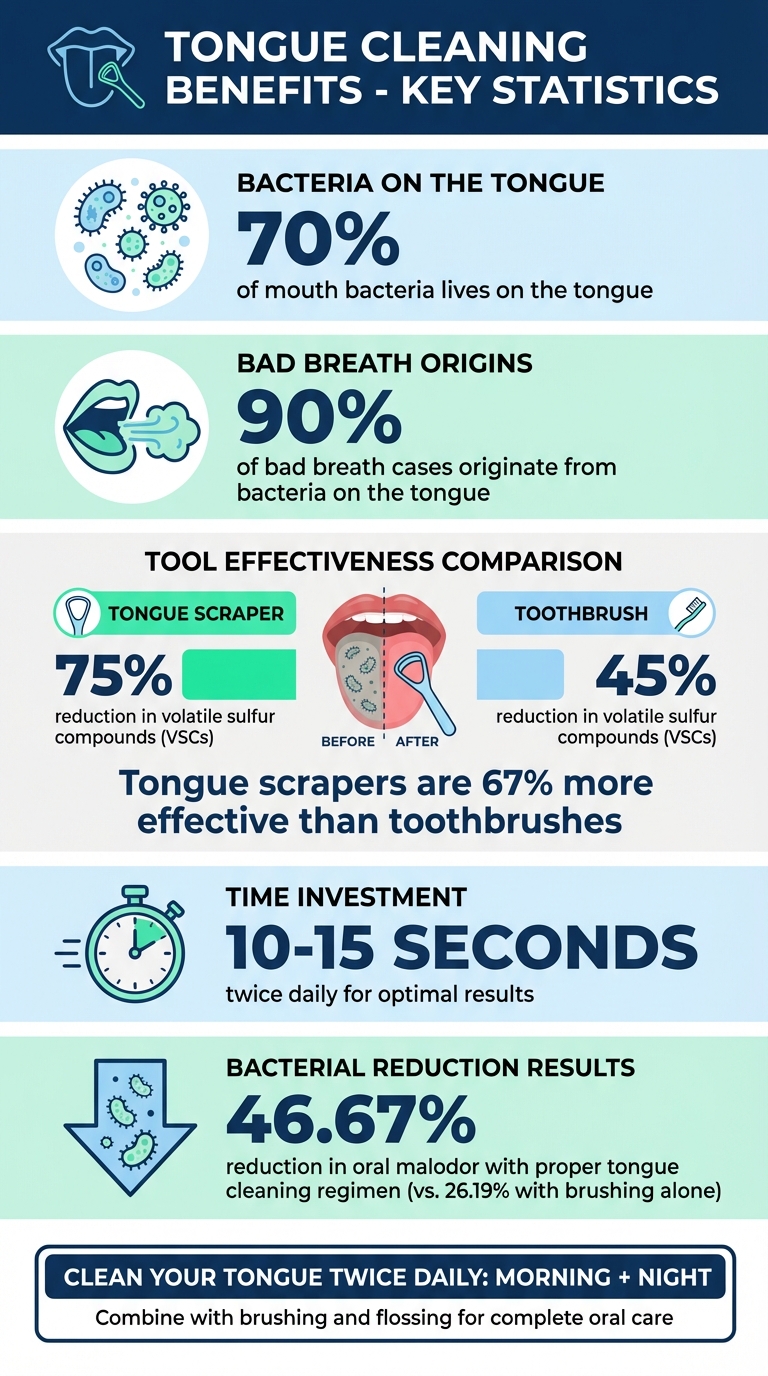
Tongue Cleaning Benefits: Key Statistics for Oral Health and Fresh Breath
Effects of Tongue Scraping on Plaque, Gingivitis, and Cavities
sbb-itb-2be92ed
How Tongue Cleaning Reduces Bacteria
The tongue’s textured surface provides an ideal environment for bacteria to thrive. Regular tongue cleaning disrupts these bacterial biofilms, helping to reduce the overall bacterial load in your mouth.
Removing Bacterial Biofilm from the Tongue
Research shows that tongue cleaning can significantly lower bacterial levels. For example, a meta-analysis revealed that combining tongue cleaning with toothbrushing reduces tongue coating with a large effect size of 0.922. Additionally, studies found that tongue scraping alongside toothbrushing leads to bacterial reductions ranging from 0.11 to 0.40 log10 cfu/sample [5][9]. More advanced methods, like using a vacuum ejector paired with antibacterial mouthwash, achieved even greater reductions of 1.11 to 1.96 log10 cfu/sample [9].
Tongue cleaning is particularly effective against Fusobacterium nucleatum, a bacterial species that acts as a "bridge" between early and late colonisers in oral biofilms. Clinical trials demonstrated that regular tongue cleaning reduced F. nucleatum levels in tongue coatings from a baseline of 2.19 ± 1.18 log pg to 1.75 ± 1.29 log pg within just three days [8]. Incorporating tongue cleaning with brushing and flossing ensures a more thorough oral hygiene routine, disrupting bacterial reservoirs and reducing the risk of harmful bacteria spreading. This not only improves the balance of oral microbes but also supports gum health.
Effects on Gum Health
Lowering bacterial levels on the tongue has a direct impact on gum health. Bacteria on the tongue can contribute to bad breath and gum disease by increasing inflammation. By reducing the tongue’s bacterial load, tongue cleaning helps decrease pro-inflammatory cytokines like IL-1β and IL-8 in the gingival crevicular fluid [11]. Studies on gingivitis patients have shown that tongue scraping can effectively manage both gingival inflammation and volatile sulphur compound (VSC) levels [11].
The tongue can also host periodontopathic bacteria linked to more severe gum conditions [8][4]. Regular tongue cleaning prevents these harmful microbes from migrating to the gums, reducing the likelihood of periodontal damage.
"Tongue cleaning and tooth brushing should both be performed for reducing bacterial load." – BMC Oral Health [8]
Consistency matters. Since bacterial biofilms quickly reform, cleaning your tongue twice daily is a crucial part of maintaining healthy gums. This evidence highlights the importance of tongue cleaning as a vital component of a complete oral care routine.
Tongue Cleaning for Better Breath and Taste
Reducing Bad Breath Through Tongue Cleaning
Tongue cleaning doesn’t just help with bacterial reduction – it also plays a big role in improving breath quality.
Bad breath, or halitosis, affects between 8% and 50% of people in developed countries, with 85–90% of cases originating in the mouth [4]. A common cause is the coating on the tongue, which is essentially a biofilm of bacteria. These bacteria break down sulphur-containing amino acids like methionine and cysteine, releasing volatile sulphur compounds (VSCs) such as hydrogen sulphide and methyl mercaptan. These compounds are the main culprits behind unpleasant odours [4][12].
Research backs this up. Meta-analyses reveal that adding tongue cleaning to your brushing routine significantly reduces both VSCs (effect size 0.745) and tongue coating (0.922) compared to brushing alone [5]. In one clinical trial, the Philips Sonicare TongueCare+ regimen reduced oral malodour by 46.67% eight hours after a single use, while manual toothbrushing only achieved a 26.19% reduction [10]. This demonstrates that brushing alone isn’t enough to tackle bad breath – real improvements come when you add tongue cleaning or mouthwash to your routine [12].
"Mouth washing and tongue cleaning significantly reduce oral malodour, but combining tooth brushing, mouth washing and tongue cleaning regimens is most effective." – Aung EE et al., Trials Journal [12]
For effective tongue cleaning, it’s best to wipe from the back of the tongue to the front [4][7]. Consistency is key – since bacterial biofilms can quickly reform, cleaning your tongue at least twice a day as part of your oral hygiene routine helps maintain fresh breath [2].
But tongue cleaning isn’t just about breath – it can also improve how you taste food.
How Tongue Cleaning Improves Taste
Besides reducing bacteria and preventing gum disease naturally, tongue cleaning has another perk: it sharpens your sense of taste.
That white coating on your tongue doesn’t just harbour bacteria; it also blocks your taste buds from fully detecting flavours. Dr. Michael Kosdon, a cosmetic dentist at Smiles of NYC, explains:
"By scraping it off, you can actually taste things better because germs are covering where the taste buds are situated" [2].
A 2004 study by Quirynen et al. explored this link between tongue cleaning and enhanced taste perception [11]. The act of cleaning removes the bacterial film, exposing taste buds and allowing them to better detect flavours [4][12].
However, technique matters. Use light pressure when cleaning your tongue – pushing too hard can create tiny cuts on the papillae (the small bumps that house your taste buds), which might cause discomfort when eating spicy or acidic foods [2].
Adding Tongue Cleaning to Your Daily Routine
How to Clean Your Tongue Properly
Tongue cleaning is quick – it takes just 10–15 seconds [13]. The trick is to use the right technique and make it a consistent part of your routine.
Start by sticking your tongue out as far as you can comfortably manage. Place your tongue scraper (or a soft-bristled toothbrush if you prefer) at the farthest point back that doesn’t trigger your gag reflex. Apply steady, even pressure and pull the scraper smoothly from the back of your tongue to the tip. After each stroke, rinse the tool under running water to remove debris. Repeat this process 5 to 10 times until your tongue appears clean and pink, with no residue left behind. Don’t forget to clean the sides of your tongue, not just the centre.
When it comes to tools, tongue scrapers are far more effective than toothbrushes. Studies show that scrapers can reduce volatile sulphur compounds by about 75%, while toothbrushes only manage around 45% [1]. This is because tongue scrapers are designed to remove the bacterial biofilm from the tongue’s textured surface, while toothbrush bristles are better suited for smooth tooth enamel. If you’re using a plastic scraper, replace it every three months. Metal scrapers, on the other hand, can last indefinitely if properly sterilised [1].
If you’re struggling with a gag reflex, try breathing through your nose to ease the discomfort. You can also start by cleaning just the front two-thirds of your tongue and gradually work further back over several days. After each use, rinse your tongue cleaner thoroughly to keep it hygienic.
Make tongue cleaning a seamless part of your oral care routine – it’s easy to incorporate and yields noticeable benefits.
Using Tongue Cleaning with Brushing and Flossing
To round out your oral care routine, combine tongue cleaning with brushing and flossing. Using tongue cleaning as the final step – after brushing and flossing – can make a big difference in your overall oral hygiene [1]. Annie Walters, MS, RDH, highlights its importance:
"We as professionals need to seriously consider the vital role tongue cleaning plays in complete, daily oral care and reprogram our patient care protocol to include the three critical steps in a patient’s daily oral care regimen: toothbrushing, interdental cleaning, and tongue brushing" [3].
For the best results, clean your tongue twice a day – once in the morning and again at night [1]. Morning cleaning is particularly crucial because bacteria build up overnight due to reduced saliva production. Professor Dileep Sharma from the University of Newcastle explains:
"Cleaning your tongue twice a day can help you check how your tongue looks and feels – and improve your breath" [13].
Since bacterial biofilms can quickly reform, making tongue cleaning a daily habit helps keep bacteria levels in check, leaving you with fresher breath and better taste perception.
Conclusion
Research highlights the importance of adding tongue cleaning to your daily oral care routine. The tongue can house up to 70% of the bacteria in your mouth, which is linked to as much as 90% of bad breath cases [1][3]. Compared to toothbrushes, tongue scrapers are more effective, reducing volatile sulphur compounds by approximately 75%, while toothbrushes achieve only about 45% [1].
But the benefits go beyond fresher breath. Tongue cleaning plays a role in improving overall oral health by lowering harmful bacteria levels, such as Fusobacterium nucleatum, which can contribute to gum disease [8]. It also enhances your sense of taste – clinical studies show that half of participants experienced better flavour detection after cleaning their tongues [6].
The tongue’s unique structure makes it a key area for bacteria to thrive, which regular brushing and flossing alone can’t fully address. Consistency is crucial. Incorporating tongue cleaning into your daily routine alongside brushing and flossing creates a well-rounded approach to oral hygiene. A study in BMC Oral Health supports this, stating:
"Tongue cleaning and tooth brushing should both be performed for promoting oral health" [8].
When combined, these practices significantly reduce both volatile sulphur compounds and tongue coating compared to brushing alone [5]. Making tongue cleaning the final step in your oral care routine ensures a cleaner mouth and fresher breath.
FAQs
Is a tongue scraper better than a toothbrush for my tongue?
A tongue scraper often works better than a toothbrush when it comes to cleaning your tongue. While toothbrush bristles are crafted to clean teeth, tongue scrapers are specifically designed to tackle the bacteria, food debris, and dead cells that can build up on the tongue’s surface. Using a tongue scraper can help combat bad breath and boost overall oral hygiene. If you’re looking for the best tool for tongue cleaning, a tongue scraper is typically the way to go.
Can tongue cleaning help if I still have bad breath after brushing?
Yes, cleaning your tongue can help minimise bad breath that lingers even after brushing. The tongue often harbours bacteria and biofilm, which are key contributors to odour-causing compounds. Including tongue cleaning in your daily oral care routine is an easy and effective way to achieve fresher breath and support better oral health.
Who should avoid tongue cleaning or check with a dentist first?
People dealing with oral injuries, ulcers, infections, or recovering from oral surgery should skip tongue cleaning unless advised otherwise by a dentist. This precaution helps avoid irritating or worsening sensitive areas in the mouth.
Related Blog Posts
- Research on Interdental Sticks: What Studies Show
- How to Prevent Gum Disease Naturally
- Research on Interdental Brushes and Oral Health
- How Gum Disease Affects Lung Health
Important Notice: Any surgical or invasive procedure carries risks. Before proceeding, you should seek a second opinion from an appropriately qualified health practitioner.
Individual results may vary. The information provided in this article is for educational purposes only and does not constitute medical advice.
Checkout Related Blogs



Get in touch with us
For more information, call us now to start feeling better. Or fill the form below to make appointment
The Latest News from Complete Smiles
How to Clean Clear Plastic Retainers
Checklist for Choosing Wearable Dental Devices
Checklist for Choosing Cloud AI Platforms in Dentistry

Complete Smiles Bella VistaAccepts All Major Health Funds, Including