





How Gum Disease Affects Lung Health

When it comes to your health, the connection between your gums and lungs might not be obvious, but it’s real. Gum disease can lead to bacteria from your mouth travelling to your lungs, worsening conditions like COPD and asthma. Inflammation caused by gum disease also plays a role in aggravating lung issues.
Here’s what you need to know:
- Bacteria from gum disease can cause lung infections like pneumonia.
- Inflamed gums release harmful substances that worsen chronic lung conditions.
- People with conditions like diabetes, COPD, or asthma face higher risks.
- Older adults and smokers are particularly vulnerable.
- Regular brushing, flossing, and dental visits can help protect both your gums and lungs.
Taking care of your oral health isn’t just about preventing tooth loss – it’s about protecting your ability to breathe and improving your overall quality of life.
Periodontal Disease and Respiratory Disease
How Gum Disease Affects Your Lungs
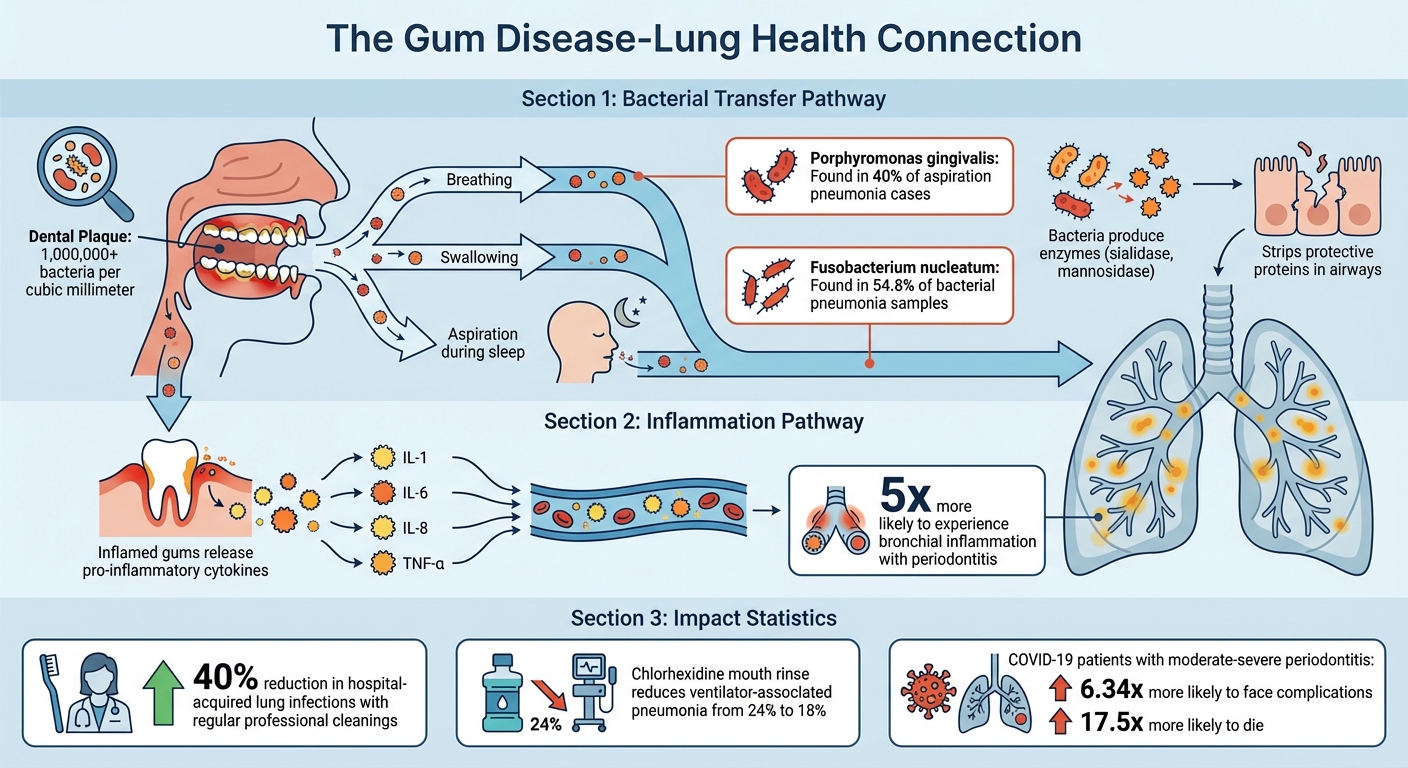
How Gum Disease Bacteria Travel to Lungs and Cause Respiratory Problems
Gum disease doesn’t just stop at your mouth – it can have a direct impact on your lung health. This connection works in two main ways: bacteria from your gums can travel to your lungs, and inflammation caused by gum disease can worsen lung conditions.
Bacteria Transfer from Mouth to Lungs
The bacteria in dental plaque can make their way into your lungs through breathing, swallowing, or even while you sleep. Just one cubic millimetre of plaque contains over a million bacteria [6]. Some of these, like Porphyromonas gingivalis and Fusobacterium nucleatum, are particularly harmful. Research shows that P. gingivalis appears in about 40% of aspiration pneumonia cases, while F. nucleatum is found in 54.8% of bacterial pneumonia samples [8].
"The anatomical continuity between the lungs and the oral cavity makes the latter a potential reservoir of respiratory pathogens." – M Bansal, Department of Periodontics [5]
These bacteria don’t just sit idly. They produce enzymes like sialidase and mannosidase, which strip away protective proteins in your airways, making it harder for your lungs to clear out harmful invaders [6] [5]. The stakes are even higher for those with other health conditions. A 2021 study on 568 COVID-19 patients in Qatar found that those with moderate to severe periodontitis were 6.34 times more likely to face complications and 17.5 times more likely to die compared to those with healthy gums [7].
This bacterial spread doesn’t just bring infections – it can also set off chain reactions in the body that worsen respiratory diseases.
Inflammation and Chronic Lung Problems
The trouble doesn’t end with bacteria. Gum disease also fuels systemic inflammation, which can aggravate chronic lung conditions. Inflamed gums release pro-inflammatory cytokines – like IL-1, IL-6, IL-8, and TNF-α – into the bloodstream, and these can contribute to lung inflammation [6] [5]. For people with conditions like COPD or asthma, this added inflammation can make things significantly worse. Studies suggest that individuals with periodontitis are five times more likely to experience bronchial inflammation compared to those without gum infections [2].
Both periodontitis and COPD share common biological processes, such as tissue destruction driven by neutrophils and the release of enzymes that break down connective tissue [3] [5]. Encouragingly, research offers hope for managing these issues. A two-year study by Zhou et al. revealed that COPD patients who underwent professional gum treatments, like scaling and root planing, experienced fewer flare-ups compared to those who didn’t receive periodontal care [3].
Taking care of your gums can do more than just protect your teeth – it may also shield your lungs. Regular professional cleanings have been linked to a 40% drop in hospital-acquired lung infections [2]. Additionally, using chlorhexidine mouth rinses has been shown to lower the risk of ventilator-associated pneumonia from 24% to 18% in critically ill patients [7].
Who Faces the Greatest Risk?
When it comes to lung problems linked to gum disease, some groups are far more at risk than others. Factors like weakened immunity, pre-existing health issues, or environmental conditions can make it easier for oral bacteria to reach and harm the lungs.
Vulnerable Populations
Older adults are among the most at risk. With age, natural defences like swallowing function, cough reflex, and airway ciliary motility – key mechanisms for clearing mucus and bacteria – tend to weaken. This makes it easier for bacteria to be aspirated into the lungs [9] [2].
Smokers face an even greater threat. Smoking not only weakens the immune system but also boosts the aggressiveness of oral bacteria. This combination increases the likelihood of severe gum disease and subsequent lung infections [2]. Quitting smoking can help reverse some of these effects, improving the body’s ability to fight bacteria and slowing the progression of gum disease.
People with chronic conditions like diabetes or lung diseases are also highly vulnerable. Those with diabetes are three times more likely to develop periodontitis [2], which can escalate inflammation throughout the body and worsen respiratory problems. Similarly, individuals with COPD, asthma, or cystic fibrosis often experience flare-ups triggered by oral bacteria. These pathogens can directly infect the lungs or create an environment that favours harmful bacterial growth [4] [3]. Research even shows that people with severe gum disease are at a much higher risk of developing COPD [5]. Unfortunately, COPD patients often struggle with poor oral hygiene, such as brushing less frequently [3].
The risk is especially pronounced in institutional settings, where maintaining good oral hygiene can be challenging.
Hospital and Aged Care Residents
Patients in hospitals and aged care facilities face unique risks. Dental plaque in these settings can harbour dangerous respiratory pathogens like Staphylococcus aureus, Pseudomonas aeruginosa, and Klebsiella pneumoniae [2] [4]. In intensive care units, bacteria found in ventilator-associated pneumonia (VAP) cases often match the pathogens present in a patient’s dental plaque [4].
In these environments, weakened immunity and reduced airway clearance – due to issues like impaired swallowing – lead to frequent micro-aspirations of bacteria, significantly raising the risk of pneumonia [9] [2]. However, professional oral care can make a big difference. Routine oral health management in hospitals and nursing homes has been shown to lower pneumonia-related deaths and even reduce influenza cases [9]. Dental care interventions have also been linked to a 40% decrease in hospital-acquired lung infections [2].
sbb-itb-2be92ed
Prevention and Treatment Options
Keeping your lungs safe from the risks linked to gum disease doesn’t have to be complicated. A combination of simple, consistent oral care routines and professional dental support can significantly lower bacterial levels and inflammation.
Daily Oral Care Practices
Prevention begins at home. Use a soft-bristled toothbrush and fluoride toothpaste to brush for two minutes, twice a day. This ensures your teeth get the full benefit of fluoride.
Don’t forget to floss or use interdental brushes daily to clean areas your toothbrush can’t reach. Pay attention to your tongue and gumline as well – gently cleaning these areas helps remove bacteria that can cause bad breath and infections. Make sure to replace your toothbrush regularly to maintain its effectiveness.
Your diet and lifestyle also play a role in your oral and lung health. Cutting back on sugary and starchy foods, drinking fluoridated tap water, and quitting smoking are all effective ways to lower your risk of gum disease and respiratory issues.
Pair these habits with regular dental check-ups to catch any problems early.
Regular Dental Visits
While daily care is essential, professional dental visits provide the deeper maintenance your oral health needs. Routine cleanings remove tartar build-up and help identify gum disease in its early stages. This is especially important for people with conditions like diabetes, COPD, or a history of smoking. Early-stage gum disease, or gingivitis, can be reversed with proper care, but advanced periodontitis can cause lasting damage.
Professional Gum Disease Treatment
If home care and routine visits aren’t enough, professional treatments can make a big difference in reducing risks to your lung health. Procedures like scaling and root planing – deep-cleaning methods that remove plaque and tartar from below the gumline – have been shown to improve lung function and lower the frequency of COPD flare-ups.
"Periodontal therapy in COPD patients with chronic periodontitis may improve lung function and decrease the frequency of COPD exacerbations." – Bakey Kouanda, Department of Medicine, State University of New York Downstate Health Sciences University [2]
In more severe cases, additional treatments may include antibiotics to target harmful bacteria or surgical options like flap surgery or bone grafting. These interventions not only address gum disease but also reduce the risk of inhaling dangerous pathogens like Porphyromonas gingivalis and Fusobacterium nucleatum into your lungs.
Complete Smiles Bella Vista (https://completesmilesbv.com.au) offers a range of gum disease treatments tailored to individual needs. Led by Dr. James Hanna, the practice focuses on evidence-based care, including scaling, root planing, and advanced periodontal treatments, all aimed at improving oral health while supporting overall well-being.
Conclusion: Maintaining Oral and Lung Health Together
Gum disease doesn’t just stop at your mouth – it can send bacteria to your lungs, leading to infections and worsening conditions like COPD and asthma. In Australia, about 30% of adults deal with moderate to severe gum disease [1], showing how deeply oral health can influence respiratory wellbeing.
The good news? Simple daily habits – like brushing, flossing, and regular dental check-ups – can significantly reduce harmful bacteria and inflammation, cutting down the risk of lung infections.
"The balance of oral microecosystem not only contributes to the maintenance of oral health, but also has a potential impact on overall health." – Frontiers in Molecular Biosciences [4]
For those already managing respiratory conditions, professional periodontal care becomes even more critical. It’s not just about protecting your teeth; these treatments can also help reduce COPD flare-ups and improve lung function [2].
Taking care of your gums is a step towards better overall health. Whether you’re managing a chronic lung condition or looking to avoid future complications, prioritising oral hygiene is key to keeping your lungs healthier, too. This connection between oral and respiratory health highlights how small changes can make a big difference.
FAQs
How does gum disease impact lung health?
Gum disease can harm lung health by allowing harmful oral bacteria to enter the respiratory system. Once these bacteria reach the lungs, they can lead to infections like pneumonia or aggravate chronic conditions such as COPD (chronic obstructive pulmonary disease). This risk is even higher for people with weakened immune systems.
Practising proper oral hygiene – like brushing, flossing, and seeing your dentist regularly – can limit bacterial spread and help minimise respiratory issues. Looking after your gums plays a key role in safeguarding your overall health.
What are the warning signs of gum disease that could impact your lung health?
Gum disease isn’t just about your teeth and gums – it can also have a ripple effect on other areas of your health, including your respiratory system. Early warning signs to keep an eye on include red, swollen, or tender gums and bleeding during brushing or flossing. If the condition progresses, you might notice more severe symptoms such as gum recession, persistent bad breath, tooth sensitivity, or even loose and shifting teeth.
Conditions like gingivitis and periodontitis can create pathways for harmful bacteria in your mouth to travel into your respiratory system. This can potentially lead to lung infections or worsen pre-existing respiratory issues. Taking care of your oral hygiene and scheduling regular dental check-ups are simple but effective steps to protect both your oral health and your overall well-being.
How can good oral hygiene help protect your lung health?
Maintaining good oral hygiene – like brushing your teeth twice a day and flossing regularly – plays a key role in lowering the risk of lung issues connected to gum disease. These habits help clear away harmful bacteria and plaque, reducing the chance of them travelling to your lungs and potentially causing respiratory problems.
Regular dental check-ups are also important. They allow for early detection and treatment of gum disease, which can further protect your overall health. Taking care of your oral health doesn’t just keep your teeth and gums in shape – it also contributes to your general wellbeing, including better lung health.
Related Blog Posts
- 5 Early Signs of Gum Disease
- Best Practices for Periodontal Care in Cardiac Patients
- Diabetes and Periodontitis: Oral Microbiome Changes
- Periodontitis and COPD: What You Need to Know
Important Notice: Any surgical or invasive procedure carries risks. Before proceeding, you should seek a second opinion from an appropriately qualified health practitioner.
Individual results may vary. The information provided in this article is for educational purposes only and does not constitute medical advice.
Checkout Related Blogs




Get in touch with us
For more information, call us now to start feeling better. Or fill the form below to make appointment
The Latest News from Complete Smiles
How to Clean Clear Plastic Retainers
Checklist for Choosing Wearable Dental Devices
Checklist for Choosing Cloud AI Platforms in Dentistry

Complete Smiles Bella VistaAccepts All Major Health Funds, Including





