





Research on Pain Control in Root Canal Therapy
Managing pain during and after root canal therapy is crucial for patient comfort and successful outcomes. Key findings from recent studies include:
- Postoperative pain is common, affecting 3%–58% of cases, with some reports as high as 69.3%.
- Pain sources include bacterial toxins, mechanical irritation, and chemical injuries like sodium hypochlorite extrusion.
- Effective local anaesthetics include articaine (4%), which outperforms lidocaine in inflamed teeth, and bupivacaine (0.5%), which provides longer-lasting relief.
- NSAIDs (e.g., ibuprofen) are first-line options for managing postoperative pain, with combination therapy (ibuprofen + paracetamol) offering better relief.
- Corticosteroids (e.g., dexamethasone) reduce inflammation and are effective for short-term pain relief.
Emerging approaches like buffered anaesthetics and cold atmospheric plasma show promise but require further research. Adhering to Australian prescribing standards ensures safe and effective pain management, focusing on evidence-based strategies tailored to individual patient needs.
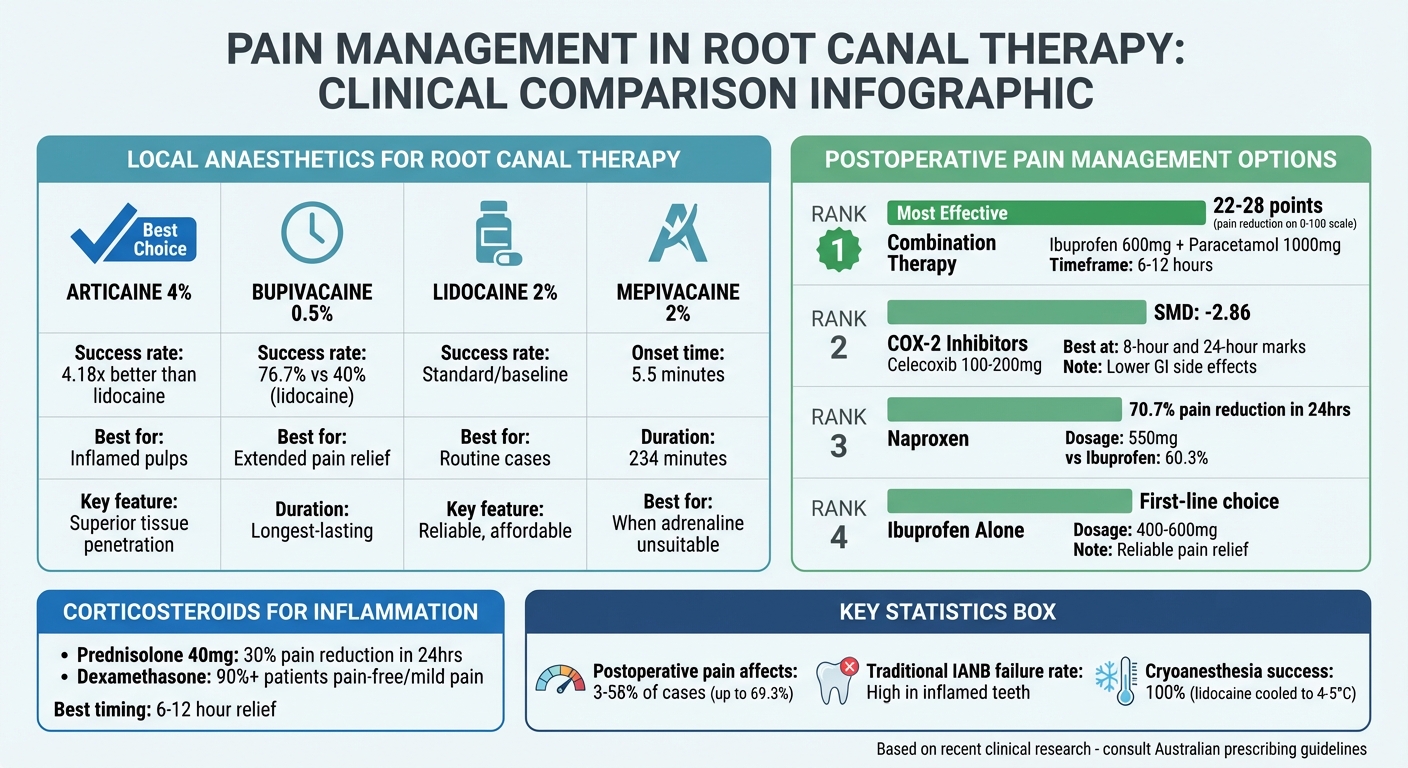
Local Anaesthetics and NSAIDs for Root Canal Pain Management: Effectiveness Comparison
Preventive Endodontic Pain Mgmt Strategies with Dr. Paul Rosenberg | Dentsply Sirona
sbb-itb-2be92ed
Local Anaesthetics in Root Canal Therapy
Choosing and administering the right local anaesthetic is a key part of managing pain during root canal therapy. Ensuring effective anaesthesia is essential for patient comfort, but it can also be one of the trickiest parts of endodontic treatment. Lidocaine (2%) is widely regarded as the go-to option because it’s reliable, safe, and affordable [7]. However, its effectiveness decreases in inflamed teeth. For instance, traditional inferior alveolar nerve blocks (IANB) using 2% lidocaine often have inconsistent results in such cases. This has led to a focus on alternative anaesthetic agents and methods to address these limitations.
Comparing Different Local Anaesthetics
Articaine (4%) stands out as a better choice for inflamed pulps. Thanks to its thiophene ring, it’s more lipophilic than lidocaine, which has a benzene ring. This property allows articaine to penetrate tissues more effectively, even in the acidic conditions caused by inflammation [3]. Research shows that 4% articaine is 4.18 times more successful than lidocaine in treating symptomatic irreversible pulpitis [3].
Bupivacaine (0.5%) offers a different advantage. While it takes longer to take effect, it provides extended pain relief and targets tetrodotoxin-resistant sodium channels involved in persistent pulpal pain. In one study, bupivacaine achieved a 76.7% success rate for anaesthesia compared to 40% for lidocaine in single-visit root canal treatments [5].
Mepivacaine (2%) is another option, performing similarly to lidocaine in healthy tissue. It has an onset time of about 5.5 minutes and lasts approximately 234 minutes, making it useful when adrenaline is not suitable [7].
"The administration of bupivacaine anaesthetic agent for inferior alveolar nerve block (IANB) injections can be a reliable and appropriate pain management aid as compared to lidocaine during root canal treatment of patient with symptomatic irreversible pulpitis." – Rizwan Jouhar, Department of Restorative Dentistry and Endodontics [5]
Overcoming Anaesthesia Failures
When standard IANB doesn’t work, adapting techniques can make a difference. For instance, using 4% articaine for a supplemental buccal infiltration is far more effective than lidocaine or mepivacaine for mandibular molars with irreversible pulpitis [3]. Adjusted protocols that incorporate additional injections or pharmacological aids are 3.62 times more effective than the traditional 2% lidocaine approach [3]. Techniques like intraligamentary (PDL) and intraosseous injections can also be employed when the initial block fails.
Interestingly, cooling the anaesthetic cartridge to 4–5°C before an intra-pulpal injection has been shown to boost success rates from 80% to 100% [9]. Administering the injection slowly, at around 1 mL per minute, can also reduce discomfort during delivery [8]. Additionally, using preoperative NSAIDs or corticosteroids can improve the success of IANB in "hot" teeth by reducing inflammation, which otherwise hampers the effectiveness of the nerve block [3].
NSAIDs for Pain After Root Canal Treatment
Managing pain after a root canal is a critical part of recovery. NSAIDs (nonsteroidal anti-inflammatory drugs) are the go-to option for controlling discomfort. They work by blocking cyclooxygenase enzymes, which stops the production of prostaglandins – key players in inflammation and pain [1][14]. These medications are most effective during the first 24–48 hours after treatment, a period when pain tends to peak [1][4]. Below, we break down the effectiveness and safety of commonly used NSAIDs.
Effectiveness of Common NSAIDs
Ibuprofen is a popular choice, with doses of 400–600 mg showing solid evidence for pain relief [6]. However, combining ibuprofen with paracetamol offers even better results. Clinical studies reveal that this combination reduces pain more effectively than either drug alone, with a 22-point improvement on a 100 mm visual analogue scale compared to placebo at 6–8 hours post-treatment [1][4][14].
Naproxen (550 mg) is another effective option. A trial conducted in Lahore, Pakistan, compared naproxen to ibuprofen (400 mg) in 116 patients with irreversible pulpitis. Naproxen reduced pain to mild or absent levels in 70.7% of cases within 24 hours, compared to 60.3% for ibuprofen. Although the difference wasn’t statistically significant (p=0.329), it still highlights naproxen as a viable alternative [12].
COX-2 inhibitors, like celecoxib, stand out for their efficacy at the 8-hour and 24-hour marks. Research ranks COX-2 inhibitors as the best option for pain relief at 8 hours, with a standardised mean difference of -2.86 [14]. In Australia, celecoxib is the only COX-2 selective NSAID recommended in the Therapeutic Guidelines: Oral and Dental, though its use for acute dental pain is off-label [15]. Additionally, a combination product like Novafen (200 mg ibuprofen, 325 mg paracetamol, and 40 mg caffeine) has been ranked highly for pain relief across multiple time points [14].
| Medication Type | Common Examples | Typical Dosage | Key Efficacy Notes |
|---|---|---|---|
| Standard NSAID | Ibuprofen | 400–600 mg | First-line choice; reliable pain relief [1][6] |
| Propionic Acid | Naproxen | 550 mg | 70.7% effective for irreversible pulpitis [12] |
| COX-2 Inhibitor | Celecoxib | 100–200 mg | Excellent for 8-hour and 24-hour relief [14][15] |
| Combination Therapy | Ibuprofen + Paracetamol | 600 mg + 1000 mg | Outperforms single-drug treatments [14] |
Studies also show that systemic ibuprofen is far more effective than local application during the first 24 hours [13].
Safety and Dosage Considerations
NSAIDs are generally safe for short-term use, but they’re not without risks. The most common side effects involve the gastrointestinal system, especially with nonselective NSAIDs like ibuprofen and naproxen. Patients with active gastrointestinal issues should avoid these medications, while COX-2 selective options like celecoxib are less likely to cause such problems [15][16]. In Australia, guidelines suggest limiting NSAID use to no more than five days for acute dental pain to reduce risks to the heart, kidneys, and digestive system [15][16].
"NSAIDs should be considered as the drugs of choice to alleviate or minimise pain of endodontic origin if there are no contraindications for the patient to ingest an NSAID." – Dr. Aminoshariae, Director of Predoctoral Endodontics, Case Western Reserve University [6]
Certain patients require extra caution. For example, combining an NSAID with a diuretic and an ACE inhibitor (or ARB) dramatically increases the risk of acute kidney injury, a situation often referred to as the "triple whammy" [16]. NSAIDs should also be avoided in patients with a glomerular filtration rate below 30 mL/min [16]. For those with NSAID-exacerbated respiratory disease or asthma, COX-2 selective drugs are a safer choice as they’re less likely to trigger bronchospasm [15].
Dosage adjustments depend on factors like preoperative pain levels, age, and gender. Older patients often report less pain, while women may experience higher pain intensity [1]. For moderate to severe pain, a combination of 600 mg ibuprofen and 1000 mg paracetamol is recommended for better relief [14]. Administering NSAIDs before or immediately after the procedure ensures peak effectiveness during the critical 6–24-hour pain window [11][14].
Corticosteroids and New Treatment Options
Using Corticosteroids to Reduce Inflammation
Corticosteroids, like dexamethasone and prednisolone, are widely recognised for their ability to reduce postoperative pain. They work by inhibiting arachidonic acid formation, suppressing vasodilation, and reducing the influx of inflammatory cells [17]. These medications stand out as the best options for alleviating pain at the 6-hour and 12-hour marks post-treatment [14]. For instance, a single 40 mg dose of prednisolone can decrease pain incidence by about 30% within 24 hours and reduce the need for additional painkillers by 55% [14]. Clinical trials have shown that over 90% of patients receiving dexamethasone injections experience no pain or only mild discomfort within 24 to 48 hours following the procedure [18].
"The painful symptomatology experienced by patients after endodontic therapy can be relieved with dexamethasone for up to 24 hours, which is the period in which most patients report experiencing pain." – Maria Eduarda de Araujo Cruz, Researcher [19]
Corticosteroids can be administered in various ways, including oral tablets, local infiltration, intraligamentary injections, or intracanal placement [14][17]. Among these, intracanal delivery is often preferred for its safety, as the small dose limits systemic absorption while directly targeting inflamed tissues. However, systemic administration carries potential side effects, such as elevated blood sugar levels and psychiatric reactions like mood changes or, less commonly, psychosis, which occur in 13%–62% of cases [20]. Diabetic patients should closely monitor their glucose levels and adjust their management plans as needed.
Corticosteroids are particularly effective for quick pain relief, while NSAIDs provide longer-lasting analgesia [14]. Research also highlights that methylprednisolone outperforms dexamethasone between 6 and 12 hours post-treatment [18], and betamethasone can offer relief lasting up to 48 hours [14]. Building on the proven efficacy of corticosteroids, newer pharmacological advancements aim to refine pain management further.
New Pharmacological Approaches
In addition to traditional painkillers, emerging strategies are being explored to improve pain management during root canal therapy. buffered anaesthetics, which combine local anaesthetics with sodium bicarbonate or mannitol, have shown promise in increasing the success rate of inferior alveolar nerve blocks in inflamed teeth [3].
Another innovative approach under investigation is cold atmospheric plasma (CAP). Known for its antibacterial properties, CAP may also help reduce inflammation [2]. Although these methods are still in the experimental phase, they highlight the ongoing progress in pain management techniques for endodontic care.
Following the Therapeutic Guidelines: Oral and Dental, practitioners are encouraged to prescribe corticosteroids at the lowest effective dose. Studies suggest that a single 4 mg dose of dexamethasone is often sufficient to achieve pain relief with minimal side effects in healthy patients [21][22].
Clinical Guidelines for Pain Management
Comparing Pain Relief Methods
When managing pain during root canal therapy, several medication options stand out based on available evidence. NSAIDs, either on their own or combined with paracetamol, have been shown to lower pain levels by 22–28 points on a 0–100 scale within 6–12 hours [4]. Corticosteroids also play a key role, offering relief at 6, 12, and 24 hours, particularly for patients suffering from symptomatic irreversible pulpitis [1].
For local anaesthesia, long-acting options like bupivacaine reduce the need for postoperative rescue medication by about 1.91 doses compared to lidocaine with adrenaline [24]. Additionally, 4% articaine has proven more effective than 2% lidocaine for patients with symptomatic irreversible pulpitis. When advanced techniques are used, its success rate is 3.62 times higher than standard inferior alveolar nerve blocks [3].
However, it’s important to note that much of the current evidence comes from studies with low to moderate quality. This highlights a pressing need for more robust clinical trials [2][11]. Until then, adhering to well-established guidelines remains critical for safe and effective prescribing.
Following Australian Prescribing Standards
Australian prescribing standards provide further clarity on effective pain management strategies. These guidelines recommend using the lowest effective dose of NSAIDs for managing root canal pain [23]. For first-line treatment, ibuprofen 400–600 mg is advised, with the addition of paracetamol reserved for cases of moderate to severe pain [6][23].
"Paracetamol and ibuprofen are more effective in combination than either of them alone, with or without opioids." – Aovana Timmerman, Specialist Endodontist [23]
Opioids are only considered when NSAIDs and paracetamol fail or are contraindicated. Even then, they should be prescribed in the smallest effective dose and for the shortest time possible, generally no longer than three days [25]. Dentists must exercise caution, as 2019 statistics revealed that 39.5% of opioid prescriptions by dentists were classified as high risk – either exceeding a three-day supply or overlapping with benzodiazepines [25]. Reviewing state-based prescription monitoring systems is essential before prescribing controlled substances.
Antibiotics, on the other hand, have no role in alleviating pain caused by irreversible pulpitis. They should only be prescribed when systemic infection signs are present, such as fever, malaise, or rapidly spreading cellulitis, or in cases involving immunocompromised patients [23]. These principles underscore the importance of evidence-based and guideline-focused approaches in endodontic pharmacological care.
Conclusion
Recent studies highlight the importance of blending evidence-based pharmacology with patient-focused care to improve pain management during root canal therapy. Research shows that 4% articaine outperforms 2% lidocaine for patients with symptomatic irreversible pulpitis, and that combining NSAIDs and paracetamol is more effective for postoperative pain relief than using either medication on its own. Additionally, innovative methods like cryoanesthesia, where lidocaine is cooled to 4–5°C, achieved a 100% success rate, offering a promising solution for complex cases [9].
Despite these advancements, concerns about the quality of existing evidence remain. As Abdelrahman M. Alhilou points out:
"The observed variability in the quality of the evidence calls attention to the necessity for further high‐quality research" [1].
Postoperative pain rates and the frequent failure of traditional nerve blocks suggest there is still room for improvement in managing pain effectively.
Beyond pharmacological treatments, managing patient anxiety and ensuring procedural precision are equally critical. High levels of dental anxiety are linked to greater pain perception [10], making it essential to screen for anxiety and address psychological factors. On the technical side, maintaining apical constriction limits, using rotary instrumentation, and selecting the right sealers can also help minimise postoperative discomfort.
Looking ahead, future strategies will likely focus on multimodal approaches. These may include preoperative pharmacological interventions and emerging technologies like cold atmospheric plasma for bacterial decontamination. Standardising methods for evaluating pain will also improve the reliability of future research. For now, clinicians should prioritise proven techniques: using articaine for local anaesthesia, prescribing combination analgesics for pain relief, and adhering to Australian prescribing standards, while tailoring care to each patient’s needs.
FAQs
Why can anaesthetic fail in a “hot tooth” during a root canal?
When dealing with a "hot tooth", anaesthetic can sometimes fail to work effectively. This is often due to several physiological factors, such as heightened activity in nociceptors (pain receptors), an increase in tetrodotoxin-resistant sodium channels, and inflammation that affects blood flow. Additionally, changes in nerve innervation caused by the inflamed state can further complicate pain management. These combined factors make it harder for local anaesthesia to provide sufficient relief, particularly during procedures like root canal therapy.
What pain relief is safest if I can’t take NSAIDs?
If NSAIDs aren’t suitable, opioids such as oxycodone, hydrocodone, or codeine might be an alternative. However, it’s essential to consult with a dental or medical professional to identify the safest and most appropriate pain relief option for your specific needs.
When is severe pain after a root canal a warning sign?
If you’re experiencing severe pain after a root canal that lingers beyond the normal recovery period – particularly if it persists for more than a week – it could be a sign of a complication. This might point to issues like an infection or other underlying problems that need immediate attention from your dentist. Don’t ignore it; a timely evaluation is crucial.
Related Blog Posts
- Studies on Pain Management in Dental Extractions
- Long-Acting Local Anesthetics in Dentistry
- Ultimate Guide to Local Anaesthesia in Endodontics
- Adjunctive Therapies for Pain in Paediatric Dentistry
Important Notice: Any surgical or invasive procedure carries risks. Before proceeding, you should seek a second opinion from an appropriately qualified health practitioner.
Individual results may vary. The information provided in this article is for educational purposes only and does not constitute medical advice.
Checkout Related Blogs




Get in touch with us
For more information, call us now to start feeling better. Or fill the form below to make appointment
The Latest News from Complete Smiles
How to Clean Clear Plastic Retainers
Checklist for Choosing Wearable Dental Devices
Checklist for Choosing Cloud AI Platforms in Dentistry

Complete Smiles Bella VistaAccepts All Major Health Funds, Including





