





Sterilization Monitoring vs. Validation: Key Differences
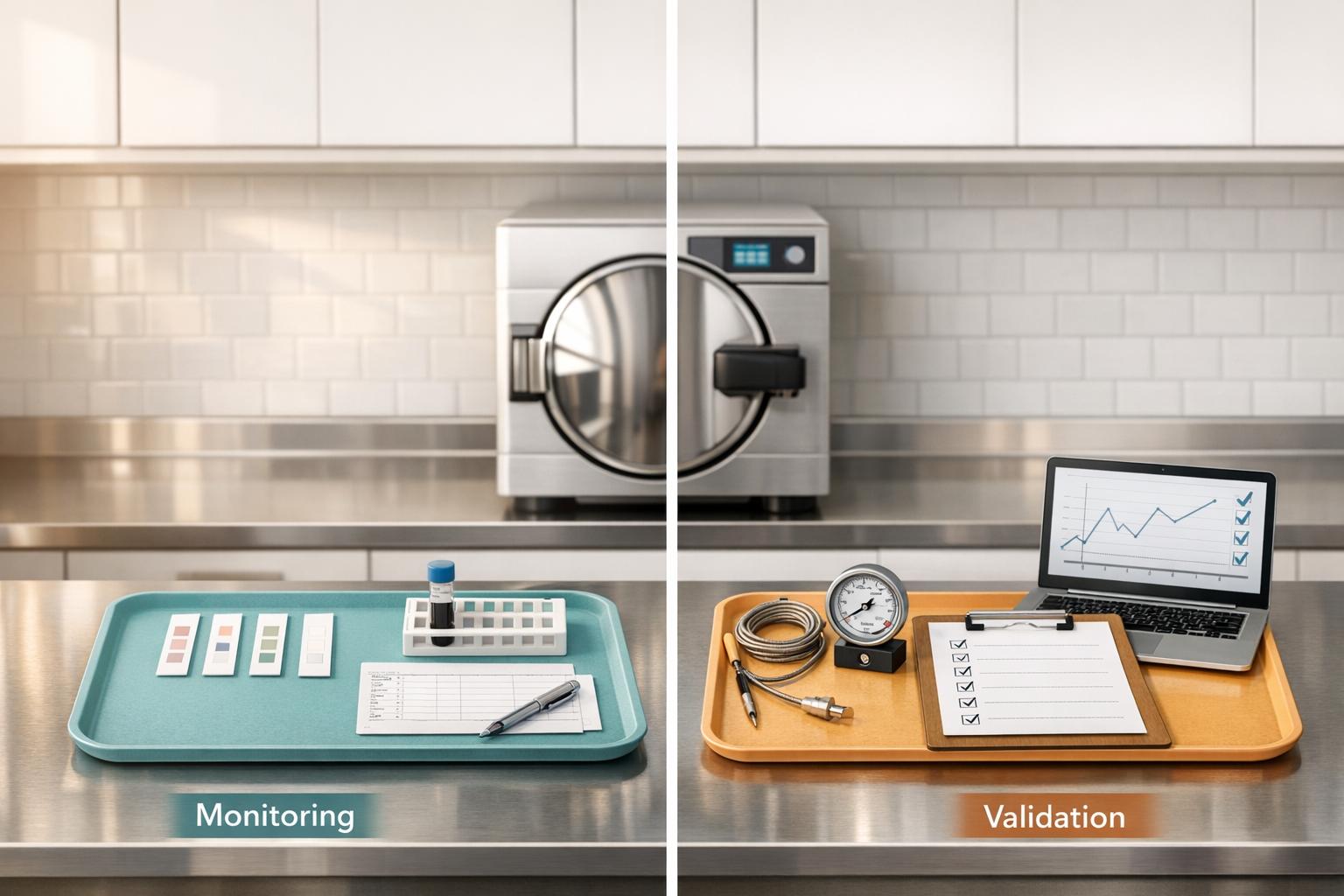
Sterilisation monitoring and validation are both critical for ensuring the safety and reliability of dental infection control processes. Monitoring checks each cycle for proper sterilisation using mechanical, chemical, and biological indicators. Validation, on the other hand, assesses the steriliser’s overall performance to confirm its ability to consistently meet required standards.
Here’s what you need to know:
- Monitoring happens daily and focuses on individual loads, ensuring they meet sterilisation conditions (e.g., temperature, pressure).
- Validation is conducted during installation, repairs, or annually. It tests the steriliser as a whole under controlled conditions to confirm its reliability.
- Both are required under Australian standards like AS/NZS 4815 and the ADA Guidelines to maintain patient safety and infection control.
Quick Overview:
- Monitoring ensures every load is safe for use.
- Validation confirms the steriliser is capable of achieving sterility.
These processes work together to prevent sterilisation failures, protect patients, and comply with regulations.
Checking Dental Autoclave Sterilization With Class 5 Integrator Strips
What is Sterilisation Monitoring?
Sterilisation monitoring involves using mechanical, chemical, and biological indicators to confirm that every sterilisation cycle meets the necessary conditions to effectively eliminate microbes and ensure safe instrument reprocessing.
Without proper monitoring, there’s a risk of using faulty equipment, which can increase the chance of infection. Beyond confirming sterility, monitoring can help detect issues like inadequate instrument cleaning, improper steriliser operation, overloading, or using unsuitable packaging materials. Keeping accurate records is key for accountability and supports recall procedures if needed.
Types of Monitoring Methods
Sterilisation monitoring relies on three complementary methods:
- Mechanical Monitoring: This involves checking steriliser gauges, computer displays, or printouts for each load to confirm that pressure, temperature, and exposure time align with the manufacturer’s guidelines.
- Chemical Monitoring: Sensitive indicators, such as strips or tape, change colour when exposed to specific conditions. Each package should have a chemical indicator inside to confirm the sterilising agent has penetrated the wrapping. If the internal indicator isn’t visible externally, an additional external indicator is recommended. Inspect these indicators immediately after removal – if the colour change isn’t as expected, the instruments should not be used.
- Biological Monitoring (Spore Testing): This method uses highly resistant microorganisms like Geobacillus stearothermophilus to validate the sterilisation process. According to the CDC, "because the spores used in biologic indicators are more resistant than the common microbial contaminants found on patient-care equipment, a negative spore test indicates that other potential microorganisms in the load have been killed" [2].
How Often to Monitor
Australian standards specify clear guidelines on how frequently monitoring should occur:
- Mechanical Monitoring: Must be performed and documented for every steriliser load. This includes checking and signing off on physical parameters like time, temperature, and pressure.
- Chemical Monitoring: Every package should include a chemical indicator to differentiate processed from unprocessed items. A high-level indicator (Class 4, 5, or 6) must also be placed inside each package or load.
- Biological Monitoring: Spore testing should be conducted at least weekly. For loads containing implantable devices, a biological indicator must be included in every cycle, and instruments should ideally not be used until a negative result is confirmed.
For vacuum-assisted (Class B) sterilisers, additional daily tests are required. These include a leak test and an air removal test (Bowie-Dick type) at the start of each day to ensure the vacuum system is functioning correctly. If a spore test returns positive, the steriliser must be taken out of service immediately, operating procedures reviewed, and the test repeated. If the second test is also positive, the unit must remain out of service until it is repaired and successfully completes three consecutive negative cycles [2].
What is Sterilisation Validation?
Sterilisation validation is all about proving that a steriliser can consistently meet the required sterilisation parameters under specific, controlled conditions. Unlike routine monitoring, which checks each individual cycle, validation focuses on establishing the equipment’s baseline performance. It ensures the steriliser can reliably achieve the necessary sterility standards before it becomes part of your regular operations.
This process confirms that the steriliser can consistently reach the pressure, temperature, and exposure time needed to eliminate even the toughest microorganisms, like Geobacillus or Bacillus species. By laying this groundwork, and combining it with ongoing monitoring, you can maintain reliable infection control in your practice.
The Validation Process
Sterilisation validation unfolds in three key stages:
- Installation Qualification (IQ): This step ensures the steriliser is installed correctly according to the manufacturer’s guidelines. It covers everything from electrical connections to water supply, drainage, and ventilation systems.
- Operational Qualification (OQ): Here, you verify that the steriliser consistently achieves and maintains the required parameters – such as temperature and pressure – across its entire operating range.
- Performance Qualification (PQ): This final stage tests the equipment with your typical load setup, ensuring the sterilising agent can reach all areas of the load effectively.
"Biological indicators, or spore tests, are the most accepted method for monitoring the sterilisation process because they assess the sterilisation process directly by killing known highly resistant microorganisms" [4].
Biological indicators offer direct proof that the sterilisation process is effective by confirming the elimination of microorganisms. In contrast, mechanical or chemical indicators only verify that certain physical conditions, like temperature or pressure, were met.
When Validation is Required
Sterilisation validation isn’t a one-and-done task – it’s an ongoing responsibility. Several situations call for validation or re-validation to ensure your steriliser remains effective.
For instance, validation is essential when installing a new steriliser before it’s used for patient care. It’s also required after any major repairs or maintenance, as these could impact performance. Changes in load configurations – like switching to new packaging materials, altering how instruments are arranged, or introducing a different set of tools – also demand re-validation. Each of these scenarios ensures that the sterilisation process remains effective under the new conditions.
sbb-itb-2be92ed
Monitoring vs. Validation: Main Differences
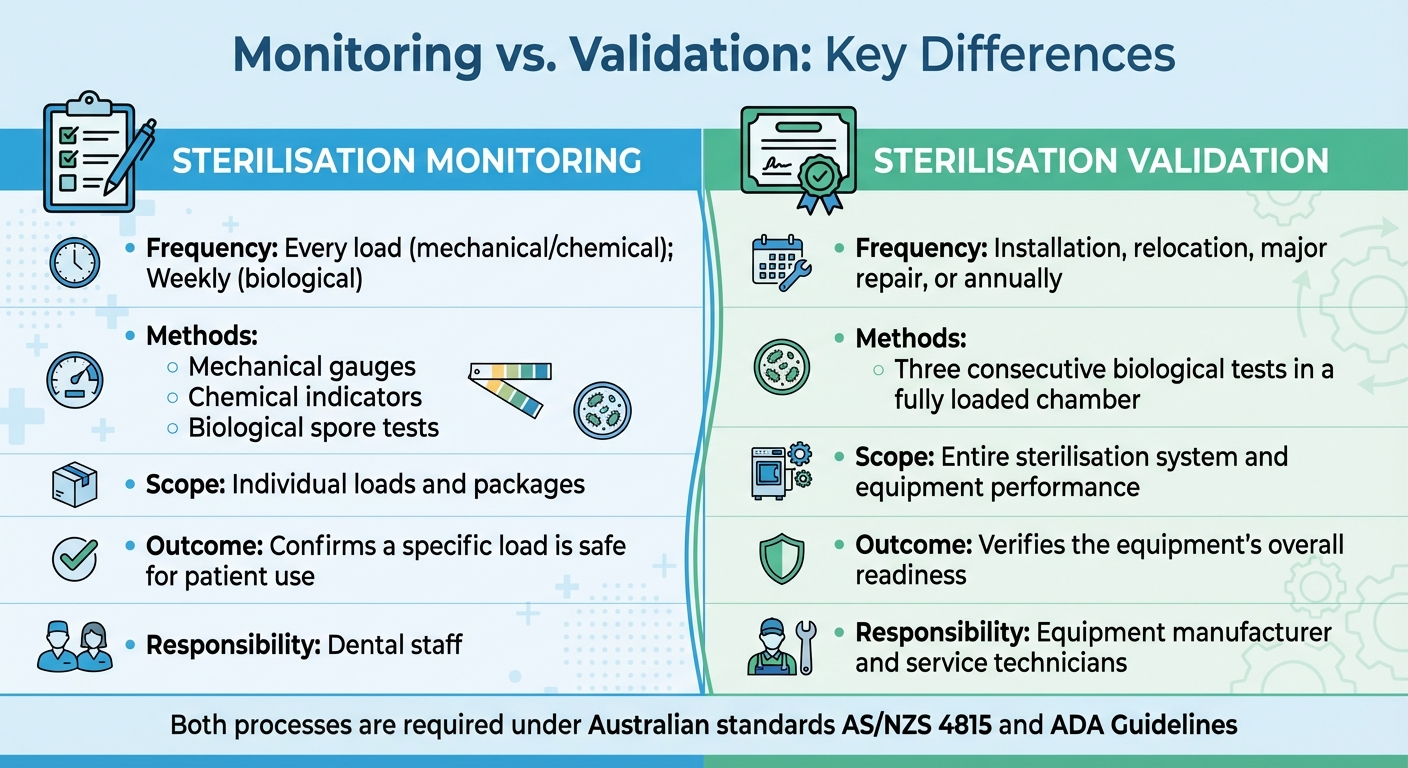
Sterilisation Monitoring vs Validation: Key Differences for Dental Practices
Sterilisation monitoring ensures the safety of each load, while validation evaluates the overall performance of the sterilisation system.
Monitoring is all about checking individual loads, offering real-time feedback after each cycle. On the other hand, validation takes a broader approach, testing the entire system at specific intervals. The responsibilities also differ: dental staff handle monitoring for every load, while validation is performed by trained technicians or the manufacturer during installation, repairs, relocation, or once a year.
"Sterilization monitoring is the process of using indicators to provide feedback on the effectiveness of instrument sterilization." – CDC [2]
The table below breaks down the key differences between these two processes.
Comparison Table
| Feature | Sterilisation Monitoring | Sterilisation Validation |
|---|---|---|
| Frequency | Every load (mechanical/chemical); weekly (biological) | Installation, relocation, major repair, or annually |
| Methods | Mechanical gauges, chemical indicators, biological spore tests | Three consecutive biological tests in a fully loaded chamber |
| Scope | Individual loads and packages | Entire sterilisation system and equipment performance |
| Outcome | Confirms a specific load is safe for patient use | Verifies the equipment’s overall readiness |
| Responsibility | Dental staff | Equipment manufacturer and service technicians |
Both processes play a critical role in ensuring the safety and reliability of sterilisation in dental practices. While monitoring keeps daily operations in check, validation ensures the system’s long-term effectiveness.
Why Dental Practices Need Both
Using both monitoring and validation together creates a strong safeguard against sterilisation failures. Australian dental practices must comply with AS/NZS 4815 and the ADA Guidelines for Infection Control to uphold high standards of service and patient care. This dual approach ensures that these standards are met consistently. Monitoring checks if today’s sterilisation cycle was successful, while validation confirms that your equipment is capable of achieving sterilisation in the first place. Skipping either process puts safety at risk.
"Quality management of reusable instruments and equipment reprocessing is essential in ensuring a reliable and reproducible process is performed." – Critical Dental [3]
When combined, monitoring and validation provide multiple layers of protection, forming the foundation of an effective infection control strategy. Detailed record-keeping plays a critical role here – if a spore test yields a positive result, monitoring logs can trace which instruments may be affected, helping determine whether a recall is needed. This level of accountability protects both patients and the practice from potential breaches in infection control.
Sterilisation failures can result from various factors, such as improper cleaning, incorrect operation, overloading the steriliser, or using unsuitable packaging materials. By integrating monitoring and validation, these issues can be identified and addressed before they impact patient safety. This approach not only ensures the safety of instruments but also supports ongoing quality management in dental infection prevention programmes.
Conclusion
Sterilisation monitoring and validation play crucial roles in maintaining infection control in dental practices. Monitoring offers real-time, cycle-by-cycle assurance that your steriliser is functioning as it should. This involves mechanical checks (like examining gauges), chemical indicators placed inside each package, and weekly biological spore tests. On the other hand, validation ensures your equipment and procedures can reliably achieve sterilisation when operated according to the manufacturer’s guidelines. Together, these processes create a robust safety system – validation confirms the system’s capability, while monitoring verifies the success of each sterilisation cycle [1][4].
These processes are also key to meeting strict regulatory requirements. In Australia, dental practices must comply with AS/NZS 4815 and the ADA Guidelines for Infection Control to ensure patient safety. This includes performing load-by-load mechanical and chemical monitoring, alongside regular biological testing. Keeping detailed records is essential, as it allows practices to identify and address any sterilisation failures quickly, ensuring that affected instruments are managed appropriately.
FAQs
What is the difference between sterilisation monitoring and validation, and why are both important in dental practices?
Sterilisation monitoring and validation are essential for maintaining the safety and reliability of sterilisation processes in dental practices.
Monitoring involves routine checks to confirm that each sterilisation cycle meets the necessary conditions for effective sterilisation. This includes using chemical indicators, mechanical indicators, and biological indicators. By doing this regularly, practices ensure that their sterilisation procedures are consistently meeting daily compliance requirements.
Validation, however, takes things a step further. It’s a detailed evaluation designed to confirm whether sterilisation equipment and processes can reliably achieve sterilisation over time. Validation is especially important when introducing new equipment, making significant repairs, or altering existing processes.
Both monitoring and validation work together to reduce the risk of cross-contamination, safeguard patient health, and ensure adherence to Australian standards like AS 5369:2023. These practices are a cornerstone of a dental practice’s dedication to safety and quality assurance.
What happens if sterilisation validation or monitoring is skipped?
Skipping sterilisation validation or monitoring can lead to serious risks. Without proper validation, medical instruments might not be completely sterilised, which could result in the spread of infections or even disease outbreaks. This not only endangers patient safety but can also bring about major legal and regulatory challenges for dental practices.
Regular monitoring plays a key role in ensuring sterilisation processes work reliably and effectively. Ignoring this critical step increases the chances of equipment malfunction, contamination, and failure to meet Australian health and safety standards. Focusing on these procedures is crucial for maintaining a clean and safe dental practice.
What are the differences between mechanical, chemical, and biological methods for monitoring sterilisation?
Sterilisation relies on a mix of mechanical, chemical, and biological methods, each contributing to the process in its own way.
Mechanical monitoring focuses on tracking steriliser controls, like gauges or digital displays, to ensure critical parameters – such as temperature, pressure, and cycle time – are within the required range. This step helps confirm that the equipment is functioning as expected.
Chemical monitoring takes things further by using indicators placed inside sterilisation packs. These indicators change visually during the cycle, confirming that the necessary conditions have been achieved.
Biological monitoring, considered the gold standard, involves biological indicators containing resistant microorganisms. This method directly verifies whether the sterilisation process has effectively destroyed harmful microbes, offering the most reliable assurance.
By combining these three methods, dental practices can achieve a robust sterilisation protocol, with biological monitoring providing the highest confidence in safety and compliance.
Related Blog Posts
- Common Causes of Sterilization Failures
- Australian Standards for Dental Tool Disinfection
- Sterilisation Monitoring: Australian Standards Explained
- Checklist for Sterilisation Competency in Dental Clinics
Important Notice: Any surgical or invasive procedure carries risks. Before proceeding, you should seek a second opinion from an appropriately qualified health practitioner.
Individual results may vary. The information provided in this article is for educational purposes only and does not constitute medical advice.
Checkout Related Blogs




Get in touch with us
For more information, call us now to start feeling better. Or fill the form below to make appointment
The Latest News from Complete Smiles
How to Clean Clear Plastic Retainers
Checklist for Choosing Wearable Dental Devices
Checklist for Choosing Cloud AI Platforms in Dentistry

Complete Smiles Bella VistaAccepts All Major Health Funds, Including





