





Top 5 Nanomaterials in Cosmetic Dentistry
Nanotechnology is reshaping cosmetic dentistry by offering materials that closely match the structure and properties of natural teeth. Here are five nanomaterials transforming dental care:
- Silver nanoparticles: Fight bacteria and prevent decay without staining teeth. Ideal for anterior restorations.
- Gold nanoparticles: Improve the look and durability of restorations while being highly biocompatible.
- Zirconium dioxide: Mimics enamel’s appearance with strength and translucency, perfect for crowns and veneers.
- Titanium dioxide: Adds gloss and antimicrobial properties, commonly used in whitening and implants.
- Graphene and carbon nanotubes: Strengthen materials and enhance bleaching agents, though limited by their dark colour.
These materials not only improve aesthetics but also enhance durability, safety, and oral health outcomes. Each offers unique benefits depending on the application, from preventing secondary decay to providing natural-looking restorations.
| Nanomaterial | Cosmetic Benefits | Antimicrobial Properties | Strength | Biocompatibility | Common Uses |
|---|---|---|---|---|---|
| Silver nanoparticles | Natural colour retention | Excellent | Moderate | High | Composites, adhesives |
| Gold nanoparticles | Enhanced optical properties | High | High | Excellent | Prosthetics, root canals |
| Zirconium dioxide | Tooth-like appearance | Moderate | Very high | Excellent | Crowns, veneers, implants |
| Titanium dioxide | Whitening and gloss | Moderate | High | Good | Whitening, implants |
| Graphene/Carbon nanotubes | Colour stability | Moderate | Exceptional | Good (at low levels) | Fillers, implant coatings |
These advancements are helping dentists create restorations that look, feel, and function like natural teeth, while also addressing common issues like decay and bacterial growth.
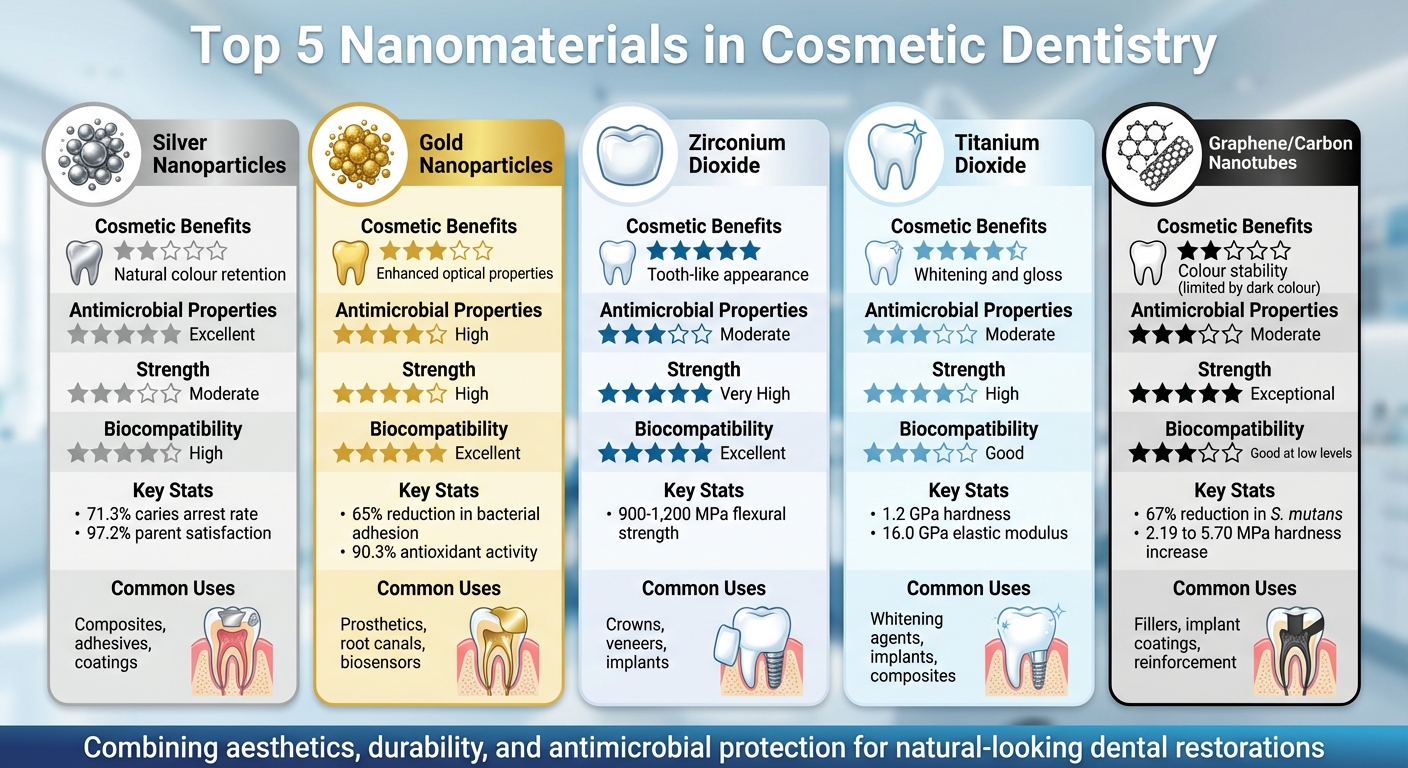
Comparison of 5 Nanomaterials in Cosmetic Dentistry: Properties and Applications
1. Silver Nanoparticles
Primary Cosmetic Benefits
Silver nanoparticles (NSF) are making waves in dentistry, particularly for their ability to stop caries without the unsightly black staining associated with silver diamine fluoride (SDF). This makes NSF a game-changer for anterior restorations where appearance matters most.
In a 2022 clinical trial at Alexandria University in Egypt, researchers Maryam Quritum and Ahmed Abdella studied 360 children under four years old. Their findings were impressive: NSF achieved a 71.3% caries arrest rate over 12 months, outperforming SDF’s 56.3%. Even better, NSF maintained the natural tooth colour, which parents loved – 97.2% of parents were satisfied with their child’s dental appearance after NSF treatment, compared to just 76.1% for SDF[6].
Products like NanoCare Gold DNT™ deliver these benefits by combining long-lasting antibacterial effects with aesthetics[5]. This dual advantage makes NSF an attractive option for modern dentistry.
Antimicrobial Properties
Beyond aesthetics, silver nanoparticles pack a punch with their antimicrobial properties. They release cationic ions that generate reactive oxygen species (ROS), damaging bacterial cell walls and disrupting DNA replication[5][6]. When used in dental adhesives and composite resins, these nanoparticles prevent secondary decay at the bonding interface, enhancing the durability of restorations[5][4].
The size of the particles plays a crucial role. Particles smaller than 10 nanometres exhibit the strongest antimicrobial effects due to their high surface area-to-volume ratio[5]. For instance, adding just 5% nanosilver to sodium fluoride varnish led to a 77% reduction in caries progression[5]. In orthodontics, silver nanoparticle-coated brackets help prevent white spot lesions – those pesky marks around braces that can ruin a smile’s appearance[5].
Biocompatibility
The safety of silver nanoparticles largely depends on how they are synthesised. Green synthesis methods, which use plant extracts like neem, onion, or tomato, enhance biocompatibility by avoiding toxic chemicals[5]. Studies have shown that 12-nanometre AgNPs combined with glass ionomer cements are safe for odontoblastic cells, making them a reliable choice for restorative dental procedures[5].
"Nanotechnology is a promising area in dentistry with several applications… the direct application of AgNP would be aimed at disinfection and the prevention against pathogenic microorganisms in the oral cavity." – Clara Couto Fernandez, Laboratory of Immunology and Molecular Biology[5]
Unlike traditional silver treatments, NSF acts as a bacteriostatic agent without causing side effects like metallic taste, painful ulcers, or the unsightly staining that often limits other options[5].
2. Gold Nanoparticles
Primary Cosmetic Benefits
Gold nanoparticles (AuNPs) play a key role in improving the appearance of dental restorations. By enhancing the optical properties of these materials, they help restorations blend seamlessly with natural tooth tissue, creating a more natural look. On top of that, their antimicrobial and mechanical strengths make them a versatile addition to dental treatments [8].
Antimicrobial Properties
Gold nanoparticles aren’t just about aesthetics – they’re also highly effective at combating bacteria. AuNPs, particularly those around 25 nanometres in size, have been found to outperform chlorhexidine in fighting common oral bacteria like Streptococcus mutans, Streptococcus salivarius, and Streptococcus sanguinis [8]. These nanoparticles attach to bacterial membranes, increasing their tension and triggering the production of reactive oxygen species (ROS), which ultimately destroy the bacterial cells. Saharat Jongrungsomran from Chiang Mai University‘s Department of Prosthodontics highlights their versatility:
"AuNPs have been reported to show favourable antimicrobial performance, anticancer effects and antioxidant and anti-inflammatory activities with less toxicity than other metal NPs."
In root canal treatments, gold nanoparticles enhance the effectiveness of irrigants by reducing micro-infiltration along canal walls. This improves the bonding of filling materials. Additionally, research shows that magnetic gold nanoparticles can reduce the adhesion of Gram-positive bacteria and fungal cells by 65% and Gram-negative bacteria by 45% [8].
Mechanical Advantages
When added to dental polymers like PMMA and resin composites, AuNPs improve the durability of these materials. This reinforcement can significantly extend the lifespan of dental restorations [8].
Biocompatibility
Gold nanoparticles are known for their chemical stability and low toxicity compared to other metal nanoparticles. They also promote better cell adhesion. Spherical AuNPs, in particular, enhance bone-forming activity and calcium deposition, aiding in tissue regeneration. Remarkably, biosynthesised red sandal AuNPs, at a concentration of 50 μg/mL, achieve an impressive 90.3% antioxidant activity, which supports faster healing [8].
3. Zirconium Dioxide Nanoparticles
Primary Cosmetic Benefits
Zirconium dioxide, often referred to as zirconia, stands out for its natural white, enamel-like appearance and enhanced translucency. This translucency is achieved by keeping the crystal size to around 55 nanometres, which allows light to pass through in a way that closely resembles natural enamel. Unlike metal alloys, which can cause unsightly dark gum margins, zirconia maintains its aesthetic appeal due to its high chemical stability and resistance to corrosion [9][10][11]. These visual qualities make it a preferred material in cosmetic applications, and its durability adds to its appeal, as explored below.
Mechanical Advantages
The impressive strength of zirconia comes from a phenomenon known as transformation toughening. Essentially, when under stress, zirconia undergoes a phase change that increases its volume by 4%, effectively halting the spread of cracks. This results in flexural strengths ranging from 900 to 1,200 MPa and a fracture toughness of 7–10 MPa m1/2 [10]. Nanostructured zirconia, when sintered at 1,400°C, can achieve flexural strength levels close to 1,020 MPa. Additionally, keeping grain sizes below 100 nanometres enhances its resistance to low-temperature degradation [9]. Polished zirconia also has the added benefit of reducing abrasion on opposing natural teeth, making it a practical choice for dental applications [9].
Biocompatibility
Zirconia isn’t just about strength and aesthetics – it’s also incredibly biocompatible. It doesn’t cause adverse local or systemic reactions and exhibits lower cytotoxicity compared to titanium dioxide [9]. Its chemical stability prevents the release of metallic ions, ensuring long-term safety. Interestingly, its nanoparticles, sized between 4 and 11 nanometres, produce reactive oxygen species that can inhibit bacterial growth, including strains like Staphylococcus aureus and Escherichia coli, without harming surrounding tissue [9]. This combination of safety and antibacterial properties makes zirconia a standout material for medical and cosmetic applications.
4. Titanium Dioxide Nanoparticles
Cosmetic Applications
Titanium dioxide nanoparticles play a key role in dental cosmetics. They enhance the glossiness of dental restorations, helping them closely resemble the natural appearance of teeth. In composites, these nanoparticles help achieve a realistic look by adjusting colour and opacity, particularly in zirconia-based prosthetics [12][2]. They are also used in polishing agents to refine enamel surfaces, leaving a smooth finish that may even lower the risk of cavities [7]. These aesthetic contributions complement their other clinical applications.
Fighting Microbes
The benefits of titanium dioxide nanoparticles go beyond aesthetics – they also help combat harmful microbes. These nanoparticles are effective in reducing the formation of oral biofilms [12] and dental plaque [7]. A study by Totu et al. highlighted that adding just 0.4% TiO₂ nanoparticles to PMMA denture base materials significantly boosted antibacterial properties, especially against Candida species [1]. This is particularly valuable for denture wearers, who may be more susceptible to fungal infections.
Strength and Durability
When it comes to mechanical performance, titanium dioxide nanoparticles offer impressive advantages. They reinforce resin-based composites while maintaining their chemical stability [2][12]. For example, incorporating 1%–5% TiO₂ nanotubes into yttria-stabilised zirconia (Y-TZP) used in crowns and bridges enhances their structural reliability and boosts Weibull modulus values [1]. Additionally, resin nanocomposites with TiO₂ achieve a hardness of 1.2 ± 0.1 GPa and an elastic modulus of 16.0 ± 1.1 GPa [4].
Safe and Stable
Titanium dioxide nanoparticles are known for their low toxicity and high compatibility with the human body, making them a safe option for long-term use in implants and oral care products [12][7]. They remain stable in the ever-changing conditions of the oral cavity and are relatively cost-effective compared to other metallic nanoparticles. This combination of safety, stability, and affordability makes them an excellent choice for a range of cosmetic dental applications.
sbb-itb-2be92ed
5. Graphene and Carbon Nanotubes
Primary Cosmetic Benefits
Graphene and carbon nanotubes are transforming tooth whitening by enhancing the effectiveness of bleaching agents and providing excellent colour stability, which helps maintain the natural appearance of dental restorations [13][14]. Marco A. Castro-Rojas and his team from Tecnologico de Monterrey highlighted:
"the incorporation of carbon nanotubes into glass ionomer cements has led to enhanced colour stability profiles compared with other reinforcement materials such as silver nanoparticles."
These materials also play a key role in creating dental fillers that replicate the natural translucency and structure of human enamel and dentine [4][2]. However, multi-walled carbon nanotubes can darken materials, which limits their use primarily to posterior teeth [14]. By improving wear resistance and minimising micro-cracks, they help restorations maintain a polished, smooth surface over time [14][4]. These cosmetic advantages pave the way for a range of additional functional benefits.
Antimicrobial Properties
Graphene and carbon nanotubes aren’t just about aesthetics – they also bring strong antimicrobial benefits to the table. Studies show that graphene oxide (GO) can reduce S. mutans survival by 67% [13]. When paired with carnosine and hydroxyapatite, this reduction increases to 78.2% [13]. Unlike chemical antibiotics, graphene works by physically damaging bacterial membranes with its sharp edges, effectively preventing biofilm formation on dental restorations [3].
Mechanical Advantages
These nanomaterials also significantly improve the mechanical performance of dental materials. For instance, adding 2% w/w multi-walled carbon nanotubes to glass ionomer cements increases their hardness from 2.19 MPa to 5.70 MPa [14]. In prosthodontic and restorative composites, carbon nanotubes help reduce polymerisation shrinkage, which is a major factor in the development of secondary caries, often caused by micro-leakage (affecting 50–60% of cases) [15][4].
Biocompatibility
Graphene oxide is biocompatible at concentrations below 20 μg/ml, and graphene materials are considered safe for use at levels of ≤1.5 wt% [13][3]. However, cytotoxic effects become more pronounced at concentrations of 50 μg/ml [13]. Researchers from the Department of Oral Implantology at The Affiliated Hospital of Qingdao University describe graphene as:
"the thinnest and strongest material."
Additionally, graphene nanocoatings do not provoke high TNF-α expression from macrophages [13], supporting their suitability for long-term use in the oral environment. This strong safety profile underscores the potential of graphene and carbon nanotubes in advancing next-generation dental materials.
Comparison of Nanomaterials
Nanomaterials bring a range of benefits to cosmetic dentistry, each suited to specific applications. Zirconium dioxide, often called "ceramic steel", is highly valued for crowns and veneers due to its tooth-like colour and impressive fracture resistance, making it a go-to for aesthetic restorations[7][17]. Silver nanoparticles stand out for their strong antimicrobial properties, making them ideal for composites, adhesives, and coatings aimed at infection control. However, their greyish tint limits their use in highly visible areas. Meanwhile, graphene and carbon nanotubes boast extraordinary strength-to-weight ratios, perfect for reinforcing composites and implant coatings, though their dark colour restricts their cosmetic applications[18]. Gold nanoparticles offer excellent biocompatibility and chemical stability, but their metallic sheen makes them less effective at mimicking natural teeth compared to ceramics[7]. Lastly, titanium dioxide enhances the whiteness of dental materials and provides moderate antimicrobial effects when exposed to UV light, making it a versatile choice for whitening agents, implants, and composites[16].
| Nanomaterial | Cosmetic Benefits | Antimicrobial Properties | Mechanical Strength | Biocompatibility | Common Uses |
|---|---|---|---|---|---|
| Silver (AgNPs) | Low (can cause grey tint) | Excellent (broad spectrum) | Moderate | High (at low concentrations) | Composites, adhesives, coatings |
| Gold (AuNPs) | Moderate (metallic sheen) | Low | High | Excellent | Prosthetics, biosensors |
| Zirconium Dioxide | Excellent (tooth-coloured) | Moderate (reduced adhesion) | Very High | Excellent | Crowns, veneers, implants |
| Titanium Dioxide | High (whitening agent) | Moderate | High | Good | Whitening, implants, composites |
| Graphene/CNTs | Low (naturally dark) | Moderate | Exceptional | Good (at ≤1.5 wt%) | Implant coatings, reinforcement |
This table highlights how the unique properties of each nanomaterial align with specific clinical goals, helping practitioners make informed decisions.
Victor P. Feitosa and his team from the Department of Restorative Dentistry at the University of São Paulo explain:
"Nanomaterials used in dentistry may provide mechanical reinforcement, improve aesthetic aspects, and induce antimicrobial and therapeutic effects" [2].
Conclusion
Nanomaterials have brought a new level of sophistication to cosmetic dentistry by combining aesthetics with durability. These advanced materials closely mimic the structure of natural teeth, allowing for seamless blending with existing teeth and ensuring restorations can handle the stresses of everyday use [1][2]. By matching the biomechanical properties of natural teeth, they deliver both functionality and a natural appearance.
The choice of nanomaterial hinges on several factors, including the patient’s age, the size and location of the cavity, the condition of the remaining tooth structure, and the individual’s risk of caries [4]. For example, in areas like the back teeth, where strength is critical, nano-zirconia offers the durability to withstand heavy chewing forces. On the other hand, high-translucency nanofilled resins are ideal for front teeth, where appearance takes precedence. Additionally, adhesives and sealants enriched with silver or quaternary ammonium nanoparticles can provide an antibacterial shield, especially for patients prone to cavities [2][4]. This personalised approach ensures that materials not only restore functionality but also promote oral health.
Beyond their restorative capabilities, nanomaterials offer therapeutic advantages. Bioactive options like nano-hydroxyapatite actively repair tiny enamel defects and encourage remineralisation, addressing issues such as sensitivity after bleaching treatments [19]. This evolution positions dental materials as active contributors to long-term oral health rather than merely passive solutions.
This biomimetic strategy is revolutionising dental restoration techniques. As Professor Salvatore Sauro, an expert in dental biomaterials, explains:
"One of the most stimulating perspectives for dental restorative nanomaterials is that nanotechnology can mimic the biomechanical properties of enamel" [2].
FAQs
How do silver nanoparticles protect teeth from decay without causing stains?
Silver nanoparticles play a key role in preventing tooth decay by halting the growth and adhesion of harmful bacteria like Streptococcus mutans, the primary culprits behind cavities. They also safeguard enamel and dentine by minimising demineralisation – all while keeping your teeth looking naturally white.
This cutting-edge application of nanotechnology supports oral health without compromising the appearance of your smile.
Why is zirconia a popular choice for dental crowns and veneers?
Zirconia, also known as zirconium dioxide, is a popular choice for dental crowns and veneers, thanks to its impressive strength, long-lasting nature, and lifelike appearance. Its resistance to chipping and cracking comes from its high fracture toughness, while its biocompatibility ensures it works harmoniously with the body.
Another standout feature of zirconia is its naturally white colour, which can be tailored to match the precise shade of your teeth. This makes it a great option for achieving dental restorations that are not only durable but also visually seamless.
Why aren’t graphene and carbon nanotubes widely used in cosmetic dentistry despite their strength?
Although graphene and carbon nanotubes are known for their exceptional strength and promising applications, their role in cosmetic dentistry remains limited. This hesitation stems from ongoing concerns about their biocompatibility and long-term safety. Researchers are still working to understand how these materials interact with the oral environment over extended periods, leaving questions about potential toxicity and their overall suitability unanswered.
As nanotechnology progresses, future studies may provide clarity and open the door for these materials in dental treatments. For now, cosmetic dentistry favours other nanomaterials with established safety records.
Related Blog Posts
- Nanomaterials in Dentistry: Wear Resistance Explained
- Biocompatibility of Dental Nanomaterials: Overview
- Nanotechnology vs Traditional Dental Materials
- How Nanotechnology Improves Dental Restoration Durability
Important Notice: Any surgical or invasive procedure carries risks. Before proceeding, you should seek a second opinion from an appropriately qualified health practitioner.
Individual results may vary. The information provided in this article is for educational purposes only and does not constitute medical advice.
Checkout Related Blogs




Get in touch with us
For more information, call us now to start feeling better. Or fill the form below to make appointment
The Latest News from Complete Smiles
How to Clean Clear Plastic Retainers
Checklist for Choosing Wearable Dental Devices
Checklist for Choosing Cloud AI Platforms in Dentistry

Complete Smiles Bella VistaAccepts All Major Health Funds, Including





