





Factors Influencing Dental Implant Corrosion

Dental implant corrosion happens when titanium or its alloys break down in the mouth due to chemical and physical conditions. This leads to the release of titanium ions, which can trigger gum inflammation and bone loss, increasing implant failure risks. Here’s a quick summary of the main causes:
- Low saliva pH: Acidic foods or bacterial activity can lower pH, dissolving the implant’s protective layer.
- Fluoride exposure: High fluoride levels in toothpaste or mouthwash, especially under acidic conditions, can damage the implant surface.
- Mechanical stress: Chewing forces combined with acidic environments accelerate wear and corrosion.
- Inflammation and bacteria: Immune responses and bacterial biofilms create conditions that weaken the implant’s protective coating.
These factors often work together, making it crucial to maintain good oral hygiene and monitor implants regularly to prevent complications like peri-implantitis.
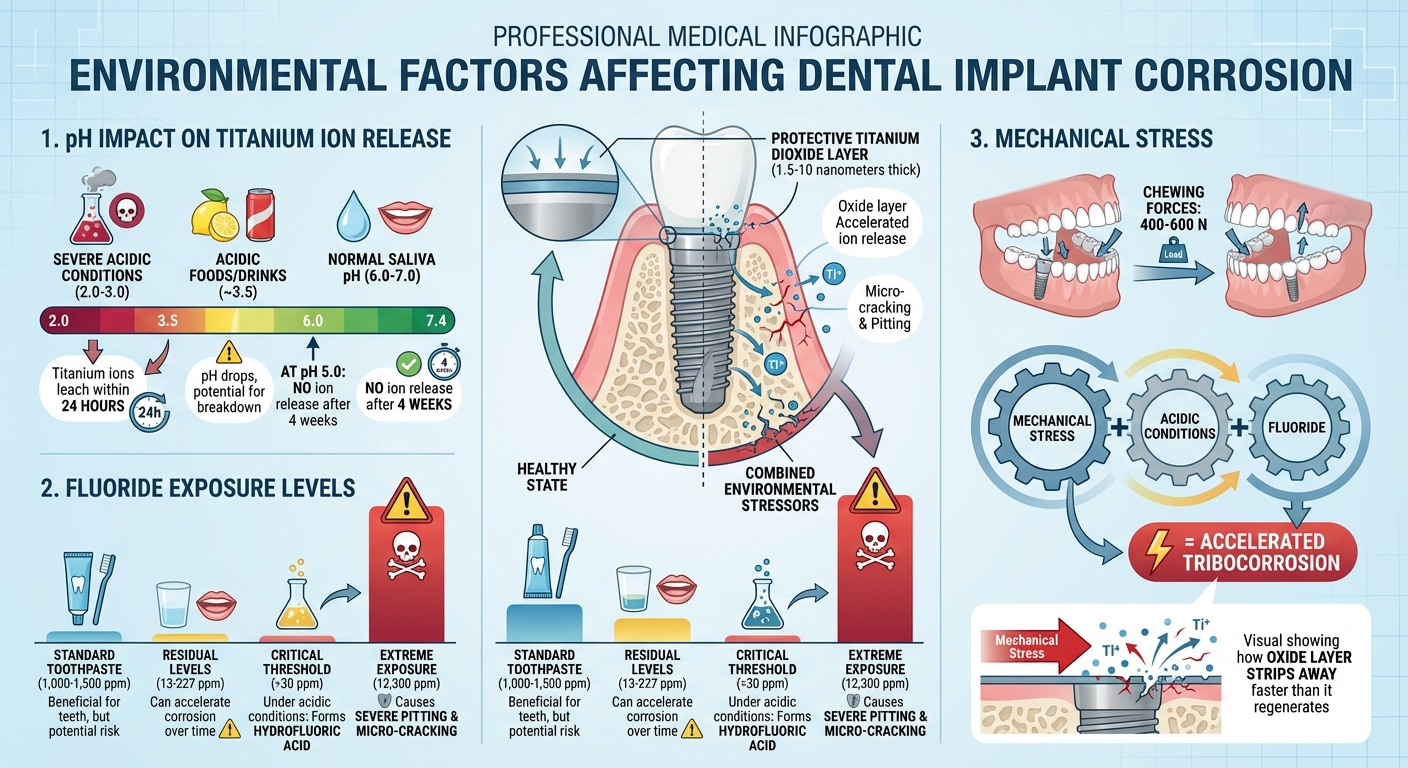
How pH Levels and Fluoride Affect Dental Implant Corrosion
Corrosion of Dental Implants – Forms of Corrosion
1. Environmental Factors
The oral cavity is a tough place for dental implants to thrive. Several external factors combine to weaken the protective titanium dioxide layer that shields implants. Let’s break down how pH changes, fluoride exposure, and chewing forces contribute to this degradation.
Saliva pH fluctuations play a critical role in implant stability. Normally, saliva has a pH of 6.0–7.0, but consuming acidic foods or drinks can drop it to around 3.5 [5][7]. At pH levels of 2.0–3.0, titanium ions start leaching out within just 24 hours. In contrast, at pH 5.0 or 7.4, no ion release occurs even after four weeks [8]. Lactic acid, produced by oral bacteria, is particularly damaging. It’s more corrosive than hydrochloric acid at similar pH levels because it binds to titanium ions, preventing the oxide layer from reforming [8].
"In acid pH the oxide film of the dental implant loosed smoothness, increasing the surface area and, thus, the corrosion." – Journal of the Mechanical Behavior of Biomedical Materials [5]
Fluoride exposure from everyday toothpaste adds another challenge. Most toothpastes contain 1,000–1,500 ppm of fluoride. Even residual fluoride levels as low as 13–227 ppm can speed up corrosion [5]. Under acidic conditions, fluoride concentrations above 30 ppm trigger the formation of hydrofluoric acid, which aggressively breaks down the titanium oxide layer [9]. Experimental studies reveal that extreme fluoride exposure (e.g., 12,300 ppm) leads to severe damage – commercially pure titanium develops pitting corrosion, while Ti-6Al-4V alloys suffer from general corrosion and surface micro-cracking [9].
Mechanical stress makes things even worse. Chewing forces, which range from 400–600 N, work in tandem with acidic and fluoride-rich conditions to accelerate tribocorrosion. This process strips away the oxide layer faster than it can regenerate [7].
With these environmental factors in mind, the next section will explore how biological elements further impact implant corrosion.
2. Biological Factors
Alongside environmental influences, biological factors play a major role in speeding up implant corrosion. One significant issue is inflammation, which affects around 20% of implant cases. When inflammation occurs, immune cells release reactive oxygen species, such as hydrogen peroxide, which attack the titanium dioxide layer on implants. This weakens the oxide layer and disrupts its ability to repair itself [4]. Research using Ti-6Al-4V alloy discs under simulated inflammatory conditions showed a sharp increase in corrosion rates – from 10⁻⁶ A/cm² to 10⁻³ A/cm² – when exposed to low oxygen levels, 1% hydrogen peroxide, and 1% albumin at pH 3 [4]. This damage caused by inflammation often paves the way for biofilm formation, which exacerbates corrosion even further.
Bacteria play a key role in this process by colonising implant surfaces and forming biofilms. These biofilms create small, corrosive environments that trap bacterial by-products [10][6]. Certain bacteria, like Streptococcus mutans and Lactobacillus, produce organic acids that can lower the local pH to below 3.0, while Candida albicans can push it even further down to 2.81. These highly acidic conditions encourage the release of titanium ions [8]. Adding to the problem, biofilms often have uneven thicknesses, leading to oxygen-starved regions. These low-oxygen areas make it harder for the protective oxide layer on the implant to regenerate [10].
"Biofilms allow the development and maintenance of locally corrosive environments and/or permit direct corrosion including pitting corrosion." – Acta Biomaterialia [6]
Beyond the acidic environment created by bacteria, proteins also contribute to the breakdown of the oxide layer. For example, albumin from surrounding tissues can attach to the implant surface in acidic conditions, destabilising the oxide film and increasing metal dissolution by a factor of ten [4]. Crevices between the implant and nearby tissue can also create sealed pockets with extremely low oxygen levels, sometimes dropping the local pH to as low as 1 [3]. A retrieval study of a titanium implant removed after just four weeks due to peri-implantitis revealed severe corrosion damage. The implant showed pitting, violet discolouration caused by trivalent titanium ions, and branched stress cracks – all linked to the inflammatory response [3].
The release of titanium ions further amplifies the problem by attracting macrophages and T lymphocytes. These immune cells release cytokines like IL-1β, IL-6, and TNF-α, which acidify the environment even more, creating a vicious cycle of corrosion [1][11][5].
sbb-itb-2be92ed
Advantages and Disadvantages
Here’s a breakdown of the effects of various oral factors:
| Factor | Benefits | Risks |
|---|---|---|
| Saliva pH (~6.5) | Maintains chemical stability and aids in forming a protective titanium dioxide (TiO₂) passive film [5][2]. | When pH falls below 3.5 (due to dietary acids or inflammation), it triggers active dissolution [5][3]. |
| Fluoride | Offers anti-cavity benefits for natural teeth [5]. | Standard toothpaste fluoride levels may weaken the protective oxide layer [5]. |
| Oral Bacteria | Some bacteria create less aggressive conditions and can occasionally act as a protective barrier [6]. | Certain bacteria produce acids that promote localised corrosion [12][6]. |
| Proteins (Albumin) | Can form a protective pellicle on metal surfaces [6]. | In the presence of hydrogen peroxide, albumin significantly accelerates the corrosion of Ti-6Al-4V alloys [6]. |
These interactions highlight the delicate balance within the oral environment. For instance, low pH levels combined with fluoride can work together to speed up corrosion. Acidic conditions, especially when paired with fluoride ions, can shift titanium from a passive state to one of active dissolution [5].
In addition to chemical factors, physical changes also play a role. Rapid temperature shifts, for example, can speed up electrochemical reactions, further intensifying corrosion [6]. Research from the University of Illinois at Chicago reported a nearly perfect correlation (coefficient of 0.997) between titanium ion concentration and corrosion rate [2]. This finding underscores how environmental changes can quickly lead to the degradation of implant materials.
Conclusion
The longevity of dental implants hinges on managing both environmental and biological factors. A drop in saliva pH – from a neutral 6.5 to an acidic 3.5 – caused by dietary habits or inflammation, can dissolve the protective titanium oxide layer that shields implants from corrosion[5]. Exposure to fluoride under such acidic conditions may further speed up this process. Together, acidic environments and bacterial biofilms contribute to the release of titanium ions, which can trigger tissue inflammation, bone resorption, and ultimately increase the risk of implant failure[5][13].
"The corrosive titanium products in peri-implant tissues are a potential risk factor for peri-implantitis." – Mostafa Alhamad, Department of Restorative Dentistry, University of Illinois at Chicago[2]
Given these risks, timely detection and intervention are critical. Regular professional monitoring can help identify early signs of corrosion, such as surface discolouration, which often signals oxidation in acidic conditions[3]. With peri-implantitis affecting between 10% and 30% of implant patients[2], early identification plays a vital role in preventing further complications like progressive bone loss.
Good oral hygiene practices can reduce the formation of bacterial biofilms that lower local pH to harmful levels (5.5 or below)[13]. During professional cleanings, using non-metal instruments is essential to avoid scratching the implant surface and damaging the thin protective oxide film, which measures just 1.5 to 10 nanometres thick[2]. For patients showing early signs of corrosion, clinicians might recommend fluoride-free or low-fluoride oral care products to minimise the risk of active metal dissolution.
FAQs
What steps can I take to prevent dental implant corrosion?
To help reduce the risk of dental implant corrosion, it’s important to maintain a neutral oral pH. This means practising good oral hygiene and limiting your intake of acidic foods and drinks. Be cautious with high-fluoride products – unless specifically recommended by your dentist – as too much fluoride can contribute to corrosion. Regular brushing and cleaning are essential to minimise bacterial biofilm and plaque, which can create a corrosive environment around your implants.
Additionally, choosing implants made from high-quality, corrosion-resistant materials, such as titanium alloys with protective surface coatings, can enhance their durability and longevity.
For tailored advice on caring for your dental implants, speak with your dentist. They can provide guidance based on your unique oral health needs.
How does saliva pH affect the corrosion of dental implants?
The pH of saliva is a key factor in the corrosion process of dental implants. When saliva becomes more acidic, with a pH around 5.2, it can accelerate the corrosion of titanium alloys commonly used in implants. However, a neutral to slightly alkaline pH, up to 7.8, can help minimise this risk and better preserve the integrity of the implants.
Practising good oral hygiene and scheduling regular dental check-ups are essential steps to maintain a balanced oral environment, which can safeguard implants and extend their longevity.
What are the warning signs that my dental implant could be corroding?
Signs that a dental implant might be corroding include discolouration or darkening of the implant, pitting or visible surface damage, and an increase in mobility of the crown or abutment. Other warning signs can be persistent pain, swelling, gum inflammation, or even bone loss around the implant site, which may point to conditions like peri-implantitis.
If you notice any of these symptoms, it’s crucial to see your dentist as soon as possible. Acting early and seeking professional care can help address the issue and safeguard your oral health.
Related Blog Posts
- How Saliva Affects Implant Material Stability
- Factors Affecting Long-Term Implant Success
- Immune Response to Dental Implant Materials
- How Material Degradation Impacts Implant Longevity
Important Notice: Any surgical or invasive procedure carries risks. Before proceeding, you should seek a second opinion from an appropriately qualified health practitioner.
Individual results may vary. The information provided in this article is for educational purposes only and does not constitute medical advice.
Checkout Related Blogs




Get in touch with us
For more information, call us now to start feeling better. Or fill the form below to make appointment
The Latest News from Complete Smiles
How to Clean Clear Plastic Retainers
Checklist for Choosing Wearable Dental Devices
Checklist for Choosing Cloud AI Platforms in Dentistry

Complete Smiles Bella VistaAccepts All Major Health Funds, Including





